How to Check PDF Accessibility on Mac: Fast Checks for Text, Reading Order, and Forms Before You Share
To check PDF accessibility on Mac, save the final file in Finder, open it in Preview, confirm it has selectable text, then review reading order, headings, forms, links, tables, and the document title before you share it.
If the PDF behaves like a scan, copied text comes out jumbled, or form labels only make sense visually, use OCR or repair the source file before the final send.
That is the short answer. The useful part is knowing what to check first on a Mac, which failures matter most in real work, and how to tell the difference between a PDF that merely looks polished in Preview and one that still makes sense when someone searches it, extracts text, tabs through fields, or opens it with assistive technology. A fast Mac review can catch most of the problems people regret discovering after a report, contract, handbook, form, invoice packet, or public download is already out in the world.
Fastest practical path: review the real saved file, verify the text layer, run an accessibility check, inspect reading order and labels, then OCR scans or repair the source before final sharing.
In a hurry? Jump to quick start: check PDF accessibility on Mac in about 8 minutes.
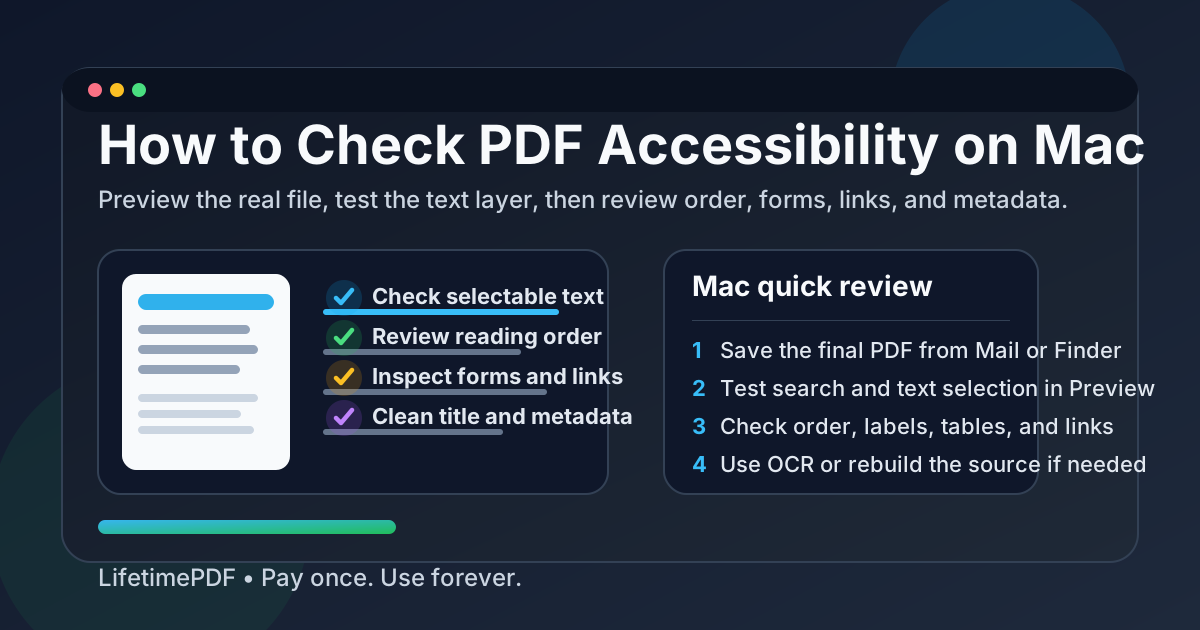
Table of contents
- Quick start: check PDF accessibility on Mac in about 8 minutes
- The best Mac workflow before you trust the PDF
- What to review first on Mac
- Step-by-step: practical PDF accessibility checks on Mac
- Common warning signs on Mac
- When to OCR and when to fix the source
- When the Mac check is enough and when deeper validation still matters
- Related LifetimePDF tools and guides
- FAQ (People Also Ask)
Quick start: check PDF accessibility on Mac in about 8 minutes
If your goal is simply tell me whether this PDF is safe to share, this order catches the most important issues quickly:
- Open the exact file you plan to send, publish, upload, or archive rather than a temporary preview from Mail, Safari, iCloud Drive, or Quick Look.
- Try to select text in Preview and search for a word you can clearly see on the page.
- Use PDF to Text or copy a sample section so you can see whether the reading order still makes sense outside the page layout.
- Review headings, lists, tables, forms, and links and ask whether they still communicate clearly without relying only on visual styling.
- Check the title and metadata with PDF Metadata Editor so the file identifies itself cleanly before anyone reads page one.
- If the PDF behaves like an image or several checks fail at once, run OCR PDF or repair the source file before final sharing.
The best Mac workflow before you trust the PDF
macOS is where many PDFs get their last-minute review. Someone saves a file from Mail, drags it out of iCloud Drive, opens it in Preview from Downloads, or checks a portal export in Safari and assumes the document is ready because it looks tidy on screen. That is where false confidence enters.
A better workflow is simple. Save one final copy, test whether the text is real, check whether the content still reads in the right order, and inspect the details that usually fail first: headings, lists, table logic, form labels, link wording, and the document title. That gives you a practical accessibility screen without pretending a quick glance equals full compliance.
| What you notice on Mac | What it usually means | Best next move |
|---|---|---|
| You can select, search, and extract text cleanly | The PDF likely has a usable text layer | Move on to reading order, structure, and labels |
| Copied text comes out scrambled | Reading order or layout structure may be weak | Review extraction more closely and consider source repair |
| Forms and links look fine but feel vague in use | The PDF may rely too heavily on nearby visual cues | Improve labels, wording, or rebuild from a cleaner source |
| The file behaves like a picture | The document probably needs OCR before deeper review | Run OCR, then repeat the same checks |
| The title is blank or generic | Packaging and metadata are weak even if the page content looks acceptable | Clean the metadata before final distribution |
In plain English: checking PDF accessibility on Mac is less about finding one magic badge and more about confirming that the document still behaves like a real document when the surface polish is no longer enough.
What to review first on Mac
A fast accessibility review becomes much more useful when you check the basics in the right order. Most failures are obvious once you know where to look.
- Real text: if you cannot select or search it in Preview, everything else gets harder fast.
- Reading order: a good-looking layout can still fall apart when content is copied or extracted.
- Headings and lists: visual styling is not the same thing as clear structure.
- Forms, tables, and links: this is where real users often get stuck first.
- Title and metadata: users should know what the file is before they even start reading.
Important reality check
A quick Mac review can catch many practical accessibility problems early. It does not replace deeper remediation or formal validation for high-risk, public-facing, or regulated documents. What it does exceptionally well is stop weak PDFs from slipping through because they merely looked fine in Preview or Quick Look.
Step-by-step: practical PDF accessibility checks on Mac
1) Start with the exact file you actually plan to share
Save the final PDF in a normal Mac location such as Downloads, Desktop, Finder, iCloud Drive, or a project folder. Do not rely on a temporary preview from Mail, Safari, or Quick Look if the final attachment or upload copy might differ. Accessibility review only helps when you are checking the real file.
2) Confirm the PDF has a real text layer
Try selecting text in Preview, searching for a visible word, or extracting a sample using PDF to Text. If none of that works, the document is often scan-based or image-only. In that case, a deeper accessibility judgment is premature. Run OCR PDF first, then test again.
3) Check whether the reading order still makes sense
Copy a few paragraphs from the beginning, middle, and end of the file. If the text jumps between columns, pulls in headers and footers at the wrong time, or scrambles sidebars with the main narrative, the PDF may look polished while still becoming frustrating for real users. This is especially common in reports, brochures, handbooks, investor decks, and slide exports opened on Mac.
4) Review headings, lists, forms, tables, and links
Ask whether the document would still be understandable if the styling became less important. Do headings actually separate ideas? Do lists keep their sequence? Are form fields obvious without guessing? Do links tell the reader where they go? Do tables communicate relationships instead of just showing numbers inside boxes?
If you want a broader structure pass, pair this step with the main Check PDF Accessibility guide and related focused articles for headings, lists, tables, forms, and links.
5) Check the title and metadata before the PDF leaves your Mac
A reader should not meet a file named final-v9-really-final.pdf with a blank title field.
Use PDF Metadata Editor to clean the title and supporting metadata when necessary.
This matters for accessibility, but it also helps anyone who searches, stores, or reopens the file later.
6) Decide whether OCR or source repair is the right fix
If the file is basically a scan, OCR is usually the first move. If the file already has text but the order, headings, or labels are weak, source repair is often better. A clean Pages, Word, PowerPoint, Excel, or HTML source usually produces a more reliable final PDF than repeated after-the-fact patching.
Reliable Mac sequence: final saved copy → test text → inspect order → review labels and title → OCR scans or rebuild the source → check again.
Common warning signs on Mac
- You cannot select text in Preview. That usually means the file is image-only or the text layer is weak.
- Search misses words you can clearly see. The PDF may need OCR or a cleaner export.
- Copied text reads out of order. Columns, sidebars, or decorative layout may be interfering with structure.
- Form flow depends on visual guesswork. Users may not know what a field means without surrounding layout clues.
- Links are vague. Repeated link text like click here forces extra guessing.
- The file title is empty or generic. Weak packaging is still part of a weak accessibility experience.
- The PDF looks perfect until you extract it. That usually means the layout is doing too much hidden work.
None of these warning signs automatically means the document is unusable. They do mean the Mac review found something worth fixing before the file becomes somebody else's problem.
When to OCR and when to fix the source
OCR and source repair solve different problems, so it helps to pick the right path early.
Use OCR first when
- the PDF came from a scanner, copier, photographed page, or old archive image,
- selection and search fail on visible text,
- you need a usable text layer before any real accessibility review can happen.
Fix the source first when
- the PDF already contains text but the order is scrambled,
- headings, lists, tables, or form labels are weak across multiple pages,
- you still control the original Pages, Word, PowerPoint, Excel, or HTML file,
- the PDF has several structural problems at once and patching them one by one would be slow and fragile.
| Situation | Better first move | Why |
|---|---|---|
| Scanned handout, paper form, or camera capture | OCR the PDF | You need real text before structure review becomes meaningful |
| Exported report with scrambled copy-and-paste order | Fix the source | The layout or export logic is likely the root problem |
| Interactive form with confusing labels | Fix the source or rebuild the form | Form logic is usually cleaner upstream than in a damaged final PDF |
| File has one scan-heavy appendix inside an otherwise normal PDF | OCR the weak section, then retest | Mixed-content PDFs often need targeted cleanup rather than total rebuild |
When the Mac check is enough and when deeper validation still matters
Many teams only need a practical answer: is this PDF reasonable to share? For that question, the Mac workflow is excellent. It quickly surfaces scan problems, reading-order issues, confusing labels, vague links, and weak metadata.
But some documents deserve more. Public-facing forms, legal records, compliance materials, government submissions, procurement packs, and high-visibility reports may need deeper remediation or formal validation beyond a quick review. The point of the Mac check is not to replace that work. It is to prevent obviously weak PDFs from reaching the final gate in the first place.
A good rule
If the PDF only works because you already know what it is supposed to say, the file needs more work. A strong PDF should still communicate clearly to someone who did not build it, did not design it, and is not relying on the original layout to guess what you meant.
Need a cleaner workflow for text checks, OCR, metadata, and source repair? LifetimePDF keeps those steps in one pay-once toolkit.
FAQ (People Also Ask)
How do I check PDF accessibility on Mac?
Open the final PDF on your Mac, confirm it has selectable text in Preview, review whether copied or extracted text stays in the right order, then inspect headings, lists, forms, links, tables, and the document title before you share the file.
Can Mac alone prove that a PDF is fully accessible?
Not by itself. Mac is excellent for practical review, but deeper remediation or formal validation may still be necessary for important public-facing or regulated documents.
What should I check first in a PDF on Mac?
Start with the text layer. If you cannot select or search visible text in Preview, the PDF often needs OCR or source repair before the rest of the accessibility review means much.
Should I OCR a scanned PDF before checking accessibility?
Usually yes. OCR adds a usable text layer, which makes it possible to review reading order, extraction quality, and structural clues instead of judging a picture of text.
When should I fix the source instead of patching the PDF?
If the PDF has several issues at once—such as scrambled order, weak headings, unclear form labels, and poor metadata—repairing the original source file usually creates a cleaner and more maintainable final PDF.
Published by LifetimePDF — Pay once. Use forever.