How to Convert HEIC to PDF on Chromebook: Turn Phone Photos and School Uploads Into One Clean Document
To convert HEIC to PDF on Chromebook, open LifetimePDF's Images to PDF tool in Chrome, choose the HEIC files from Downloads, the Files app, or Google Drive, arrange them in order, then create one clean PDF.
If the images came from an iPhone, a shared folder, an email attachment, or a school upload workflow, that is usually the fastest practical Chromebook route without wrestling with app compatibility or messy page order.
That is the short answer. The useful part is knowing how to gather the right HEIC files on ChromeOS, when a pile of images should become one PDF, and when to stop after conversion versus compressing or OCRing the finished document. For most Chromebook users, the real goal is not understanding the HEIC format. The real goal is making one clean file that uploads, emails, prints, or submits without drama.
Fastest path: gather the HEIC files you actually need, open Images to PDF in Chrome, put the pages in the right order, create the PDF, then review it once before sending it anywhere important.
In a hurry? Jump to Quick start: convert HEIC to PDF on Chromebook in a few minutes.
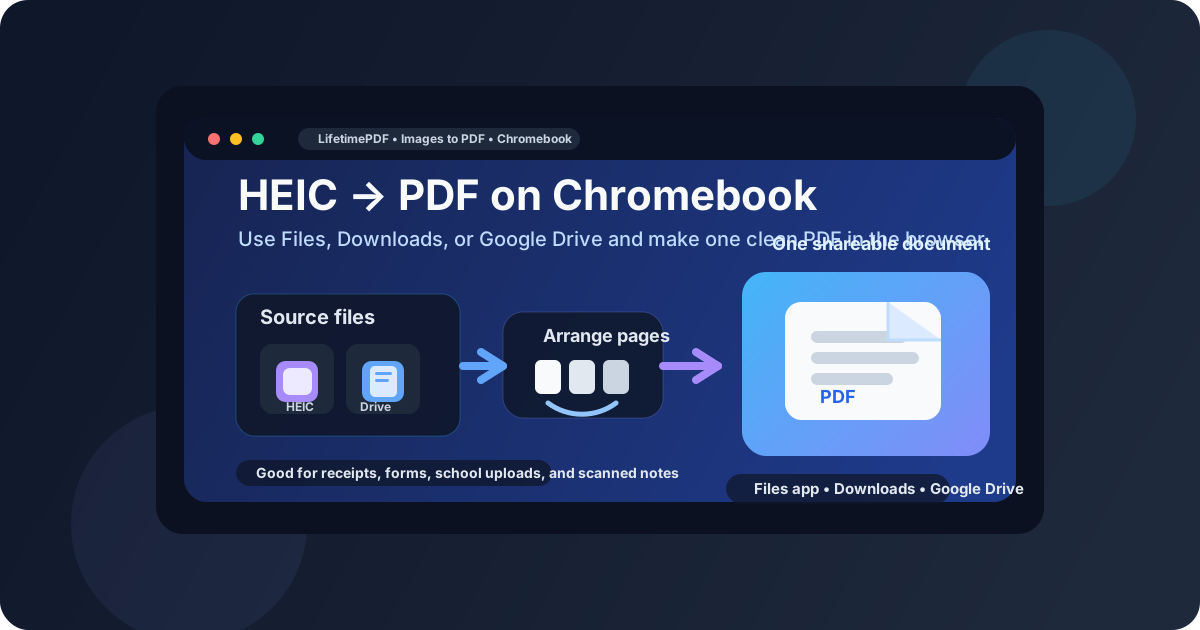
Table of contents
- Quick start: convert HEIC to PDF on Chromebook in a few minutes
- Why HEIC becomes awkward on Chromebook workflows
- The easiest Chromebook workflow for HEIC to PDF
- Step-by-step: make one clean PDF from HEIC files on Chromebook
- Where Chromebook users usually pull HEIC files from
- Print to PDF vs a dedicated browser tool on Chromebook
- When to compress, OCR, or protect the finished PDF
- Common Chromebook HEIC-to-PDF problems and quick fixes
- Related LifetimePDF tools and guides
- FAQ (People Also Ask)
Quick start: convert HEIC to PDF on Chromebook in a few minutes
If the HEIC files are already on your Chromebook and you just need one finished document, this is the simplest dependable workflow:
- Open LifetimePDF Images to PDF in Chrome.
- Choose the HEIC files from Downloads, Files, Google Drive, or a folder synced from your phone.
- Put the images in the order you want another person to read them.
- Create the PDF and check readability, orientation, and page order once.
- If the file is too large, run Compress PDF. If the HEIC images contain photographed text you need to search later, run OCR PDF afterward.
Why HEIC becomes awkward on Chromebook workflows
HEIC is a good image format for modern phones, especially iPhones, but it is not always the format you want to deliver. On Chromebook, the friction usually is not that the file is impossible to open. The friction is that school portals, HR forms, insurance uploads, reimbursement systems, and shared team workflows often want one PDF, not a pile of separate image files.
Even when ChromeOS previews HEIC just fine, several images still create practical problems. They can upload in the wrong order. They may scatter across Downloads and Drive. They can feel fine to you because you know the story behind them, but confusing to the next person who only sees a loose set of images. Converting HEIC to PDF fixes that by turning the set into a document with a clear beginning, middle, and end.
| What you have on Chromebook | Best first move | Why it helps |
|---|---|---|
| Several phone photos for one upload | HEIC to PDF | Creates one clean document instead of several loose files. |
| Receipts, forms, or claim evidence | Combine into one PDF | Makes the packet easier to review and less likely to upload out of order. |
| Photos of paper documents | HEIC to PDF, then OCR if needed | Packages the pages first and adds searchable text only if you need it. |
| A file that is too heavy after conversion | Compress the finished PDF | Reduces size without rebuilding the whole document from scratch. |
The easiest Chromebook workflow for HEIC to PDF
The cleanest route on ChromeOS is usually Files app plus browser. You do not need a heavy local app workflow. You do not need to bounce through random previews and exports. You usually just need one clear path from image set to finished PDF.
Start by deciding which images actually belong in the document
Remove duplicates, blurry retakes, screenshots you do not need, and near-identical versions sitting in both Downloads and Google Drive. A clean PDF starts with a clean source set.
Think in reading order, not file order
The timestamp order in Files is not always the order another person should read. If the PDF is a school assignment, claim packet, reimbursement bundle, or scanned form sequence, set the pages in that real-world order before you generate anything.
Keep the workflow browser-first
Browser-based conversion is usually smoother on Chromebook because it stays simple. Open the tool, choose the right images, arrange them, create the PDF, and move on. That is often more reliable than trying to force a print workflow to behave like a proper document assembly process.
Best setup habit: gather the right HEIC files first, build the PDF once, and only optimize the final document if the next step actually requires it.
Step-by-step: make one clean PDF from HEIC files on Chromebook
1) Gather the HEIC files in one place
If the images came from your phone, email, Google Drive, or a class portal download, collect them in a folder you can find quickly. Downloads is fine. A temporary folder in Files is fine. The point is clarity, not perfection.
2) Open Images to PDF in Chrome
Go to LifetimePDF Images to PDF and upload the HEIC images. This avoids turning a simple packaging task into a local compatibility experiment.
3) Put the pages into human order
If someone else will read the final PDF, order matters more than people expect. Put the cover or first document page first, the supporting images after it, and any appendices or evidence in the sequence that makes the whole packet understandable.
4) Create the PDF and review it once
Generate the PDF, then quickly check the first page, a middle page, and the last page. That catches the usual avoidable mistakes: sideways pages, unreadable text, duplicate images, or a page that landed in the wrong place.
5) Only add follow-up steps if they solve a real problem
If the portal rejects the file for size, compress it. If the images are photos of paper and you need searchable text later, OCR it. If neither issue exists, stop there. A clean two-step workflow is better than a cluttered five-step one.
Recommended sequence: gather the right HEIC files, arrange them carefully, create the PDF, verify it once, then compress or OCR only if the finished document still needs something.
Where Chromebook users usually pull HEIC files from
The hardest part is often not conversion. It is remembering where the images actually live. Chromebook workflows commonly bounce between Downloads, the Files app, Google Drive, phone transfer folders, Gmail attachments, and class or work portals.
| Source | Typical use | Practical HEIC-to-PDF tip |
|---|---|---|
| Downloads | Email attachments, portal downloads, shared files | Check for duplicates so you do not convert an old file and the corrected file together. |
| Google Drive | School, work, or shared-team workflows | Make sure you are using the final folder and not a draft or autosynced duplicate. |
| Files app local folders | Temporary working copies and manually organized image sets | Use a dedicated folder if the images matter, so the conversion step stays clean. |
| Phone-import or chat-export folders | Images coming from an iPhone, Android device, or messaging app | Remove extra screenshots and retakes before you build the PDF. |
This matters because ChromeOS keeps things easy to access, but easy access is not the same as clean document order. A ten-second source check before conversion prevents a lot of avoidable cleanup later.
Print to PDF vs a dedicated browser tool on Chromebook
Chromebook does give you ways to print or save content as PDF, and for one image in a hurry that can be enough. But it becomes clumsy once the job includes several HEIC files, specific page order, or a packet that has to look intentional rather than improvised.
| Method | Best for | Where it struggles |
|---|---|---|
| Print to PDF | Very small one-off jobs | Awkward for multi-file ordering, repeatable workflows, and cleaner document assembly |
| Manual image-by-image handling | Quick previews | Time-consuming, easier to misorder, and not ideal for several pages |
| Browser-based Images to PDF | School uploads, receipts, multi-page scans, shared packets | You still need to choose the right source files and arrange them deliberately |
When to compress, OCR, or protect the finished PDF
Compress when size is the problem
If the PDF looks good but the portal rejects it or email becomes annoying, use Compress PDF. That is usually smarter than rebuilding the document with worse source choices.
Use OCR when the HEIC images contain photographed text
If the images are photos of worksheets, letters, invoices, forms, or notes and you want the words to become searchable later, run OCR PDF after conversion. HEIC to PDF packages the pages. OCR makes the text behave like text.
Protect the final document if the contents are sensitive
If the PDF contains private records, IDs, signatures, or financial details, use PDF Protect before wider sharing. Neat packaging is useful, but it is not the same thing as access control.
Useful mental model: HEIC to PDF creates the document. Compression trims the weight. OCR adds searchable text. Protection limits access.
Common Chromebook HEIC-to-PDF problems and quick fixes
The images are out of order
Reorder them before creating the PDF whenever possible. Fixing order at the source is faster than repairing a confusing packet later.
The file is too large for the upload portal
Convert first, then use Compress PDF on the finished file. That preserves the exact document you already checked.
The text still is not searchable
That is normal. HEIC to PDF wraps images into a document, but it does not automatically create selectable text. Run OCR PDF if searchability matters.
I only need a few images from a larger set
Build the smaller, focused PDF instead of carrying unrelated pages into the final document. Clean documents are easier to review and easier to trust.
The HEIC files came from different places
Gather them into one working folder first. Chromebook makes switching between local files and Drive easy, but a single clean staging folder reduces the chance that you miss a page or mix old and new versions.
Related LifetimePDF tools and guides
HEIC to PDF usually sits inside a bigger Chromebook document workflow. These tools pair naturally with it:
- Images to PDF — turn one or more HEIC files into a single document.
- Compress PDF — reduce the size of the finished PDF for upload or email.
- OCR PDF — make photographed text searchable after conversion.
- PDF Protect — lock the final document before wider sharing.
- Organize PDF — reorder or clean up the finished document if needed.
- HEIC to PDF — the broader guide for turning Apple image files into one shareable document.
- Scan to PDF on Chromebook — what to do when the workflow starts with paper instead of image files already on your device.
- How to OCR a PDF on Chromebook — the next step when your finished PDF needs searchable text.
- How to Merge PDFs on Chromebook — useful when the image conversion is only one part of a bigger packet.
- How to Convert HEIC to PDF on Android — the Android companion workflow.
- How to Convert HEIC to PDF on iPhone — the companion workflow when the files are still on your phone.
- How to Convert HEIC to PDF on Windows — the Windows companion workflow.
Best order for most Chromebook users: gather the right HEIC files, make one PDF, check it once, then compress, OCR, or protect the document only if the real next step requires it.
FAQ: How to Convert HEIC to PDF on Chromebook
How do I convert HEIC to PDF on Chromebook without installing another app?
Open a browser-based Images to PDF tool in Chrome on your Chromebook, choose the HEIC files from Downloads, Files, or Google Drive, arrange them in the right order, create the PDF, and save the result. That is usually the simplest no-extra-install workflow.
Can I combine multiple HEIC files into one PDF on Chromebook?
Yes. You can select multiple HEIC images, place them in the order you want, and turn them into one PDF for receipts, assignments, claim evidence, applications, or scanned paperwork.
Should I use Print to PDF on Chromebook for HEIC files?
Print to PDF can be fine for a very small one-off task, but it gets clumsy when you need better ordering, cleaner multi-file handling, or a repeatable workflow. A dedicated Images to PDF tool is usually easier for real-world jobs.
Why convert HEIC to PDF on Chromebook instead of keeping the images?
PDF is easier to upload, print, email, and hand to someone else as one finished document. HEIC may be fine for capture and storage, but a single PDF is usually the cleaner delivery format.
Should I compress or OCR after converting HEIC to PDF on Chromebook?
Compress the PDF if it is too large for upload or email. Use OCR if the HEIC images contain photographed text that you want to search, highlight, or copy after conversion.
Published by LifetimePDF — Pay once. Use forever.