Convert Remittance Advice PDF to Excel: Extract Payment References, Invoice Matches, and Deductions Faster
To convert remittance advice PDF to Excel, upload the remittance file to LifetimePDF's PDF to Excel tool, export the XLSX, and review payment references, invoice numbers, applied amounts, deductions, and notes before using the sheet.
If the remittance advice is scanned, faxed, photographed, or mixed with invoice copies, isolate the real remittance pages and run OCR first so the spreadsheet comes out cleaner and needs less repair.
Most people searching this phrase are not trying to admire a file conversion. They are trying to stop retyping payment data, match customer payments to invoice rows faster, and get a spreadsheet they can sort, filter, reconcile, or import without turning one remittance packet into manual cleanup work.
Fastest path: use LifetimePDF's PDF to Excel tool, and OCR the remittance first if it came from a scan, a phone photo, or an image-only export.
In a hurry? Jump to Quick start: convert remittance advice PDF to Excel in about 5 minutes.
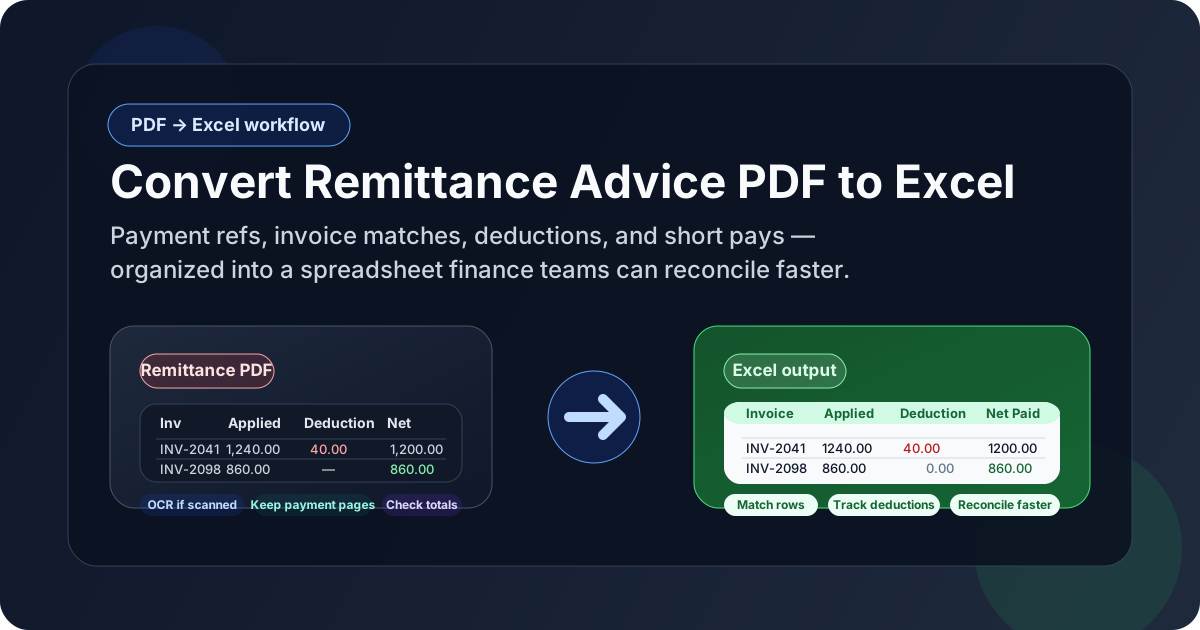
Table of contents
- Quick start: convert remittance advice PDF to Excel in about 5 minutes
- Why finance teams need remittance advice PDFs in Excel
- Which remittance fields matter most
- What converts cleanly and what usually breaks
- Step-by-step: extract remittance data with LifetimePDF
- Review checklist before you trust the spreadsheet
- Excel vs CSV for remittance workflows
- Privacy and finance document hygiene
- Related LifetimePDF tools and companion guides
- FAQ (People Also Ask)
Quick start: convert remittance advice PDF to Excel in about 5 minutes
If the remittance already contains selectable text and the layout is reasonably clean, this workflow is usually enough:
- Open PDF to Excel.
- Upload the remittance advice PDF you want to extract.
- If the file also includes invoice copies, statement pages, email threads, or proof-of-payment screenshots, first isolate only the real remittance pages with Extract Pages.
- If the remittance advice is scanned or image-only, run OCR PDF before converting.
- Export the spreadsheet and review the remittance number, payer, invoice references, dates, applied amounts, deductions, and notes.
Why finance teams need remittance advice PDFs in Excel
A remittance advice PDF is fine when you only need to read one payment once. It becomes frustrating when you need to match payments against open invoices, trace deductions, review short pays, compare customer references, or hand the data to AR staff without making them retype every row. That is where Excel becomes much more useful than the original PDF.
- Cash application and accounts receivable posting
- Reconciling customer payments against invoice balances
- Reviewing deductions, claims, and short pays
- Audit support and backup schedules
- Faster follow-up with customers when something does not match
- Payment references stay intact
- Invoice numbers remain aligned with amounts
- Deductions and short pays do not disappear into note text
- Net paid totals are easy to spot and compare
- Remarks and claim notes are still reviewable when they matter
The point is not to get a perfect spreadsheet from every remittance without any review. The point is to get close enough that cleanup takes a minute or two instead of forcing someone to type every payment row by hand. For bookkeepers, AR teams, controllers, and finance operations staff, that time savings adds up quickly.
Why remittance advice PDFs feel different from invoices or statements
Remittance advice PDFs often mix payer details, payment summaries, invoice rows, deduction codes, bank references, dispute notes, and contact remarks on the same pages. Humans filter that out automatically. Converters have to infer structure from spacing and alignment, which is why page isolation and OCR matter so much here.
Which remittance fields matter most
Not every field matters equally. If you know which columns actually matter for the next step in your workflow, you can review the spreadsheet much faster and catch the errors that create real downstream problems.
- Remittance or payment reference
- Payment date
- Invoice number or customer reference
- Applied amount
- Deduction amount or short-pay value
- Net paid total
- Currency
- Payer or customer name
- Bank or transfer reference
- Claim code or deduction reason
- Notes or comments
- Invoice date or due date
- Contact details for follow-up
If the spreadsheet gets those fields right, it is usually useful. If it loses invoice references, shifts deductions onto the wrong row, or breaks the net paid total away from the payment summary, you may still save time compared with manual typing, but only if you catch the bad rows early.
Rows and sections that deserve extra attention
- Summary totals: they often sit outside the main invoice table and can become stray rows.
- Deductions and short pays: these are easy to separate from the wrong invoice line if layout detection breaks.
- Claim notes: note text can wrap and spill into nearby amount columns.
- Bank references: long payment IDs sometimes split awkwardly across rows.
- Multi-invoice payments: one payment applied across many invoices can create alignment problems if the original PDF is dense.
What converts cleanly and what usually breaks
Remittance extraction gets easier when the PDF is already digital, text-based, and consistent across pages. It gets harder when the remittance is scanned, photographed, faxed, or bundled with unrelated paperwork.
- Digital exports from ERP, AR, or customer payment systems
- Files with selectable text
- Consistent invoice tables with clear amount columns
- Standalone remittance PDFs without invoice copies or email chains
- Scanned paper remittances or phone photos
- Documents with stamps, highlights, or handwritten notes over key fields
- Packets mixed with invoices, statements, proofs of payment, or correspondence
- Dense layouts with tiny fonts, wrapped notes, or repeated headers
The phrase convert remittance advice PDF to Excel sounds simple, but the quality of the input still decides how clean the output can be. A good converter saves time. A good workflow saves even more time because it gives the converter a cleaner file to work with in the first place.
Why page isolation helps more than people expect
If your file includes invoice copies, email notes, screenshots from banking portals, or statement pages you do not need in the spreadsheet, separate those first. A converter cannot know that an attached invoice image or long email thread is irrelevant to your remittance table. Removing the clutter first often improves row detection more than people expect.
Step-by-step: extract remittance data with LifetimePDF
Here is the practical workflow that works best when you want a spreadsheet that is useful fast instead of technically converted but annoying to trust.
1) Start with the right pages
If the file includes invoice attachments, statement pages, approval emails, or bank screenshots, remove those first. Use Extract Pages to keep only the remittance rows you actually need.
2) OCR first if the remittance is scanned
Image-only PDFs make everything harder. Before converting, run the file through OCR PDF so payment references, invoice numbers, applied amounts, and deductions are easier to recognize as text. This is especially important for emailed scans, faxes, archive scans, and phone-camera captures.
3) Fix sideways or noisy pages before extraction
If a page is rotated, tilted, or padded with large borders, clean it up first. Rotate PDF helps with orientation problems, and Crop PDF helps when margins, stamps, or footer clutter are overwhelming the useful table area.
4) Convert the remittance to Excel
Open PDF to Excel, upload the cleaned remittance PDF, and export the XLSX file. At this point, the goal is not perfection. The goal is a structured sheet that already has most payment references, invoice matches, applied amounts, and deduction notes in the right place.
5) Review the high-risk fields first
Check remittance reference, payment date, invoice number, currency, applied amount, deduction amount, short-pay notes, and net paid total. If those look good, the rest of the spreadsheet is usually much easier to clean.
Review checklist before you trust the spreadsheet
A short review catches most of the errors that matter. You do not need to audit every row equally. You need to focus on the fields most likely to break when PDFs become spreadsheets.
- Confirm the payment batch: make sure you converted the remittance you actually meant to process.
- Check the remittance reference and net paid total: those two fields quickly reveal whether the extraction still reflects the original payment advice.
- Spot-check the first few invoice rows: verify invoice numbers, applied amounts, and dates stay aligned.
- Find one deduction or short-pay row: confirm it did not detach from the right invoice line.
- Check one note or claim code: long text fields are easy to split awkwardly.
- Compare one row from the bottom of the remittance: late-page layout shifts often show up there first.
- Match at least one row back to the source PDF: that quick trace gives you confidence before importing or sharing the sheet.
Common cleanup moves after conversion
- Delete repeated header rows that appear once per page
- Separate payment summaries from invoice-level rows if they landed together
- Standardize date and currency formats for filtering
- Keep long payment or bank references as text when leading zeros matter
- Tag invoice, deduction, credit, and note rows for easier sorting
Excel vs CSV for remittance workflows
Both formats can be useful. The better choice depends on what happens after extraction.
- You still need to review and clean the output
- You want filters, formulas, notes, or highlighting
- You are handing the file to finance, AR, or operations staff
- You want a working spreadsheet, not just raw rows
- You only need plain rows and columns for import
- The downstream system already expects CSV
- You do not need formulas, tabs, or workbook formatting
- You want the simplest possible export after cleanup
For most remittance workflows, Excel is the better first stop because it gives you room to review and fix the extraction. Once the structure looks right, you can always save a CSV afterward if another system requires it.
Privacy and finance document hygiene
Remittance advices are not casual attachments. Even when they look routine, they still reveal payer names, invoice references, payment timing, deduction reasons, and other sensitive business context. That means the workflow should stay deliberate.
- Upload only the pages you need instead of the full document packet.
- Redact when appropriate if the remittance includes details that should not move further down the chain.
- Use OCR and cleanup tools first so you do not share more pages than necessary just to get a better extraction.
- Protect final files when needed if cleaned remittances or spreadsheets are going out by email.
- Keep the source and reviewed output traceable so corrections are easy to audit later.
If the original PDF needs cleanup before or after extraction, pair this workflow with Redact PDF, Delete Pages, or Password Protect PDF for Email depending on what the file needs next.
Related LifetimePDF tools and companion guides
Converting the remittance is often only one step in the overall workflow. These related tools and guides help when the raw PDF needs cleanup before or after extraction.
Extract Pages
Remove invoice copies, statements, or email threads before converting.
Open Extract PagesCompanion guides
Useful adjacent reading for nearby finance-document extraction workflows.
Statement of Account GuideWithout Monthly Fees
More related guides
- Convert Credit Card Statement PDF to Excel
- Convert Receipt PDF to Excel
- Convert Credit Note PDF to Excel Online Without Monthly Fees
- Extract Tables from PDF to Excel Online Without Monthly Fees
Need the shortest route? Keep only the remittance pages, OCR the file if needed, convert it to Excel, then review payment references and deduction rows before sharing or importing the sheet.
FAQ (People Also Ask)
How do I convert a remittance advice PDF to Excel?
Upload the remittance advice PDF to a PDF to Excel converter, export the XLSX file, and review payment references, invoice numbers, dates, applied amounts, deductions, and notes before using the spreadsheet. If the file is scanned, OCR first usually improves the result.
Can I convert a scanned remittance advice PDF to Excel?
Usually yes. Scanned remittance advice PDFs work better when you run OCR first and isolate only the pages that actually contain payment rows. Cleaner scans and straighter pages usually produce better row detection.
Why do remittance advice PDFs often create messy spreadsheets?
Because many remittance pages combine payment summaries, invoice rows, deductions, claim notes, bank references, footer notices, and repeated headers in the same layout. Wrapped comments and extra non-remittance pages also make extraction harder.
Is Excel better than CSV for remittance advice extraction?
Usually yes if a person still needs to review the result. Excel makes it easier to filter, check payment matches, fix row issues, and hand the file to finance, AR, or operations before importing the data elsewhere.
What should I verify after converting remittance advice data?
Check remittance reference, payment date, invoice references, currency, applied amounts, deductions, short-pay notes, and net paid total. Those are the fields most likely to create downstream reconciliation problems if one row shifts during extraction.