Convert Delivery Note PDF to Excel: Extract Delivery Numbers, Item Rows, Quantities, and Discrepancy Notes Faster
To convert delivery note PDF to Excel, upload the delivery note to LifetimePDF's PDF to Excel tool, export the XLSX, and review the delivery note number, PO reference, item rows, quantities delivered, batch codes, and discrepancy notes before using the spreadsheet.
If the delivery note is scanned or mixed into a larger shipment packet, isolate the delivery-note pages and run OCR first so the spreadsheet comes out cleaner and needs less repair.
Most people searching this phrase are not trying to admire a file conversion. They are trying to stop retyping shipping paperwork, compare what was sent against the purchase order, flag shortages or substitutions faster, and get a sheet they can sort, filter, reconcile, or import without turning one delivery PDF into a long cleanup session.
Fastest path: use LifetimePDF's PDF to Excel tool, and OCR the delivery note first if it came from a scan, a phone photo, or an image-only archive.
In a hurry? Jump to Quick start: convert delivery note PDF to Excel in about 5 minutes.
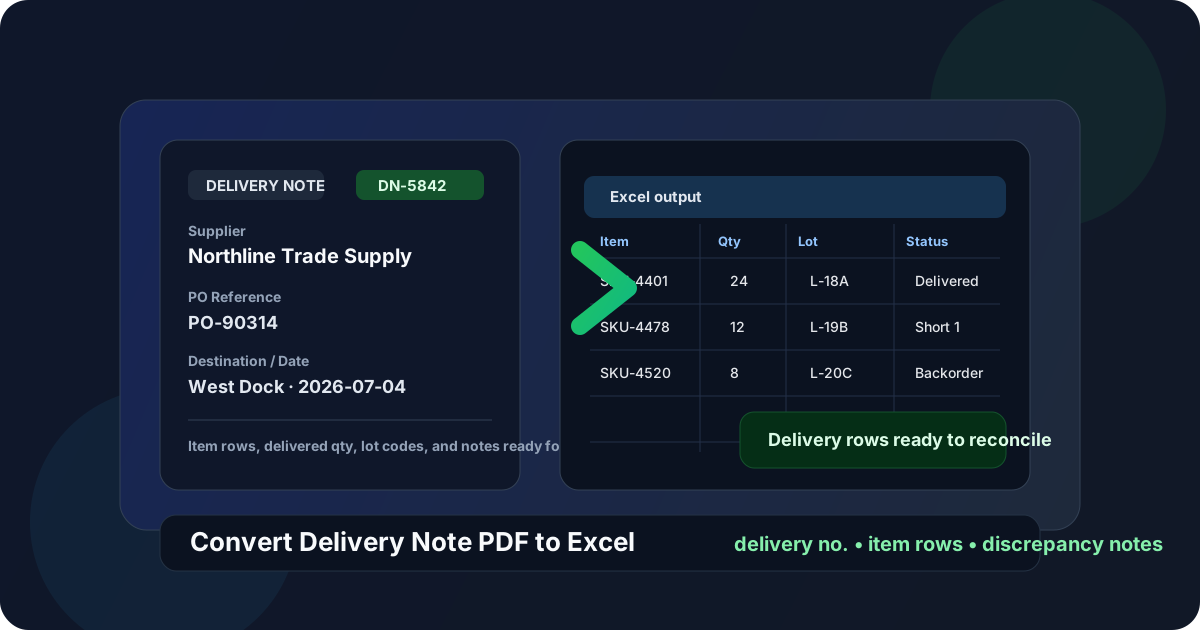
Table of contents
- Quick start: convert delivery note PDF to Excel in about 5 minutes
- Why teams need delivery-note PDFs in Excel
- Which delivery-note fields matter most
- What converts cleanly and what usually breaks
- Step-by-step: extract delivery-note data with LifetimePDF
- Review checklist before you trust the spreadsheet
- Delivery note vs proof of delivery vs goods receipt note
- Excel vs CSV for delivery notes
- Privacy and shipping-document hygiene
- Related LifetimePDF tools and companion guides
- FAQ (People Also Ask)
Quick start: convert delivery note PDF to Excel in about 5 minutes
If the delivery note PDF already contains selectable text and the layout is reasonably clean, the fast workflow is simple:
- Open PDF to Excel.
- Upload the delivery note PDF you want to extract.
- If the file is scanned, run OCR PDF first.
- Download the generated XLSX file.
- Review the delivery note number, PO reference, item rows, delivered quantities, batch codes, and discrepancy notes before using the spreadsheet.
Why teams need delivery-note PDFs in Excel
A delivery note records what a supplier or shipper says was sent. It usually links a shipment to a purchase order, customer or warehouse destination, item codes, quantities, pack details, and any remarks that matter during handoff. Humans can scan a delivery note quickly because we understand which fields are the references and which rows are the actual line items. Excel makes that information reusable instead of leaving it frozen inside a page layout.
Once a delivery note becomes spreadsheet data, warehouse teams can filter shipments by supplier, PO number, date, or SKU. Operations can compare expected versus delivered quantities. Procurement can flag shortages or substitutions sooner. Customer service and finance teams can trace disputes faster. That is why the query convert delivery note PDF to Excel is commercially useful: people want a worksheet they can act on, not just a prettier file.
- Delivery note number and shipment date
- Supplier name and PO reference
- Item code, description, and unit of measure
- Delivered quantity and batch or lot code
- Warehouse, dock, site, or consignee details
- Discrepancy notes, shortages, and remarks
- Sort and filter deliveries by supplier, date, PO, or SKU
- Compare ordered versus delivered quantities quickly
- Flag shortages, substitutions, and partial shipments fast
- Prepare receiving, reconciliation, or audit schedules
- Reuse the data in pivots, reports, or imports
Which delivery-note fields matter most
Not every delivery note uses the same layout, but most teams care about the same core fields. When those fields survive conversion cleanly, the spreadsheet becomes genuinely useful instead of becoming another repair job.
- Delivery note number
- Shipment or dispatch date
- Supplier or shipper name
- PO number or customer reference
- Delivery location, consignee, or dock
- Item code or SKU
- Item description
- Unit of measure
- Quantity delivered
- Batch, lot, or serial reference
- Short shipment or backorder note
- Damaged or substituted item note
- Driver or handoff remarks
- Receiver comment or discrepancy note
- Totals and final instructions
The more the document mixes addresses, signatures, stamps, transport notes, and dense item tables on the same page, the more likely the Excel output will need a quick review. That review is normal. The goal is not perfect magic. The goal is getting to a usable sheet much faster than manual retyping.
What converts cleanly and what usually breaks
Some delivery note PDFs convert beautifully. Others are packed with the exact kinds of layout problems that make any PDF-to-table workflow harder.
- Digitally generated delivery notes with selectable text
- Single-document PDFs without extra attachments
- Consistent column layouts across all pages
- Readable tables with clear row spacing
- Straight, clean scans with high contrast
- Skewed phone photos of shipping paperwork
- Packets mixed with invoices, POs, and proof-of-delivery pages
- Repeated headers and footers on every page
- Long wrapped descriptions or handwritten remarks
- Stamped, low-resolution, or shadow-heavy scans
If your delivery-note packet is messy, the smartest workflow is often to separate the real delivery-note pages first, straighten or OCR the scan if needed, and then convert. That one minute of prep usually saves a lot more than one minute of spreadsheet cleanup later.
Step-by-step: extract delivery-note data with LifetimePDF
Here is the workflow that usually gets the cleanest result without overcomplicating the job.
1. Keep only the delivery-note pages
If the file bundle includes the purchase order, invoice, proof of delivery, route plan, or email printout, use Extract Pages or Split PDF so the converter only sees the delivery-note pages. Mixed packets are one of the easiest ways to get broken tables and random extra rows.
2. OCR the file if it is scanned
If the delivery note is a scan, a courier photo, or an image-only PDF, run it through OCR PDF first. OCR improves recognition of small fields like delivery numbers, PO references, item codes, batch codes, and quantity columns.
3. Convert the PDF into Excel
Open PDF to Excel, upload the cleaned delivery-note PDF, and export the spreadsheet. If the document has multiple tables or repeated headers, expect one quick review pass after download.
4. Review the exception rows, not just the easy rows
The rows that matter most are often the ones that break most easily: shortages, substitutions, backorders, damaged items, and handoff remarks. Do not stop after checking the first page header. Scan the exception rows and totals too.
5. Save the reviewed file with a useful name
A filename like DN-5842-reviewed.xlsx is a lot more useful than output.xlsx. If the worksheet will move into receiving, procurement, customer service, or audit workflows, make the handoff obvious.
Review checklist before you trust the spreadsheet
Before the Excel file gets sent to a coworker or imported into another system, verify the fields that matter most.
- Delivery note number and shipment date
- Supplier name and PO reference
- Item code or description
- Delivered quantity and unit of measure
- Batch, lot, or serial reference
- Discrepancy notes and totals
- Description rows split across multiple lines
- Repeated page headers mixed into the item table
- Quantity columns shifted one cell over
- Batch or lot codes dropped into the wrong row
- Blank rows created from spacing-only areas
- Footer notes merged with totals or signatures
If one delivery note is still messy after conversion, sometimes the smarter move is to extract a narrower page range, rerun OCR, or request a cleaner export from the sender rather than fighting the worksheet row by row.
Delivery note vs proof of delivery vs goods receipt note
These documents overlap, which is exactly why they often get confused during search and conversion work. But they are not the same thing, and the Excel workflow changes depending on which document you actually have.
Usually travels with the shipment and lists what the sender says was dispatched. Best when you need item rows, quantities sent, PO references, and shipping detail.
Usually confirms receipt, often with a timestamp, signature, or exception note. Best when you need handoff evidence rather than the full shipment list.
Usually an internal receiving record created after inspection. Best when the business needs accepted, rejected, damaged, or short quantities inside the warehouse process.
If your file is really a proof of delivery or a goods receipt note, use the matching workflow. If it is truly a delivery note, the extraction priority is usually shipment detail first, receiving confirmation second.
Excel vs CSV for delivery notes
People often ask whether delivery-note data should end up in Excel or CSV. The answer depends on what happens next.
Choose Excel when:
- You need to review and clean the data manually.
- You want filters, formulas, comments, or multiple tabs.
- You plan to hand the file to warehouse, procurement, or operations teammates.
- You need to compare several shipments before import.
Choose CSV when:
- You only need plain rows and columns for a downstream import.
- You do not care about worksheet formatting.
- You want the simplest structured file possible for another system.
Privacy and shipping-document hygiene
Delivery notes often contain more than item rows. They may include addresses, customer references, contact names, route details, internal location names, signatures, or remarks. So conversion quality matters, but document hygiene matters too.
- Only upload the pages you actually need.
- Use Redact PDF when sensitive fields should not travel further.
- Use Delete Pages to remove extras before conversion.
- Use PDF Metadata Editor if the file carries unnecessary author or software metadata.
- Follow your organization's shipping, supplier-data, and retention rules before sharing converted output.
Being selective up front saves time twice: once during conversion and again when you do not have to clean or explain unnecessary data later.
Related LifetimePDF tools and companion guides
If you are building a repeatable delivery-note workflow, these tools and pages fit naturally with this exact task:
- PDF to Excel for the core extraction step.
- OCR PDF for scanned delivery notes.
- Extract Pages and Split PDF for delivery-note-only page ranges.
- Compress PDF if the source file is unnecessarily heavy.
- Redact PDF for customer-sensitive shipping documents.
- Convert Delivery Note PDF to Excel Online Without Monthly Fees if you want the cost-model angle.
- Convert Proof of Delivery PDF to Excel, Convert Goods Receipt Note PDF to Excel, and Convert Purchase Order PDF to Excel for adjacent shipment and receiving workflows.
Bottom line: the best delivery-note-to-Excel workflow is boring in a good way — clean source pages, OCR when needed, one review pass, then use the spreadsheet to compare what was supposed to ship with what the document actually says shipped.
FAQ (People Also Ask)
How do I convert a delivery note PDF to Excel?
Upload the delivery note PDF to a PDF to Excel converter, export the XLSX file, and review the delivery note number, supplier, PO reference, item rows, quantities delivered, batch codes, and discrepancy notes before using the spreadsheet. If the file is scanned, OCR first usually improves the result.
Can I convert a scanned delivery note PDF to Excel?
Yes, but the cleanest workflow is usually OCR first, then convert. Straight pages and readable scans make a big difference when the delivery note contains small labels, dense tables, stamps, or handwritten remarks.
Why do some delivery note PDFs create messy spreadsheets?
Because delivery notes often combine addresses, PO references, item rows, quantity columns, batch data, remarks, signatures, and repeated headers on the same page. Mixed layouts, low-quality scans, and extra non-delivery-note pages are common reasons columns shift.
What is the difference between a delivery note and a proof of delivery?
A delivery note usually lists what was sent with the shipment. A proof of delivery usually confirms receipt, often with a signature, timestamp, or exception note. The fields overlap, but they serve different operational steps.
What should I verify after converting delivery-note data?
Check the delivery note number, shipment date, supplier, PO reference, item rows, delivered quantities, batch or lot codes, warehouse references, and discrepancy notes. Those are the fields most likely to create downstream shipping or receiving problems if one cell shifts during conversion.