How to Split PDF in Brave: Separate Pages from Downloads, Attachments, and Cloud Files Without Version Confusion
To split PDF in Brave, open a browser-based Split PDF tool in Brave, choose the source file from Downloads, a saved attachment, cloud storage, or a local folder, set the page ranges you want, then download the smaller PDFs.
If you only need one section instead of several new files, use Extract Pages instead so the result stays simpler, easier to name, and easier to send.
That is the short answer. The part that actually saves time in Brave is avoiding duplicate downloads, stale preview tabs, private-window confusion, and vaguely named output files that are harder to trust than the original PDF.
Fastest path: open LifetimePDF's Split PDF tool in Brave, confirm the real source file first, split only the ranges you actually need, then review the smaller outputs once before you email, upload, or archive them.
In a hurry? Jump to Quick start: split PDF in Brave in a few minutes.
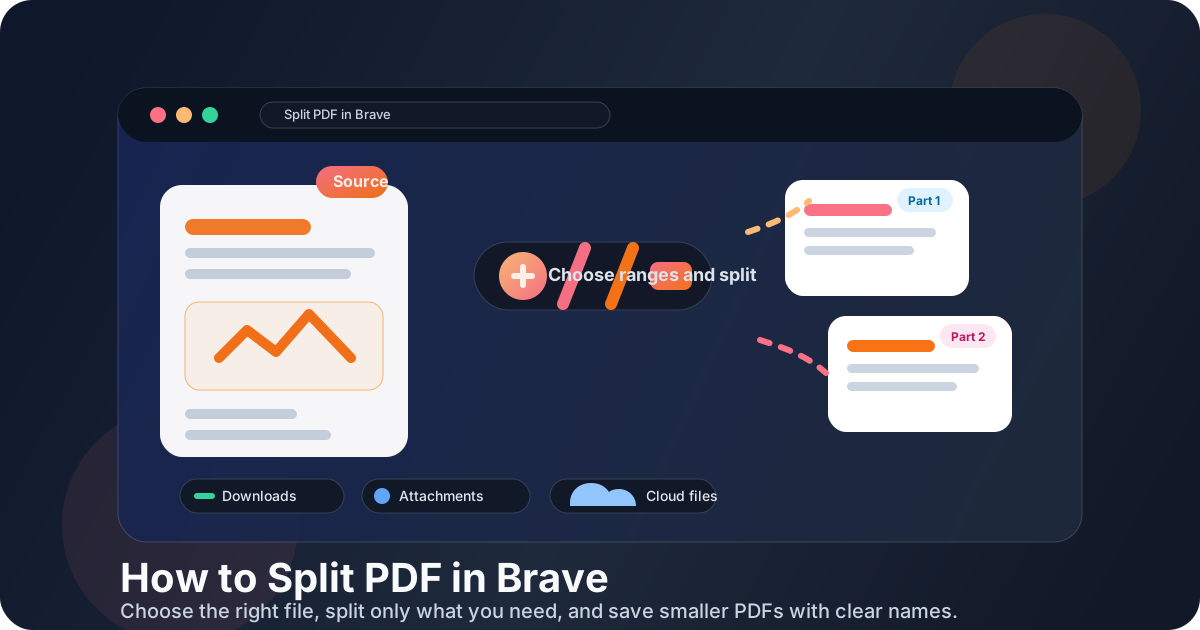
Table of contents
- Quick start: split PDF in Brave in a few minutes
- Why Brave is a good place to start
- Step-by-step: split PDF in Brave
- How to choose the right source file from Downloads, attachments, cloud folders, and local storage
- When to use Split PDF vs Extract Pages in Brave
- How to avoid duplicate downloads, stale previews, and private-window mix-ups
- What to do if the outputs still need cleanup, OCR, or compression
- Related LifetimePDF tools and guides
- FAQ
Quick start: split PDF in Brave in a few minutes
If the file is already the correct PDF and you simply need smaller parts, this is the Brave workflow most people actually want:
- Open Split PDF in Brave.
- Choose the real source file from Downloads, a local folder, a saved attachment, or a synced cloud folder.
- Select the page ranges or logical sections you actually need.
- Run the split and save the smaller PDFs with clear names.
- Open each output once in Brave and confirm the right first page, the right last page, and the right filename before sharing it.
Why Brave is a good place to start
Brave is where a lot of modern PDF work already begins. A file opens from webmail. A contract downloads from a portal. A report lives in a shared drive. A form opens in a tab while another copy lands in Downloads. If you need smaller PDFs for upload, review, or sharing, it makes sense to keep the workflow inside the browser instead of bouncing between apps.
The catch is simple: Brave's built-in PDF viewer is still mainly a viewer. It is helpful for opening a file, scrolling through it, checking the page count, and making sure you grabbed the right document. It does not create several new PDF outputs by itself. The actual split step still needs a tool built for that job.
| Method | Best for | Where it struggles |
|---|---|---|
| Brave PDF viewer only | Opening a file quickly and checking whether it is the right document | It can preview PDFs, but it does not turn one file into several smaller PDFs by itself |
| Attachment or cloud previews | Spot-checking one file before deciding what you actually need | Easy to confuse previews, saved copies, synced files, and duplicate downloads when you need precise outputs |
| Brave + Split PDF | Creating several clean PDFs from one longer source without leaving the browser workflow | You still need to choose the correct source file and set the ranges deliberately |
| Brave + Extract Pages | Keeping one selected section as one new PDF | Not the right tool when one document needs to become several different outputs |
For most people, the calmest path is the same every time: use Brave to find and verify the real PDF, open the split tool, create only the smaller files you need, then review them once before they move onward to email, a portal, or a shared folder.
Step-by-step: split PDF in Brave
If you want a repeatable routine for contracts, approval packets, school forms, invoices, onboarding files, reports, or long scanned documents, use this:
- Open the split tool. Launch Split PDF in Brave.
- Choose only the file you mean to split. Do not trust whichever tab is already open. Confirm the filename and location.
- Set the page ranges with a real purpose. Decide whether you want logical sections, several single pages, or one clean excerpt instead of random fragments.
- Run the split once. Save the outputs somewhere obvious so they do not disappear among older downloads with nearly identical names.
- Review the results. Open each smaller PDF once and verify the boundaries before you upload, send, or archive anything.
Useful rule: split according to how another person will use the files, not according to how the original document happened to be laid out. Meaningful outputs are easier to name, easier to review, and less likely to get sent to the wrong place.
If the split looks wrong, do not keep patching the outputs blindly. Go back to the source list, remove the stale download, replace the wrong attachment copy, export the correct cloud revision, or rethink the ranges and rerun the split once. A clean rerun is usually faster than rescuing a messy set of outputs afterward.
How to choose the right source file from Downloads, attachments, cloud folders, and local storage
The most common Brave split problem is not the split itself. It is source confusion. One file opens from webmail. Another sits in Downloads. A third lives in cloud storage. A fourth has the same name with a (1) or (2) because it was downloaded again. If you split the wrong copy, the outputs may look fine while still being the wrong document.
A cleaner approach is to identify the final version before you split:
- Downloads: useful for recent files, but often cluttered with accidental duplicates.
- Email attachments: convenient for previewing, but save the file locally if you need a stable source for final splitting.
- Cloud folders: helpful when the file came from a shared workspace, but confirm you are exporting the intended revision.
- Portal exports: often the real source of truth, but easy to confuse with older versions you already downloaded.
- Local folders: usually the calmest place to keep the exact PDF you actually mean to work on.
If you are moving quickly, create one temporary folder and place the exact source PDF there first. That small habit prevents a surprising number of bad splits because it stops previews, synced folders, downloads, and browser tabs from all competing for your attention at once.
When to use Split PDF vs Extract Pages in Brave
People often search for split when they really need extract. The difference matters because it changes how many outputs you create and how much cleanup you do afterward.
| If your goal is... | Use this | Why |
|---|---|---|
| Turn one long PDF into several separate files | Split PDF | You need multiple outputs, each with its own page range or section |
| Keep one selected chapter, appendix, or form as one new PDF | Extract Pages | You only need one clean excerpt, not several new documents |
| Reorder pages before deciding what to keep | Organize PDF | Page order problems are easier to fix before you split |
A good rule is this: if someone else will receive several smaller documents, use split. If you only want one chosen section for yourself or for one upload, extract is usually the cleaner path.
How to avoid duplicate downloads, stale previews, and private-window mix-ups
The easiest way to ruin a split job in Brave is to assume the most visible file must be the right one. A browser tab, a webmail preview, a synced cloud copy, and a local download can all refer to the same document family while still being different versions.
Before you split, answer two questions: Which version is final? and What should each output be called? Once those answers are clear, the rest gets much calmer.
- Double-check filenames that look nearly identical, especially if Brave saved duplicate downloads with extra numbers.
- Do not assume the attachment preview is the same as the file you saved yesterday.
- Confirm whether the cloud copy is newer than the file sitting in Downloads.
- If you use a private window, remember that the tab may disappear while the downloaded file remains elsewhere. Treat the saved file as the source of truth.
- Name the outputs by meaning, not just by page numbers, whenever another person will receive them.
What to do if the outputs still need cleanup, OCR, or compression
Splitting solves document scope. It does not automatically solve everything else. Sometimes the outputs still contain blank pages, the order needs a small correction, the file remains too large, or the source was a scan that is not searchable.
When that happens, use the follow-up tool that matches the real problem instead of repeating the split unnecessarily:
- Delete Pages if a smaller PDF still includes pages you do not want.
- Organize PDF if the page order still feels off after the first pass.
- Compress PDF if the outputs are correct but still too large for email or portal limits.
- OCR PDF if the source was scanned and you need searchable text after splitting.
The order usually works best like this: split first, confirm the ranges are right, then fix the one remaining issue. That keeps the workflow predictable and avoids extra work on the wrong version.
Good sequence: verify the real file, split it once, review the outputs, then compress or clean them up only if a real problem remains.
Related LifetimePDF tools and guides
Splitting often overlaps with one or two other PDF tasks. These are the most useful companions in Brave-heavy workflows:
- Split PDF — turn one large file into several smaller PDFs.
- Extract Pages — keep one selected range as one new PDF.
- Organize PDF — preview, reorder, and prepare the file before splitting.
- Delete Pages — remove unwanted pages while keeping one cleaned-up copy.
- Compress PDF — shrink the final smaller files if upload limits still complain.
Related reading on LifetimePDF: How to Split PDF in Edge, How to Split PDF in Firefox, How to Merge PDFs in Brave, How to Sign a PDF in Brave, and How to Add Text to a PDF in Brave.
Brave shortcut: confirm the real file, split only what you actually need, give the outputs names that still make sense tomorrow, and review them once before they leave Downloads, email, or cloud storage.
FAQ: How to split PDF in Brave
Can Brave split PDF files by itself?
Brave can preview PDFs very well, but its built-in viewer does not create separate PDF files by itself. Use a browser-based Split PDF tool inside Brave for the actual split.
What is the cleanest way to split a PDF from downloads or cloud storage in Brave?
Confirm which file is the real source first, then split that copy in Brave. That prevents you from creating outputs from an older preview, the wrong cloud revision, or a duplicate download.
When should I use Extract Pages instead of Split PDF in Brave?
Use Extract Pages when you only want one smaller output from a larger PDF. Use Split PDF when one document needs to become several separate files.
Will splitting a PDF in Brave reduce quality?
Usually no. Splitting normally keeps the original text, layout, and page quality because you are reorganizing pages into smaller PDFs rather than turning them into screenshots.
What if the file is a scan or the split outputs are still too large?
If the source is a scan, splitting will still work, but it will not make the text searchable by itself. OCR the PDF if you need searchable text, and compress the final outputs after splitting if upload limits still complain.
Published by LifetimePDF — Pay once. Use forever.