How to Check PDF Tables on Android: Files, Drive, and Column Order Before You Share
To check PDF tables on Android, save the final file into Files or Files by Google, confirm the table has selectable text, and test whether the headers, rows, and columns still make sense when you search, copy, or extract the content.
If column order breaks, merged cells lose context, or totals detach on a narrow screen, the safest fix is usually to repair the source file and export a cleaner PDF before you share it.
That is the short answer. The useful Android answer is that Drive preview, Files preview, Gmail attachments, Chrome downloads, and chat-app previews can make a weak table feel more trustworthy than it really is. A quote sheet, delivery report, grade summary, budget table, or audit extract can look perfectly neat on a phone while still collapsing the moment someone copies the data, checks it for accessibility, or tries to reuse it in another tool.
Fastest practical path: save the real Android copy, confirm the text layer, test one header row in extraction, inspect a wide or dense table near the end of the file, and fix the source if the relationships only work inside the visual grid.
In a hurry? Jump to quick start: check PDF tables on Android in about 8 minutes.
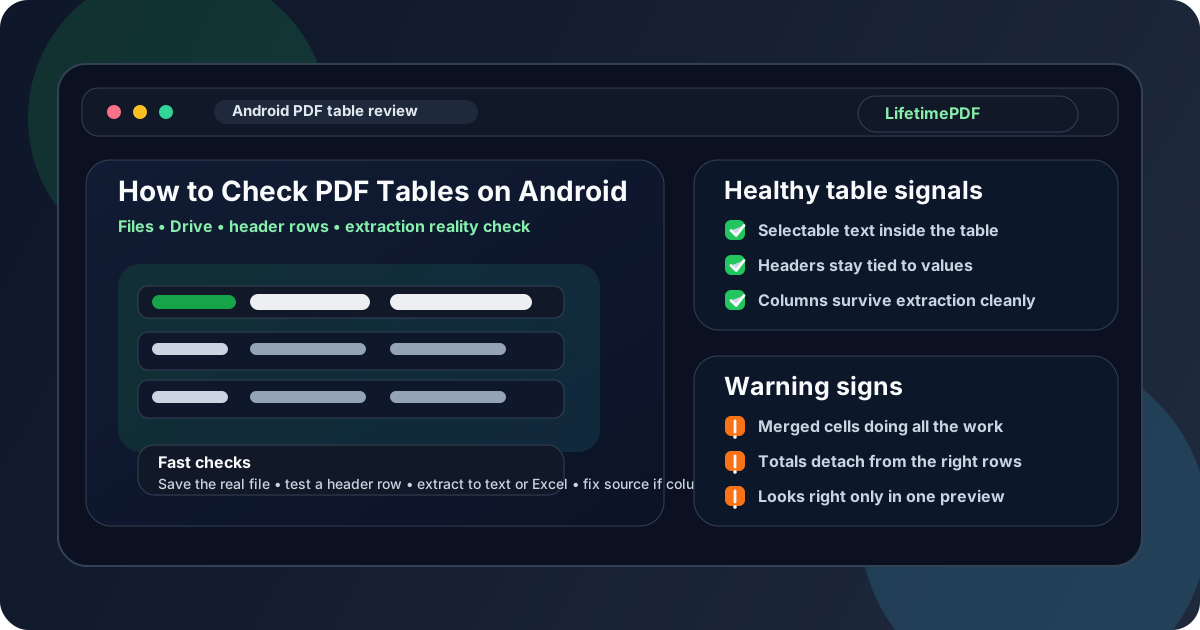
Table of contents
- Quick start: check PDF tables on Android in about 8 minutes
- What you are really checking when you inspect PDF tables
- Where Android users get misled
- Step-by-step: how to check PDF tables on Android
- Warning signs that the table only looks reliable
- When to fix the source versus patch the PDF
- Related LifetimePDF tools and guides
- FAQ
Quick start: check PDF tables on Android in about 8 minutes
If your real goal is simply tell me whether this Android PDF table is trustworthy before I send it, use this order:
- Open the exact PDF you plan to submit, email, upload, archive, or publish from Downloads, Files, Files by Google, Drive, Gmail, or a chat attachment save.
- Confirm you can select a few cells, search for a visible value, and copy a header row. If not, the file may be a scan or weak OCR job and your table review is starting from a broken foundation.
- Look for a clear header row or stub column and ask whether the relationships would still make sense if the visual grid disappeared.
- Compare the visual impression with PDF to Text or PDF to Excel. If the rows and columns scramble, the table is weaker than it looked.
- Spot-check wide tables, repeated headers, totals, merged cells, and notes near the end of the file where mobile review is easiest to rush.
- Run a broader PDF accessibility check and compare what it surfaces with what you noticed manually.
- If the relationships are clearly weak, repair the source document and export a cleaner PDF instead of trusting the current Android preview.
What you are really checking when you inspect PDF tables
Checking PDF tables on Android is not just asking whether the lines look straight on a bright phone screen. The more useful question is whether the table preserves relationships: which header belongs to which value, which subtotal belongs to which group, and whether notes or qualifiers stay attached to the right data.
That matters for accessibility, but it also matters for ordinary work. People turn PDFs into spreadsheets, paste them into messages, upload them to portals, feed them into AI workflows, and review them on the go every day. If the table falls apart outside its original layout, the PDF becomes less trustworthy even if it looked polished in an Android preview.
| What a healthy Android PDF table does | What a weak table does instead | Why it matters |
|---|---|---|
| Keeps headers tied to the right cells | Headers float away, repeat badly, or disappear when copied or extracted | Readers lose context and values turn into guesswork |
| Preserves row and column order | Extraction jumps between columns or stitches unrelated cells together | The table stops behaving like usable data |
| Handles totals and notes clearly | Grand totals, footnotes, or qualifiers drift away from the lines they explain | Important business or compliance meaning gets lost |
| Survives reuse outside the page layout | It only makes sense when you see the exact visual grid on one screen size | Exports, accessibility review, and desktop reuse all suffer |
In plain English: the question is not merely can I see the table? The real question is does the table still communicate the same meaning when the layout becomes secondary?
Where Android users get misled
Android gives you several fast ways to preview a PDF, but fast previews create false confidence. Files, Drive, Gmail, Chrome, and chat previews can make a table look more dependable than it really is.
Small screens hide structural problems
A table can seem organized because you are only looking at one zoomed section at a time. That does not prove the headers, rows, or totals still connect properly.
Drive or Gmail preview can feel more trustworthy than it is
A clean attachment preview is useful for a quick glance, but it cannot prove that the table survives copying, extraction, or accessibility review.
Wide tables encourage rushed judgment
Horizontal scrolling makes it easy to inspect columns in isolation and miss the fact that repeated headers, notes, or totals no longer belong to the right data.
That is why a good Android table check always includes at least one extraction test. If you never force the content outside the page design, you can easily miss the exact failures that matter in real use.
Step-by-step: how to check PDF tables on Android
1. Save the exact final Android copy first
Start with the PDF that will actually leave your device. Do not inspect a Drive preview, portal tab, or old download if another saved copy is the one that will be uploaded, emailed, or archived. Tiny version differences are where weak table exports often hide.
2. Confirm the table is not only a picture
Try selecting text inside the table, searching for a visible amount, or copying a header row. If nothing behaves like real text, run OCR PDF first. OCR is not a guarantee of clean structure, but it turns a picture of data into something you can actually inspect.
3. Compare Files, Drive, and a fuller viewer without trusting any one of them
Use Files or Drive for speed and Acrobat Reader or another fuller viewer when you want a stronger review path, but treat all of them as lenses rather than proof. If the table only feels coherent in the prettiest preview, that is not a win. It is a hint that the structure may be leaning too hard on the visual grid.
4. Test extraction instead of trusting the design
Use PDF to Text to see how the table reads when the layout polish disappears. Then try PDF to Excel when you want a stronger reality check on whether columns, dates, totals, and labels still stay aligned. If the extracted output turns into clutter, the PDF table likely needs upstream repair.
5. Watch repeated headers, merged cells, and totals closely
These are the places where many Android-reviewed PDFs start lying to people. A repeated header can look fine while you scroll, but extraction may not preserve the relationship. A merged heading may visually cover several columns while the underlying data treats it like one lonely label. A total can end up detached from the rows it summarizes. If those elements become ambiguous, the table is not safe just because it looked tidy on your phone.
6. Run an accessibility review as a triage layer
PDF Accessibility Checker helps surface broader structure problems quickly. Use it as triage, then make a human judgment about the tables that matter most. An invoice packet, grade report, product matrix, pricing schedule, or compliance table deserves more than a casual mobile glance.
7. Repair the source and export again if the table logic is weak
If the PDF came from Sheets, Excel, Word, Docs, a BI dashboard, or semantic HTML, the cleanest fix is usually upstream. Simplify confusing merges, clarify headers, reduce decorative layout tricks, and export again. That is almost always cleaner than trying to rescue a structurally weak final PDF one symptom at a time.
Reliable sequence: confirm real text, test extraction, review headers and totals, run an accessibility check, then repair the source before the final export.
Warning signs that the table only looks reliable
Table problems repeat themselves. Once you know the usual failure patterns, you can spot them much faster during an Android review.
| Warning sign | What goes wrong | Better move |
|---|---|---|
| Visual-only headers | A bold top row looks important, but extraction does not preserve the relationships properly. | Rebuild the header logic in the source file and export again. |
| Columns read in the wrong order | Values jump across the page or combine with unrelated cells. | Check text order and fix the export path upstream. |
| Merged-cell confusion | Category labels drift away from the values they describe. | Reduce decorative merges and make grouping clearer in the source. |
| Totals detached from details | Subtotals and grand totals lose context when the grid collapses. | Rework placement and test extraction before publishing. |
| Small-screen confidence | The table feels fine while zoomed in section by section, but the full relationship between columns and notes breaks down. | Check the table through extraction and a broader structure review, not only by visual scrolling. |
One simple smell test: if you had to explain the table aloud without showing the page, would the relationships still be obvious? If not, the structure is probably leaning too hard on visual placement.
Where people get fooled
The grid lines are crisp, the columns look aligned, and the totals seem easy to find once you zoom in. That visual neatness creates false confidence. A real table review asks whether the relationships survive extraction, accessibility review, and downstream reuse—not just whether the page design looks professional on your device.
When to fix the source versus patch the PDF
Source-first repair usually wins when the table problem is broad rather than local. If headers are inconsistent, merged cells are carrying too much meaning, or several pages break during extraction, editing the final PDF is rarely the best long-term move.
Repair the source when:
- multiple tables in the same file behave differently,
- merged cells are doing more organizational work than they should,
- the PDF came from Sheets, Excel, Word, Docs, HTML, or a report builder you still control,
- table problems appear alongside reading-order, heading, or alt-text issues,
- the document will be revised or reused again later.
If the file is part of a broader accessibility review, pair this table check with accessibility, reading order, headings, and alt text. Tables do not live in isolation. Weak structure in one area often travels with weak structure elsewhere.
Related LifetimePDF tools and guides
Useful tools
Need a cleaner review workflow for tables, extraction, and accessibility checks? LifetimePDF combines OCR, extraction, structure checks, and export tools in one pay-once toolkit.
FAQ
How do I check PDF tables on Android quickly?
Confirm the file has real text, inspect whether headers and cells stay in a sensible order, then test extraction so the rows and columns do not collapse when the layout disappears.
Can a PDF table look organized in Drive or Files preview and still be weak?
Yes. Many tables look polished in Android previews while still having weak headers, broken column order, or ambiguous merged cells underneath.
Is PDF to Excel useful for checking table quality?
Usually yes. It is a fast way to see whether the table behaves like structured data or collapses into messy values during extraction.
Should I OCR a scanned PDF before checking tables on Android?
Usually yes. OCR restores a text layer so you can evaluate whether the table behaves like real content instead of a picture of a table.
Should I fix PDF tables in the final PDF or in the source file?
If you still control the source, fix it there first. A cleaned-up spreadsheet, report template, Word document, or HTML table usually exports a better PDF than after-the-fact patching.
Published by LifetimePDF — Pay once. Use forever.