How to Check PDF Language on iPad: Files, Split View, and Text-Layer Checks Before You Share
To check PDF language on iPad, save the final PDF into Files or open it in Acrobat, confirm the text layer works, and compare the document's main language with the words readers will actually hear or extract.
If the file came from a reused template, scan, or multilingual export, use Split View to inspect the text closely, then fix the source file before you share it.
iPad is one of the easiest places to trust a PDF too quickly. The larger screen makes a document feel finished, and Files, Books, Mail preview, Safari, and Acrobat can all make a messy file look calm. But a polished preview can still hide stale language settings, weak OCR, or an old template that no longer matches the content. The useful question is not only whether the page looks right on your tablet. It is whether the file will behave like the language it is actually written in when someone reads it aloud, extracts text, converts it, or reviews it for accessibility.
Fastest practical path: review the real iPad copy, confirm the text layer works, compare the document language with the actual body text in Split View, inspect multilingual sections, then fix the source if anything feels stale or wrong.
In a hurry? Jump to quick start: check PDF language on iPad in about 7 minutes.
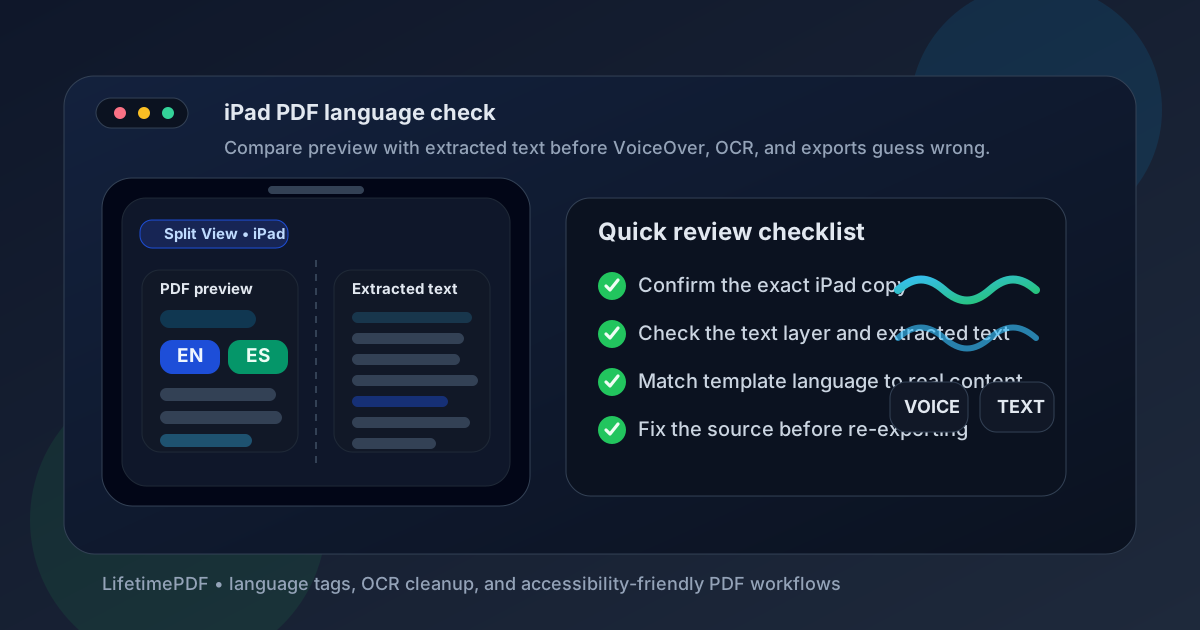
Table of contents
- Quick start: check PDF language on iPad in about 7 minutes
- What you are really checking when you review PDF language
- Where iPad users get misled
- Step-by-step: how to check PDF language on iPad
- Why Split View helps on iPad
- Warning signs that the language setting is stale or wrong
- Scans, multilingual files, and translated PDFs on iPad
- When to fix the source versus patch the PDF
- Related LifetimePDF tools and guides
- FAQ
Quick start: check PDF language on iPad in about 7 minutes
If your real question is tell me whether this iPad PDF is using the right language before I send it, use this order:
- Open the exact PDF you plan to email, upload, archive, print, or share from Files, Books, Mail, Safari downloads, or a saved cloud folder.
- Confirm the file has usable text. Search a visible word, copy a line, or run PDF to Text. If it behaves like a picture, run OCR PDF first.
- Identify the real dominant language of the document body, not the old template language or whatever language the previous version used.
- Use Split View to compare the visible page with extracted text so headings, names, accented words, and translated sections still make sense outside the page layout.
- Do one broader PDF accessibility check or quick VoiceOver-minded review so language problems do not hide inside larger structure issues.
- If the language is stale, missing, or clearly wrong, repair the source file and export a cleaner PDF instead of trusting the current copy.
What you are really checking when you review PDF language
Checking PDF language on iPad is not only asking whether the document contains English, Spanish, French, German, or another language. You are checking whether the file's internal language setting still matches the real reading experience. That matters because VoiceOver depends on it for pronunciation, OCR cleanup works better when the assumptions fit the content, and multilingual PDFs often keep invisible leftovers from older templates or exports.
In practice, you are looking for three things:
- Main-language accuracy: the PDF's primary language still matches the main body of the document.
- Text-layer credibility: the extracted or searchable text behaves like real language instead of OCR mush, broken accents, or stale template output.
- Mixed-language awareness: translated clauses, quotes, names, and bilingual sections do not get quietly flattened into the wrong assumptions.
Good outcome
The document sounds right, extracts cleanly, and does not surprise you once the text leaves the page.
Common failure
The visible content changed, but the PDF still carries an old template language or weak OCR assumptions from a previous version.
Best next move
Review the real file, then repair the source if the language setting is obviously stale or the text layer is weak.
Language also overlaps with broader accessibility and conversion work. If the PDF is badly tagged, scan-heavy, or exported from a messy source, the language review often reveals the first visible symptom rather than the only problem. That is why it helps to treat document language as part of a real iPad workflow, not as an isolated checkbox.
Where iPad users get misled
iPad gives you several pleasant ways to preview a PDF. The trap is that convenience feels like proof. A good-looking file in Files, Books, Mail preview, Safari, or Acrobat Reader can still carry the wrong document language underneath.
| iPad view | What it is good for | What it cannot safely prove |
|---|---|---|
| Files preview or quick browser preview | Confirming the file opens and that the pages broadly look right. | That the underlying language setting matches the content or that OCR assumptions are correct. |
| Books or Mail preview | Useful for a quick first pass and confirming you have the right document. | Whether the final saved copy still has the right language once it is extracted, converted, or heard aloud. |
| Acrobat Reader on iPad | A useful second opinion for complex layouts, scans, and larger accessibility-minded review. | You still need text extraction and judgment. A file can look finished while carrying stale language metadata. |
| Split View with extracted text | Revealing whether the real content still behaves like the language you think you exported. | It does not explain every root cause, but it tells you quickly whether the file is trustworthy. |
| Accessibility checker results | Surfacing larger issues around language, structure, and reading behavior. | Whether a human will trust the wording, context, and multilingual decisions without a manual review. |
Step-by-step: how to check PDF language on iPad
This workflow gives you a dependable answer without turning a fast tablet review into a giant remediation project.
Step 1: Start with the final iPad copy
Review the exact file that will leave your device. If the PDF is still living inside Mail preview, Safari preview, Messages, or a shared-drive app, save the real copy into Files first. Language review only matters when you inspect the same PDF that will actually be shared.
Step 2: Confirm the text layer before you trust the language
If the PDF is a scan or a weak export, a language review becomes guesswork fast. Try selecting text, searching a visible word, or extracting a sample with PDF to Text. If the file behaves more like an image than a document, run OCR PDF first. OCR will not solve every language problem, but it makes the rest of the check much more honest.
Step 3: Decide what the document's real primary language is
This sounds obvious until you review translated reports, recycled templates, bilingual forms, or documents assembled from several sources. The right language is the language that dominates the actual reading experience, not necessarily the first page, the filename, or the previous version.
Step 4: Spot-check the text after it leaves the layout
Run a small sample through PDF to Text and read it like a human instead of trusting the pretty page. Check headings, one paragraph near the start, one paragraph in the middle, any names or accented words, and any section that was translated or pasted from elsewhere. If the extracted text looks suspicious, the language setting, OCR pass, or export workflow may need repair.
Step 5: Inspect multilingual sections on purpose
Bilingual forms, translated clauses, product names, quotations, and appendices are where lazy export habits show up. A mostly English PDF can still contain short Spanish sections, French names, Arabic phrases, or legal text copied from another source. Those sections deserve a deliberate glance instead of an optimistic shrug.
Step 6: Finish with one accessibility-minded reality check
Language is one part of a usable PDF, not the whole story. Pair your review with PDF Accessibility Checker or the iPad-specific guides How to Check PDF Accessibility on iPad and How to Check if a PDF Is Tagged on iPad so stale language settings do not hide inside bigger issues. If the file is still weak, use PDF to Word to recover an editable starting point and repair the source instead of endlessly poking at the final export.
Reliable sequence: final iPad copy → verify text → compare extracted text with the visible page → inspect multilingual sections → OCR scans or rebuild the source → retest the finished PDF.
Why Split View helps on iPad
iPad has one advantage over a phone for language checks: you can keep the PDF and a second signal visible at the same time. That makes it easier to stop trusting a pretty preview too quickly.
A simple Split View setup
- Open the PDF in Files, Books, or your preferred iPad reader.
- Open PDF to Text in Safari beside it.
- Check one page near the beginning, one dense page in the middle, and one translated or scan-heavy page near the end.
- Ask whether the extracted words still sound like the language the document claims to be using.
What a healthy file looks like
The PDF stays readable, extracted text follows the same language as the visible page, and translated or accented sections still look intentional instead of garbled.
What a weak file looks like
The preview feels polished, but extracted text breaks accents, keeps the wrong template language, or exposes that a scan never became trustworthy text.
Warning signs that the language setting is stale or wrong
These are the patterns that usually matter in real iPad workflows, not just in theory.
| What you notice | What it usually means | Best next move |
|---|---|---|
| The visible text changed languages, but the file came from an old template | The PDF may still carry the source template's old language settings. | Check the source document properties and export again. |
| Names, accents, or common words look broken after extraction | The text layer or OCR assumptions may not match the real language well. | Re-run OCR if needed and recheck the source. |
| The PDF looks fine in Files or Books, but accessibility review flags language or structure issues | The file is visually tidy but not structurally trustworthy. | Do not trust the preview alone. Repair upstream and rebuild the PDF. |
| Bilingual sections feel inconsistent or awkward | The export may be flattening mixed-language content too aggressively. | Review those sections in the source and mark them cleanly before re-exporting. |
| The PDF is scan-heavy and hard to search | You may be fighting OCR problems before you even reach the language question. | Repair the text layer first, then revisit document language. |
Scans, multilingual files, and translated PDFs on iPad
iPad PDF review gets trickiest when the file was translated late, assembled from multiple sources, or rescued from a scan. In those cases, language mistakes are usually a symptom of a broader workflow problem, not a random one-off.
Translated reports and reused templates
These are prime candidates for stale document language because the visible content changed while the hidden settings stayed behind.
Bilingual forms and legal packets
They often need a more deliberate source-file workflow because one global assumption can be too blunt for the whole document.
Scans and OCR recovery
If the text layer is weak, language review becomes guesswork. OCR first, then judge the language using real extracted text.
Pasted-together PDFs
When pages come from different systems or teams, invisible leftovers from older exports are common and deserve a manual check.
A practical opinion: if the document changed languages during its life, assume the metadata and export settings deserve a second look too. PDFs are very good at hiding old decisions under a professional-looking tablet preview.
When to fix the source versus patch the PDF
Not every iPad language problem deserves the same response. The useful question is whether the PDF is almost healthy and only needs a light cleanup, or whether the real problem clearly lives upstream.
Patch lightly or leave the PDF alone when
- the text layer is already clean and stable,
- the document is mostly one language with only minor translated fragments,
- you only need a quick confidence check before sharing internally,
- the source file is unavailable but the current PDF is otherwise solid.
Fix the source and re-export when
- the PDF came from a reused template with different old language settings,
- several extracted sections look broken or suspicious,
- OCR assumptions are obviously hurting the text quality,
- the file will be published, archived, submitted, or reused seriously,
- the language problem is part of broader accessibility or structure issues.
If the PDF matters to more than one reader, more than one revision, or more than one device, upstream repair usually wins. A clean source produces a cleaner export and saves future-you from reliving the same fix.
FAQ
How do I check PDF language on iPad quickly?
Open the final PDF on iPad, confirm the text layer works, identify the document's real main language, and spot-check extracted text before you share it. If the file is a scan or the text looks suspicious, OCR or source repair should happen before you trust the export.
Can Files or Books tell me whether a PDF is using the right language?
Not completely. They are useful for opening the real file and confirming the visible pages, but they cannot prove that the underlying language setting matches the content. Use text extraction, OCR awareness, and a broader accessibility-minded review for that.
Why is Split View useful for checking PDF language on iPad?
Split View lets you keep the PDF on one side and extracted text on the other, which makes stale template language, broken accents, and multilingual trouble much easier to spot without bouncing between apps.
Should I OCR a scanned PDF before checking language on iPad?
Usually yes if the PDF has a weak or missing text layer. OCR does not magically fix every language issue, but it gives you searchable, extractable text so the rest of the review becomes far more trustworthy.
When is the source file a better fix than the PDF itself?
If the file came from a stale template, if multiple sections extract badly, or if the PDF will be reused seriously, fix the source and export a cleaner PDF. That is usually faster and more dependable than repeated patching.
Published by LifetimePDF — Pay once. Use forever.