Compress PDF for FogBugz: Keep Case Attachments, Bug Evidence, and QA PDFs Easy to Review
To compress a PDF for FogBugz, upload the file to LifetimePDF's Compress PDF tool, start with Medium compression, and keep the smaller copy only if screenshots, timestamps, notes, and labels still read clearly.
If the attachment contains more than the case actually needs, extract only the relevant pages first so developers, testers, support, and stakeholders reach the useful evidence faster.
FogBugz cases tend to collect the kinds of PDFs that get reopened later: reproduction packets, annotated screenshots, QA verification notes, support appendices, release signoffs, and customer-facing paperwork saved for traceability. That makes file quality more important than a one-time upload check. A smaller PDF should not merely upload. It should also open quickly, stay readable, and preserve the details that help someone confirm a bug, review a fix, or understand the case history without extra friction.
Fastest path: compress the real FogBugz attachment on Medium, review the important details once, then trim or split pages only if the document is still bulkier than the case really needs.
Want the short version? Jump to Quick start: compress a PDF for FogBugz in under 2 minutes.
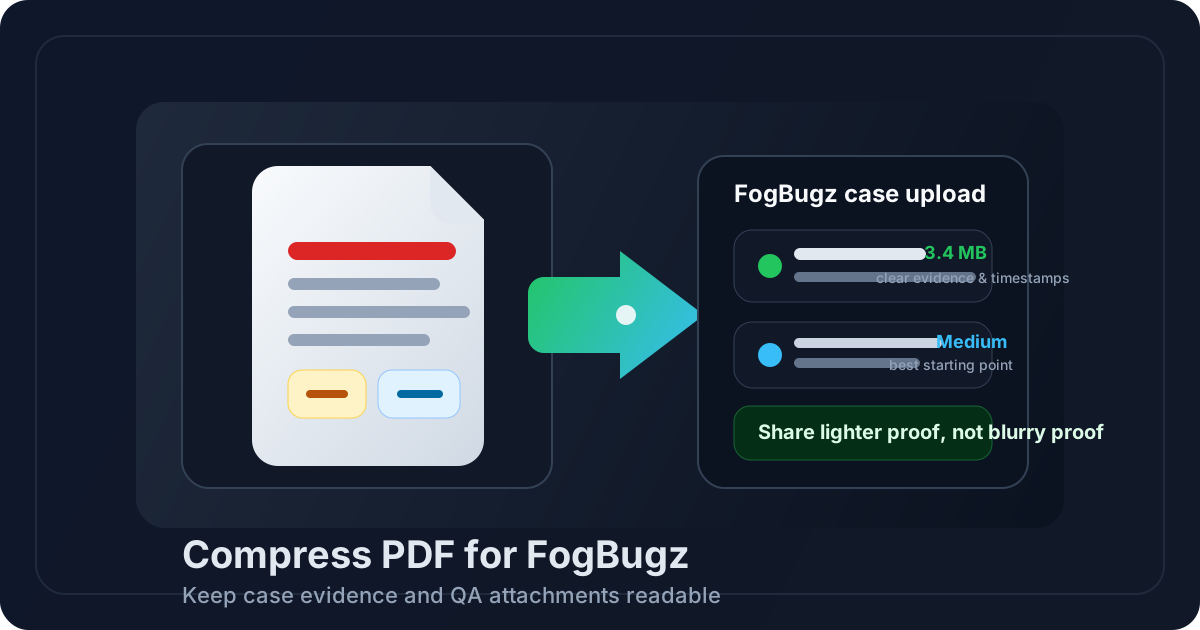
Table of contents
- Quick start: compress a PDF for FogBugz in under 2 minutes
- Why smaller PDFs help in FogBugz
- What file size should you aim for?
- Which compression level should you choose?
- Step-by-step: shrink a FogBugz PDF with LifetimePDF
- Common FogBugz PDFs that benefit from compression
- When splitting or extracting pages is smarter than more compression
- Readability checks before attaching the smaller file
- Workflow habits that keep FogBugz files cleaner
- Related LifetimePDF tools and internal links
- FAQ (People Also Ask)
Quick start: compress a PDF for FogBugz in under 2 minutes
If your goal is simply make this PDF easier to attach, reopen, and review in FogBugz, this workflow is usually enough:
- Open Compress PDF.
- Upload the exact case attachment, bug evidence pack, QA review PDF, support export, or scanned appendix you plan to share.
- Choose Medium compression first.
- Download the smaller copy and compare the new size with the original.
- Open it once and check screenshots, timestamps, version details, labels, annotations, and any page another reviewer may rely on later.
- If only one section matters, use Extract Pages or Split PDF instead of forcing harsher compression on the whole file.
- If the PDF is scan-heavy, use OCR PDF so the smaller copy is also easier to search and review.
For many FogBugz cases, that is enough to make an attachment feel lighter and more practical without harming the evidence inside it.
Why smaller PDFs help in FogBugz
FogBugz is part case log, part working conversation, and part long-term record. Attachments do not disappear after the first upload. They get revisited during triage, debugging, retesting, release review, customer follow-up, or duplicate-case cleanup. When a PDF is oversized, each later review takes a little more effort than it should.
- Faster case review: reviewers can open the file quickly and get to the actual evidence without waiting on a bloated download.
- Cleaner handoffs: developers, QA, support, and product can work from the same focused document instead of a bulky attachment full of extra pages.
- Less friction on repeat visits: long-lived cases often get reopened later, so smaller files save time more than once.
- Better case hygiene: when every attachment is lighter and more focused, the history stays easier to scan and trust.
Rule of thumb: smaller only counts as better if the next reviewer can still read the exact screenshot, timestamp, note, table, or approval detail they need to make a decision.
What file size should you aim for?
There is no universal limit that fits every team, but these targets are practical for most FogBugz workflows:
| Attachment type | Comfortable target | Why it works |
|---|---|---|
| Single screenshot PDF, short reproduction note, or one-page case appendix | Under 2 MB | Easy to open quickly during triage or follow-up review. |
| Typical bug evidence pack with screenshots, notes, or tables | 2-5 MB | Usually small enough to feel light while keeping detail readable. |
| Longer scan-heavy support packet, release review, or approval record | 5-10 MB after cleanup | Reasonable if you already removed wasted pages, blank backs, and oversized margins. |
If your file still feels heavy above those ranges, the problem is often not the compression level alone. It is more often extra pages, scanner borders, repeated screenshots, or sections that do not belong in the case at all.
Which compression level should you choose?
The safest answer for most FogBugz attachments is still Medium. It gives you a meaningful size drop without being reckless with screenshots, tables, small labels, or timestamps.
- Low compression: best when the PDF is already fairly compact and you only need a modest reduction while preserving tiny details.
- Medium compression: the default for most bug evidence, QA summaries, support documents, issue appendices, and release notes.
- High compression: use only when the attachment is image-heavy and you are willing to inspect every important page carefully afterward.
If High compression makes a reviewer zoom in just to read a callout box or timestamp, it is usually the wrong tradeoff. In FogBugz, clarity beats squeezing out the last possible megabyte.
Step-by-step: shrink a FogBugz PDF with LifetimePDF
- Start with the actual file you plan to attach. Do not test on a different export if the real attachment has more screenshots, comments, or scan noise.
- Open Compress PDF. Upload the exact PDF from your case workflow.
- Choose Medium first. That gives you a realistic baseline before you consider stronger compression.
- Download and review the smaller copy once. Focus on screenshot labels, timestamps, browser chrome, version strings, callout arrows, signatures, and page numbers.
- Trim the document if the file is still bigger than it should be. Use Extract Pages, Delete Pages, or Split PDF to remove irrelevant sections.
- Crop wasted space when scans are the real problem. Crop PDF can help remove heavy borders and blank edges.
- Upload the final version with a clear name. A filename like
case-8421-retest-evidence-compressed.pdfis easier to trust than something vague likescan-final-v2.pdf.
Common FogBugz PDFs that benefit from compression
Not every attachment behaves the same way. These are some of the most common FogBugz PDFs where compression helps without changing the working meaning of the file:
- Bug evidence packs: screenshot bundles with annotations, browser details, and brief reproduction notes.
- QA verification PDFs: test runs, expected-versus-actual tables, pass/fail notes, and retest summaries.
- Support appendices: customer-provided scans, support exports, case paperwork, or escalation records attached for context.
- Release and approval records: signoff pages, validation evidence, and packaged review notes attached to release-related cases.
- Long reference appendices: exported logs or multi-page support documents converted into PDF for convenience.
In all of those cases, the best result is usually a PDF that opens fast, stays readable, and contains only the pages the case truly needs.
When splitting or extracting pages is smarter than more compression
Compression is not always the real fix. Often the document is simply too broad for the case. If only one section matters, shrinking the whole file harder is usually worse than trimming it first.
- If the case only depends on 3 pages from a 20-page export, pull those pages out with Extract Pages.
- If one support packet includes several unrelated issues, separate them with Split PDF.
- If the attachment contains blank scanner backs, repeated screenshots, or filler appendices, remove them with Delete Pages.
- If the PDF is mostly huge scanner margins and dark borders, trim the dead space with Crop PDF.
Good attachment hygiene beats aggressive compression. A focused 3-page PDF is usually more useful in FogBugz than a muddy 20-page PDF squeezed to the same size.
Readability checks before attaching the smaller file
Before you replace the original attachment, do one quick pass on the compressed copy. Check the details another person would actually depend on during triage, coding, retest, or support follow-up.
- Can you still read small text inside screenshots and UI labels?
- Do timestamps, version numbers, environment notes, and case IDs remain clear?
- Are annotations, arrows, boxes, and highlighted areas still obvious at normal zoom?
- Do tables, signatures, and approval notes stay readable?
- If the PDF includes scan-heavy pages, is the result still legible enough to trust?
If any of those answers are no, step back. Use a lighter compression setting or trim the file instead of forcing a smaller number.
Workflow habits that keep FogBugz files cleaner
The best long-term fix is not just one good compression pass. It is a cleaner attachment habit across the whole case workflow.
- Create one focused PDF per case instead of bundling unrelated evidence together.
- Export only the pages, screenshots, or approvals the case genuinely needs.
- Crop scanner margins before sharing rather than carrying wasted pixels forever.
- Use Redact PDF when customer or internal information should not travel with the case.
- Clean hidden data with PDF Metadata Editor if the document may move outside the immediate team.
- Name files clearly so future reviewers can understand the attachment without guessing.
Those small habits reduce clutter and make old FogBugz cases easier to reopen when a bug resurfaces months later.
Related LifetimePDF tools and internal links
Compress PDF is the main starting point, but these tools are often just as useful when the real problem is extra pages, messy scans, or overstuffed evidence packs:
- Extract Pages for pulling only the pages a FogBugz case actually needs.
- Split PDF for breaking one long attachment into cleaner pieces.
- Delete Pages for removing blanks, duplicates, or filler sections.
- Crop PDF for trimming wasted margins from scans.
- OCR PDF for making scan-heavy attachments easier to search and review.
- Lifetime Access if you want the full toolkit without another monthly subscription.
You may also find these related guides useful if you want broader companion coverage around bug-tracking and issue-attachment workflows:
- Compress PDF for FogBugz: Upload Smaller Bug Attachments and QA Evidence Faster
- Compress PDF for Bugzilla
- Compress PDF for MantisBT
- Compress PDF for Redmine
- Compress PDF for YouTrack
- Compress PDF for Jira
Bottom line: for most FogBugz PDFs, start with Medium compression, keep the case evidence readable, and remove irrelevant pages before you try harsher compression.
FAQ (People Also Ask)
How do I compress a PDF for FogBugz?
Upload the PDF to a compressor, start with Medium compression, and keep the smaller copy only if screenshots, timestamps, notes, tables, and comments still read clearly. If the file is still too large, extract only the relevant pages or split the document instead of over-compressing the whole attachment.
What file size should I aim for in FogBugz?
Under 5MB is a strong target for many everyday case attachments, bug evidence bundles, and QA PDFs. Short focused files can often land under 2MB, while long screenshot-heavy or scan-heavy PDFs may still be reasonable between 5MB and 10MB if readability stays strong.
Will compression make screenshots blurry in FogBugz?
It can if you compress too aggressively. That is why Medium compression is usually the best first pass. Always review screenshots, timestamps, labels, and any fine detail before you replace the original file.
When should I split a PDF instead of compressing it more?
Split or extract pages when only one section matters to the case, bug discussion, QA review, or release handoff. A shorter focused PDF usually works better than an over-compressed all-in-one attachment full of pages nobody needs in the moment.
Which LifetimePDF tools pair best with FogBugz attachments?
Compress PDF is the main starting point. Extract Pages, Split PDF, Delete Pages, Crop PDF, OCR PDF, Redact PDF, and PDF Metadata Editor are especially useful when you want smaller, cleaner FogBugz files that still preserve the evidence reviewers need.