Table of contents
- Quick start: rotate a PDF in Opera in 3 minutes
- What Opera can and cannot do with a sideways PDF
- Step-by-step: rotate a PDF from Downloads, Workspaces, webmail, or cloud storage
- Rotate one page vs the whole file in Opera
- How to save the corrected PDF without version mix-ups
- Common Opera problems and quick fixes
- What to do after the PDF is upright again
- Related LifetimePDF tools and guides
- FAQ
Quick start: rotate a PDF in Opera in 3 minutes
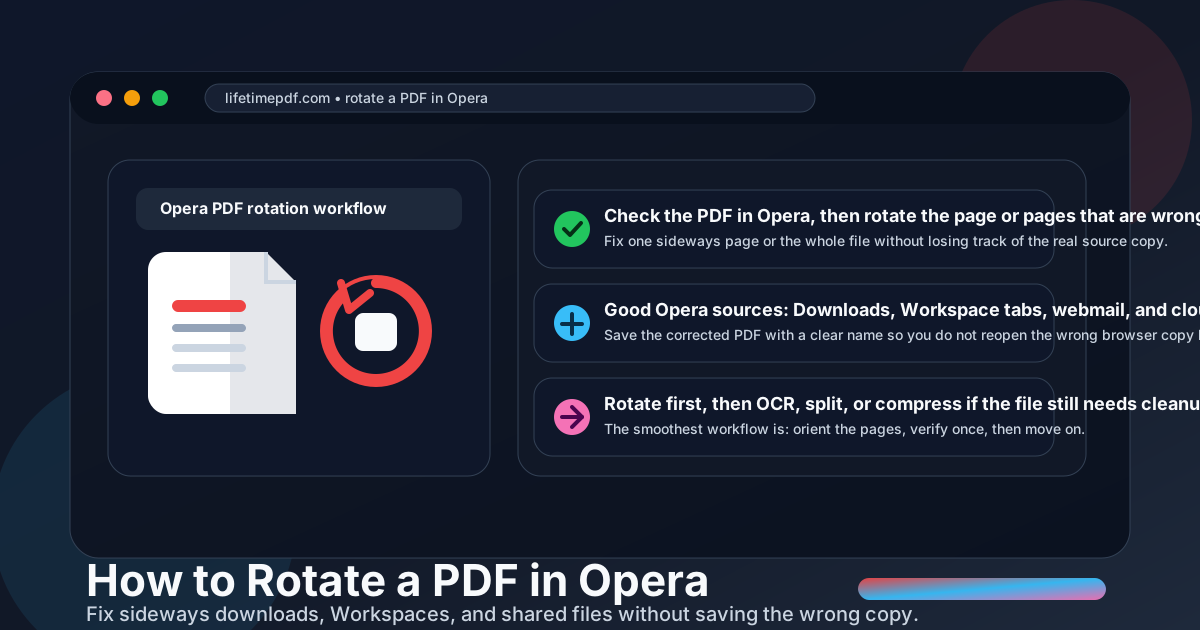
If the PDF is already open in Opera and you mainly want the direct workflow, this is the cleanest route for most files:
- Open the exact PDF in Opera and confirm whether one page or the whole file is facing the wrong way.
- Open Rotate PDF in Opera.
- Choose the file from Downloads, a saved webmail attachment, an Opera Workspace workflow, Google Drive, Dropbox, OneDrive, or another real source location.
- Rotate the wrong page or pages by 90°, 180°, or 270°.
- Download the corrected PDF with a clear filename like contract-upright.pdf or scan-rotated.pdf.
- Open that saved copy once in Opera before you upload, send, or share it anywhere.
What Opera can and cannot do with a sideways PDF
Opera is a good place to notice the problem because a lot of PDFs reach it first through downloads, a webmail attachment preview, a shared Drive link, or a document left open in a Workspace tab. That makes Opera a practical front door for PDF work.
Opera is useful for opening the file, confirming whether one page or the whole document is wrong, zooming in to see if the text reads naturally, and checking the corrected version after you save it. Where Opera alone becomes less helpful is when you need the fix to persist across the exact file you will actually upload or send.
The simplest way to think about it is this:
- Opera viewer: good for spotting the orientation problem.
- Rotate PDF workflow: better for saving the corrected file cleanly.
- OCR after rotation: useful if the PDF is a scan and the text is still not searchable.
- Compression or extraction later: worth doing only after the page direction is fixed.
In practice, Opera works best when you use it to keep the workflow organized, not when you expect one open tab to solve every PDF problem by itself.
| Situation | Best Opera-friendly option | Why it usually works better |
|---|---|---|
| You only need to confirm the PDF is sideways | Opera's built-in PDF viewer | Fastest way to inspect the file before changing anything. |
| You need a corrected file you can save and send | Rotate PDF in Opera | Keeps the fix attached to a new saved copy instead of a temporary browser view. |
| The PDF is a scan and text still is not searchable | Rotate first, then OCR | Upright pages usually give OCR cleaner source material. |
| You only need a few corrected pages | Rotate first, then extract or split pages | It is easier to choose the right pages once they read the right way. |
Step-by-step: rotate a PDF from Downloads, Workspaces, webmail, or cloud storage
1) Start from the real source file
This matters more in Opera than people expect. It is easy to keep one PDF pinned in a Workspace, open another copy from Gmail or Outlook, preview a cloud version in another tab, and then rotate the wrong file. If the document matters, pause for a moment and decide which copy is the real source before you do anything else.
2) Check whether one page or the whole file is wrong
Sometimes only one page is sideways because it came from a scanner, phone camera, or pasted receipt. Other times every page is rotated because the entire document was exported or scanned in the wrong orientation. Knowing the difference first prevents over-fixing the document.
3) Open Rotate PDF in Opera
Use Rotate PDF in an Opera tab so you can correct the actual file and save a fresh corrected copy. This keeps the whole workflow in the browser without depending on a preview state that is easy to confuse with another tab.
4) Choose the PDF from the right source
Most Opera rotation jobs start from one of these places:
- Downloads after a browser save
- Workspace tabs where the PDF has been sitting open while you compare other files
- Webmail attachments that were previewed and then downloaded
- Cloud storage files from Dropbox, Google Drive, or OneDrive that need a corrected downloadable version
Pick the file you actually want to keep. Do not assume the newest tab, the left-most Workspace item, or the latest download is automatically the right one.
5) Use the right angle: 90°, 180°, or 270°
Most sideways pages need a quarter turn, but not always. A page that is sideways usually needs 90° or 270°. A page that is upside down needs 180°. The easy rule is to stop when the text reads naturally and the page order still makes sense.
6) Download the corrected file and check it once
After the rotation is done, save the corrected PDF with a fresh, obvious name and reopen that exact file once in Opera. This is the step that prevents the classic mistake where the fix worked fine but the original download is the one that gets uploaded later.
Clean sequence: open the real file in Opera → rotate the wrong page or pages → save the corrected copy with a clear name → reopen it once → only then upload, send, print, or continue editing.
Rotate one page vs the whole file in Opera
This is where a clean Opera workflow saves the most time. If only one page is wrong, rotating the whole document just creates a different problem. If every page is wrong, fixing them one by one wastes effort.
Rotate one page when you are dealing with:
- a single receipt inside a larger PDF
- one sideways signature page in a contract
- a mixed scan where only one sheet was fed in incorrectly
- one photo-based page added to an otherwise normal document
Rotate the whole file when:
- every page opens sideways in Opera
- the entire document came from a phone scan the wrong way
- a scanner exported the whole file in the wrong orientation
- an upside-down archive PDF needs one full correction
If you are unsure, fix the first affected page, scan the rest quickly, and then decide whether the whole PDF needs the same change.
How to save the corrected PDF without version mix-ups
Opera makes it very easy to create duplicates without meaning to. A file can exist as a Workspace tab, a webmail preview, a cloud tab, and two nearly identical Downloads copies. The rotation itself is simple. Keeping the final version straight is where people usually trip up.
Use a filename that tells the truth
Avoid names like final.pdf or document-new.pdf if there are already several copies around. Better names are things like invoice-rotated.pdf, lease-upright.pdf, or application-corrected.pdf.
Reopen the corrected file once
Before you share anything, open the saved corrected copy in Opera one time. That quick check catches wrong-angle saves, full-file rotation when you meant to rotate one page, and the common mistake where you thought you saved the fix but reopened the older download.
Keep the original only if you need it
If the PDF is important, keeping the original can be smart. Just make the corrected version visibly different so you never wonder which file is safe to send.
| If this happens in Opera | What to do |
|---|---|
| You have the same PDF open in a Workspace tab and in Downloads | Choose one real source, rotate that copy, and rename the result immediately. |
| You fixed a webmail preview but still sent the older downloaded file | Reopen the saved corrected PDF once before you attach or upload it anywhere. |
| You are not sure which copy is newest | Check the source location and filename first, then save the corrected version with a clear new name. |
Common Opera problems and quick fixes
The PDF still looks sideways after I saved it
Usually the wrong page was rotated, the wrong angle was used, or the corrected file was saved but the original download was reopened by mistake. Open the corrected file directly and verify the filename before assuming the rotation failed.
I fixed the wrong duplicate from a Workspace tab or cloud storage
That is a source-file problem, not a rotation problem. Go back, identify the real file, then rotate that copy and save it with an unmistakable name.
The pages are upright now, but the text still is not selectable
That means you are dealing with a scan. Rotation fixes page direction, not searchability. Run OCR PDF next if you need the document to behave like searchable text.
The PDF is upright, but it is too large to upload or email
Once the orientation is fixed, use Compress PDF. It is usually better to rotate first and compress second, so you know the layout issue is actually solved before you optimize file size.
I only need some of the corrected pages
Rotate first, then use Extract PDF Pages or Split PDF. Once the pages are upright, it is much easier to judge which ones belong in the final file.
What to do after the PDF is upright again
After the file reads the right way in Opera, the next step depends on what the document actually needs:
- Need searchable text? Run OCR PDF.
- Need to send it by email? Use Compress PDF if the file is too large.
- Need only part of the document? Use Extract PDF Pages after the pages are facing correctly.
- Need to keep working in the browser? Continue with how to edit a PDF in Opera or how to OCR a PDF in Opera.
The smoothest order is usually: fix orientation first, verify once, then do the next cleanup step only if it is still necessary.
Practical rule: rotate first, verify once, then move on to OCR, compression, splitting, or other cleanup only if the file still needs it.
Related LifetimePDF tools and guides
Rotating a PDF in Opera often leads into one or two nearby cleanup steps. These are the most useful companions:
- Rotate PDF — fix sideways or upside-down pages in the browser.
- OCR PDF — make a rotated scan searchable and selectable.
- Extract PDF Pages — pull only the pages you actually need after rotation.
- Split PDF — separate sections once the orientation is correct.
- Compress PDF — shrink the corrected file before uploading or emailing it.
Related reading on LifetimePDF: how to OCR a PDF in Opera, how to split PDF in Opera, how to edit a PDF in Opera, how to watermark a PDF in Opera, and how to rotate a PDF on Windows.
FAQ: How to rotate a PDF in Opera
Can I rotate a PDF directly in Opera?
Opera is excellent for opening a PDF and checking which pages are wrong, but the cleanest way to save a corrected copy is usually a browser-based Rotate PDF tool opened in Opera.
Can I rotate only one page in a PDF in Opera?
Yes. If only one page is sideways, rotate just that page and leave the rest of the document untouched. That is especially useful for mixed scans, receipts, and signature pages.
Why is my PDF still sideways after I save it from Opera?
Usually the wrong page was rotated, the original download was reopened instead of the corrected copy, or the file was saved with a confusing name. Reopen the saved corrected PDF once before you share it.
Should I rotate a scanned PDF before OCR in Opera?
Yes. Rotating first usually gives OCR cleaner source material because the text is already facing the correct direction before recognition starts.
What if the PDF came from Downloads, a Workspace tab, or shared cloud storage?
Start from the real source file, not a duplicate browser tab, stale preview, or older download. Save the corrected PDF with a clear name so the fixed version is obvious the next time you open Opera.
Published by LifetimePDF — Pay once. Use forever.