How to Delete Pages from a PDF on Linux: Remove Blank Scans, Extra Attachments, and Old Pages Without Installing Another Editor
To delete pages from a PDF on Linux, open a browser-based Delete Pages tool in Firefox or Chrome, choose the file from your file manager, Downloads, a saved Thunderbird attachment, or a shared folder, remove the pages you do not want, save the cleaned PDF, and open it once before sharing.
If you only need one kept section rather than one cleaned full document, Extract Pages is usually the better Linux workflow.
That is the short answer. The useful part is avoiding the real Linux mess: editing the wrong copy from Downloads, trusting the printed page numbers instead of the actual PDF index, or saving a cleaned file with a name so vague that you attach the original full packet five minutes later. A good Linux routine keeps the cleanup simple, reversible, and easy to verify.
Fastest path: save the source PDF somewhere obvious, open LifetimePDF's Delete Pages tool in Firefox or Chrome, remove the extra pages in one pass, then save the cleaned copy with a filename that clearly separates it from the original.
In a hurry? Jump to Quick start: delete PDF pages on Linux in a few minutes.
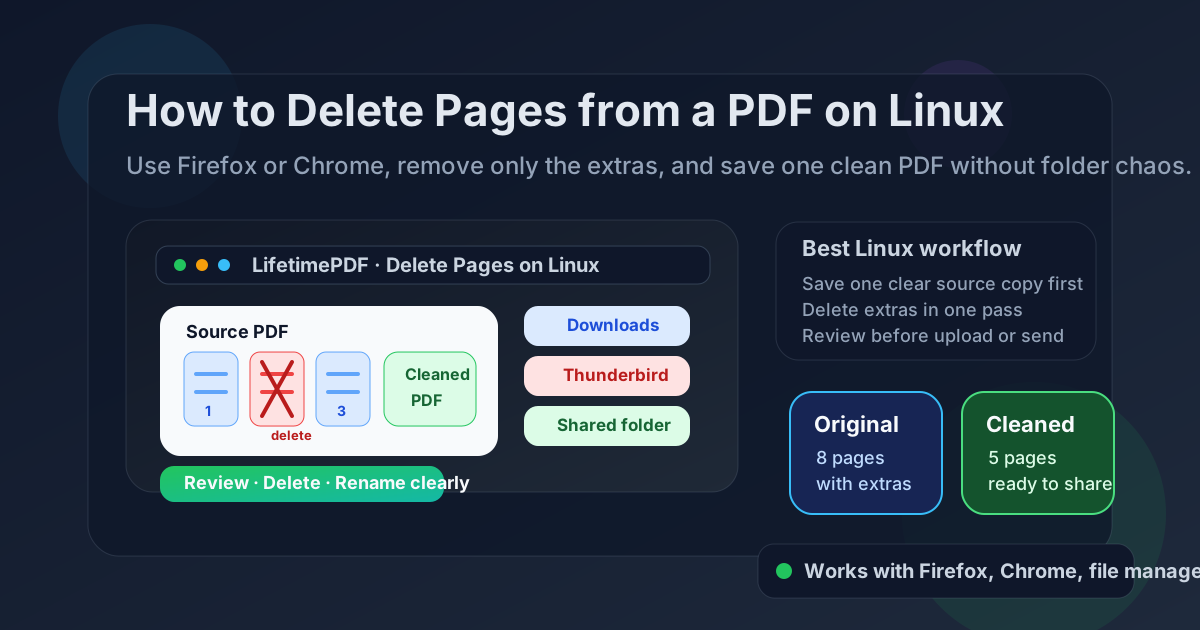
Table of contents
- Quick start: delete PDF pages on Linux in a few minutes
- The easiest Linux workflow for deleting pages
- Step-by-step: remove the pages you do not need
- Delete pages vs extract pages vs split PDF on Linux
- Working with Downloads, Thunderbird, file managers, and shared folders
- Best Linux use cases for page cleanup
- Common Linux problems and quick fixes
- Quality, privacy, and file-handling tips
- Related LifetimePDF tools and guides
- FAQ (People Also Ask)
Quick start: delete PDF pages on Linux in a few minutes
If you already know which pages should go, this is the fastest practical workflow:
- Open Delete Pages in Firefox or Chrome on Linux.
- Choose the PDF from Downloads, your home folder, a saved Thunderbird attachment, or a shared project folder.
- Check the real PDF page numbers before you remove anything.
- Delete the unwanted pages or ranges in one pass.
- Save the cleaned PDF with a clear filename and open it once to confirm the result.
The easiest Linux workflow for deleting pages
Most Linux PDF cleanup jobs move through three places: where the file first arrived, the folder where you keep it, and the browser tab where you actually clean it up. The smoothest delete-pages workflow uses each one for what it does best.
- Thunderbird, webmail, a portal, or a synced workspace is usually where the PDF first lands.
- Your file manager is where you keep the original and save the cleaned version with a name that still makes sense later.
- Firefox or Chrome is where you actually remove the pages without turning a small cleanup job into a bigger editing project.
This is where Linux users usually get tripped up. One copy is in Downloads. Another is still attached in Thunderbird. A third is in a shared folder that already contains older revisions with nearly identical names. If you clean up the wrong source, the result can still be wrong even if the page removal itself worked perfectly.
A calmer Linux routine is simply save, confirm, remove, save again, check, send. That sequence works whether you use Ubuntu, Debian, Fedora, Mint, or another desktop because the real issue is not the distro. It is file clarity.
Step-by-step: remove the pages you do not need
Here is the most dependable Linux workflow when the goal is to clean up a PDF, not rebuild it.
1) Save the PDF somewhere easy to find again
If the document came from Thunderbird, webmail, Slack, a client portal, or a synced folder, save it to a clear location first. Working from a stable saved copy is less risky than hopping between attachment previews, temporary downloads, and background sync folders.
2) Open Delete Pages in Firefox or Chrome
Open LifetimePDF Delete Pages in Firefox or Chrome and upload the file from your file manager. This is the point where you should decide whether you want one cleaned version of the original or whether you really only need one kept section.
3) Confirm the real PDF page index before deleting anything
This is the step that prevents most mistakes. The page number printed inside a footer may not match the PDF's actual page index. Cover pages, title pages, divider pages, and scanner separator sheets can shift the numbering by one or more pages.
4) Remove the extra pages in one pass
Delete the blank scan pages, duplicate attachments, outdated cover sheets, old exhibits, internal notes, or irrelevant appendix pages in one batch if possible. Doing the whole cleanup at once is easier than reopening the file several times and wondering which version is newest.
5) Save the result with a filename that makes the difference obvious
Avoid names like report-final-new2.pdf. Better names are things like proposal-cleaned.pdf, contract-without-appendix.pdf, or invoice-packet-trimmed.pdf. On Linux, a good filename is not cosmetic. It is how you avoid uploading the wrong file later.
6) Open the cleaned PDF once before you share it anywhere
Give the result a quick review. Make sure the right pages are still there, the order still makes sense, and you did not remove something that looked disposable but was actually important.
Useful Linux habit: keep the original untouched until the job is fully done. Edit the copy, review the copy, then send the copy.
Delete pages vs extract pages vs split PDF on Linux
These three workflows sound similar, but they solve different problems. Picking the right one saves time and avoids messy results.
| Tool | Best when | Typical Linux use case |
|---|---|---|
| Delete Pages | The PDF is mostly correct and you only need to remove a few unwanted pages. | Remove blank scans, a cover sheet, duplicate attachment pages, or one appendix before sharing. |
| Extract Pages | You only want to keep one specific section of the document. | Keep pages 5-8 from a long packet and ignore everything else. |
| Split PDF | You want several separate output files rather than one cleaned copy. | Break one long packet into invoices, exhibits, approvals, or team-specific sections. |
A simple way to choose: if you are thinking remove these few pages, use Delete Pages. If you are thinking keep only these few pages, use Extract Pages. If you are thinking break this file into parts, use Split PDF.
That distinction matters on Linux because it prevents unnecessary file clutter in your folders and reduces the chance that you create three extra outputs when you only needed one cleaner copy.
Working with Downloads, Thunderbird, file managers, and shared folders
The delete step itself is easy. Source confusion is the real Linux problem. One copy is in Downloads. Another came from Thunderbird. A third lives in a shared folder or a synced directory. If you clean the wrong source, the final file will still be wrong.
The safest habit is to save the source PDF first, then edit that copy. That gives you one reliable starting point and makes the cleaned output easier to name and compare.
- Thunderbird: save the attachment first if you are not completely sure which copy is current.
- Downloads: rename the source if the folder is full of duplicates like report.pdf, report (1).pdf, and report-final.pdf.
- File managers: use list view or sort by date modified when filenames are too similar.
- Shared folders: confirm you are editing the current version, not an older synced copy.
- Scanner exports: keep the raw scan until you verify the cleaned version in case one page removal was a mistake.
Clear names reduce the chance that you send the full confidential packet when you meant to send only the cleaned version.
Best Linux use cases for page cleanup
Deleting pages from a PDF on Linux is most useful when the document is technically correct but practically too broad.
- Scanned office packets: remove blank separator pages or duplicate scans before archiving.
- Contracts and proposals: drop outdated exhibits, unused pricing pages, or internal review notes before forwarding.
- Expense and reimbursement files: keep the receipts that matter and remove unrelated pages from a combined packet.
- Client deliverables: trim internal comments, instructions, or support pages before sending the final file.
- Upload portals: send only the version the portal expects instead of a bloated packet with unnecessary pages.
- Privacy and compliance work: keep unrelated addresses, signatures, or personal data out of documents that are leaving your machine.
In all of those cases, the benefit is not just tidiness. It is clarity and risk reduction. A cleaner PDF is easier for the next person to review and less likely to reveal information that never needed to be shared.
Common Linux problems and quick fixes
The printed page numbers do not match what I expected
This is the most common mistake. Ignore assumptions and check the actual PDF page position before deleting anything. If the file starts with a cover page or scan separator, the page labeled 1 inside the document may not be page 1 in the file.
I deleted pages from the wrong copy
That is usually a Downloads or sync-folder problem, not a delete-pages problem. Go back to the original source, confirm which file is current, and rename both the source and cleaned output more clearly.
I only need one signed page or one section
That is an extraction job. Use Extract Pages if the final result should be one small kept section instead of one cleaned version of the full document.
The PDF is still too large to send after deleting pages
Deleting a few pages helps, but not always enough. If the file still needs to fit an email or upload limit, run it through Compress PDF after the cleanup is complete.
I cannot tell which PDF is the final one
Save the cleaned copy with a clear suffix and keep the original untouched until the task is finished. On Linux, confusion usually comes from filenames and folder clutter, not from the page-removal step itself.
Quality, privacy, and file-handling tips
Deleting pages usually preserves the quality of the pages you keep, which is one reason it is better than taking screenshots or rebuilding the file from images. Still, a few habits make the finished PDF safer and cleaner.
- Review the final file once: especially if it contains signatures, dates, totals, or deadlines.
- Keep the original until the task is complete: it is your safety net if you remove the wrong page.
- Use clear filenames: this matters more than people think when Downloads, attachments, and sync folders all hold lookalike copies.
- Compress after cleanup, not before: get the content right first, then reduce the file size only if needed.
- Protect sensitive PDFs when appropriate: if the cleaned file still contains private information, use Protect PDF before storing or sending it.
Related LifetimePDF tools and guides
If your Linux PDF job turns into something slightly different, these are the next useful options:
- Delete Pages for removing extra pages from the full document
- Extract Pages when you only want one section
- Split PDF when one document needs to become several files
- Compress PDF after cleanup if the file is still too large
- How to extract pages from PDF on Linux
- How to split PDF on Linux
- How to merge PDFs on Linux
- How to scan to PDF on Linux
Want the simplest Linux workflow? Open Delete Pages in Firefox or Chrome, remove the extras, then keep LifetimePDF handy for extract, split, merge, compress, and protect jobs too.
FAQ (People Also Ask)
How do I delete pages from a PDF on Linux without installing another app?
Open a browser-based Delete Pages tool in Firefox or Chrome on Linux, choose the file from your file manager, Downloads, Thunderbird, or a shared folder, remove the pages you do not want, save the cleaned PDF, and open it once before sharing. That is usually the fastest no-install workflow on Linux.
What is the difference between delete pages and extract pages on Linux?
Delete pages removes unwanted pages and keeps the rest of the original PDF. Extract Pages creates a new PDF containing only the pages you want to keep. Extraction is usually better when only one section matters.
Can I remove blank scans and old attachment pages from a PDF on Linux?
Yes. Deleting pages is one of the most useful Linux cleanup jobs for blank scan pages, duplicated attachment pages, outdated cover sheets, internal notes, and other extras that should not stay in the final file.
Will deleting pages reduce PDF quality on Linux?
Usually no. Deleting pages normally preserves the quality of the pages you keep because you are removing pages rather than converting the rest of the document into screenshots.
Why do the printed page numbers not match the page positions in the PDF?
Cover pages, title pages, and scan separators often shift the numbering. The page labeled 1 inside the document may actually be page 2 or 3 in the PDF file, so always check the real PDF index before deleting anything.