How to Check PDF Headings on Windows: Acrobat, Edge, and Fake Bold Text Before You Share
To check PDF headings on Windows, open the final file, confirm it has selectable text, and review whether the document uses a real H1, H2, and H3 hierarchy instead of big bold text that only looks organized.
If the structure is weak, skipped, or inconsistent, the cleanest fix is usually to repair the source file and export a better PDF before you share it.
That is the short answer. The useful Windows answer is that Edge preview, File Explorer thumbnails, and even a quick open in Acrobat can make a document look calmer than it really is. A report can feel polished on screen while still hiding fake headings, broken hierarchy, or section labels that fall apart as soon as someone navigates with assistive tech, extracts the text, or repurposes the file.
Fastest practical path: open the real Windows copy, confirm the text layer, check the heading hierarchy, compare the file with extracted or editable output, and only patch the PDF directly if you truly have no better source.
In a hurry? Jump to quick start: check PDF headings on Windows in about 7 minutes.
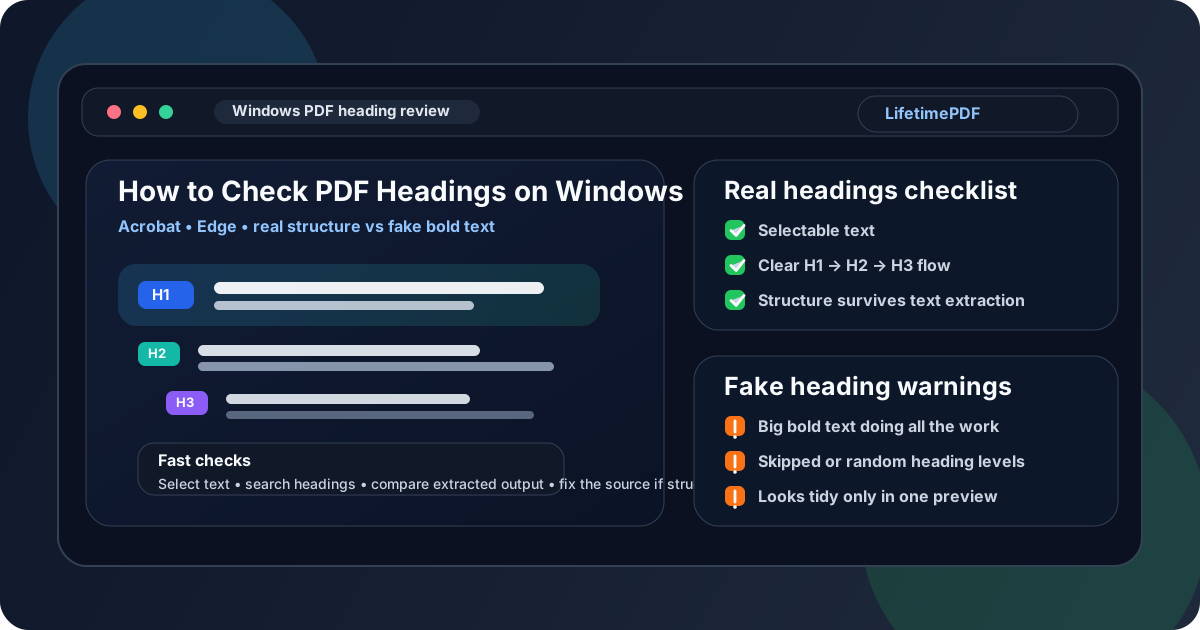
Table of contents
- Quick start: check PDF headings on Windows in about 7 minutes
- What you are really checking when you inspect PDF headings
- Where Windows users get misled
- Step-by-step: how to check PDF headings on Windows
- Warning signs that the PDF only looks structured
- When to fix the source versus patch the PDF
- Related LifetimePDF tools and guides
- FAQ
Quick start: check PDF headings on Windows in about 7 minutes
If your real goal is simply tell me whether this Windows PDF uses real headings or just good-looking formatting, use this order:
- Open the exact PDF you plan to submit, email, archive, upload, or publish from Downloads, OneDrive, Teams, Outlook, or a shared folder.
- Confirm you can select text and search for a visible heading. If not, the file may be a scan or weak OCR job and your heading review is starting from a broken foundation.
- Look at the major section titles and ask whether they form a believable hierarchy or simply use bigger bold text to fake structure.
- Compare the visual impression with PDF to Text or PDF to Word. If the structure gets muddy outside the page layout, the headings are weaker than they looked.
- Run a broader PDF accessibility check and compare what it surfaces with what you noticed manually.
- If the hierarchy is clearly weak, repair the source document and export a cleaner PDF instead of trusting the current Windows preview.
What you are really checking when you inspect PDF headings
Checking PDF headings on Windows is not just asking whether the section titles are large enough. The more useful question is whether the document has a real structural ladder that helps people navigate, understand, and reuse the file without guessing.
In practice, that means looking for three things:
- Logical hierarchy: the document has a clear H1, H2, and H3 flow instead of random jumps that confuse the reader.
- Real structure instead of styling: the headings do more than look bold or larger. They actually organize the document.
- Consistency under reuse: when the text is extracted, converted, or reviewed for accessibility, the section relationships still make sense.
Good outcome
Top-level sections are clear, subsections follow a believable pattern, and the structure still makes sense when the visual layout stops doing all the work.
Warning outcome
The PDF looks polished in Edge or Acrobat, but extracted text or accessibility review reveals vague sections, skipped levels, or random bold labels pretending to be headings.
Typical root cause
The source document relied on formatting instead of real structure, mixed content from several files, or came from a scan that never had healthy text to begin with.
Where Windows users get misled
Windows gives you several fast ways to glance at a PDF. That convenience is useful, but it also creates false confidence. A file can look organized in Microsoft Edge, Adobe Acrobat, Outlook preview, Teams, or a synced folder preview and still have weak heading structure underneath.
| Windows view | What it is good for | What it cannot safely prove |
|---|---|---|
| Edge browser preview | Fast first look at the actual pages and section labels. | That the big bold text is truly functioning as structured headings rather than decorative formatting. |
| Acrobat or another PDF app | Better file review, more document controls, and a stronger manual inspection workflow. | You still need to compare structure signals instead of assuming a clean-looking PDF equals a clean hierarchy. |
| Outlook, Teams, or SharePoint preview | Confirming the right file and checking whether the broad layout survived a handoff. | That section structure will make sense to screen readers, extracted text, or later editing workflows. |
| Text extraction or editable conversion | Revealing whether the sections still read like a structured document after the layout protection disappears. | It will not tell you the exact tagging mechanics, but it does expose whether the current structure is fragile. |
Step-by-step: how to check PDF headings on Windows
This workflow gives you a dependable answer without turning a simple Windows review into a full remediation project.
Step 1: Start with the real Windows copy
Make sure you are reviewing the exact file that will leave your machine. If the PDF sits in Downloads, OneDrive, an email attachment, or a shared folder, save or open the final copy directly rather than relying on a temporary preview card.
Step 2: Confirm the text layer before you judge the headings
A heading review depends on usable text. Try selecting a heading, searching for a visible word, or running PDF to Text. If the file acts like a picture, heading structure cannot be trusted until OCR PDF repairs the text layer.
Step 3: Inspect the major section pattern
Look at the top-level sections, then the subsections underneath them. Healthy documents usually reveal a pattern quickly: one main title, several major sections, then smaller nested sections where needed. Weak documents tend to show one of these Windows-friendly warning patterns instead:
- every section title is the same size and weight even when the content hierarchy is different,
- the document jumps from a major heading straight into body text without a stable subsection pattern,
- the same heading style means different things in different parts of the file,
- one imported section suddenly resets the structure or stops matching the rest.
Step 4: Compare the visual document with extracted or editable output
This is where many fake heading systems reveal themselves. Use PDF to Word or text extraction to see whether the sections still feel organized once the page design is stripped away. If the structure becomes muddy, repetitive, or unexpectedly flat, the Windows preview was doing more of the organizational work than the PDF itself.
If you want the broader non-platform explanation too, the companion guide Check PDF Headings goes deeper into the underlying logic.
Step 5: Use adjacent accessibility checks when the answer is still fuzzy
Headings do not live alone. If the document also has trouble with tags, reading order, lists, tables, or the title, that often confirms the headings are only part of a broader structure problem. On Windows, these related checks are usually the most useful companions:
- PDF Accessibility Checker for the broad structural picture,
- How to Check if a PDF Is Tagged on Windows if the file feels visually polished but structurally hollow,
- How to Check PDF Accessibility on Windows when headings are only one part of a larger review.
Step 6: Decide whether the fix belongs in the PDF or the source
If the structure is weak across the document, the best Windows move is usually not heroic patchwork inside the final PDF. It is repairing headings in Word, Docs, PowerPoint, HTML, or another editable source, then exporting a cleaner final file.
Reliable sequence: open the real Windows copy, verify the text layer, review hierarchy, compare extracted output, then rebuild the source if the PDF depends on styling instead of structure.
Warning signs that the PDF only looks structured
These are the patterns that matter most in real Windows workflows, especially when documents are moving through email, collaboration tools, or compliance review.
| What you notice | What it usually means | Best next move |
|---|---|---|
| Every section title looks bold but equally important | The file may be styling headings visually without a meaningful hierarchy. | Compare the structure in extracted or editable output and rebuild the source if needed. |
| The document jumps from major sections straight into body text | Intermediate levels may be missing or inconsistently applied. | Review the original document outline and repair heading levels upstream. |
| One inserted section feels structurally different | The PDF may be a mixed-source file with imported pages or templates. | Normalize the source sections before exporting again. |
| The preview looks fine, but extracted text feels flat or messy | The layout is masking weak structure. | Treat the problem as real and stop trusting the visual preview alone. |
| The file is scanned and headings cannot be selected | The PDF lacks a healthy text layer or the OCR is too weak to support structure checks. | Run OCR first, then reassess the hierarchy. |
Healthy default
If the PDF only feels well-organized inside one Windows preview path and starts making less sense anywhere else, the heading structure is probably not healthy enough yet.
When to fix the source versus patch the PDF
Not every structure problem deserves the same response. The practical question is whether the PDF is close enough to healthy that a light repair makes sense, or whether the source file is the only sane place to fix it.
Patch lightly or leave the PDF alone when
- the structure is broadly logical and you only need a minor cleanup,
- the headings remain meaningful in extracted or editable output,
- the file is already near the end of a workflow and the source is unavailable,
- you are fixing one small inconsistency rather than rescuing a broken hierarchy.
Fix the source and re-export when
- large bold text is doing all the organizational work,
- heading levels are skipped, repeated randomly, or inconsistent,
- multiple sections came from different documents or templates,
- the PDF is scanned or badly OCRed,
- the document will be reused, published, archived, or reviewed for accessibility seriously.
My practical opinion: if the document matters to more than one reader, more than one device, or more than one workflow, fixing the source once is usually cheaper than pretending a weak export will somehow age gracefully.
FAQ
How do I check PDF headings on Windows?
Open the final PDF on Windows, confirm the file has selectable text, then review whether the section titles form a logical H1, H2, and H3 hierarchy instead of only using bold styling. If the answer is unclear, compare the file with extracted text or an editable conversion.
Can Microsoft Edge prove that a PDF has real headings?
No, not by itself. Edge is useful for a quick visual pass, but it cannot prove that visually large section titles are real structural headings. That is why extracted text, accessibility checks, and source-file review still matter.
What is the fastest sign of weak heading structure on Windows?
The fastest signs are repeated bold titles with no believable nesting, skipped heading levels, structure that resets mid-document, or a PDF that looks tidy visually but reads like a flat wall of text once extracted.
Should I OCR a scanned PDF before checking headings?
Usually yes. If the file is image-only or the OCR is weak, you cannot judge the heading structure confidently because the PDF does not yet behave like a healthy text document.
Is it better to fix PDF headings in the PDF or in the source file?
If you still have the source file, fix the headings there first. A clean Word, Docs, PowerPoint, or HTML source usually exports a much better PDF than repeated after-the-fact repair on the final file.
Published by LifetimePDF — Pay once. Use forever.