How to Check if a PDF Is XFA on Chromebook: Chrome, Files, and Adobe-Only Form Clues
To check if a PDF is XFA on Chromebook, save the exact file into Files, open it in Chrome or the built-in viewer, then compare that same copy with a fuller form viewer if one is available and watch for missing fields, broken buttons, or layout that only works in the stronger viewer.
If the form behaves normally in the fuller viewer but loses interactivity in Chrome, Drive preview, Gmail, Classroom, or browser upload flows, it is very likely an XFA form rather than a standard fillable PDF.
That difference matters because Chromebook users often meet XFA at exactly the wrong moment: a school form opens but will not really submit, a client PDF looks fine until the fields vanish in Chrome, or a browser portal accepts the document and then strips the live form behavior. A fast comparison between the preview you actually use and the viewer the form depends on usually tells you whether the safe move is to keep using the original workflow, flatten the finished document, or rebuild the form into something more portable.
Fastest path: save one clean Chromebook copy, test it in Chrome or Files first, then compare the same file in a fuller form viewer if you have one. If the stronger viewer works and the lighter Chromebook path does not, treat that as a major XFA clue.
Need the short version? Jump to quick start: tell if a Chromebook PDF is XFA in about 5 minutes.
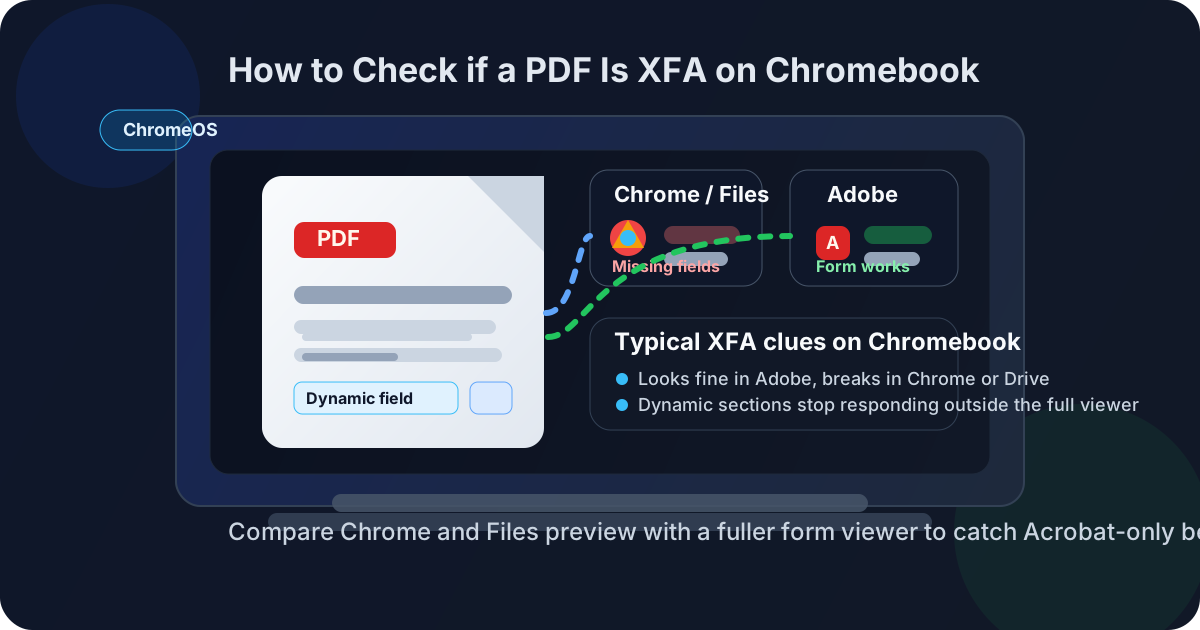
Table of contents
- Quick start: tell if a Chromebook PDF is XFA in about 5 minutes
- What XFA usually looks like on Chromebook
- The strongest Chromebook-side signs a PDF may be XFA
- Step-by-step: compare Chrome, Files, Drive, and a fuller viewer
- XFA vs AcroForm vs flat PDF on Chromebook
- What to do if the file really is XFA
- Mistakes that waste time during a Chromebook check
- Related LifetimePDF tools and guides
- FAQ
Quick start: tell if a Chromebook PDF is XFA in about 5 minutes
If you want the fastest reliable answer, do this:
- Save the PDF out of Gmail, Drive preview, Classroom, or a browser tab and open the actual file from Files.
- Test the saved copy in Chrome or the built-in Chromebook path most people around you will actually use.
- If your Chromebook has access to a fuller form viewer, open the same file there and compare the fields, buttons, dropdowns, and page layout.
- Run one real fill-save-reopen cycle instead of only clicking the first field.
- If the fuller viewer works but Chrome, Files, Drive preview, or the upload step breaks, assume the file is probably XFA and plan the rest of the workflow carefully.
What XFA usually looks like on Chromebook
XFA stands for XML Forms Architecture. In practical Chromebook terms, it usually means you are dealing with a form that behaves more like a small application than a plain document. Fields may appear or disappear, sections may expand, calculations may run, and the file may depend on a stronger PDF engine than the one behind everyday browser or cloud previews.
Chromebook adds one extra twist: many people meet the same PDF through completely different routes. One person opens it from Chrome, another from Files, another from Google Drive preview, another from Gmail, and another through a school or work portal. That is exactly why XFA feels inconsistent. The file is not always broken everywhere. It is simply less portable than a standard AcroForm PDF.
| Chromebook situation | What it often means | What to do next |
|---|---|---|
| A fuller form viewer works, Chrome does not | A strong sign the form depends on viewer-specific behavior | Keep testing the same file in the real downstream workflow before you trust it |
| Fields vanish in Drive, Gmail, or Files preview | The form may be dynamic or unsupported outside a stronger PDF engine | Open the saved local copy and compare side by side with a fuller viewer if possible |
| Layout grows, collapses, or rearranges itself | Dynamic XFA behavior becomes more likely | Complete it only in the intended viewer or rebuild the form |
| Upload, signing, or classroom handoff fails | The platform may not support XFA structure | Flatten a completed copy or rebuild the form as standard fields |
The strongest Chromebook-side signs a PDF may be XFA
No single symptom proves everything, but this pattern is usually enough to make a smart call quickly.
1) The stronger viewer works, lighter Chromebook previews do not
This is the biggest everyday clue. If the form behaves normally in a fuller PDF form viewer but drops fields or logic in Chrome, Files, Drive, Gmail preview, or a portal handoff, you are probably dealing with more than a standard AcroForm.
2) Chrome or Drive is misleading
The page can render well enough to fool you while the real form behavior is broken underneath. That gap between visible page content and working fields is a classic XFA warning sign.
3) The form is obviously dynamic
If sections appear, collapse, expand, or recalculate as you type, that is consistent with XFA-style behavior and deserves a deeper compatibility check.
4) A portal or signing workflow rejects it
A file that looks acceptable on a Chromebook can still fail once it hits an upload validator, browser-based signing step, or classroom submission flow.
Step-by-step: compare Chrome, Files, Drive, and a fuller viewer
The safest Chromebook check is not theoretical. It follows the actual path your PDF will take. You are trying to learn whether the file is a portable form or a viewer-dependent one.
1. Save the real file locally before you test
Do not judge the PDF from Gmail preview, Drive preview, or a browser tab alone. Save it into Files first. That removes one common source of confusion: sometimes the preview layer is the problem, not the form itself.
2. Test the copy in Chrome or the built-in path first
Chromebook users often rely on what opens fastest. That makes the lighter local path important. Try a few real actions: click a text field, change a dropdown, tick a checkbox, or test one button if the file uses them. You are building a baseline for what the common Chromebook experience looks like.
3. Compare the same file in a fuller form viewer if one is available
If your Chromebook can open the file in a stronger PDF form viewer, use that as the comparison point. If the fields, dynamic sections, save behavior, or page layout work there but not in Chrome or Files, that difference tells you far more than a hidden metadata label ever will.
If you do not have a fuller viewer on the Chromebook itself, compare the lighter Chromebook result with the actual downstream step that matters most: the upload portal, the signing flow, or the viewer the sender told you to use. You are still looking for the same pattern of selective compatibility.
4. Check one real cloud or browser touchpoint
If the file will travel through Drive, Gmail, Classroom, or a browser upload portal, test that too. XFA problems often show up when the PDF leaves the stronger viewer and enters the exact workflow a Chromebook user reaches for by habit. If the form appears in one place but not another, the document is not broadly portable.
5. Reopen the file after saving
Some forms fail only after a save cycle. Enter test data, save the PDF, close it, and reopen it in the lighter Chromebook path and, if possible, the fuller viewer. If values vanish, buttons stop working, or the file only preserves data in one environment, you have learned something important about the form's portability.
A reliable Chromebook sequence
- Save the file in Files.
- Test it in Chrome or the built-in viewer.
- Compare it in a fuller form viewer if available.
- Save and reopen once.
- Test Drive, Gmail, Classroom, or the real upload step if it matters.
What counts as a real XFA clue
- Unsupported-form warnings
- Missing or dead fields outside the fuller viewer
- Layout reflow or expanding sections
- Portal or signing failure after viewer success
- Different save behavior between paths
Need a quick form-safe cleanup? If the goal is to deliver the completed result rather than preserve live field behavior, flattening the finished copy is usually safer than hoping every Chromebook recipient supports XFA.
XFA vs AcroForm vs flat PDF on Chromebook
Many Chromebook frustrations disappear once you identify which kind of document you actually have. These three categories behave very differently.
| PDF type | What it feels like on Chromebook | Best next move |
|---|---|---|
| XFA form | May work in a stronger viewer but lose fields, logic, or layout in Chrome, Drive preview, or browser-based workflows. | Complete it in the intended viewer, then flatten or rebuild if portability matters. |
| Standard AcroForm PDF | Usually travels better across ChromeOS, browsers, and upload flows, even if not every viewer is perfect. | Keep it if it behaves consistently in the real workflow. |
| Flat PDF | Looks like a form but behaves like a printed page or image. | Use a form filler, add fields, or OCR it if the problem is actually a scan. |
What to do if the file really is XFA
Once the Chromebook check points to XFA, the next step depends on what you actually need. The safest answer is not always “convert everything.” Sometimes the right move is simply to finish the form in the environment it expects and stop there.
If you only need to submit the form
If you own the workflow
For many teams, the practical fix is not force every Chromebook preview to support everything. It is stop handing lightweight browser and classroom workflows a form structure they were never meant to carry well. If the document must travel widely, portability beats cleverness.
Mistakes that waste time during a Chromebook check
- Trusting the preview layer: Gmail, Drive, Files, and browser previews are convenient, but they are not a full form audit.
- Testing only one field: some XFA problems show up only after save, submit, reopen, or upload steps.
- Assuming every Chromebook uses the same PDF path: the way a user opens the file matters almost as much as the file itself.
- Sending the live XFA file to everyone: if the recipient only needs the completed result, a flattened copy is often safer.
- Blaming ChromeOS itself: the bigger issue is usually viewer support and workflow design, not the operating system alone.
Related LifetimePDF tools and guides
If the XFA check shows a portability problem, these are usually the most useful next steps:
Bottom line: on Chromebook, the fastest trustworthy XFA check is a side-by-side behavior check between Chrome or Files and a fuller form viewer, followed by one real save/reopen or upload test.
FAQ
How do I check if a PDF is XFA on Chromebook?
Save the file locally, open it in Chrome or the built-in viewer, then compare the same PDF in a fuller form viewer if one is available. If the form behaves correctly only in the stronger viewer and breaks in Chrome, Files, Drive preview, or browser-based workflow steps, that is one of the strongest practical signs that it is XFA.
Can Chrome or the Files app show an obvious XFA label?
Usually not. On Chromebook, those tools are more useful as behavior tests than metadata labelers. If the form loses fields, save behavior, or layout there while a fuller viewer still works, the viewer comparison tells you more than a hidden technical tag would.
Does fuller-viewer-only behavior always mean XFA?
No, but it is a serious clue. Permissions, corruption, or bad JavaScript can also cause trouble, which is why you should compare the exact saved Chromebook copy across paths and test one full fill-save-reopen cycle.
What is the safest way to share a completed XFA form from Chromebook?
If the recipient only needs the finished result, flattening the completed copy is usually safer than assuming they have the same viewer support you used to complete it.
Should I rebuild an XFA form if my team uses Drive, Chrome, Gmail, Classroom, and browser portals a lot?
Usually yes. If the workflow depends on lightweight previews, browser upload portals, e-sign steps, or broad sharing, a standard AcroForm PDF is usually much easier to support than a viewer-dependent XFA form.
Published by LifetimePDF — Pay once. Use forever.