How to Check if a PDF Is Linearized on Windows: Fast Web View, Edge, and Acrobat Checks
To check if a PDF is linearized on Windows, open the file in Acrobat or Reader and look for Fast Web View, or test the real PDF URL in Edge and see whether page 1 starts rendering before the full file finishes downloading.
If Fast Web View is off or the live browser version still waits too long before showing page 1, the PDF is not properly optimized for web delivery and should be linearized before you publish or replace it.
That is the short answer. The practical answer is a little more specific: Windows users need to check the actual file, avoid cached browser results, and make sure they are testing the published copy rather than a convenient local copy that behaves differently from what visitors will open.
Fastest path: check Fast Web View in Acrobat first, then open the live URL in Edge InPrivate once. If the file still behaves like a full download, linearize the final copy and retest the published URL.
In a hurry? Jump to Quick start: the fastest Windows linearization check.
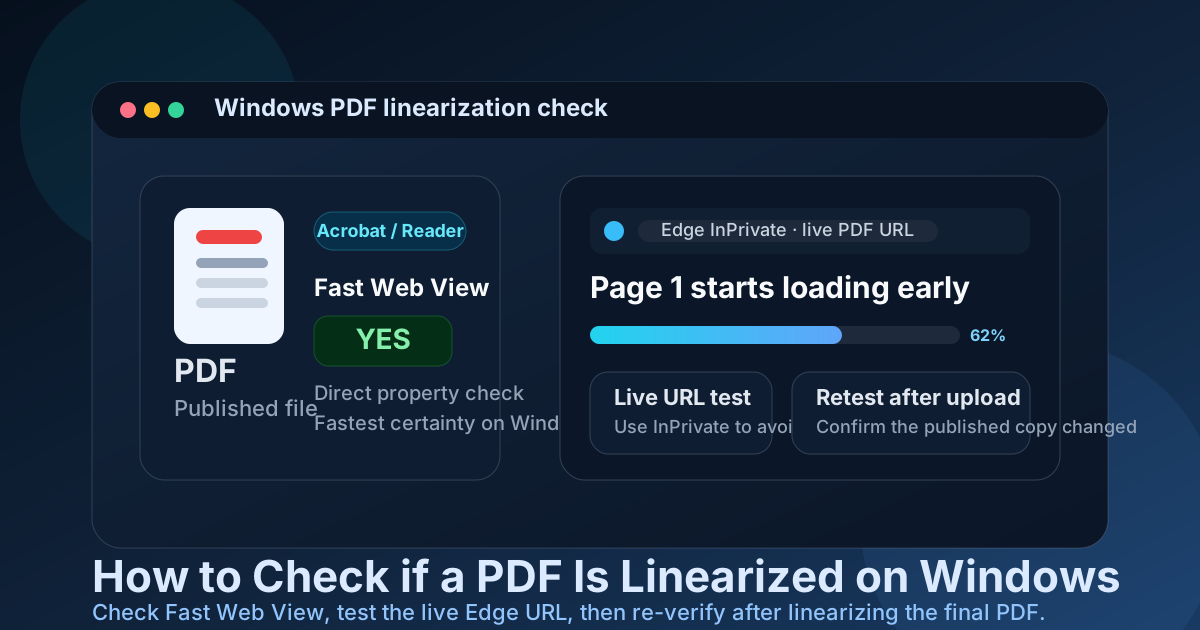
Table of contents
- Quick start: the fastest Windows linearization check
- What a linearized PDF means on Windows
- The best order to test it on Windows
- Method 1: check Fast Web View in Acrobat or Reader
- Method 2: test the live URL in Edge
- Compression vs linearization on Windows
- What to do if the PDF is not linearized
- Common Windows mistakes that give false confidence
- Related LifetimePDF tools and guides
- FAQ (People Also Ask)
Quick start: the fastest Windows linearization check
If your real goal is simply tell me whether this PDF is web-optimized, use this order:
- Save the exact PDF you plan to publish, replace, or test.
- Open it in Acrobat or Reader and check whether Fast Web View says Yes.
- If that field is not available, open the real web URL in an Edge InPrivate window.
- Watch whether page 1 appears while the rest of the file continues loading.
- If the browser seems to wait for too much of the file first, linearize the final PDF, re-upload it, and re-test once.
What a linearized PDF means on Windows
A linearized PDF is structured so the parts needed to show page 1 arrive early. That lets a browser begin rendering the opening page before the entire file is downloaded. On many systems, that status is labeled Fast Web View.
Windows users notice the difference most clearly when opening PDFs from websites, client portals, SharePoint-style document pages, knowledge bases, or LMS links. A non-linearized file can still open successfully, but it often feels sluggish because the first page waits too long. A linearized file feels more responsive because something useful appears earlier.
| File state | What Windows users usually notice | Best use case |
|---|---|---|
| Linearized PDF | Page 1 starts rendering sooner in a browser while later pages continue loading | Web-hosted manuals, policies, brochures, reports, classroom handouts |
| Non-linearized PDF | The browser may appear idle or wait longer before showing anything useful | Internal-only downloads where first-page speed does not matter much |
| Compressed but not linearized PDF | The file may be smaller but still feel slow to start in a browser | Storage savings without guaranteed browser speed improvement |
The best order to test it on Windows
The safest workflow is not to jump straight into one method and call it done. On Windows, you get the strongest answer by combining a direct property check with a real live-delivery check.
1. Acrobat or Reader
Best for a direct yes/no Fast Web View signal when your Windows viewer exposes that property.
2. Edge InPrivate live URL test
Best for seeing what a real visitor experiences instead of what your local cache already knows.
3. Re-test after optimization
Best for confirming the published replacement file is actually the improved one, not the old copy in disguise.
If the PDF will only ever be downloaded and stored locally, the browser step matters less. If the PDF will be opened directly from a link, the browser step matters a lot. That is why a Windows-only local test is helpful, but not always enough.
Method 1: check Fast Web View in Acrobat or Reader
This is the cleanest direct method when it is available to you. Open the PDF in Acrobat or Reader on Windows, then open the document properties. Many people use Ctrl+D as the fastest shortcut.
- Open the exact PDF file you plan to publish or replace.
- Open the document properties view.
- Look for a field named Fast Web View.
- If it says Yes, the PDF is linearized.
- If it says No, the file is not linearized.
- If the field is missing in your viewer, do not guess. Move to the live Edge test.
Why this works well
It gives you a property-level answer instead of a feeling-based answer. That is especially useful when a file is small enough to seem quick even though it is still not arranged for fast first-page delivery.
This method is strongest for local certainty. It tells you what the file is. It does not automatically prove that the web server, CDN, or published URL is serving the new version. That is why the next method still matters.
Method 2: test the live URL in Edge
If Windows users will open the PDF from the web, this is the behavior that matters. Open the actual published PDF URL in an InPrivate Edge window, not a tab that already cached the file earlier.
- Copy the real PDF URL, not a local file path.
- Open a fresh Edge InPrivate window.
- Paste the URL and load the PDF.
- Watch whether page 1 becomes readable while later pages are still loading.
- Compare the result again after you linearize and re-upload the file.
You are not trying to stage a lab-grade network benchmark here. You are looking for a practical difference in first-page behavior. If the PDF is large enough for linearization to matter, the contrast is often obvious.
| What you see in Edge | What it usually means | Next move |
|---|---|---|
| Page 1 appears quickly and the rest keeps loading | Good sign the PDF is linearized or at least browser-friendly | Confirm with Acrobat if you want a direct property check |
| Edge waits too long before showing anything useful | The PDF may not be linearized or the published version may still be the old file | Linearize the final copy, replace the published file, and retest |
| The result seems inconsistent across repeated tests | Cache, CDN delay, or mixed versions may be confusing the test | Use a fresh InPrivate session and verify the replacement file really propagated |
A common Windows trap
If you test the PDF in a normal Edge tab after opening it earlier, you may only be measuring cache luck. InPrivate or another truly uncached path is much closer to what a new visitor sees.
Compression vs linearization on Windows
These are not the same fix, and Windows users mix them up constantly. A smaller file can still be poorly arranged for browser delivery. A linearized file can still be too heavy because of giant images or bloated embedded content.
If your PDF is both large and slow, treat the two problems separately:
- Compression reduces how much data has to travel.
- Linearization changes the order of the data so page 1 can show up sooner.
In real workflows, both may be worth doing. If a Windows team is publishing long brochures, manuals, audit reports, or scanned packets, the smoothest result often comes from compressing first when needed, then linearizing the final finished copy.
What to do if the PDF is not linearized
Once you confirm the issue, do not optimize a random draft and hope it matches what goes live. Work from the final approved PDF.
That last recheck matters. Teams often do the optimization step correctly, then accidentally keep serving the old published file. The final browser re-test is what protects you from a false finish.
Common Windows mistakes that give false confidence
- Testing only a local file: the local copy may be optimized while the website still serves the old version.
- Trusting small size alone: a light file is not automatically linearized.
- Using a cached browser tab: Edge can make a slow file look fast after the first open.
- Linearizing the wrong copy: if the final export changed afterward, you optimized an outdated file.
- Ignoring the real use case: if users download the file and read it offline, browser-first speed matters less than when they open it directly from a link.
None of these are exotic technical failures. They are normal workflow mistakes, which is why a simple, repeatable Windows process is more useful than a vague definition of linearization.
Related LifetimePDF tools and guides
FAQ (People Also Ask)
How do I check if a PDF is linearized on Windows?
Open the PDF in Acrobat or Reader and check whether Fast Web View is set to Yes. If that field is not available, load the real published PDF URL in Edge InPrivate and see whether page 1 begins rendering before the full file finishes downloading.
Where is Fast Web View on Windows?
Many Windows users find it in Acrobat or Reader by opening the document properties, often with Ctrl+D, and then reading the Fast Web View field if the viewer exposes it. If your PDF viewer does not show that field, use a live browser-loading test instead of guessing.
Can Microsoft Edge tell me if a PDF is linearized?
Not directly in the same way Acrobat can, but Edge can still show the effect. When page 1 begins appearing quickly from the real web URL while later pages continue loading, that is a useful real-world sign the PDF is optimized for browser delivery.
Is a compressed PDF automatically linearized?
No. Compression reduces size; linearization changes internal page-delivery order. Many PDFs need one of those fixes, and some benefit from both.
Do I need Adobe Acrobat to check this on Windows?
No. Acrobat or Reader gives the clearest direct Fast Web View check, but a careful Edge InPrivate test against the real published URL is still useful when that property is not visible in your current Windows viewer.