How to Check if a PDF Has Layers on Mac: Preview, Acrobat, and Print-Safe Checks
To check if a PDF has layers on Mac, open the saved file in Acrobat or another full PDF app that exposes a Layers or Optional Content sidebar and see whether named content can be hidden or shown.
If you only open the PDF in Preview or Quick Look, treat that as a visual check, not final proof, because macOS previews often show the rendered result without exposing real layer controls.
That is the short answer. The useful part is knowing how to separate a convenient Mac preview from an actual layer check, how to tell layers apart from comments or form fields, and when it is smarter to flatten a delivery copy before you send the file to a client, printer, portal, or teammate. On Mac, layered PDFs often look perfectly normal until one viewer ignores hidden content, one upload flow simplifies the file, or one recipient sees a different version than you expected.
Fastest path: save one clear Finder copy, check for a real Layers sidebar in Acrobat, then flatten a separate delivery copy only if the PDF needs to behave the same way everywhere.
In a hurry? Jump to Quick start: confirm PDF layers on Mac in a few minutes.
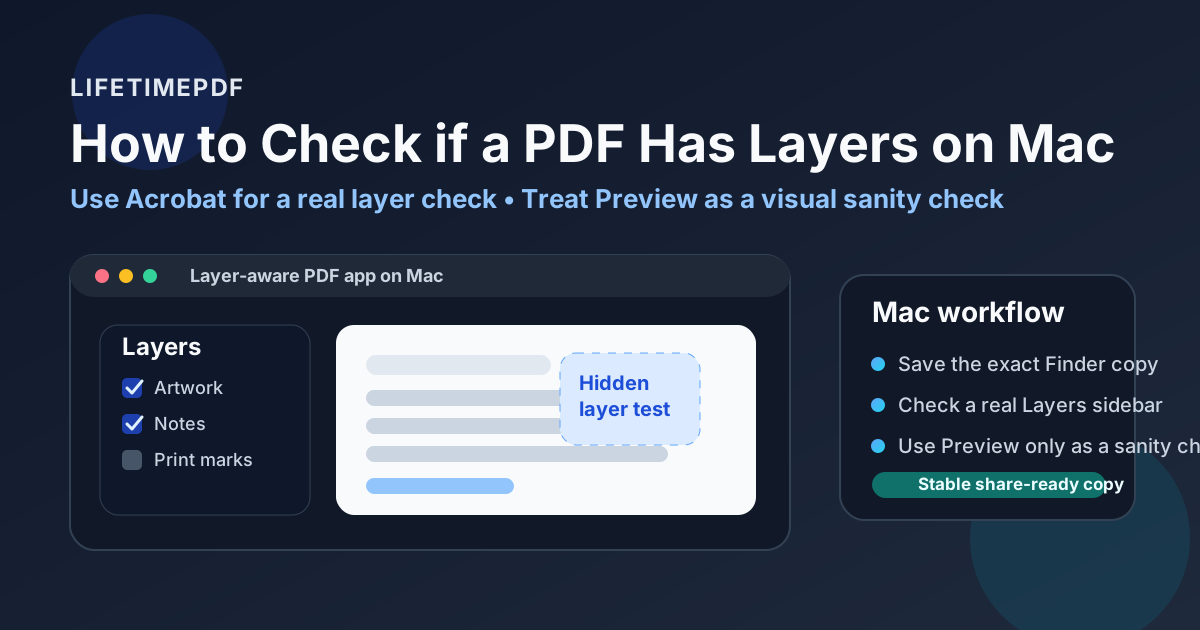
Table of contents
- Quick start: confirm PDF layers on Mac in a few minutes
- What counts as a layered PDF on Mac
- What Preview and Quick Look can and cannot tell you
- Step-by-step: how to check a PDF for layers on Mac
- Fast signs the PDF really has layers
- When to flatten a copy after checking layers
- Common Mac mistakes that create false confidence
- Related LifetimePDF tools and articles
- FAQ (People Also Ask)
Quick start: confirm PDF layers on Mac in a few minutes
If you only need a reliable yes-or-no answer before sharing the file, this workflow saves the most time:
- Save the exact PDF from Mail, Safari, Messages, or Google Drive into one obvious folder in Finder.
- Open that saved copy in Acrobat or another Mac PDF app that can expose a real Layers or Optional Content sidebar.
- Toggle one layer off and back on. If specific content disappears and returns while the rest of the page stays intact, the PDF contains layers.
- Open the same file once in Preview or Quick Look only to see how a simpler Mac preview behaves for everyday recipients.
- If the PDF must print cleanly or upload safely without hidden behavior, create a flattened delivery copy and keep the layered original separately.
What counts as a layered PDF on Mac
In PDF language, layers usually mean optional content groups. That is content that can be shown or hidden without rebuilding the whole document. Architectural plans, packaging proofs, product diagrams, multilingual handouts, map exports, and markup-heavy review files often use layers because different people need to see different content states from the same source PDF.
This matters because Mac users often call several different PDF features “layers” when they are not the same thing. A highlight can appear and disappear. A form field can react when you click it. A comment can stay hidden until a richer viewer reveals it. None of that automatically proves the file has real PDF layers. A layered PDF specifically contains grouped content that can be shown or hidden independently.
| PDF feature | What it does | Is it the same as layers? |
|---|---|---|
| Optional content groups | Lets content appear or disappear independently | Yes — this is what people usually mean by PDF layers |
| Comments or annotations | Adds notes, highlights, or markups above the page | No |
| Bookmarks | Helps navigation through the document | No |
| Form fields | Creates areas for typing, clicking, or signing | No |
That distinction is useful because it changes what you should test. If your real question is whether a plan set, proof, or design export contains toggleable content, you need a layer-aware app. If your question is really about comments or forms, you need a different check entirely.
What Preview and Quick Look can and cannot tell you
On Mac, Preview and Quick Look are great for quick viewing and basic sharing. They are also the reason many people misjudge layered PDFs. A built-in preview can render the current visible state cleanly while hiding the fact that optional content groups still exist underneath. That means the file may look stable even though a different app, print workflow, or portal could treat the same PDF differently.
What Preview and Quick Look are good for
- opening the exact delivery copy quickly,
- spotting obvious visual problems,
- seeing how a simple preview behaves for a normal recipient.
What Preview and Quick Look are not good for
- proving that optional content groups exist,
- showing a trustworthy Layers sidebar,
- telling layers apart from annotations or form behavior.
So if someone asks, “The PDF looks fine in Preview — does that mean it has no layers?” the honest answer is no. It only means the built-in preview showed one visible version of the document. That can be useful, but it is not the same as an actual layer inspection.
Step-by-step: how to check a PDF for layers on Mac
Here is the most practical Mac workflow for a real PDF you may need to print, review, upload, or hand off.
1) Start with the exact saved copy
Do not inspect one version in a Mail preview and send another from Downloads or Drive. Save one clear copy into Finder first so your test matches the file you actually plan to use.
2) Open it in a full PDF app
Acrobat on Mac is the familiar choice because it can expose richer PDF controls than Preview. Another serious Mac PDF app can work too, as long as it shows actual layer or optional-content controls.
3) Look for a Layers or Optional Content sidebar
If the PDF contains layers, you should usually see a control where named items can be shown, hidden, or expanded. No visible sidebar does not always prove the file is flat, but a populated sidebar is strong confirmation.
4) Toggle visibility deliberately
Hide one item at a time and watch what changes. Real layer behavior means some artwork, notes, labels, marks, or language content disappears while the rest of the page remains intact.
5) Compare what happens in simpler Mac previews
After you confirm the layer structure in a full PDF app, open the same file once in Preview or use Quick Look from Finder. This tells you how the delivery copy may behave for recipients who never open the file in a full editor. If the preview looks stable but does not expose any layer controls, that is normal. The point is not to make the built-in preview prove the layers exist. The point is to learn whether the visible result is acceptable in a simpler environment.
6) Decide whether you need a flattened delivery copy
If the layered PDF is mainly for your own editing or internal review workflow, keep it layered. If it is heading to a client, teacher, printer, job portal, or teammate who just needs one dependable final appearance, a flattened copy is often safer. That preserves the current visible state and reduces surprises when other apps simplify or reinterpret the file.
Practical Mac sequence: confirm the layers in a full PDF app, open the same file once in Preview for a sanity check, then flatten only the delivery copy if consistency matters more than editability.
Fast signs the PDF really has layers
You do not always need a long inspection. A few signals usually tell you quickly whether the Mac PDF is truly layered:
- the PDF app shows a named Layers or Optional Content list,
- turning one item off hides only certain artwork, labels, notes, or language variants,
- the page layout stays intact while one content group changes,
- the file behaves differently when you compare the layered original against a flattened copy,
- the document naturally fits layered workflows, such as plans, design proofs, maps, or multilingual exports.
If none of those clues appear, the PDF may simply be a normal flat document that happens to be visually complex. That is not a problem by itself. It just means the next check should match the real issue. For example, if your concern is file reliability rather than optional content, you may need to review PDF properties, permissions, or print settings instead.
When to flatten a copy after checking layers
Flattening is not a punishment for bad PDFs. It is a delivery choice. Once you confirm that a PDF contains layers on Mac, the next question is whether the next recipient needs those layers to remain live. If the answer is no, flattening a copy often makes the file simpler and more dependable.
Keep the original layered when:
- you still need to edit, review, or toggle content later,
- the file is part of an internal production workflow,
- different recipients need different visible states from the same source.
Flatten a delivery copy when:
- the PDF is headed to a print workflow that should not guess at hidden content,
- the file must upload to a rigid portal that dislikes richer PDF features,
- you want a client, teacher, or teammate to see one stable final appearance instead of a live layered document.
The healthy habit is simple: keep one master, send one delivery copy. That gives you the safety of editability without forcing every downstream viewer to interpret your layered workflow correctly.
Common Mac mistakes that create false confidence
Most layer-check failures on Mac are workflow failures, not technical mysteries. Someone checks the wrong copy, confuses comments with layers, or decides the file is safe because Preview opened it without errors.
- Testing a Mail or Safari preview instead of the saved PDF you will actually send.
- Assuming a clean look in Preview means there is no hidden optional content.
- Flattening the only copy, then realizing you needed the editable layered original later.
- Calling annotations, highlights, or form controls “layers” and chasing the wrong fix.
- Ignoring downstream reality such as printers, school portals, job application sites, or client preview apps.
If you avoid those five mistakes, you already do a better Mac layer check than most people. The rest is just matching the file to its destination.
Related LifetimePDF tools and articles
If you are checking layers because something feels unstable, these are the most useful next resources to keep nearby:
Best next move: if the file needs to survive everyday Mac viewing, portal uploads, and printing without surprises, keep the layered master and send a flattened copy.
FAQ (People Also Ask)
How do I check if a PDF has layers on Mac?
Save the PDF to your Mac, open it in Acrobat or another full PDF app, and look for a Layers or Optional Content sidebar. If you can turn specific content on and off without changing the entire page, the PDF has layers.
Can Preview show PDF layers on Mac?
Not reliably for confirmation. Preview is good for opening the file and seeing the current visible result, but it usually does not expose true optional-content controls the way a richer PDF app can.
Does Quick Look prove a PDF has no layers?
No. Quick Look can render the visible state of a PDF without revealing the underlying layer structure, so a file may still contain layers even if the preview looks normal.
Are PDF layers the same as comments, highlights, or form fields?
No. Layers usually mean optional content groups that can be shown or hidden independently. Comments, highlights, bookmarks, and form fields are separate PDF features.
Should I flatten the original PDF after checking layers on Mac?
Usually no. Keep the original layered master if you might need to edit or toggle content later, and create a separate flattened delivery copy only for the final destination that needs consistent behavior.
Published by LifetimePDF — Pay once. Use forever.