How to Check if a PDF Has Attachments on Mac: Find Embedded Files Before You Open, Share, or Archive the Document
To check if a PDF has attachments on Mac, open the exact file in Preview or another PDF workflow that can expose attachments, embedded files, or portfolio-style content, and do not treat a clean-looking preview as proof that nothing extra is inside.
If Finder Quick Look, Safari, Mail, or a lightweight browser tab only shows the pages, switch to Validate PDF or a fuller viewer before you open hidden files, share the document, or archive it as clean.
That is the short answer. The useful answer is understanding where Mac users get false confidence: a PDF can look perfectly ordinary in Quick Look, Preview thumbnails, Mail, Messages, or a browser tab while still carrying spreadsheets, XML exports, draft source files, or other embedded extras underneath. If you never inspect the attachment layer, you are checking the pages, not the whole package.
Fastest practical path: open the exact PDF you plan to use, look for an attachments or embedded-files view, then confirm the package with a dedicated checker if the document matters or the preview feels too quiet.
In a hurry? Jump to quick start: check PDF attachments on Mac in about 5 minutes.
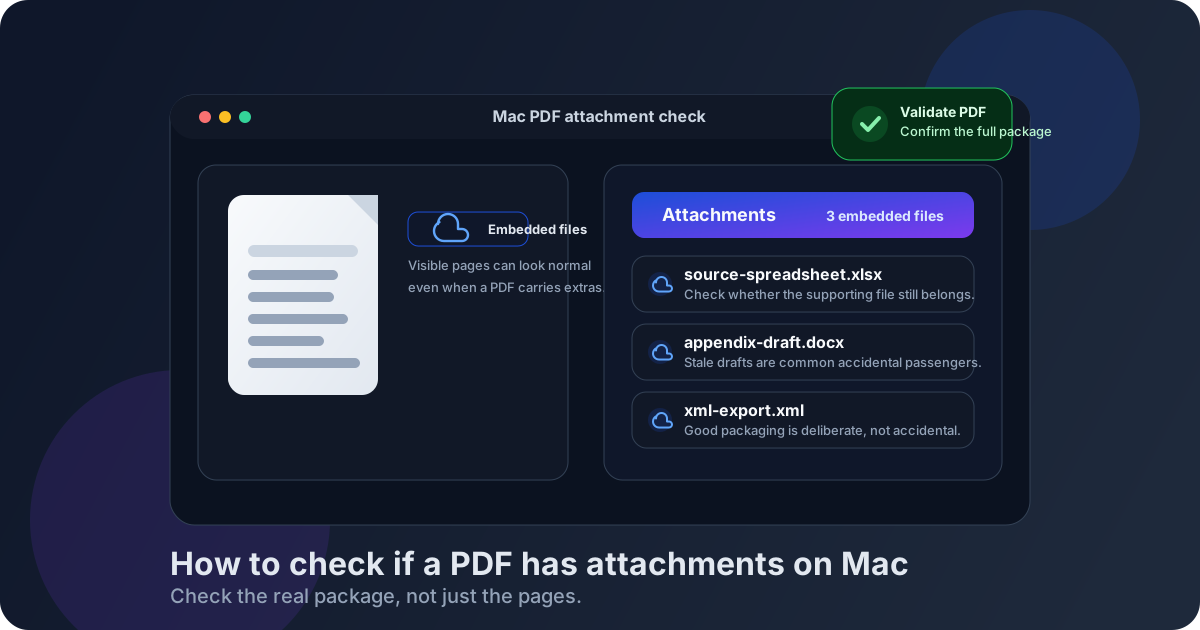
Table of contents
- Quick start: check PDF attachments on Mac in about 5 minutes
- What counts as a PDF attachment on Mac
- Step-by-step: check a PDF for attachments on Mac
- Quick Look vs Preview vs browser preview
- Signals that a PDF may contain embedded files
- When a quick Mac preview is not enough
- What to do next if the PDF matters
- Related LifetimePDF tools and guides
- FAQ
Quick start: check PDF attachments on Mac in about 5 minutes
If you want the shortest dependable workflow, use this sequence:
- Open the exact PDF you plan to share, upload, archive, print, or inspect later.
- Look for an attachments, embedded files, or paperclip-style view in Preview or another fuller PDF workflow on your Mac.
- If you are only seeing Finder Quick Look, a browser tab, or an in-app preview from Mail or Messages, treat that as a first look, not a final answer.
- If the sender mentioned exhibits, spreadsheets, source files, or a portfolio, assume extras may exist even if the visible pages look ordinary.
- Run the file through Validate PDF or inspect it in a fuller viewer when you need a definitive yes-or-no answer.
- Only open, forward, or archive the PDF after you know whether the embedded files are intentional and appropriate.
What counts as a PDF attachment on Mac
A PDF attachment is a separate file embedded inside the PDF package. It is not the same thing as a hyperlink, comment, highlight, or bookmark. On Mac, those embedded items may be spreadsheets, Word drafts, XML exports, ZIP files, images, CAD references, or supporting exhibits bundled with the main document.
Embedded files
Extra documents packed inside the PDF rather than shown as visible pages.
PDF portfolios
Container-style PDFs that behave more like a bundle of related files than one flat document.
Support files you may miss
Draft source material, stale data exports, duplicate exhibits, or convenience files that create privacy and version-control problems.
Some attachments are perfectly legitimate. Procurement packets, legal bundles, finance reports, technical handoffs, and archival records may intentionally include sidecar files. The risk is not that attachments exist. The risk is treating an uninspected package as harmless simply because the first Mac view looked tidy.
Step-by-step: check a PDF for attachments on Mac
This workflow gives you a reliable answer without pretending every Mac preview path is equally informative.
Step 1: Start with the exact file you are about to use
Save the PDF locally if it is still sitting in Mail, Messages, Safari, Slack, or a portal download wrapper. Version mix-ups are common. People inspect one copy, then share another with different packaging. Checking the exact file first removes a lot of confusion before you even look for attachments.
Step 2: Do not confuse Finder Quick Look with a structural check
Quick Look is excellent for confirming you opened the right document, but it is not a complete attachment audit. A PDF can show crisp pages, readable text, and the right page count while still carrying embedded files that Quick Look never surfaces clearly.
Step 3: Open the PDF in Preview or another viewer that can expose attachments
Look for a paperclip, an attachments list, an embedded-files panel, or any portfolio-style file list. If your current Mac viewer offers a way to list attached files, use it. If it does not, you are not done checking yet.
Step 4: Treat Safari, Chrome, and in-app previews as convenient but incomplete
Browser-based PDF viewing on Mac is fine for a quick read, but it is often the wrong place to make trust decisions about the document package. The pages may look completely normal while the viewer hides the embedded-file layer or gives you no obvious cue that extra files are present.
Step 5: Use a definitive checker when certainty matters
If the PDF affects a client handoff, contract, legal packet, compliance archive, finance review, procurement workflow, or records copy, run it through Validate PDF or inspect it in a fuller desktop PDF environment. That turns a vague visual impression into a more dependable structural answer.
Step 6: Decide whether the attachments belong before you move on
Once you confirm that embedded files exist, ask the practical question: should these files really stay inside this PDF for this recipient and this stage of the workflow? Some will belong. Others will be stale drafts, conflicting exports, duplicate evidence, or material that should travel separately or not at all.
Best next move after the check: if the PDF contains embedded files, decide whether they belong before you AirDrop it, email it, upload it, or store it as a final record.
Quick Look vs Preview vs browser preview
Different Mac viewing paths are useful for different jobs, but they are not equally good at exposing hidden package content.
| Mac view | Best for | Where it can mislead you |
|---|---|---|
| Finder Quick Look | Confirming the file looks like the document you expected | It can show normal pages while giving you little or no visibility into embedded files |
| Preview or a fuller PDF viewer | Inspecting the actual document more deliberately | Still only helps if you move beyond the simple page view and actually check for attachments |
| Safari or Chrome tab | Fast reading before download or a quick check of visible pages | Convenient rendering can hide the attachment layer or suppress portfolio cues |
| Mail, Messages, or app preview | First look at a received PDF inside the app you got it from | You may be seeing an app wrapper, not the full behavior of the actual file |
| Validate PDF | Getting a definitive answer when attachments matter | Requires one extra step, but usually saves time compared with guessing from a limited preview |
In practice, Mac users get the best results by treating quick previews as a convenient first pass and a fuller viewer or validator as the place where trust decisions actually happen.
Signals that a PDF may contain embedded files
These clues do not prove attachments exist, but they are strong enough that you should not stop at a quick preview.
| What you notice | What it usually suggests | Best next step |
|---|---|---|
| The sender mentions exhibits, spreadsheets, or source files inside the PDF | The document may contain genuine embedded files even if the preview looks plain | Check with a viewer or validator that exposes attachments clearly |
| The file size seems large for a short document | Extra package content may exist beyond the visible pages | Inspect for attachments rather than assuming the PDF is just image-heavy |
| A colleague sees a paperclip or bundle cue you do not see | Your current Mac viewing path is probably hiding useful structure | Move to a fuller viewer instead of trusting the quieter one |
| The PDF behaves more like a package than a simple document | You may be dealing with a portfolio or embedded-file workflow | Inspect the file structure before you archive or forward it |
| You are about to send the PDF outside your team | Even harmless attachments can create privacy, version, or retention issues | Confirm the contents before sharing |
When a quick Mac preview is not enough
There is nothing wrong with using Quick Look or Preview for speed. The mistake is treating that speed as certainty.
- The PDF is headed into a legal, finance, procurement, compliance, or records workflow.
- You did not create the file yourself and do not fully trust the sender or packaging.
- The visible document looks ordinary, but the workflow often bundles source files or exhibits.
- You are about to forward the PDF to a client, vendor, recruiter, regulator, or public recipient.
- Hidden extras would be embarrassing, confusing, or risky if someone opened them first.
In those situations, the right move is not poking around longer in the same preview window. It is switching to a path that can answer the question properly.
What to do next if the PDF matters
Once you know a quick Mac preview is not enough, the next step depends on what you need from the file.
If you only need to confirm whether extra files exist
Start with Validate PDF. It is the fastest way to move from “this preview looks normal” to a more dependable structural check.
If you need to share the PDF safely
Pair the attachment check with related trust checks such as permissions and JavaScript when the document came from an unfamiliar workflow. Attachments are only one part of the package story.
If the embedded files are intentional and important
Keep them only if they are current, relevant, and expected by the recipient. If the PDF is supposed to act as a bundle, make sure the bundle is deliberate and defensible rather than an accidental byproduct of a rushed export.
If you cleaned the package and want to verify the outgoing copy
Use Compare PDFs to help confirm the visible document stayed intact while you removed or changed the parts that should not travel. That is especially helpful when you are balancing cleanup against record accuracy.
Related LifetimePDF tools and guides
These are the most useful follow-up pages when your Mac attachment check turns into action.
If you want the device-agnostic workflow first and the Mac nuance second, start with Check PDF Attachments and then come back to this page when Quick Look, Preview, Mail, or Safari leaves you uncertain.
FAQ
How do I check if a PDF has attachments on Mac?
Open the exact PDF on your Mac, look for an attachments, embedded files, or portfolio-style view, and do not rely on Finder Quick Look or browser preview alone. If the document matters, confirm it with Preview plus a fuller check such as Validate PDF before you trust or forward it.
Can Quick Look or Safari hide PDF attachments on Mac?
Yes. Finder Quick Look, Safari, Mail previews, and lightweight browser views can show the visible pages while hiding embedded files, so a normal-looking preview is not proof that the PDF has no attachments.
Are PDF attachments the same as comments, annotations, or links?
No. Attachments are separate embedded files inside the PDF package. Comments, annotations, and links live on or around the visible pages instead.
Why would someone embed files inside a PDF?
To keep supporting spreadsheets, exhibits, source docs, XML exports, or other reference material bundled with the main document. That can be helpful, but it also means you should check what is inside before you share the package.
What should I do before forwarding a suspicious PDF from my Mac?
Confirm whether the PDF contains embedded files, review any related trust issues such as permissions or active content, and avoid forwarding the document until you know the package is appropriate for the recipient.
Bottom line: on Mac, a PDF that looks perfectly clean in Quick Look or Safari can still carry embedded files you never intended to pass along. Check the real package, not just the pages.
Published by LifetimePDF — Pay once. Use forever.