How to Check if a PDF Has a Text Layer on Linux: Confirm Real Text Before OCR, Extraction, or AI
To check if a PDF has a text layer on Linux, open the saved file in your usual PDF viewer or browser, search for a visible word, then select and paste one short line into a plain-text editor.
If search fails, the page behaves like one flat image, or pasted text comes out broken, the PDF needs OCR or a cleaner export before you rely on extraction, summaries, translation, or AI tools.
That is the quick answer. The more useful answer is knowing how to test the exact Linux copy you plan to keep, how to tell the difference between a missing text layer and a weak one, and when the smarter fix is a clean re-export instead of more trial and error. A PDF that looks fine in Evince, Okular, Firefox, or Chrome is not automatically a PDF you should trust for copy-paste, clause extraction, summarization, or accessibility work.
Fastest path: save one local copy, run a viewer search, copy one full sentence into plain text, and use PDF to Text before OCR if the file matters.
In a hurry? Jump to the 2-minute Linux check.
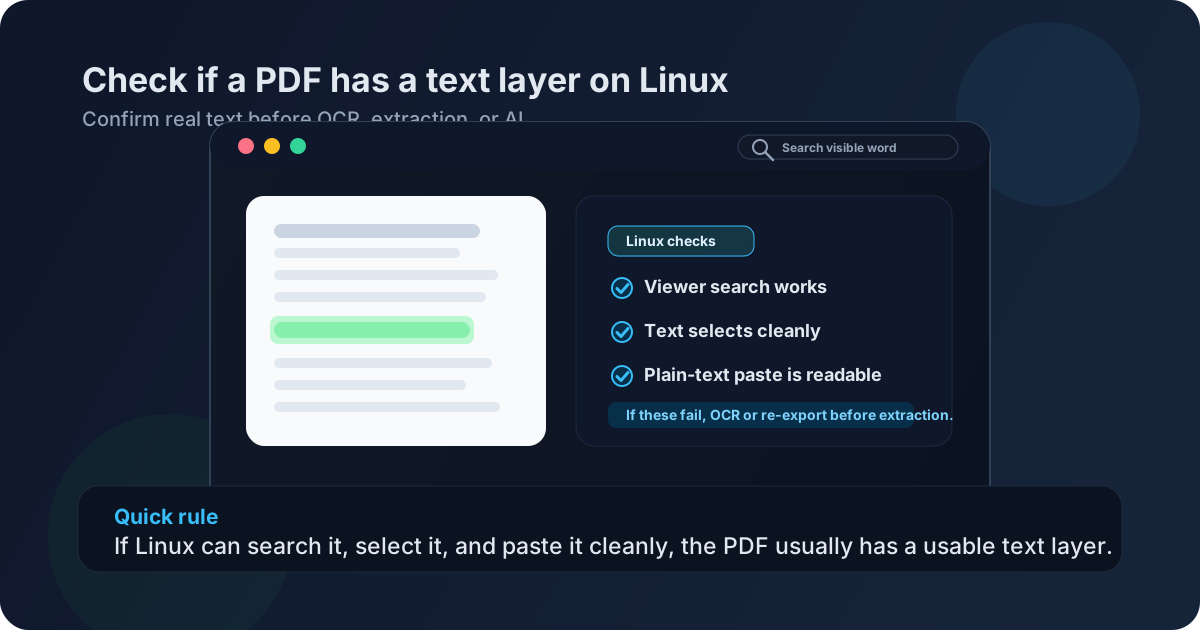
Table of contents
- Quick start: check for a text layer on Linux in 2 minutes
- What a PDF text layer actually means on Linux
- The best Linux workflow for checking text layers
- What your results mean
- How to spot a weak text layer, not just a missing one
- When OCR is right and when a cleaner export is better
- What to do after the check
- Related LifetimePDF tools and guides
- FAQ (People Also Ask)
Quick start: check for a text layer on Linux in 2 minutes
If you only need a fast yes-or-no answer, use this order:
- Save the PDF from email, chat, cloud storage, or a browser tab into one clear Linux folder.
- Open it in your usual Linux PDF viewer and search for a visible word.
- Select one full sentence rather than tapping at a single word.
- Paste that sentence into a plain-text editor.
- If it all works cleanly, the PDF has a usable text layer. If it fails, use OCR PDF or export a cleaner source copy.
What a PDF text layer actually means on Linux
A text layer is the machine-readable text behind the page image or layout. It is what makes a PDF searchable, selectable, and useful for extraction, summarization, translation, AI Q&A, accessibility review, and copy-paste. Without a usable text layer, the file may still look crisp in a viewer, but it behaves more like a screenshot than a document.
On Linux, that distinction matters because PDFs often come from very different sources:
- Native PDFs exported from LibreOffice, Google Docs, Word, spreadsheets, or design tools
- Scanned PDFs from a copier, phone camera, or multi-function printer
- Mixed PDFs where some pages are digital text and others are inserted scans, photos, signatures, or screenshots
All three can appear perfectly readable on screen. That is why behavior tests matter more than a quick glance. If Linux can search the page, let you select a full sentence, and produce sensible pasted text, the file is usually ready. If one of those tests breaks, the text layer is weak or missing, and downstream tools will feel less reliable than they should.
The best Linux workflow for checking text layers
The easiest mistake on Linux is testing different copies in different apps and assuming the result was about the PDF instead of the workflow. If one copy opened from a browser cache, another from Downloads, and a third from cloud sync, you do not really know which file passed the check. Start with one saved local copy and keep the test honest.
1) Save one local copy first
Pull the PDF out of webmail, Slack, Teams, Drive, Nextcloud, or a browser preview and save it into one obvious folder. On Linux, version confusion causes as many bad diagnoses as bad files do. One local file means one real answer.
2) Search for a visible word in your Linux viewer
Open the file in the viewer you normally trust, whether that is Evince, Okular, Firefox, Chrome, or another PDF app. Search for something distinctive like a heading, invoice number, surname, or product name rather than a tiny common word. If search misses text you can clearly see, the page may be image-only or the text layer may already be broken.
3) Select one full sentence, not one lucky word
A single highlighted word can make a bad PDF look better than it is. Drag across a full sentence or a short paragraph. If selection behaves naturally, that is a strong sign the file contains real text. If the cursor snaps around in fragments or the page acts like one photo, the text layer is missing or badly aligned.
4) Paste the copied text into a plain-text editor
This is the reality check that saves the most time later. Paste the copied line into any plain-text editor you already use. If the result stays clean, you are in good shape. If the text collapses, spacing disappears, columns arrive out of order, or characters turn into junk, the file may technically contain text but not a text layer you should trust.
5) Use PDF to Text if the PDF actually matters
If the document is heading into compliance review, legal review, finance work, research notes, or AI workflows, run it through PDF to Text. That tells you whether the reading order, paragraph flow, and extracted content still make sense beyond one successful viewer test.
6) Decide whether the right fix is OCR or a cleaner export
If the file began as a scan or photo, OCR is usually the right fix. If it came from LibreOffice, Word, Google Docs, or another editable source but behaves badly on Linux, the smarter move is often a cleaner export instead of stacking OCR on top of a digital file that was already exported poorly.
Recommended Linux sequence: save one local copy → search in your viewer → select a full sentence → paste into plain text → use PDF to Text if it matters → OCR or re-export only when the test tells you to.
What your results mean
Once you run those checks, use the outcomes below to choose the next step instead of guessing.
| What happened on Linux | What it usually means | Best next step |
|---|---|---|
| Search, full-sentence selection, paste, and extraction all work cleanly | The PDF has a usable text layer | Move straight to PDF to Text, PDF Summarizer, or PDF Q&A |
| Search works, but pasted or extracted text looks messy | The text layer exists, but it is weak or damaged | Retest with PDF to Text and consider OCR or a cleaner export |
| Your PDF viewer fails, but the browser finds some text | You may be seeing app differences rather than a fully healthy file | Judge the PDF by copy-paste and extraction quality, not one app's search box |
| Nothing searches or selects and the page behaves like an image | The PDF is probably image-only | Run OCR PDF |
| Only some pages behave like real text | The PDF is mixed: part native, part scanned, or partly flattened | Check the important pages and OCR or rebuild the problem pages before you rely on the whole file |
How to spot a weak text layer, not just a missing one
A lot of Linux PDFs fall into the awkward middle. They are not completely image-only, but they are not clean enough for dependable extraction either. That is why the plain-text paste test matters so much.
Common warning signs of a weak text layer include:
- Copy-paste returns scrambled text with broken spacing, missing letters, or merged words
- Search finds some matches but misses obvious ones
- Multi-column layouts paste in the wrong order
- Tables, totals, or lists turn messy after extraction
- One page works well while the next behaves like an image
- Rotated scans, dark borders, or faint originals confuse recognition
In other words, a weak text layer can still trick you into thinking the PDF is ready because one search test succeeded. That is not enough if you plan to quote from the file, compare clauses, summarize a report, translate it, or feed it into AI. If the pasted text is ugly, later steps will usually be ugly too.
When OCR is right and when a cleaner export is better
OCR is not the right answer to every bad Linux PDF. Sometimes it is the best fix. Sometimes it is only a patch on top of an avoidable export problem.
Run OCR when
- the PDF came from a scanner, copier, fax, or phone capture,
- search misses obvious visible text,
- the page behaves like one flat image,
- the file mixes scanned pages with native ones, or
- you need the file to become searchable before extraction, summarization, accessibility review, or AI Q&A.
Export a cleaner source file when
- the PDF came from LibreOffice, Word, Google Docs, Sheets, Slides, or another editable app,
- the source document still exists,
- copy-paste order stays messy even though the document was digital, or
- the PDF was created through a rough print-to-PDF or screenshot workflow that flattened text unnecessarily.
A simple rule works well here: if the file started on paper, think OCR first. If it started in software, think clean re-export first. You can still use OCR afterward, but a better source file often preserves structure, spacing, and accuracy more cleanly.
Need cleanup before OCR? Rotated pages, borders, and stray margins make weak text layers even worse.
What to do after the check
Once you know the condition of the text layer, the rest of the workflow gets much easier.
If the text layer is clean
- Use PDF to Text if you need editable extracted content.
- Use PDF Summarizer if you want the main points quickly.
- Use PDF Q&A if you need targeted answers from the file.
- Use Translate PDF or Redact PDF only after you know the text behaves properly.
If the text layer is weak or missing
- Clean the file if needed with Rotate PDF or Crop PDF.
- Run OCR PDF.
- Repeat the same Linux search, selection, and paste tests.
- Then move into extraction, summarization, translation, or AI Q&A once the file behaves like real text.
The main value of this check is practical. It saves you from blaming the wrong tool later. If the text layer is weak, every later step feels less accurate than it should. If the text layer is solid, you can skip unnecessary reprocessing and move straight to the work that matters.
Related LifetimePDF tools and guides
- PDF to Text - extract text once the Linux PDF is behaving properly
- OCR PDF - add a searchable text layer to scanned or image-only PDFs
- PDF Summarizer - turn a readable PDF into a fast brief
- PDF Q&A - ask follow-up questions once the text layer is usable
- How to Check if a PDF Has a Text Layer - the cross-platform version of this workflow
- How to Check if a PDF Is Searchable on Linux - related Linux searchability checks
- Why Is My PDF Not Searchable? - common causes behind image-only or weak-text PDFs
FAQ (People Also Ask)
How do I check if a PDF has a text layer on Linux?
Open the saved PDF on Linux, search for a visible word, highlight one short sentence, and paste it into a plain-text editor. If those tests work cleanly, the PDF usually has a usable text layer. If they fail, the file probably needs OCR or a cleaner export.
Is a searchable PDF the same as a PDF with a text layer on Linux?
In most everyday situations, yes. A searchable PDF usually has a text layer underneath the page. The real nuance is quality: some PDFs have a weak text layer that partly works for search but still fails during copy-paste or extraction.
Why does the PDF look sharp on Linux if it still has no usable text layer?
Because visual clarity and machine-readable text are different things. A Linux viewer or browser can display a page that is only an image of words. Search, selection, and copy-paste are the faster tests for whether the file contains real text underneath.
Should I trust one successful search result?
Not by itself. One matching word can hide a weak text layer. Copy a full sentence, paste it into plain text, and if the document matters run PDF to Text so you know whether the file is truly extraction-ready.
Should I OCR the PDF or export a new one from LibreOffice, Word, or Google Docs?
If the file started on paper, OCR is usually the better first move. If it started in editable software and still behaves badly, a clean re-export often preserves structure better than layering OCR on top of a poor digital export.
Ready to test the file for real?
Good default workflow: save one copy → search in your Linux viewer → paste one line into plain text → use PDF to Text if it matters → OCR or re-export only if needed → retest before you continue