Merge PDF and HTML Files: Combine Web Pages, Saved HTML, and Supporting PDFs Into One Clean Final PDF
To merge PDF and HTML files, the most reliable workflow is to convert the HTML to PDF first, then use Merge PDF to combine that new PDF with the rest of your documents in the right order.
That keeps layout steadier, avoids awkward page-break surprises, and gives you one final PDF that is much easier to share, print, upload, or archive.
Most people searching this phrase are not really trying to join two random file formats for fun. They are trying to finish something practical: a report with a saved web appendix, an invoice packet built from HTML, a proposal with a captured pricing page, or a knowledge-base page that needs to sit beside signed PDF forms. The problem is that HTML is meant for screens and scrolling, while PDF is meant for stable pages. Once you stop treating them as equal at the last second, the workflow becomes much calmer.
Fastest dependable path: make the HTML print-friendly, convert it to PDF, merge the PDFs in the right order, then only compress or protect the final file if the real handoff needs it.
Need the short version? Jump to Quick start: merge HTML and PDF files in about 5 minutes.
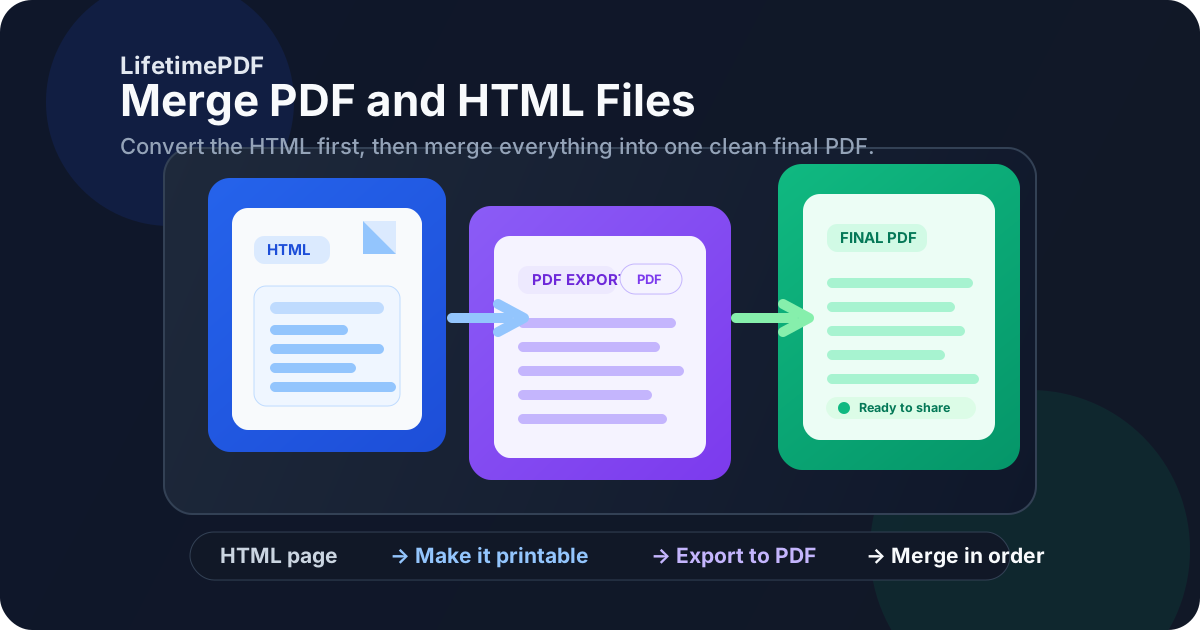
Table of contents
- Quick start: merge HTML and PDF files in about 5 minutes
- What this workflow really means
- Why HTML to PDF first is the cleanest method
- Step-by-step: merge the files without wrecking layout
- How to keep the HTML pages readable after conversion
- Common real-world use cases
- Troubleshooting broken assets, ugly page breaks, and big files
- Related LifetimePDF tools and companion guides
- FAQ (People Also Ask)
Quick start: merge HTML and PDF files in about 5 minutes
If the content is already final and you just need one polished file, this is the workflow most people actually want:
- Use the final saved HTML file or a clean browser version of the webpage you want to include.
- Remove anything that should not belong in the final document, such as oversized navigation, irrelevant sidebars, or noisy screen-only sections.
- Open HTML to PDF.
- Convert the HTML into PDF with the paper size, margins, and orientation that fit the actual use case.
- Open Merge PDF.
- Upload the new HTML-based PDF together with the other PDF pages, reports, forms, signed sheets, or appendices.
- Drag the files into the exact order the recipient should read them, merge them, and download the final packet.
- If the result is too large for email or a portal, use Compress PDF.
What this workflow really means
A lot of people search for merge PDF and HTML files as if the job should happen in one magical click. In practice, there are usually two separate goals hiding inside that phrase. One goal is technical convenience: make different files stick together somehow. The other goal is communication: build one final PDF another person can open, understand, and forward without confusion. The second goal is the one that matters.
| If your goal is... | The better workflow is usually... | Why |
|---|---|---|
| One clean shareable PDF | HTML → PDF → Merge PDF | You get stable pages, predictable page breaks, and a calmer final packet. |
| Just reviewing a live page for yourself | Keep it as HTML or use browser print | You may not need a merged PDF at all if nobody else is consuming it as a document. |
| Adding a webpage, template, or report behind another PDF | Convert first, then merge | The HTML becomes a readable document section instead of an awkward extra file. |
Why HTML to PDF first is the cleanest method
HTML can look perfect in a browser and still behave badly once you try to turn it into a formal document packet. Navigation bars waste space. Long pages split in awkward places. Tables run wide. Images or fonts can load differently. That is why the safest workflow is pleasantly boring: make the HTML print-friendly, export it to PDF once, then merge only PDFs.
In practice, merge PDF and HTML files usually means create a stable HTML-based PDF first, then package it with the rest of the document set. That is how you keep the final result useful instead of merely technically combined.
| Workflow | Best when | Main tradeoff |
|---|---|---|
| Convert HTML to PDF, then merge | Invoices, reports, saved webpages, onboarding docs, product pages, appendices, client packets | One extra step, but much better layout control and readability |
| Try to combine mixed files immediately | Low-stakes internal sharing where presentation barely matters | More page-break surprises and less confidence in the final result |
Step-by-step: merge the files without wrecking layout
The workflow is straightforward, but doing each step in the right order prevents most of the usual headaches.
1) Start from the right HTML source
If you have a saved .html or .htm file, use the final version you actually want to share. If the content is a live webpage, make sure you are capturing the version that has fully loaded and does not depend on temporary UI states. This is a small choice that saves a lot of rework later.
2) Clean up the layout for print
Remove clutter that belongs to a screen but not to a document. Oversized menus, sticky headers, huge footers, sidebars, or promotional blocks often make sense on a webpage and feel silly inside a PDF packet. If the HTML contains long tables or cards, decide early whether portrait or landscape will read better.
3) Convert the HTML to PDF once
Use HTML to PDF to create a stable PDF from the HTML. This is the step that freezes the layout. It turns flexible web content into pages you can confidently sequence with the rest of the packet.
4) Gather the supporting PDFs
These might include contracts, signed pages, forms, reports, invoices, screenshots already saved as PDF, or existing appendices. Putting everything in one place before the merge helps you catch missing pieces and keeps the final assembly much calmer.
5) Merge in the final reading order
Open Merge PDF, upload the HTML-based PDF and the rest of the PDFs, then drag them into the order the recipient should actually follow. Reading order matters more than people expect because the packet will be experienced top to bottom, not as a pile of source files.
6) Review the final packet once before sharing
- Check the first page: does the packet open with the right summary, main document, or cover page?
- Check one HTML-derived page: do margins, images, and page breaks still feel deliberate?
- Check transition points: do appendices, forms, or supporting pages start where you intended?
- Check file size: is it still reasonable for email or portal limits?
- Check the filename: does it make sense to the person receiving it?
Calmest sequence: clean the HTML, convert once, merge once, review once, then only compress or protect the finished packet if the real workflow needs it.
How to keep the HTML pages readable after conversion
Most problems in this workflow are not really merge problems. They are layout problems that started inside the HTML. A merge usually preserves what it receives. If the HTML-derived PDF is cluttered or awkward before the merge, the final packet will simply preserve that awkwardness more officially.
Trim screen-only clutter
Website chrome is not the same thing as document content. Navigation bars, cookie banners, sidebar widgets, and giant newsletter prompts rarely belong in a final PDF packet. The cleaner the source, the calmer the final PDF.
Watch page breaks honestly
HTML scrolls forever. PDFs do not. Check whether tables, images, section headings, and important blocks are being split in ugly places. If the converted PDF already feels hard to read, fix that before you merge anything else.
Be realistic about wide layouts
A full-width dashboard or pricing table may look fine on a monitor and become unreadable on a portrait PDF page. Landscape orientation, better spacing, or reducing low-value columns usually gives a more honest result than squeezing everything tiny.
Make sure assets actually load
Broken image paths, delayed fonts, or CSS that only works in a specific environment can make a converted HTML page look unfinished. If the PDF depends on the page looking polished, review the converted output by itself before you package it with the rest.
| If the HTML problem is... | The better fix is usually... |
|---|---|
| The page looks noisy | Remove navigation, sidebars, and screen-only extras before conversion. |
| Tables or sections split badly | Adjust print CSS, spacing, or page settings before making the final PDF. |
| Content is too small to read | Use landscape, simplify the layout, or break the content into cleaner sections. |
| Images or fonts look wrong | Check asset paths and preview the converted PDF before you merge it with anything else. |
Common real-world use cases
This keyword exists because mixed HTML-plus-PDF packets show up in ordinary work all the time. Here are the situations where this workflow tends to matter most.
Invoices and order summaries
A billing page may start as HTML while approvals, signed forms, or supporting documents already exist as PDFs. Converting the HTML first makes the final packet cleaner for finance, clients, or records.
Reports with web-based appendices
A formal PDF report may need a captured dashboard page, internal knowledge-base article, or saved web summary attached behind it. One merged PDF is easier to review than a loose mix of files.
Client and onboarding packets
Teams often combine web-generated instructions, account setup pages, and existing PDF forms into one handoff. A merged packet keeps the next person from chasing links and attachments.
Saved webpages for compliance or evidence
Sometimes a webpage needs to be preserved beside contracts, screenshots, or signed records. Converting it to PDF and merging it into the packet creates a more stable archive trail.
In each case, the value is not just convenience. It is clarity. One well-ordered PDF reduces missed attachments, broken context, and the annoying question of which file someone was supposed to open next.
If the packet is headed to an inbox or portal: merge first, then compress if needed so you are optimizing the real final file instead of guessing too early.
Troubleshooting broken assets, ugly page breaks, and big files
Most problems in this workflow are fixable without starting over.
The HTML-derived pages look messy
Go back to the source layout. Remove clutter, check margins, and make sure the page was actually prepared for print instead of just copied from a screen view. The merge is rarely the real culprit.
Images or fonts are missing
That usually means the HTML depended on assets that did not load properly during conversion. Fix the asset paths or use a cleaner self-contained source, then export the PDF again before merging.
The merged file is too large
Finish the merge first, then run Compress PDF on the combined result. That gives you a size fix based on the real packet instead of separate guesses.
The order feels wrong after download
Reopen the merge step and resequence the files by reading flow, not by creation time. This is especially common when the HTML-based appendix was uploaded first even though it belongs later in the packet.
The packet contains sensitive information
After merging, consider using PDF Protect before sharing it. Protection does not replace judgment, but it can help when the handoff genuinely needs an extra layer of control.
Related LifetimePDF tools and companion guides
This workflow works best as part of a small document toolkit rather than one heroic button. These are the most useful next steps and nearby guides:
- HTML to PDF - convert saved HTML files or cleaned web content into stable PDF pages before the merge.
- Merge PDF - combine the HTML-based PDF with reports, forms, signed pages, invoices, or appendices.
- Compress PDF - reduce the final packet for email or upload limits.
- PDF Protect - add a password if the final file contains sensitive content.
- Add Page Numbers to PDF - make longer packets easier to reference once the order is final.
For related reading around the same topic, these guides fit naturally next: HTML to PDF, HTML to PDF Converter Online, Merge PDF and Word Files, Merge PDF and Images, and Best Way to Combine Multiple PDFs Into One File.
Bottom line: the smartest way to merge PDF and HTML files is not to force a live web layout directly into a finished packet. Stabilize the HTML first, turn it into PDF, then merge the pages in the order a real person should read them.
FAQ (People Also Ask)
1) How do I merge PDF and HTML files?
The cleanest method is to convert the HTML to PDF first, then use a PDF merger to combine that new PDF with your other PDF files. That keeps the final packet easier to read, review, and share.
2) Can I combine a webpage and a PDF into one final PDF?
Yes. Save or convert the webpage into PDF first, then merge it with the other PDF files. That gives you one finished document instead of a mixed-format handoff.
3) Why should I convert HTML to PDF before merging?
Because HTML is flexible and screen-based, while PDF is fixed and paged. Converting first lets you control page breaks, margins, and readability before the file becomes part of a larger packet.
4) What kinds of HTML files fit this workflow well?
Saved webpages, invoice templates, knowledge-base pages, onboarding instructions, order summaries, reports, and HTML-based appendices are all common fits. The workflow is most useful when the content needs to sit beside existing PDF material.
5) What should I do if the merged file is too large?
Finish the merge first, then use Compress PDF on the final packet. That gives you a size reduction based on the real finished file rather than on scattered parts.
Ready to build one clean final packet?
Best workflow: clean the HTML - convert to PDF - merge in order - review once - then compress or protect only if needed.
Published by LifetimePDF - Pay once. Use forever.