Convert Payslip PDF to Excel: Extract Salary, Tax, Deductions, and Net Pay Faster
To convert payslip PDF to Excel, upload the payslip to LifetimePDF's PDF to Excel tool, export the XLSX, and review the employee name, pay period, gross pay, deductions, tax, YTD values, and net pay before you reuse the spreadsheet.
If the payslip is scanned, image-only, or bundled inside a larger HR packet, keep only the actual payslip pages and run OCR first so the payroll fields come through more cleanly.
People searching this phrase are usually not trying to create a prettier file. They are trying to stop retyping payroll values, compare pay periods faster, summarize income records, review deductions, or hand a usable sheet to finance, HR, payroll, or a lender without rebuilding the whole document by hand.
Fastest path: use LifetimePDF's PDF to Excel tool, and OCR the payslip first if it came from a scan, a photocopy, or an image-only archive.
In a hurry? Jump to Quick start: convert payslip PDF to Excel in about 5 minutes.
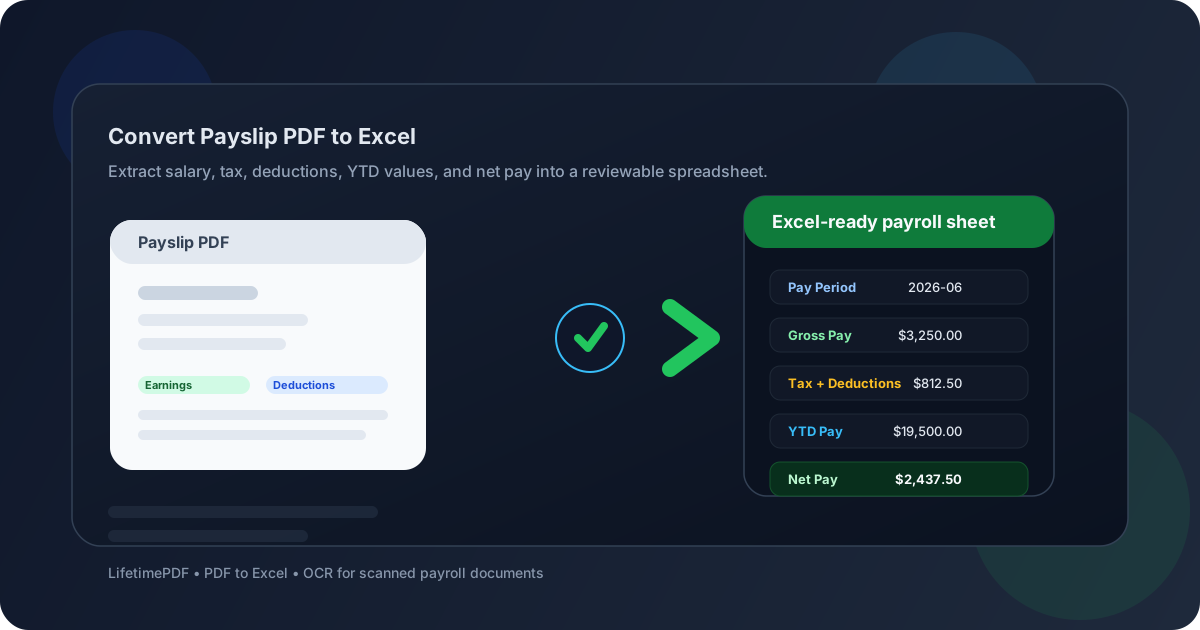
Table of contents
- Quick start: convert payslip PDF to Excel in about 5 minutes
- Why people need payslip PDFs in Excel
- Why payslip PDFs often break into messy columns
- Where payslip spreadsheets help most in real workflows
- Step-by-step: convert a payslip PDF to Excel
- The payroll fields worth verifying before you trust the output
- Scanned payslips and OCR: what changes
- Excel vs CSV for payslip extraction
- A cleanup checklist that saves time later
- Privacy and payroll-document hygiene
- Related LifetimePDF tools and companion guides
- FAQ (People Also Ask)
Quick start: convert payslip PDF to Excel in about 5 minutes
If the payslip PDF already contains selectable text and the layout is reasonably clean, the fast workflow is simple:
- Open PDF to Excel.
- Upload the payslip PDF you want to extract.
- If the file is scanned or image-only, run OCR PDF first.
- Download the generated XLSX file.
- Review the employee name, pay period, gross pay, deductions, tax, YTD values, and net pay before using the spreadsheet.
Why people need payslip PDFs in Excel
A payslip records the details behind a pay period. Depending on the employer and payroll system, it can include the employee name, pay date, pay period, gross pay, overtime, bonuses, tax, insurance, pension, leave balances, YTD totals, reimbursements, and net pay. Humans can read a payslip quickly because we instantly recognize which values belong to earnings, which belong to deductions, and which belong to summaries. A PDF keeps that information frozen in layout form. Excel makes it reusable.
Once a payslip becomes spreadsheet data, it is easier to compare periods, check tax withholding, sort by employee, total deductions, or summarize income. That is the real value behind searching convert payslip PDF to Excel. People usually do not want another PDF trick. They want an editable worksheet they can review, reconcile, or share without typing payroll fields by hand.
- Employee name and pay date or pay period
- Gross pay, base pay, overtime, and bonus amounts
- Tax withholding and employer or employee deductions
- Pension, insurance, or benefit contributions
- Net pay and payment reference fields
- YTD totals, leave balances, and notes when present
- Sort or compare payroll data across several pay periods
- Check deductions and taxes without opening one PDF after another
- Summarize income records for finance, HR, or applications
- Reuse the data in reports, pivots, or imports
- Spot mismatches faster when one period looks unusual
Why payslip PDFs often break into messy columns
Payslip PDFs look structured to humans because we visually understand labels, tables, totals, and summary blocks. A converter has to infer rows and columns from spacing and alignment. One payslip may contain employee details, pay-period data, earnings lines, deduction blocks, tax summaries, YTD values, and footer notes all on the same page. Excel wants clean rows and columns. Many payslip layouts were never built for that.
- Digitally generated PDFs from payroll systems
- Files with consistent labels and stable table spacing
- Standardized templates used every pay cycle
- PDFs with selectable text instead of image-only scans
- Scanned paper payslips or phone-made PDFs
- Documents with stamps, handwriting, or blurred print
- Files bundled with letters, forms, or HR attachments
- Dense layouts where current-period and YTD values sit very close together
The goal is not magic perfection. The real win is getting a spreadsheet that is close enough to verify quickly instead of retyping every payroll line by hand.
Where payslip spreadsheets help most in real workflows
Payslip data becomes much more useful the moment it is no longer trapped in PDF form. A few real workflows come up repeatedly:
Teams can compare gross pay, deductions, tax, and net pay across periods without opening one PDF after another.
Individuals and finance teams can summarize earnings, reimbursements, and withholding more easily when the data lives in rows and columns.
Lenders, landlords, immigration teams, and compliance reviewers often need a clean summary of dates, employer details, and take-home pay.
Converted data is easier to flag for missing deductions, odd tax values, duplicate rows, or periods that no longer match expectations.
Step-by-step: convert a payslip PDF to Excel
The most reliable workflow is intentionally boring. That is good. Boring workflows are the ones payroll, finance, and HR teams can repeat without surprises.
- Keep only the pages that contain the payslip. If the packet includes letters, forms, or unrelated attachments, isolate the actual payslip pages first.
- Open LifetimePDF's PDF to Excel tool. Upload the file you want to extract and let the converter focus on the payslip itself.
- Run OCR when needed. If the file came from a scan or image-only archive, OCR first usually improves recognition of small payroll fields and table labels.
- Download the XLSX output. Keep the original PDF nearby while you review the extracted sheet.
- Check the high-risk fields. Do not assume the sheet is correct just because it opened cleanly.
- Use filters and light cleanup. Once the core data looks right, Excel becomes the easier place to sort, compare, and reuse it.
Useful tool stack: PDF to Excel for extraction, Extract Pages for isolating only the payslip, and OCR PDF for scanned payroll documents.
The payroll fields worth verifying before you trust the output
Most extraction mistakes are small but annoying. A shifted tax value, missing deduction, or wrong YTD amount can travel surprisingly far before someone notices. Review the output with a checklist instead of a quick glance.
- Employee name
- Employer name if relevant to the workflow
- Pay date or pay period
- Employee ID or payroll reference
- Current-period versus YTD columns
- Gross pay and overtime
- Tax withholding and deductions
- Benefit or pension contributions
- Reimbursements, adjustments, or bonuses
- Net pay and repeated summary rows
| Field | Why it matters | Common extraction problem |
|---|---|---|
| Pay period or pay date | Helps separate one period from the next | Date formats drift or land in the wrong column |
| Gross pay | Acts as the main earnings anchor | Overtime or bonus lines blend into the main pay value |
| Deductions and tax | Often needed for payroll review or verification | Multiple deduction lines merge or shift under the wrong heading |
| YTD values | Easy to confuse with current-period amounts | Side-by-side columns collapse together during extraction |
| Net pay | The number many people care about most | Footer totals or repeated labels create duplicate-looking values |
If the extracted file will be imported anywhere else, this review matters even more. It is much easier to correct a few shifted cells now than to explain a broken payroll summary later.
Scanned payslips and OCR: what changes
Scanned payslips are still workable, but they need a little more respect. OCR helps convert image-only text into something the spreadsheet extraction step can read. It does not magically fix every layout problem, but it usually makes employee names, pay dates, earnings lines, tax fields, and net pay much easier to capture.
- the payslip was scanned from paper,
- the PDF came from a phone photo or dark photocopy,
- the text is not selectable,
- stamps or notes overlap key fields, or
- the file is part of a mixed HR or payroll packet with inconsistent page quality.
Even after OCR, keep expectations realistic. Dense tables, skewed pages, small fonts, and current-versus-YTD columns still need a human review. OCR improves the odds of a cleaner sheet. It does not replace checking the result.
Excel vs CSV for payslip extraction
Both formats have a place, but they solve slightly different problems.
- a person still needs to review the output,
- you want filters, formulas, or quick fixes,
- you are comparing payslip values across periods,
- another team will read the sheet before import.
- you only need plain rows and columns,
- the next step is a structured system import,
- formatting does not matter,
- someone else already defined the final schema.
For most real payslip workflows, Excel is the safer first stop because it gives you one more chance to catch broken rows before the data moves on.
A cleanup checklist that saves time later
A small amount of cleanup early often prevents a larger headache downstream.
- Delete non-payslip pages before converting if they are still mixed into the file.
- Format employee IDs or payroll references as text if leading zeros matter.
- Filter for blanks in pay period, gross pay, deduction, tax, or net-pay columns.
- Check whether repeated page headers or footers were captured as data rows.
- Confirm that current-period and YTD amounts did not slide into neighboring columns.
- Spot-check a few values against the original PDF before sharing the sheet onward.
Privacy and payroll-document hygiene
Payslips often carry more sensitive detail than people expect. They can reveal salary, home addresses, employee IDs, tax information, bank or payment references, employer details, deductions, and benefit contributions. Treat them as real private records, not throwaway attachments.
- Upload only the pages you actually need.
- Redact anything unrelated before wider sharing.
- Remove letters or HR notes if the next reviewer does not need them.
- Protect the final file if it will move outside the core payroll or finance workflow.
- Follow your organization's privacy, retention, and payroll-handling policies before sending converted output onward.
Being selective up front saves time twice: once during conversion and again when you do not have to explain why unrelated private detail ended up in a spreadsheet that moved too far.
Related LifetimePDF tools and companion guides
If you are building a repeatable payroll or income-document workflow, these tools and pages fit naturally with this exact task:
- PDF to Excel for the core extraction step.
- OCR PDF for scanned payslips.
- Extract Pages and Delete Pages for payslip-only page ranges.
- Crop PDF and Rotate PDF for messy scans before extraction.
- Redact PDF for payslips that contain unnecessary private details.
- Convert Payslip PDF to Excel Online Without Monthly Fees if you want the cost-model angle.
- Convert Payment Voucher PDF to Excel, Convert Receipt PDF to Excel, Convert Remittance Advice PDF to Excel, and Convert Statement of Account PDF to Excel for adjacent finance workflows.
Bottom line: the best payslip-to-Excel workflow is the one that gets you a reviewable spreadsheet fast without losing the payroll fields people actually care about.
FAQ (People Also Ask)
How do I convert a payslip PDF to Excel?
Upload the payslip PDF to a PDF to Excel converter, export the XLSX file, and review the employee name, pay period, gross pay, deductions, tax, YTD values, and net pay before using the spreadsheet. If the file is scanned, OCR first usually improves the result.
Can I extract data from a scanned payslip PDF?
Yes, but the cleanest workflow is usually OCR first, then convert. Straight pages and readable scans make a noticeable difference when the payslip contains small labels, dense tables, or side-by-side current and YTD values.
Why do some payslip PDFs create messy spreadsheets?
Because payslips often combine identity fields, earnings, deductions, tax values, YTD columns, and footer notes on the same page. Mixed layouts, low-quality scans, and extra non-payslip pages are common reasons columns shift.
Is Excel better than CSV for payslip extraction?
Usually yes if a human still needs to review the output. Excel makes it easier to filter, compare periods, fix shifted columns, and hand the file to another team before importing the data elsewhere.
What should I verify after converting a payslip?
Check the employee name, pay date or pay period, gross pay, deductions, tax withholding, YTD columns, and net pay. Those are the fields most likely to create downstream reporting or reconciliation mistakes if one row or column shifts during conversion.