Compress PDF for Zotero: Sync Smaller Research Papers, Journal Articles, and Attachments Faster
To compress a PDF for Zotero, upload the final paper, journal article, chapter, report, or scan to LifetimePDF's Compress PDF tool, start with Medium compression, and keep the smaller copy only if footnotes, search, OCR text, and annotation targets still look clean after you add it to your library.
For most Zotero libraries, aim for under 5MB for ordinary text-heavy PDFs and roughly 5MB to 20MB for heavier chapters, image-rich reports, or scan-heavy sources that still need comfortable reading and syncing.
Zotero bloat usually shows up quietly. A library feels fine at first, then attachment sync gets slower, storage fills up, downloads take longer on a second device, and huge scanned PDFs become the part of the workflow you keep postponing. The goal is not to crush a research paper until it looks cheap. The goal is to make the attachment lighter while preserving the parts that actually matter in research work: readable references, searchable text, stable highlighting, and pages you can still revisit without annoyance.
Fastest path: run the Zotero PDF through LifetimePDF's Compress PDF tool on Medium, then test one footnote, one search query, and one passage you would realistically highlight before you keep the smaller attachment.
Need the short version? Jump to Quick start: compress a PDF for Zotero in under 2 minutes.
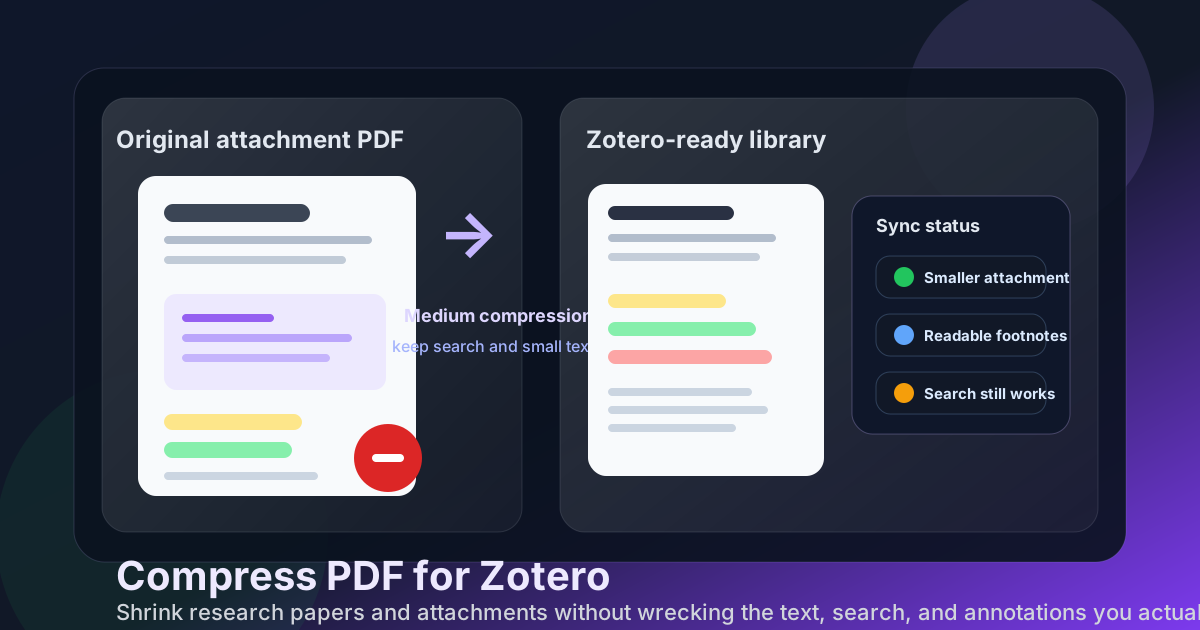
Table of contents
- Quick start: compress a PDF for Zotero in under 2 minutes
- Why smaller PDFs help in Zotero
- What file size should you aim for?
- Which compression level should you choose?
- Step-by-step: shrink a Zotero PDF with LifetimePDF
- Best strategy for common Zotero file types
- What if the PDF is still too large?
- How to keep search, highlights, and small text usable
- Workflow habits that keep Zotero libraries cleaner
- Related LifetimePDF tools and useful internal links
- FAQ (People Also Ask)
Quick start: compress a PDF for Zotero in under 2 minutes
If your real goal is simply make this research PDF lighter before it lives in Zotero, this workflow is usually enough:
- Open Compress PDF.
- Upload the final article, chapter, report, or scanned paper you actually want to save in Zotero.
- Choose Medium compression first.
- Download the smaller PDF and compare the new file size with the original.
- Add it to Zotero or test it in the exact reader workflow you use with Zotero.
- Check the pain points that matter most: tiny footnotes, formulas, OCR search, references, and the passages you would realistically highlight or quote.
- If the file is still heavy, use Extract Pages, Split PDF, or Crop PDF before trying stronger compression.
Why smaller PDFs help in Zotero
Zotero is not just a place where PDFs sit. It is a working research library. The attachment needs to behave well enough that you can open it, skim it, search it, annotate it, sync it, and come back to it later without the file itself becoming the bottleneck.
Why lighter PDFs usually behave better in Zotero
- Less sync friction: smaller attachments move more comfortably across devices and shared research setups.
- Lighter storage footprint: giant scans and bloated exports fill a library faster than most people expect.
- Faster opening and scrolling: especially noticeable with long reports, scan-heavy chapters, and image-rich references.
- Cleaner annotation work: highlighting and note-taking feel better when the document is not sluggish or fuzzy.
- Better portability: smaller files are easier to back up, upload, email, or move into another research workflow later.
- Less attachment clutter: when the working copy is right-sized, you are less likely to keep multiple oversized duplicates around forever.
In other words, compression is not only about storage. It is about making research attachments feel practical enough that your attention stays on the source, not on the file management overhead.
What file size should you aim for?
There is no single perfect number because a 12-page journal article behaves very differently from a 400-page scan, a dissertation appendix, or a book chapter full of figures. Still, practical targets help. The goal is to make the attachment light enough that it stops feeling wasteful while preserving the details you actually need in Zotero.
| Zotero PDF type | Comfortable target | Notes |
|---|---|---|
| Journal articles, working papers, and text-heavy reports | Under 5MB | Usually light enough for easy syncing and readable footnotes while keeping search and annotations comfortable. |
| Book chapters, image-mixed reports, and reference PDFs with charts | 5MB to 15MB | Still practical if figures, formulas, and small references remain easy to inspect. |
| Scanned papers, archival materials, and OCR-heavy sources | 10MB to 25MB | These usually benefit more from OCR, cropping, and splitting than from aggressive compression alone. |
| Huge appendices, proceedings, or multi-part source bundles | Split into smaller parts if possible | One giant attachment is rarely the cleanest Zotero workflow when you only need one section at a time. |
If a PDF stays slightly larger but remains easy to read, search, and cite, that is fine. The goal is not to create the smallest possible file. The goal is to keep the document genuinely useful.
Which compression level should you choose?
Most Zotero users do not need a complicated decision tree. Start with Medium, then only go harder if the attachment is still much heavier than the research job requires.
Low compression
Use Low when the PDF is already fairly clean and you only want a modest size reduction without risking tiny footnotes, equations, screenshots, or figure labels. It is a good choice for papers where small details carry real meaning.
Medium compression
Medium is the best default for most Zotero attachments. It usually cuts enough size to matter while keeping ordinary reading, searching, highlighting, and citation checking comfortable. If you do not have a strong reason to choose something else, start here.
High compression
Use High only when the file is still annoyingly large after smarter cleanup or when the attachment is mostly a convenience copy rather than a precision reading copy. High can be fine for casual reference, but it deserves a quality check afterward. Tiny references, weak scans, and formula-heavy pages are where problems usually show up first.
Step-by-step: shrink a Zotero PDF with LifetimePDF
- Start with the final file. Use the exact PDF you plan to save in Zotero, not an older export or draft copy.
- Open Compress PDF.
- Choose Medium compression first. This is usually the safest balance for research-heavy documents.
- Download the smaller copy. Compare the result with the original so you know whether the reduction was meaningful.
- Add the smaller copy to Zotero. If the original is already in your library, test carefully before replacing anything important.
- Review the hard parts. Check a footnote, formula, bibliography entry, table label, or OCR search query where clarity matters most.
- Adjust only if necessary. If the file is still too heavy, split it, crop blank scan borders, remove unused pages, or OCR the document before trying stronger compression.
- Keep the original until you are sure. Once the smaller copy passes the real reading and search test, use it as the working attachment and archive the heavier source if you still need it.
Best strategy for common Zotero file types
Not every Zotero attachment deserves the same treatment. The cleanest workflow depends on what kind of source you are actually saving.
Journal articles and preprints
These often compress well. Prioritize readability of references, tables, figure captions, equations, and any passages you may want to annotate or cite later. If the source is already text-heavy and clean, Medium compression is usually enough.
Book chapters and long reports
These are often bigger because they contain more pages, images, and side matter. They usually benefit from a combination of compression plus page extraction. If you only need one chapter or one appendix, there is no reason to make the entire library carry more weight than the project needs.
Scanned papers and archival sources
These are the usual troublemakers. Compression helps, but the bigger win often comes from trimming blank borders, removing duplicate scan pages, and running OCR PDF so the attachment stays searchable after it lands in Zotero.
Supplementary appendices and data-heavy PDFs
If the appendix matters, keep it readable. If it does not, split it away. Giant source bundles are one of the easiest ways to make a library heavier than it needs to be.
Already annotated attachments
Treat these gently. If the PDF already carries meaningful highlights, notes, or comments, make a backup first and verify that the smaller copy still behaves correctly before you replace the attachment. Compression is safest before the file becomes deeply embedded in your research workflow.
What if the PDF is still too large?
If one compression pass was not enough, do not immediately jump to the harshest setting. First ask what is actually making the file heavy. Often the real answer is too many pages, scanner waste, or a document that should have been split into cleaner parts.
- Use Extract Pages when you only need part of the chapter, report, or appendix.
- Use Delete Pages to remove blank scans, duplicate leaves, covers, and dead matter.
- Use Split PDF for giant source bundles that work better as sections.
- Use Crop PDF if empty margins or scan borders are inflating the file.
- Use OCR PDF if the real problem is poor searchability, not just file size.
- Keep a heavier archive copy only if the untouched original genuinely matters; otherwise a cleaner working copy is often the better research attachment.
In many research workflows, a cleaner PDF beats a more aggressively compressed PDF. Removing noise usually helps more than squeezing every page harder.
How to keep search, highlights, and small text usable
Zotero users notice damage fast because research reading is detail-heavy. If the PDF gets fuzzy, the pain shows up in the exact places you care about: footnotes, formulas, table labels, bibliographies, and search results that suddenly feel unreliable.
Check these before you keep the smaller copy
- Footnotes and references: zoom into the smallest citation text on a dense page, not just the title page.
- Formulas, tables, and figure labels: these are easy to damage with over-compression.
- OCR search: run a real search for a keyword or author name and make sure the result is still trustworthy.
- Highlight targets: mark one or two passages you would realistically annotate and make sure the text still feels precise.
- Scanned paragraphs: faint letters and gray scan noise often reveal quality loss before larger text does.
The simplest rule is this: test the smallest important detail, not the prettiest page. If that hard case still looks good, the rest of the document is usually fine.
Workflow habits that keep Zotero libraries cleaner
Compression works best when it sits inside a sensible research workflow. A few habits make a bigger difference than most people expect.
- Compress before adding to Zotero when possible: it is cleaner to start with a right-sized attachment than to repair a bloated one later.
- Keep clear file versions: if you need both the archive copy and the working copy, name them so the difference is obvious.
- Split giant sources by the way you actually read: by chapter, appendix, report section, or week.
- OCR scans before deep annotation work: searchable text often adds more value than one more round of raw compression.
- Remove dead weight early: covers, scan blanks, duplicate pages, and irrelevant appendices do not deserve permanent library space.
- Test on the device you really use: a PDF that feels fine on a large desktop monitor may still feel clumsy on a tablet or laptop during real reading.
A better Zotero library is not the one with the biggest files. It is the one where the attachments stay light, searchable, and calm enough that you can focus on the sources themselves.
Related LifetimePDF tools and useful internal links
Compressing the PDF is usually the main fix, but some Zotero attachments benefit from one or two supporting tools first. These are the most useful follow-up options:
- Compress PDF - shrink the final attachment before it enters your library.
- OCR PDF - make scanned sources more searchable.
- Extract Pages - keep only the chapters or appendices that matter.
- Delete Pages - remove blanks, duplicates, covers, and dead weight.
- Crop PDF - trim scanner borders and oversized margins.
- PDF Metadata Editor - clean document properties before filing or sharing.
If you want related reading around the same workflow, these guides fit naturally next: Compress PDF for MarginNote, Compress PDF for LiquidText, Compress PDF for DEVONthink, Compress PDF for Obsidian, and OCR PDF.
Best workflow for most Zotero attachments: clean the PDF first, compress it once, test one real search and one real highlight, then save the smaller copy only if it still feels trustworthy.
FAQ (People Also Ask)
1) How do I compress a PDF for Zotero?
Upload the final PDF to a compressor, start with Medium compression, and keep the smaller copy only if footnotes, OCR text, formulas, references, and highlighted passages still look clean after you add it to Zotero. For most research workflows, Medium is the safest first step because it reduces size without making the document rough to read, search, or annotate.
2) What PDF size should I aim for in Zotero?
Under 5MB is a strong target for ordinary text-heavy journal articles and working papers. Heavier chapters, reports, and scan-heavy attachments often land around 5MB to 20MB and can still feel practical if zooming, OCR, and small references remain readable.
3) Will compression break Zotero highlights, notes, or OCR search?
Usually not if you start with Medium compression and the source PDF is already clean. Problems usually show up in weak scans, tiny footnotes, formulas, or poor OCR. Always test one highlighted passage and one real search query before replacing an attachment you care about.
4) Should I compress a PDF before adding it to Zotero?
Yes, when possible. Compressing before you file the PDF is cleaner because the library starts with the right-sized attachment from the beginning. If the PDF is already annotated, make a backup and confirm the smaller copy still behaves correctly before replacing it.
5) Which LifetimePDF tools pair best with Zotero?
Compress PDF is the main starting point. OCR PDF, Extract Pages, Split PDF, Crop PDF, Delete Pages, and PDF Metadata Editor are the most useful companions when you want lighter, cleaner research attachments before they enter Zotero.
Published by LifetimePDF - Pay once. Use forever.