OCR PDF: Make Scanned PDFs Searchable, Selectable, and Actually Usable
To OCR a PDF, upload the scanned or image-based file to an OCR tool, let it add a readable text layer, then test the result by searching for a visible word or copying a line.
If the PDF behaves like a picture instead of normal selectable text, OCR is the step that makes it searchable, reusable, and much easier to work with.
Most people looking for OCR are not trying to learn a technical acronym for fun. They are stuck with a contract scan, a receipt packet, a copier export, a photographed handout, or an old archive that looks readable to the eye but refuses to cooperate with search, copy-paste, summaries, translation, or AI tools. Good OCR fixes that. The real trick is knowing when a file actually needs OCR, how to improve the source before processing it, and what to do with the result once the words are finally usable again.
Fastest path: use LifetimePDF's OCR PDF tool, verify the important details once, then keep the searchable PDF or send it into PDF to Text if you need reusable text outside the file.
Need the short version? Jump to Quick start: OCR a PDF in a few minutes.
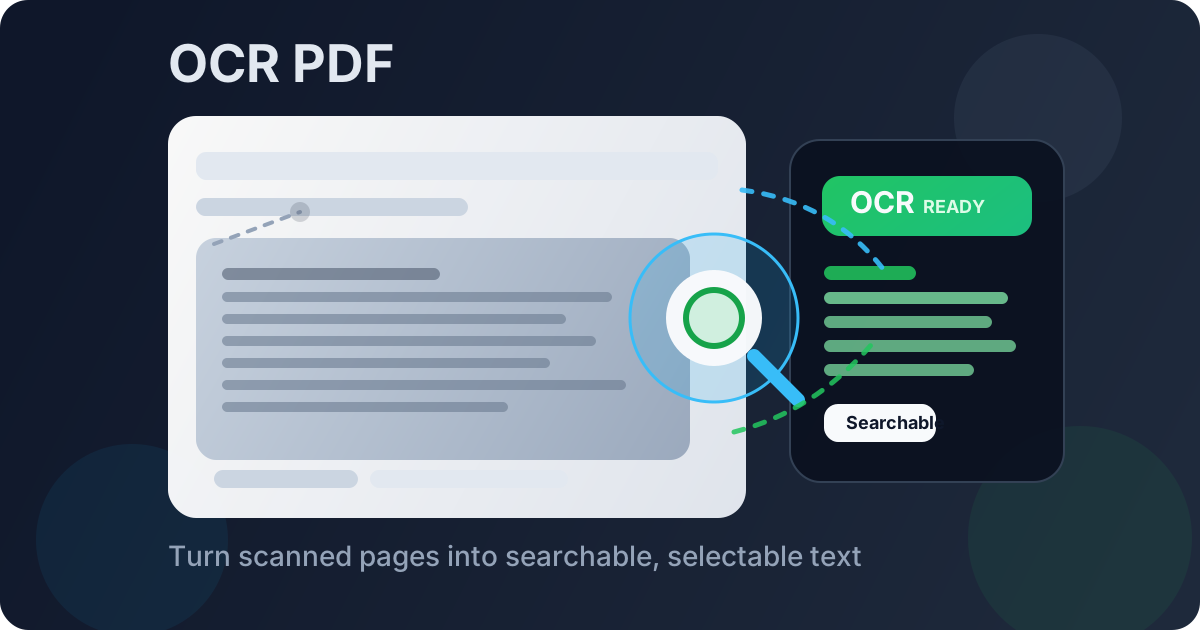
Table of contents
- Quick start: OCR a PDF in a few minutes
- What “OCR PDF” really means
- How to tell when a PDF actually needs OCR
- Step-by-step: how to OCR a PDF cleanly
- Searchable PDF vs plain text: which output should you keep?
- How to improve OCR accuracy before you start
- Best real-world use cases for OCR
- What to do after OCR
- Privacy and safer document handling
- Related LifetimePDF tools and internal guides
- FAQ (People Also Ask)
Quick start: OCR a PDF in a few minutes
If the PDF came from a scanner, copier, camera, or paper archive and you just need it to behave like a normal document again, this workflow is usually enough:
- Open OCR PDF.
- Upload the scanned or image-based file.
- Run OCR so the PDF gains a machine-readable text layer.
- Test the result by searching for a visible word or copying one short paragraph.
- If you need the content outside the PDF, use PDF to Text after OCR.
What “OCR PDF” really means
OCR means optical character recognition. In practice, it means software looks at letters trapped inside a scanned page image and turns them into text that software can actually understand. That is why an OCRed PDF becomes searchable, selectable, and far easier to reuse.
This matters because a lot of PDFs are not true text documents at all. They are photographs of pages, copier exports, scans of old paperwork, or flattened printouts. To a human, the page looks readable. To software, it is often just one large image.
| What you want | What is blocking you | Best next step |
|---|---|---|
| Search for a word or clause | The page is image-only | Run OCR first |
| Copy text into notes or email | Copy-paste returns nothing useful | OCR, then extract text |
| Summarize or ask questions about the file | The tool cannot see real text | OCR before AI workflows |
| Translate the document | The translator is reading a picture, not text | OCR, then translate |
| Archive old paper files cleanly | The scans are readable but not searchable | OCR and keep searchable copies |
How to tell when a PDF actually needs OCR
A lot of frustration comes from using the wrong workflow on the wrong kind of file. Before you do anything else, run three fast checks.
1. Try highlighting one sentence
If you can drag across a normal line of text and select the words, the PDF may already contain real text. If the whole page behaves like one big block or image, OCR is probably needed.
2. Search for a word you can clearly see
Use Ctrl+F or Cmd+F and look for a visible word.
If search finds nothing even though the word is obvious on the page, the PDF likely has no usable text layer.
3. Try a small copy-paste test
Copy one short paragraph. If the result is blank, scrambled, or weirdly incomplete, that is another sign the file is scan-based or has a damaged text layer.
| What you notice | What it usually means | What to do |
|---|---|---|
| You can highlight and search text normally | The PDF already contains digital text | Try PDF to Text instead of OCR |
| The page acts like one image | The file is probably scan-based | Use OCR PDF |
| Search fails on visible words | No usable text layer exists | Run OCR, then retest |
| Copied text is broken or empty | The file may need OCR or cleanup first | Rotate, crop, then OCR |
Step-by-step: how to OCR a PDF cleanly
The basic button-clicking is easy. The quality of the result usually depends on what you do right before and right after the OCR step.
Step 1: Start with the pages you actually need
If the packet includes a lot of extra pages, isolate the useful ones first. Smaller focused files are easier to review after OCR and reduce the chance that you waste time on irrelevant pages. Use Extract Pages if only part of the document matters.
Step 2: Clean obvious scan problems
OCR works better on upright, readable pages. If the source is visibly messy, fix the easy issues before processing:
- Rotate PDF for sideways or upside-down pages
- Crop PDF to remove dark borders, desk background, or wasted margins
- Extract Pages to keep only the pages worth processing
Step 3: Run OCR
Upload the file to LifetimePDF OCR PDF and let the tool create a text layer. This is the point where the document stops being just an image and starts acting like a document again.
Step 4: Verify the high-risk details first
You do not need to proofread every line immediately. Start with the details that are most expensive to misread:
- Names of people, companies, and places
- Dates, deadlines, clause numbers, and reference IDs
- Totals, invoice numbers, account numbers, and prices
- Headings, table labels, and any words used for later search
Step 5: Decide what output you really need
Sometimes the searchable PDF is enough. Sometimes you need reusable text outside the PDF. The best output depends on whether layout still matters or whether the words themselves matter more. That is why OCR is usually a gateway step rather than the finish line.
Recommended workflow: check the file → clean the scan if needed → OCR → verify the risky details → choose the output that fits the job.
Searchable PDF vs plain text: which output should you keep?
This is where a lot of users hesitate. OCR gives you more than one useful path, and the right choice depends on the job.
Keep the searchable PDF when layout still matters
If you still need the original page look, signatures, stamps, page flow, or document structure, keeping the OCRed PDF is usually the best choice. You get search and selection without giving up the visual shape of the file.
Extract plain text when content matters more than page design
If you want notes, quotes, summaries, translation, spreadsheet entry, or content reuse, plain text is often better. After OCR, use PDF to Text to pull the words out cleanly.
| If your goal is... | Best output | Why |
|---|---|---|
| Search the original file later | Searchable PDF | Keeps the same page layout while adding a text layer |
| Copy wording into notes or email | Plain text | Faster to reuse outside the PDF |
| Summarize, translate, or analyze content | Either works, but plain text often feels cleaner | Text-first workflows reduce friction |
| Preserve the file as evidence or reference | Searchable PDF | The document still looks like the original |
How to improve OCR accuracy before you start
Better input creates better OCR. A few minutes of cleanup before processing usually helps more than trying to rescue a bad output later.
- Upright pages with clear orientation
- Sharp printed text and decent contrast
- Minimal scanner borders, glare, or desk shadows
- Only the pages you actually need
- Clean scans instead of blurry camera photos
- Sideways or crooked pages
- Dark edges, folds, glare, or punched holes
- Tiny type, dense tables, or multi-column layouts
- Handwriting on top of printed content
- Stamps or signatures covering key words
| Problem | Best fix | Why it helps |
|---|---|---|
| Sideways pages | Rotate before OCR | Recognition works better when the text is upright |
| Heavy borders or background noise | Crop the page area | Removes visual clutter around the text block |
| Large mixed packet | Extract only needed pages | Makes the review step faster and more focused |
| Critical names or numbers | Manual spot-check | Prevents costly mistakes later |
Best real-world use cases for OCR
OCR matters most when someone has a real downstream task, not just a curiosity about the file. These are some of the most common cases.
Contracts, forms, and signed paperwork
- Search specific clauses without endless scrolling
- Copy wording into review notes or email
- Prepare the file for summary, translation, or Q&A
Invoices, receipts, and finance packets
- Find invoice numbers, totals, suppliers, and due dates quickly
- Move extracted details into a spreadsheet or accounting process
- Recover searchable records from old paper archives
Office archives and legacy records
- Make old scans searchable again
- Reduce time spent hunting through static image files
- Support indexing, audit review, and knowledge workflows
School handouts, research packets, and study materials
- Pull quotes and notes from scanned readings
- Search long packets for names, terms, dates, and citations
- Feed the content into summaries or study guides
What to do after OCR
OCR is often just the first useful step. Once the words become machine-readable, a better document workflow opens up.
Extract plain text
If content reuse matters more than layout, send the OCRed file into PDF to Text. This is useful for notes, quotes, documentation, spreadsheets, or cleanup.
Translate the document
OCR first, then use Translate PDF. Translation tools work much better when they receive readable text rather than a page image.
Summarize or ask questions
OCRed files work far better with PDF Summarizer and AI PDF Q&A because those tools can finally see the underlying content clearly.
Protect or redact sensitive files
If the document contains confidential details, use Redact PDF or PDF Protect before sharing it more widely.
Rebuild a cleaner deliverable
If the original scan is ugly but the text itself is what matters, you can rebuild a cleaner final document after extraction. That is often easier than pretending the old scan will ever feel polished.
Privacy and safer document handling
OCR is often used on exactly the files you should treat carefully: contracts, IDs, HR records, finance documents, and internal paperwork. So the workflow should not just be about recognition quality. It should also be about handling the document responsibly.
- Process only what you need: isolate the relevant pages before OCR when possible.
- Verify sensitive fields: OCR mistakes on names, dates, totals, or IDs matter more than cosmetic formatting issues.
- Redact confidential details first when appropriate: use Redact PDF.
- Protect the final file before sharing: use PDF Protect.
Related LifetimePDF tools and internal guides
OCR works best when it connects to the rest of the document job. These tools and guides fit naturally around it:
- OCR PDF - turn scan-based PDFs into searchable documents.
- PDF to Text - extract plain text after OCR.
- Rotate PDF - fix sideways pages before recognition.
- Crop PDF - remove borders and scanner noise.
- Extract Pages - isolate only the pages that need OCR.
- PDF Summarizer - condense long OCRed files quickly.
- AI PDF Q&A - ask questions about OCRed content.
- Translate PDF - translate readable text after OCR.
- Redact PDF - remove confidential details before wider sharing.
- PDF Protect - secure the final file.
Related blog guides
- OCR PDF Online
- OCR PDF Online Free
- OCR PDF Without Monthly Fees
- Make PDF Searchable Online Free
- Extract Text from Scanned PDF Online Free
- Convert Scanned PDF to Text Online
- Convert Scanned PDF to Word Online
- Translate Scanned PDF Online Free
- OCR vs Copy Paste: Which Method Works Better?
Ready to make your scanned PDF usable again? OCR the file, verify the details that matter, then move straight into extraction, translation, summary, or secure sharing.
Best practical sequence: clean the scan if needed → OCR → verify key details → keep the searchable PDF or extract text → protect or share.
Published by LifetimePDF - Pay once. Use forever.
FAQ (People Also Ask)
How do I OCR a PDF?
Upload the scanned or image-based PDF to an OCR tool, let it process the pages into readable text, then test the result by searching for a visible word or copying a line. If the scan is sideways or noisy, rotate or crop it first for cleaner output.
When does a PDF need OCR?
A PDF usually needs OCR when you cannot naturally highlight text, search does not find visible words, or the pages behave like flat images from a scanner, copier, or phone capture.
Does OCR make a PDF searchable?
Yes. OCR adds a text layer so the PDF becomes searchable and selectable. That also makes extraction, translation, summarization, and Q&A workflows much more reliable.
What should I verify after OCR?
Check names, dates, totals, invoice numbers, clause references, and any wording that would be costly to misread. OCR can be excellent on clean scans, but important details still deserve a quick review.
Should I keep the OCRed PDF or extract plain text?
Keep the OCRed PDF when the original layout still matters and you mainly want search and selection. Extract plain text when you need to quote, summarize, translate, or reuse the content outside the PDF.