Compress PDF for Tidio: Keep Chat Attachments, Help Docs, and Support PDFs Easy to Open
To compress a PDF for Tidio, upload the final chat attachment, help doc, invoice, return sheet, warranty PDF, or support handoff file to LifetimePDF's Compress PDF tool, start with Medium compression, and keep the smaller copy only after screenshots, order numbers, and instructions still look clean in the real Tidio conversation, support thread, or handoff workflow where the file gets reopened.
For most Tidio PDFs, under 2MB is a strong target for simple guides, receipts, and policy handouts, while longer screenshot-heavy, scan-heavy, or multi-page files usually work best around 2MB to 5MB after light cleanup.
Tidio works best when support feels fast and clear. A heavy PDF adds friction at exactly the wrong moment: when a customer needs instructions, proof, or a next step without waiting. The goal is not the tiniest possible file. It is the lightest PDF that still feels sharp, reliable, and easy to trust.
Fastest path: run the Tidio PDF through LifetimePDF's Compress PDF tool on Medium, then extract key pages or split a bulky appendix only if the document is still heavier than the real support workflow needs.
In a hurry? Jump to Quick start: compress a Tidio PDF in about 2 minutes.
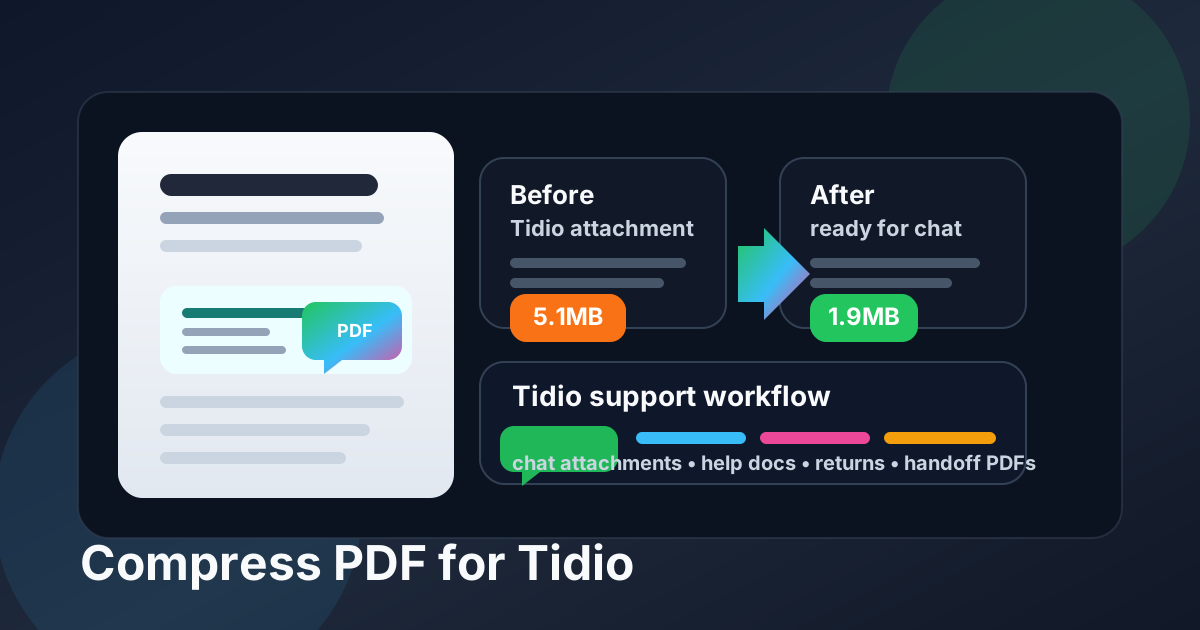
Table of contents
- Quick start: compress a Tidio PDF in about 2 minutes
- Why Tidio PDFs get heavy so quickly
- Where large PDFs create friction in Tidio
- What file size should you aim for?
- Which compression level should you choose?
- Step-by-step: shrink a Tidio PDF with LifetimePDF
- Best strategy for common Tidio PDF types
- What if the file is still too big?
- How to keep screenshots, order numbers, and instructions readable
- Workflow habits that keep Tidio PDFs lighter
- Related LifetimePDF tools and useful internal reading
- FAQ (People Also Ask)
Quick start: compress a Tidio PDF in about 2 minutes
If your goal is simply make this PDF smaller so it is easier to use in Tidio, this is the cleanest workflow:
- Open Compress PDF.
- Upload the exact PDF you plan to use in Tidio.
- Choose Medium compression first.
- Download the smaller copy and check the new size.
- Open the file on the busiest page and confirm screenshots, item numbers, labels, and directions still read clearly.
- If the PDF is still too heavy, extract only the necessary pages or split the file before moving to stronger compression.
Why Tidio PDFs get heavy so quickly
Most support PDFs do not start huge on purpose. They grow because each small convenience adds weight: extra screenshots, duplicated pages, oversized scans, brand-heavy exports, long return policies, internal notes, or multiple versions packed into one file. By the time someone attaches the document in Tidio, the file is doing more jobs than the conversation actually needs.
That matters because chat-based support is timing-sensitive. Customers are not opening the file hours later in a calm review session. They are usually waiting inside a live conversation, checking a handoff message, or reopening a help document on mobile while trying to finish a task. Lighter PDFs reduce that friction immediately.
Why smaller PDFs work better in Tidio
- Faster opens: better for live chat and quick follow-up moments.
- Less upload friction: helpful when agents are moving quickly between chats.
- Cleaner customer experience: a concise file feels more intentional than a bulky dump.
- Better mobile viewing: smaller files are easier for customers to load on phones.
- Smoother handoffs: teammates can review the same file without waiting through unnecessary bulk.
Where large PDFs create friction in Tidio
Big PDFs are especially annoying in support contexts where the file is meant to remove confusion, not create a new delay. Tidio teams often run into problems when the attachment is supposed to help with:
- product setup or troubleshooting instructions,
- returns, exchanges, or warranty paperwork,
- invoices, receipts, or payment confirmations,
- order-related proof, shipping labels, or claim documents,
- internal handoff summaries for another agent or manager.
In each case, the customer rarely needs every page that was exported. They need the right page, the right detail, and a file that opens without resistance.
What file size should you aim for?
There is no single perfect number, but these targets work well for most Tidio workflows:
- Under 1MB: ideal for short receipts, simple help sheets, and lightweight one- or two-page attachments.
- Under 2MB: a strong default for most customer-facing support PDFs.
- 2MB to 5MB: reasonable for longer return instructions, screenshot-heavy guides, or multi-page handoff files.
- Over 5MB: usually a sign the file should be cleaned up, split, or trimmed before sharing.
The right target depends on whether the PDF is mostly text, mostly images, or mostly scans. What matters more than the exact number is whether the smallest important detail still reads clearly without zoom frustration.
Which compression level should you choose?
Start with the least force that solves the problem. That keeps the document readable while still trimming the bulk that slows support work down.
- Low compression: best when tiny labels, serial numbers, diagrams, or dense screenshots must stay especially crisp.
- Medium compression: the best default for most Tidio files because it reduces size without making the document feel degraded.
- High compression: useful for scan-heavy or image-heavy PDFs when size matters more than perfect visual fidelity.
If you are unsure, use Medium first, then inspect the smallest text, thinnest lines, and busiest screenshot before deciding whether to go further.
Step-by-step: shrink a Tidio PDF with LifetimePDF
- Use the final version. Do not compress an outdated draft if the real file still contains extra pages or heavier images.
- Open Compress PDF.
- Upload the PDF. This might be a help guide, invoice, return packet, screenshot-heavy troubleshooting document, or support handoff file.
- Pick Medium compression. That is usually the safest first pass for Tidio use.
- Download the result.
- Review the smallest important detail. Check item numbers, links, screenshot labels, form fields, signatures, and barcodes if they matter.
- Test the real workflow. Open the file the same way an agent or customer will actually receive it.
- Trim further only if needed. Extract pages, delete extras, or split the file instead of forcing maximum compression too early.
Best strategy for common Tidio PDF types
Different PDFs benefit from different cleanup choices. Matching the fix to the file type works better than compressing everything the same way.
Help docs and troubleshooting guides
These often include screenshots, arrows, callouts, and step lists. Start with Medium compression and make sure the smallest screenshot labels still read comfortably. If the guide covers several unrelated issues, splitting it into narrower PDFs is often better than forcing one giant guide through stronger compression.
Returns, exchanges, and warranty instructions
These documents usually need to stay clear because customers are following steps under pressure. Compress first, then double-check tracking numbers, deadlines, addresses, and any checkbox or signature area. If the packet includes internal policy pages the customer does not need, remove them before sharing.
Invoices, receipts, and payment PDFs
These are often safe to compress lightly because they are text-forward. Still, always review totals, tax lines, invoice numbers, and any approval marks. For a short invoice or receipt, aiming well under 1MB is usually realistic without sacrificing trust.
Screenshot-heavy support evidence
This is where people over-compress and regret it. If the PDF exists mainly to show error messages, UI states, or account history, readability matters more than shaving off every possible kilobyte. Keep the version where the screenshot still proves the point instantly.
Scanned forms and handoff files
Scans are often bulkier than necessary because empty borders, shadows, and repeated pages add weight fast. Compress them, then use Crop PDF, Delete Pages, or Extract Pages if the file still feels heavier than the support case requires.
What if the file is still too big?
If Medium compression does not get you close enough, do not jump straight to maximum compression. Clean the file in smarter ways first:
- use Extract Pages to keep only the customer-facing section,
- use Delete Pages to remove duplicate exports or irrelevant appendices,
- use Split PDF when one file is trying to handle several separate support jobs,
- use Crop PDF to trim wasted scan borders,
- re-export a cleaner original if the source document itself is overloaded with giant images.
Compression works best after structure improves. If you try to fix a messy file only by shrinking it harder, readability usually pays the price.
How to keep screenshots, order numbers, and instructions readable
Before you replace the original attachment, check the things customers and agents actually rely on:
- order numbers, invoice numbers, case IDs, and tracking references,
- small screenshot labels, UI highlights, and error messages,
- return steps, dates, addresses, and deadlines,
- barcode areas, signature blocks, and form fields,
- the busiest page in the file, not only the cleanest one.
If any of those feel fuzzy, uncertain, or tiring to zoom into, keep the lighter setting or clean the file another way. Compression should remove waste, not confidence.
Workflow habits that keep Tidio PDFs lighter
A few habits stop support attachments from bloating again:
- send the final customer-facing PDF, not the internal prep bundle,
- keep archived versions separate instead of stacking them into one live file,
- replace duplicate screenshots instead of collecting several almost-identical pages,
- use cleaner digital originals when possible instead of rescanning a document that already exists electronically,
- check mobile readability before deciding the PDF is truly ready.
Those habits matter because support speed is cumulative. A slightly lighter, cleaner PDF saves time every time the file is reopened, forwarded, or reviewed in the next handoff.
Related LifetimePDF tools and useful internal reading
If Tidio is only one part of your support stack, these tools and guides pair well with this workflow:
- Compress PDF for the main size-reduction step.
- Extract Pages when only the key support pages should stay attached.
- Delete Pages to remove duplicate exports or irrelevant history.
- Split PDF to separate a customer-facing file from internal material.
- Crop PDF to trim wasted scan borders.
- PDF Metadata Editor for cleaner document properties before sharing.
- Compress PDF for LiveChat.
- Compress PDF for Intercom.
- Compress PDF for Help Scout.
- Compress PDF for Freshdesk.
- Compress PDF for Front.
- Lifetime access if PDF cleanup is a repeat part of your support workflow.
Bottom line: for most Tidio PDFs, start with Medium compression, test the real workflow, and trim page weight before you use stronger compression.
FAQ (People Also Ask)
How do I compress a PDF for Tidio?
Upload the final PDF to a compressor, start with Medium compression, download the smaller copy, and test it in the real Tidio workflow before replacing the original. Medium is usually the safest first pass because it lowers file size without making screenshots, order numbers, invoices, or instructions harder to trust.
What file size should I aim for in Tidio?
For short help docs, policy handouts, and everyday support attachments, under 2MB is a strong target. Longer return packets, screenshot-heavy guides, and multi-page scanned files usually work best around 2MB to 5MB as long as the smallest useful detail still reads clearly.
Will PDF compression blur screenshots or tracking details in Tidio?
It can if you compress too aggressively. That is why Medium compression is the best place to start. Always check screenshots, order references, serial numbers, labels, signatures, and the busiest page before you keep the smaller file.
Should I split a large PDF instead of compressing it harder?
Often, yes. If one PDF combines the customer-facing document with internal notes, historical pages, or a long appendix, splitting it usually creates a cleaner Tidio workflow than forcing the whole bundle through aggressive compression.
Which LifetimePDF tools pair best with Tidio?
Compress PDF is the main starting point. Extract Pages, Delete Pages, Split PDF, Crop PDF, PDF Metadata Editor, and OCR PDF are especially useful when you want smaller, cleaner Tidio attachments without carrying extra pages, scan waste, hidden metadata, or image-only text forward.
Published by LifetimePDF - Pay once. Use forever.