Compress PDF for Bookends: Keep Research Libraries Lighter Without Hurting Search or Readability
To compress a PDF for Bookends, upload the final paper, chapter, report, or scan to LifetimePDF's Compress PDF tool, start with Medium compression, and keep the smaller copy only if text search, page numbers, footnotes, and figures still look clean when you reopen it.
For most Bookends libraries, aim for under 5MB for ordinary text-heavy papers and roughly 5MB to 15MB for longer chapters, appendix-heavy reports, or scan-heavy files that still need readable detail.
Bookends libraries rarely get heavy all at once. It is usually gradual: one journal article becomes twenty, then a few book chapters, then scanned archive pages, then a shared review packet you only needed one section from. The goal is not to crush every PDF into the smallest possible file. The goal is to keep attached sources light enough to manage comfortably while preserving the details you still need when you search, reread, quote, or verify a page reference.
Fastest path: run the PDF through LifetimePDF's Compress PDF tool on Medium, then test one dense paragraph, one figure-heavy page, and one text-search check before you keep the smaller Bookends attachment.
Need the short version? Jump to Quick start: compress a PDF for Bookends in under 2 minutes.
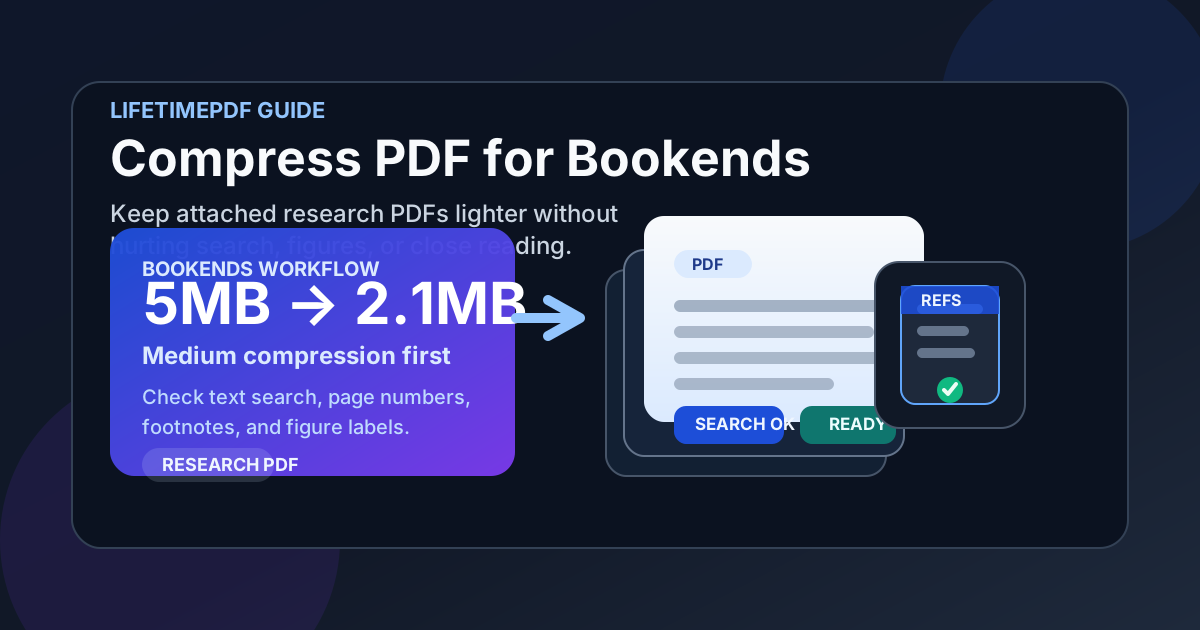
Table of contents
- Quick start: compress a PDF for Bookends in under 2 minutes
- Why smaller PDFs help in Bookends
- What file size should you aim for?
- Which compression level should you choose?
- Step-by-step: shrink a Bookends PDF with LifetimePDF
- Best strategy for common Bookends file types
- What if the PDF is still too large?
- How to protect search, page references, and close reading
- Workflow habits that keep a Bookends library cleaner
- Related LifetimePDF tools and useful internal links
- FAQ (People Also Ask)
Quick start: compress a PDF for Bookends in under 2 minutes
If your real goal is simply make this attachment lighter before it lives in Bookends, this workflow is usually enough:
- Open Compress PDF.
- Upload the final paper, chapter, report, appendix, or scanned source you actually plan to keep.
- Choose Medium compression first.
- Download the smaller PDF and compare the new size with the original.
- Check one dense paragraph, one figure or table page, and one text search or copy-and-paste test.
- If the file is still too heavy, use Extract Pages, Split PDF, or Crop PDF before you try harsher compression.
Why smaller PDFs help in Bookends
Bookends works best when your references stay easy to manage instead of dragging around unnecessarily heavy attachments. Large PDFs create quiet friction: slower backups, bulkier sync folders, messier shared research handoffs, and a growing temptation to keep oversized source packs exactly as they arrived rather than keeping only what you actually need.
Why lighter PDFs usually work better in a Bookends library
- Less attachment bloat: research libraries grow faster than most people expect once papers, chapters, and reports start stacking up.
- Easier source review: lighter PDFs are simpler to reopen when you only need one page reference, figure, or quotation check.
- Cleaner sharing and backup: smaller files move more smoothly through cloud folders, external drives, and collaborator handoffs.
- Better discipline with scan-heavy material: archive copies and old chapter scans stop feeling like permanent ballast.
- Less hesitation about keeping useful sources: right-sized attachments make it easier to keep what matters without turning the library into storage debt.
- A calmer working library: when attachments behave well, you spend more time reading and citing, not managing file weight.
Compression is not just a storage trick. It is a quality-of-life step for anyone who wants a research library that stays practical over time.
What file size should you aim for?
There is no perfect universal number because a 12-page journal article behaves very differently from a 250-page report or a noisy scan. Still, practical target ranges help. The real goal is to make the file light enough that it stops feeling wasteful without damaging the pages you actually need to trust later.
| Bookends PDF type | Comfortable target | Notes |
|---|---|---|
| Journal articles, preprints, and text-heavy papers | Under 5MB | Usually small enough to feel efficient while keeping ordinary reading and search comfortable. |
| Book chapters, report-style PDFs, and mixed text-plus-figure files | 5MB to 15MB | Still practical if small text, page numbers, captions, and tables remain easy to inspect. |
| Scanned archive material, old chapters, and packets | 10MB to 20MB | These usually benefit more from cropping, splitting, and OCR than from aggressive compression alone. |
| Very large bundles or appendices | Split into smaller parts if possible | One giant attachment is rarely the cleanest way to keep material you revisit section by section. |
If the file stays a little larger but still feels trustworthy when you zoom in and read closely, that is fine. The smallest possible PDF is not automatically the best PDF.
Which compression level should you choose?
You usually do not need a complicated decision tree here. Start with Medium, then go stronger only if the file is still much heavier than the job really requires.
Low compression
Use Low when the PDF already looks clean and you only want a modest reduction without risking tiny footnotes, equations, screenshots, charts, or page numbers. It is a strong choice for visually detailed papers.
Medium compression
Medium is the best default for most Bookends attachments. It usually trims enough size to matter while keeping reading, searching, quoting, and later verification comfortable. If you are unsure, start here.
High compression
Use High only when the source PDF is still annoyingly heavy after smarter cleanup or when the document is more of a convenience copy than a close-reading source. High can work, but it deserves a real quality check afterward.
Step-by-step: shrink a Bookends PDF with LifetimePDF
- Start with the final file. Use the exact paper, chapter, report, or scan you actually plan to keep, not a rough export or earlier draft.
- Open the compressor. Go to LifetimePDF Compress PDF.
- Upload the source. Wait for the file to finish loading fully before you choose settings.
- Pick Medium first. This is usually the safest balance for research attachments.
- Download the smaller copy. Compare the new size with the original so you know whether the reduction was actually worth it.
- Check one difficult page. Open a page with dense text, footnotes, tables, equations, or a figure and make sure it still looks trustworthy.
- Run one search test. Search for a term you know appears in the document or copy a sentence to confirm the text layer still behaves sensibly.
- Keep the smaller copy only if it passes. If not, try a lighter setting or clean the document structure instead of forcing harsher compression.
Best strategy for common Bookends file types
Different research files fail in different ways. The best compression choice depends on what the PDF is for and how closely you still need to read it.
Journal articles and preprints
These usually compress well because they are mostly structured text with predictable figures. Medium is often enough to cut weight without damaging the pages you revisit for citations, quotes, or quick fact checks.
Book chapters and long reports
These often carry more blank margins, front matter, appendices, and repeated pages than you actually need. If compression alone does not help enough, Extract Pages or Delete Pages can remove dead weight more cleanly than aggressive quality loss.
Scanned archive material
Scan-heavy sources respond best to cleanup first. Trim wasted borders with Crop PDF, then use OCR PDF if searchability matters. Compression matters here, but it should not be the only move.
Figure-heavy technical papers
Be careful with charts, microscopy images, CAD screenshots, maps, or fine diagrams. Medium may still work well, but this is where you should always inspect captions, axis labels, and tiny legends before you replace the original.
Shared review packets and appendices
If someone sent one bulky PDF that really contains three or four separate materials, splitting it into smaller parts is usually better than forcing the whole thing through extreme compression. Cleaner structure often beats harsher settings.
What if the PDF is still too large?
If Medium compression helps but not enough, do not jump straight to maximum compression. There are smarter ways to reduce size while protecting usability.
- Extract only the pages you actually need: chapters, appendices, and article sections often travel with a lot of extra baggage.
- Split oversized bundles: long source packs are easier to manage when they become smaller logical units.
- Crop dead scan borders: wasted margins can eat space without adding any research value.
- OCR strategically: searchable text can matter more than one more round of compression, especially for old scans.
- Delete covers, blank pages, and duplicate inserts: some file weight is simply avoidable clutter.
In other words, if the file is still too large, fix the structure before you punish the image quality.
How to protect search, page references, and close reading
A smaller attachment is only useful if you still trust it when the library is doing real work for you. Before you replace an original file, check the parts that matter most during actual research use.
Check these before you keep the smaller copy
- Page numbers: make sure they are still easy to read when you need to verify a citation quickly.
- Footnotes and endnotes: tiny type is often where compression damage shows up first.
- Captions and table labels: especially important in technical, medical, scientific, and data-heavy papers.
- Search behavior: try a keyword search or copy a line of text to confirm the document still behaves normally.
- Zoomed reading comfort: if the PDF looks muddy at the zoom level you actually use, go back to a lighter version.
Compression should reduce weight, not confidence. If the smaller file makes you hesitate during close reading, it is the wrong version to keep.
Workflow habits that keep a Bookends library cleaner
Good attachment habits save more time than most people expect:
- Compress before attaching when possible: it is cleaner to start with a right-sized source than to repair a bloated one later.
- Keep obvious version names: if you retain both the original and the working copy, label them so you can trust which file is which.
- Attach the material you actually cite: one chapter or appendix is often more useful than a whole export you never reread.
- Clean scans early: crop, OCR, and split before the file becomes permanent library clutter.
- Prefer usable over tiny: a slightly larger PDF that reads well is usually the better long-term choice.
A better Bookends library is not the one with the tiniest files. It is the one where your sources stay readable, searchable, and easy to trust when you come back to them later.
Related LifetimePDF tools and useful internal links
Compressing the PDF is usually the main fix, but some Bookends attachments benefit from one or two supporting tools first. These are the most useful next steps:
- Compress PDF for the main size reduction step.
- OCR PDF when a scanned source needs searchable text.
- Extract Pages when you only need one chapter, appendix, or article section.
- Split PDF for oversized source packs.
- Crop PDF to trim scan borders and wasted margins.
- PDF Metadata Editor to keep cleaned files organized once they are lighter.
If your workflow overlaps with nearby reference-manager guides, these companion articles are useful: Compress PDF for Zotero, Compress PDF for Mendeley, Compress PDF for EndNote, Compress PDF for Citavi, and Compress PDF for RefWorks.
Bottom line: make the PDF lighter on Medium, test one real reading page and one search check, then trim document structure before you sacrifice readability.
FAQ (People Also Ask)
How do I compress a PDF for Bookends?
Upload the final PDF to a compressor, start with Medium compression, and keep the smaller copy only if text search, page numbers, footnotes, and figures still look clean when you reopen it in your real Bookends workflow. Medium is usually the safest first step because it reduces file size without making the paper frustrating to read later.
What size should a Bookends PDF attachment be?
Under 5MB is a strong target for ordinary text-heavy papers and articles. Longer chapters, reports, and scan-heavy sources often land in the 5MB to 15MB range and can still be practical if small text, page numbers, and figures remain readable.
Will compression make paper text or figures harder to read?
Usually not if you begin with Medium compression and the source PDF is already clean. Problems usually show up first in weak scans, tiny footnotes, page numbers, figure captions, and dense tables, so test those before you replace an original file you care about.
Should I compress a PDF before attaching it to Bookends?
Yes, when possible. Starting with the right-sized file is cleaner than attaching a bloated copy first and fixing it later. If the source matters, keep the original until you know the smaller version still reads well.
Which LifetimePDF tools pair best with Bookends?
Compress PDF is the main starting point. OCR PDF, Extract Pages, Split PDF, Crop PDF, and PDF Metadata Editor are the most useful companion tools when you want lighter, cleaner research attachments inside a Bookends library.
Published by LifetimePDF - Pay once. Use forever.