Check PDF File Size Online Free: Confirm MB Limits Before You Upload, Email, or Share
To check PDF file size online free, open the final PDF in a browser-friendly file-details or PDF properties workflow and read the real size in MB or KB before you upload, email, or share it.
If the file is too close to the destination limit, compress it or split it before the portal, inbox, or app rejects it at the worst possible moment.
That is the short answer. The more useful answer is that most file-size problems are not technical mysteries. They are timing problems. The PDF looks finished, the content is correct, and the failure shows up only when you try to attach it to an email, submit it to a form, or send it through a workflow with stricter limits than you expected. A quick free size check helps you catch that mismatch early and choose the lightest fix that actually solves the problem.
Fastest practical path: confirm the real stored size, compare it with the exact destination limit, then compress, split, or leave the PDF alone based on the number instead of guessing.
In a hurry? Jump to quick start: check PDF file size online free in about 4 minutes.
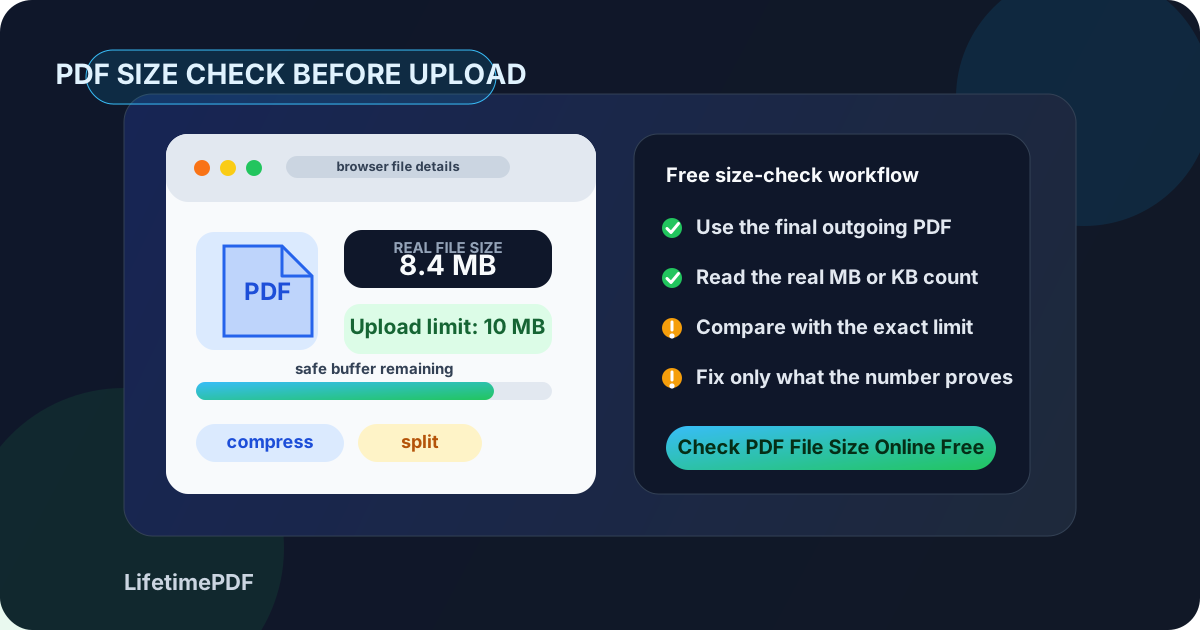
Table of contents
- Quick start: check PDF file size online free in about 4 minutes
- What “check PDF file size online free” actually means
- Where free online size checks matter most
- Step-by-step: practical free online size-check workflow
- Why PDFs become larger than expected
- When to compress, split, rebuild, or leave the PDF alone
- Common mistakes that waste time
- Final checklist before you upload or send
- Related LifetimePDF tools and guides
- FAQ
Quick start: check PDF file size online free in about 4 minutes
If your goal is simply make sure this PDF will go through without drama, this is the shortest sensible workflow:
- Open the exact PDF you plan to send, not an older draft or an earlier export.
- Use a browser-friendly details or PDF properties workflow to confirm the real size in MB or KB.
- Compare that number with the actual limit for the destination: email, job portal, school system, client upload, or chat app.
- If the file is safely under the limit, leave it alone.
- If it is too close or clearly too large, use Compress PDF. If one appendix or section is the problem, try Split PDF instead.
- Run one final upload or attachment test so you know the corrected file actually clears the limit.
What “check PDF file size online free” actually means
Most people searching this phrase are not asking for a complicated prepress audit. They are asking a much more practical question: can I confirm whether this PDF is small enough before I waste time on a failed upload or bounced attachment?
In everyday use, a free online size check usually means one or more of these tasks:
- confirming the real PDF size before uploading to a portal,
- checking whether an email attachment is risky before sending,
- deciding whether compression is actually necessary,
- spotting a huge scan or appendix before it causes trouble, and
- choosing between compressing the whole file or splitting one heavy section out.
That is why this keyword matters. People are not hunting for file-size trivia. They want a quick, low-friction answer that helps them finish a real task without getting blocked by avoidable size limits.
| Thing you are checking | What it tells you | What it does not tell you |
|---|---|---|
| PDF file size | The real upload or attachment weight of the file | Whether the page layout or document content is correct |
| Page count | How many pages the PDF contains | Whether the file will fit under a size limit |
| Page size | The physical dimensions of the page, such as A4 or Letter | How heavy the PDF is on disk |
| Visual complexity | A clue about what may be making the PDF large | The final stored size by itself |
Where free online size checks matter most
File-size problems usually appear at handoff points. A PDF may look perfectly fine until it meets a stricter system. That is why checking the size before sending is usually faster than reacting to a rejection afterward.
| Destination | Typical pressure point | What usually goes wrong |
|---|---|---|
| Email attachments | Combined message size caps | The PDF seems reasonable on its own but fails because other attachments push the message over the line |
| Job and school portals | Strict single-file limits | Resumes, transcripts, portfolios, or scanned forms are rejected near the end of submission |
| Client or vendor portals | Inconsistent upload rules | Large exhibits, contracts, or image-heavy supporting documents fail after you already completed the rest of the form |
| Chat and messaging apps | Platform-specific file ceilings | The PDF uploads in one app and fails or degrades badly in another |
| Shared cloud workflows | Download speed and preview lag | The file technically uploads but becomes awkward for other people to preview, sync, or open on mobile |
The most common trap
A PDF that is technically under the stated limit can still be risky when it sits right on the edge. If the system allows 10 MB and your file is 9.9 MB, creating a little buffer is usually smarter than trusting best-case behavior.
Step-by-step: practical free online size-check workflow
1) Start with the exact outgoing PDF
This sounds obvious, but it is one of the easiest places to make a mistake. If you check the size on an older draft and send a newer export, your number is already stale. Always verify the exact copy that is actually headed to the destination.
2) Read the real stored size instead of estimating
Use a browser-friendly file-details workflow or View PDF Properties to confirm the actual size in KB or MB. Estimating from page count, preview speed, or how simple the document looks is how people end up surprised by rejections.
3) Match the number against the real destination limit
The question is not whether the PDF feels large. The question is whether it fits the exact place where it needs to go. A file that is trivial for cloud storage may still be too large for a scholarship form, e-sign flow, or shared mailbox rule.
4) Identify what is making the file heavy
If the PDF is too large, the next useful question is why. A giant scan-heavy file often responds well to compression. A huge supporting packet may be better split into sections. A bloated export from the source app may need a cleaner re-export instead of repeated processing on the final PDF.
5) Choose the lightest useful fix
Start with Compress PDF when the whole document needs to stay together. Use Split PDF when only one appendix, image-heavy section, or exhibit is causing the problem. Rebuild or re-export the source when the PDF is clearly oversized because the original workflow was inefficient from the start.
6) Test one real upload or send
After the fix, run one real submission, attachment, or preview test. The best outcome is not just a smaller number. It is a smaller file that still opens cleanly and reaches the destination without drama.
Reliable sequence: check the real size, compare it with the real limit, identify the cause, then compress, split, or rebuild only for the specific problem you found.
Why PDFs become larger than expected
Oversized PDFs are usually caused by a handful of familiar workflow issues. Once you know which one you are dealing with, the fix becomes much easier to choose.
High-resolution scans
Scanned contracts, forms, receipts, and evidence packs get heavy fast because each page may be stored as a large image rather than efficient text and vector content.
Oversized embedded images
Screenshots, diagrams, floor plans, and phone photos can dominate the whole file even when the PDF only has a few pages.
Merged packets and repeated assets
Combined submissions often carry duplicate pages, repeated logos, or unnecessary appendices that make the final PDF heavier than anyone intended.
Wasteful export settings
A PDF can look fine but still be much larger than necessary because the source export preserved more image detail, color depth, or hidden content than the destination needs.
When to compress, split, rebuild, or leave the PDF alone
Not every size problem needs the same fix. Choosing the right one saves time and usually gives you a cleaner final result.
| Situation | Best move | Why |
|---|---|---|
| The whole PDF needs to stay together and is only moderately too large | Compress | You reduce the total size without changing the structure of the document |
| One appendix, image set, or exhibit is causing the problem | Split | You keep the main document lighter without over-processing every page |
| The source export or scan is obviously inefficient | Rebuild or re-export | A cleaner source often preserves quality better than repeatedly squeezing the finished PDF |
| The file is already safely under the real limit | Leave it alone | You avoid unnecessary quality loss and extra workflow steps |
Easy mistake to avoid
Do not judge success only by the new number. A smaller PDF that becomes blurry, awkward to review, or less trustworthy is not a real improvement unless the destination truly forced that trade-off.
Common mistakes that waste time
Most file-size frustration comes from habits that feel efficient in the moment but create more work later.
- Checking the wrong file: the number only matters on the exact outgoing PDF.
- Guessing from page count: a short scan can still be huge.
- Ignoring destination-specific limits: different portals and apps reject different sizes.
- Compressing automatically: if the file is already safely under the limit, extra processing may solve nothing.
- Recompressing over and over: repeated passes often hurt quality faster than they improve size.
- Skipping the final test: the safest workflow is to check once more after you make the change.
Final checklist before you upload or send
Before the PDF leaves your hands, run this short checklist:
- Did you check the real MB or KB count on the final outgoing file?
- Did you compare that number with the actual destination limit instead of a rough guess?
- If the file is close to the ceiling, did you give yourself some safety buffer?
- Did you choose the right fix: compress, split, rebuild, or no change?
- If you changed the file, did you test one real upload, send, or preview afterward?
- Does the corrected PDF still look clean enough for the real audience and use case?
You do not need a giant preflight process to get this right. You just need the real number, the real limit, and the discipline to change only what the workflow actually requires.
Ready to clean up the file? Confirm the real size first, then reduce the PDF only if the destination actually demands it.
Best workflow for dependable sharing: measure the real file size → compare it with the destination limit → choose the lightest useful fix → verify the final upload or send.
Related LifetimePDF tools and guides
Size checks work best when you pair them with one or two practical follow-up tools. These are the most useful next steps:
Confirm the size and reduce it when needed
- View PDF Properties to confirm the stored details before you change anything
- Compress PDF Tool when the file needs to fit through tighter limits
- Compress PDF Guide for a fuller size-reduction workflow
Handle stricter destinations and edge cases
- How to Reduce PDF File Size for Email when attachment limits are the real bottleneck
- Split PDF Tool when one section is making the whole document too heavy
- Reduce PDF Size for Mobile when the audience mostly downloads or forwards PDFs on phones
FAQ
1) How do I check PDF file size online free?
Open the final PDF in a browser-friendly properties or file-details workflow, read the real KB or MB count, and compare it with the actual limit for the place where the file needs to go.
2) Why does a short PDF sometimes have a huge file size?
Because file size depends more on the assets inside the document than on page count alone. A short PDF full of scans or oversized images can outweigh a much longer text-heavy file.
3) Should I compress the PDF if it is already under the limit?
Not automatically. If the file is already comfortably under the limit and opens smoothly for the intended audience, leaving it alone is often the cleaner choice.
4) When is splitting better than compressing?
Splitting is better when one appendix, exhibit, or image-heavy section is causing the problem and the destination accepts more than one file. It lets you keep quality in the main document instead of squeezing every page harder.
5) What is the safest way to handle a PDF that sits right at the limit?
Create some safety buffer. If the limit is 10 MB and your file is extremely close, reduce it a bit before sending so the submission is less likely to fail for avoidable reasons.
Published by LifetimePDF — Pay once. Use forever.