BMP to PDF: Best Way to Turn Bitmap Images Into One Clean PDF
To convert BMP to PDF, upload one or more BMP files, put them in the right order, choose page settings that keep text or diagrams readable, and generate one clean PDF.
If the BMP files are bulky or scan-based, the smartest workflow is usually convert first, then compress or OCR the finished PDF only if the next step actually needs it.
BMP is one of those formats that keeps showing up long after people assume it disappeared. Old Windows exports, scanner output, technical diagrams, archived screenshots, and in-house business tools still produce bitmap files all the time. The conversion itself is easy. The part that decides whether the result feels polished or sloppy is everything around it: page order, portrait versus landscape, whether small labels stay readable, whether the PDF becomes too large to upload, and whether the final file opens like a real document instead of a random pile of images.
Fastest reliable path: gather the right BMP files, arrange them in human order, create one PDF, and then compress or OCR the result only when a size limit or searchable-text need actually appears.
In a hurry? Jump to Quick start: BMP to PDF in a few minutes.
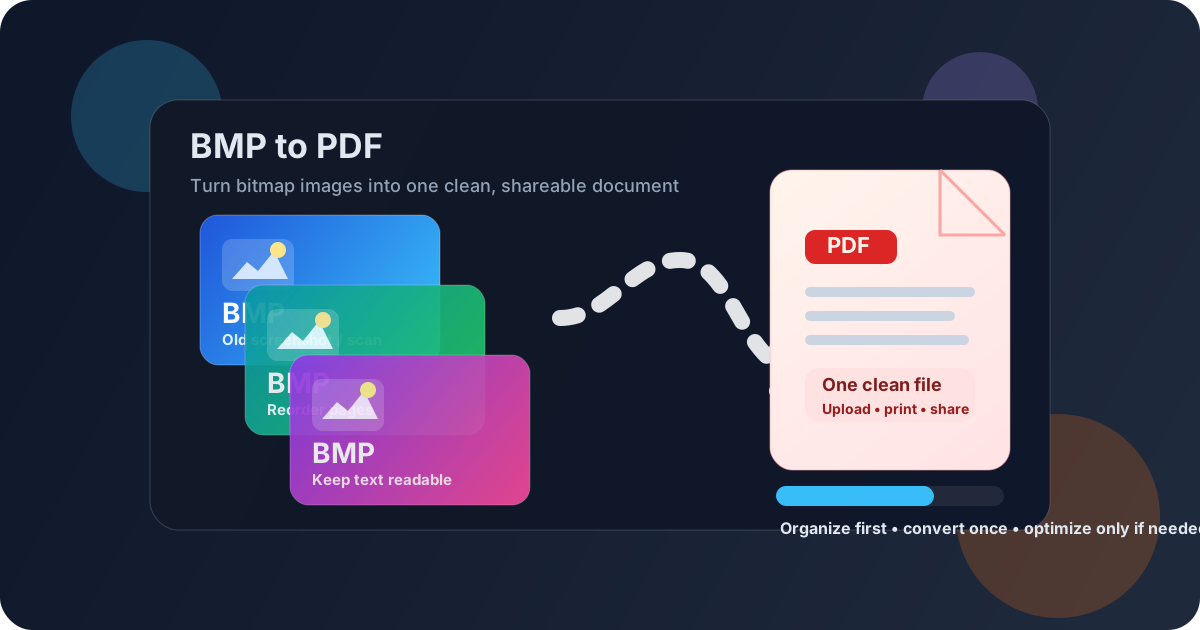
Table of contents
- Quick start: BMP to PDF in a few minutes
- Why people still need BMP to PDF
- What to decide before you convert
- Step-by-step: how to convert BMP to PDF cleanly
- How to combine multiple BMP files into one PDF
- How to keep screenshots, scans, and diagrams readable
- How to keep the PDF usable without making it huge
- BMP to PDF on Windows, Mac, Linux, and mobile
- Related LifetimePDF tools and useful next steps
- FAQ (People Also Ask)
Quick start: BMP to PDF in a few minutes
If your files are ready, the clean workflow looks like this:
- Open Images to PDF.
- Upload the BMP files you want in the finished document.
- Arrange them in the correct reading order.
- Choose orientation and page sizing that fit the images naturally.
- Create the PDF and review readability before you upload, print, or send it anywhere.
Why people still need BMP to PDF
BMP is not a fashionable format, but it survives in real workflows for a reason. It still appears in older Windows software, support screenshots, industrial systems, scanner exports, archive folders, and technical documentation. The file might be visually fine. The problem is that BMP is usually a rough handoff format, not a pleasant sharing format.
The moment you need one clean document instead of a folder full of image files, PDF usually makes more sense. That shows up in everyday tasks: evidence packets, archived screenshots, invoice or receipt scans, diagnostic image sets, product documentation, school or admin uploads, and technical diagrams that need to travel as one file instead of ten separate attachments. One BMP is manageable. Ten BMP files with vague names are not. One PDF fixes that.
| What you have | Best first move | Why it helps |
|---|---|---|
| Scanner or archive BMP pages | BMP to PDF | Turns separate bitmap pages into one uploadable document |
| Old Windows screenshots | BMP to PDF with careful ordering | Makes review easier for support, QA, or client handoff |
| Wide diagrams or dashboards | BMP to PDF with landscape where needed | Keeps labels and layout easier to read |
| Mixed-device sharing | BMP to PDF before sending | Reduces compatibility friction and loose-file clutter |
What to decide before you convert
Most weak BMP-to-PDF results are not caused by the converter. They happen because the input set was messy or nobody thought about how the final document should read.
1. Which BMP files actually belong in the document
Do not convert the whole folder just because it came from the same system or scan session. Remove duplicates, blurry captures, test screenshots, accidental exports, and side files that do not help the reader. Fewer better pages usually beat more random ones.
2. The order readers should see them
The final PDF should read like a document, not like a file explorer window. Put the overview page first, then the main pages, then supporting details. Evidence packets, technical walkthroughs, and scanned documents all become more usable when the sequence is deliberate.
3. Whether the pages should stay portrait or landscape
Portrait usually fits paper-like scans, receipts, and vertical screenshots best. Landscape works better for wide diagrams, dashboards, and system captures. Choosing the right orientation early prevents small labels from becoming unreadable later.
4. Whether the document needs searchability after conversion
BMP to PDF creates one clean document, but it does not automatically create selectable text. If the bitmap pages are really scans of text and you need to search, copy, or extract that text later, plan to run OCR PDF after the PDF is built.
Best setup habit: clean the BMP set first, put the pages in the right order, then create the PDF once instead of rebuilding it after avoidable mistakes.
Step-by-step: how to convert BMP to PDF cleanly
Once the files are ready, the actual conversion should be straightforward. The dependable workflow is mostly about not rushing past the review points.
1. Upload the BMP files you actually need
Start with the smallest complete set that serves the job. If you are building a support packet, do not mix in unrelated captures. If you are packaging scans, make sure every page appears once and only once.
2. Arrange the pages in human order
Reordering matters more than people expect. The PDF should make sense even if the recipient never saw the original files. This is especially important when the bitmap images came from different moments, different systems, or multiple people.
3. Choose sensible page settings
Avoid layouts that over-shrink text-heavy scans or force wide diagrams into narrow portrait pages. The goal is not to make every page identical at any cost. The goal is to make the final PDF easy to review.
4. Generate the PDF and review the first, middle, and last pages
That quick check catches most real-world mistakes: sideways pages, unreadable labels, extra white margins, pages in the wrong order, or one accidental duplicate that slipped through.
5. Only add follow-up steps when they solve a real problem
Compress when the file is too heavy. OCR when the pages need selectable text. Protect the file when the content is sensitive. The best workflow does not pile on extra steps just because the tools exist.
Recommended sequence: upload the right BMP files, order them carefully, choose simple layout settings, generate the PDF, then add compression or OCR only if the finished file still needs something.
How to combine multiple BMP files into one PDF
Combining several BMP files into one PDF is one of the main reasons this keyword exists. The trick is to treat the image set like one document before you convert it.
Screenshot and support packets
Start with the overview or starting state, then move to the steps, then the result or error. That makes the PDF easier for another person to follow without guesswork.
Scanned pages and archive records
Group pages by document first. If the batch really contains three separate records, build three PDFs rather than one confusing mega-file. Smaller, purposeful documents are usually easier to upload and easier to understand.
Diagrams and technical graphics
Put the broad view first, then the detail pages. That gives the reader context before they hit the tiny labels or deeper supporting material.
| Input set | Best ordering method | Good follow-up |
|---|---|---|
| Support screenshots | Chronological or action-by-action order | Compress if the file needs to travel by email |
| Scanner pages | Page 1 through final page | Run OCR if reviewers need searchable text |
| Technical diagrams | Overview first, details after | Use landscape when labels feel cramped |
| Archived image evidence | Context first, proof second | Protect if the packet includes sensitive data |
How to keep screenshots, scans, and diagrams readable
When people say their BMP-to-PDF output looks bad, the problem is often not the PDF step itself. It usually starts with poor source images, the wrong orientation, or trying to force a wide bitmap into a layout that shrinks the useful details too much.
Keep small text readable
Software screenshots, labels, receipts, forms, and diagrams can become useless fast if the text is too small. If the image contains dense information, prioritize readability over filling the whole page perfectly. Slightly larger margins are less dangerous than illegible content.
Use the orientation that matches the source image
Portrait is usually right for document-like captures. Landscape is better when the source is wide. A wrong orientation can quietly ruin readability even when the PDF technically looks fine at first glance.
Review the final PDF like a stranger would
Open the file, zoom to a normal viewing level, and check the smallest useful text instead of only the obvious headings or shapes. That is how you catch real problems before a portal rejection or a confused recipient catches them for you.
How to keep the PDF usable without making it huge
BMP is often bulky, so one combined PDF can still get heavy when you include many pages or large source images. The answer is usually not to destroy the source quality first. It is to build the document properly and then optimize the finished file if the destination demands it.
What usually makes the PDF too large
- too many bitmap pages traveling together in one packet
- duplicate or near-duplicate images
- oversized screenshots or scans that do not all need to live in one file
- high-detail graphics bundled with unrelated content in the same document
What usually makes the PDF hard to use
- text shrunk too much on the page
- the wrong orientation for the source image
- messy ordering that turns one file into a guessing game
- trying to solve size problems before the document is even built properly
In practice, the cleanest route is simple: keep the useful BMP detail, create the PDF, then use Compress PDF only if the final file is still too heavy for email or an upload limit.
If the final PDF is still too large: compress the finished document instead of sacrificing readability in the source BMP files.
BMP to PDF on Windows, Mac, Linux, and mobile
BMP is strongly associated with Windows, but a good BMP-to-PDF workflow should work wherever the files already are. Sometimes that is a legacy Windows folder of screenshots. Sometimes it is a Mac or Linux machine that received BMP exports from somewhere else. Sometimes it is a phone or tablet that just needs one final document.
On Windows
This is the natural starting point because BMP often comes from Windows-centric software in the first place. If the images are already on your PC, a browser-based BMP-to-PDF workflow saves you from manually opening and printing them one by one.
On Mac and Linux
Even if BMP is not your preferred format, you can still upload the files, clean the order, and generate one PDF without extra conversion detours. That is useful when you receive bitmap exports from someone else's environment and just need a cleaner universal final format.
On mobile
It is less common to create BMP files on a phone, but it still happens when files are downloaded or transferred from another system. Browser-based conversion means you can still handle the job on iPhone, iPad, or Android and download the finished PDF directly.
Related LifetimePDF tools and useful next steps
BMP to PDF is often the first step, not the last one. These tools commonly fit around it:
- Images to PDF — combine BMP, JPG, PNG, HEIC, and other image files into one PDF.
- Compress PDF — reduce file size after conversion.
- OCR PDF — make scanned bitmap pages searchable.
- Rotate PDF — fix sideways output after conversion.
- Merge PDF — combine the result with other PDF files.
- PDF Protect — add a password to sensitive documents.
Related blog guides
- BMP to PDF Online Free
- BMP to PDF Without Monthly Fees
- Convert BMP to PDF Online
- PNG to PDF
- JPG to PDF
- HEIC to PDF
- Browse all LifetimePDF articles
Ready to turn bitmap files into one document that is actually easy to use?
Best practical sequence: choose the right BMP files → order them clearly → create the PDF → review once → compress or OCR only when the finished document actually needs it.
FAQ (People Also Ask)
How do I convert BMP to PDF?
Upload one or more BMP files to a converter, arrange the page order, choose sensible layout settings, create the PDF, and download the result. If the final file is too large, compress it afterward.
Can I combine multiple BMP files into one PDF?
Yes. That is one of the most useful BMP-to-PDF workflows for scans, screenshots, archived graphics, support packets, and technical image sets.
Why is my BMP-to-PDF file so large?
Because BMP files are often bulky before conversion even starts. Build the PDF first, then compress the finished document if you need a smaller file for upload or email.
Will BMP to PDF reduce image quality?
A solid workflow usually preserves visual quality well, especially when the source files are clear and the page settings match the content. Review the finished PDF once if readability matters.
Can I convert BMP to PDF on Windows or Mac?
Yes. You can upload BMP files from Windows, Mac, Linux, iPhone, or Android in the browser and download one finished PDF without a complicated desktop-only workflow.
Published by LifetimePDF — Pay once. Use forever.