How to Crop a PDF in Chrome: Remove White Margins, Scanner Borders, and Crop Marks Without Leaving the Browser
To crop a PDF in Chrome, open LifetimePDF's Crop PDF tool in Google Chrome, choose the file from Downloads, Gmail, Google Drive, or a local folder, adjust the crop area so only the content you want remains, then save the cleaned PDF.
If the document only looks messy because of white margins, dark scanner borders, or crop marks, that is usually the fastest browser-based fix.
That is the short answer. The part that actually saves time in Chrome is avoiding duplicate downloads, Gmail preview tabs, Drive copies with nearly identical names, and the classic mistake of trimming one PDF while attaching another one five minutes later.
Fastest path: confirm the exact source file first, open LifetimePDF's Crop PDF tool in Chrome, trim only the margins or borders you really want gone, save the cleaned copy with a name you will recognize later, then move on to OCR, compression, or sharing only if the document still needs more work.
In a hurry? Jump to Quick start: crop a PDF in Chrome in 4 minutes.
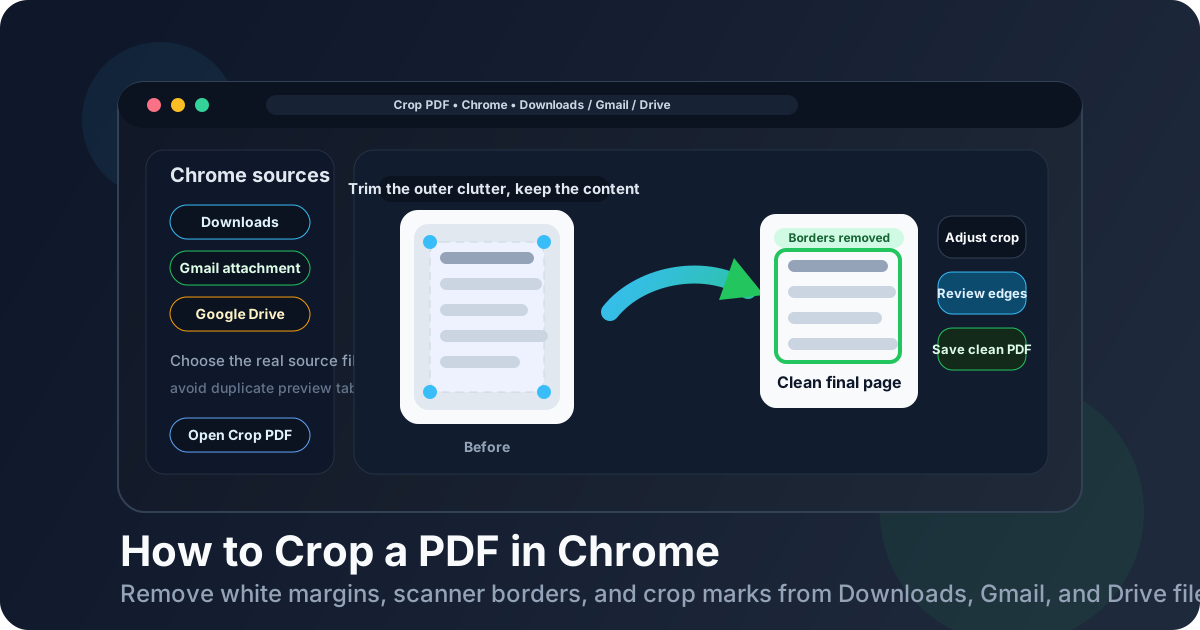
Table of contents
- Quick start: crop a PDF in Chrome in 4 minutes
- The easiest Chrome workflow for cropping PDFs
- Step-by-step: how to crop a PDF in Chrome
- What cropping actually fixes in Chrome
- Chrome preview vs a browser-based crop tool
- Crop one page vs the whole PDF in Chrome
- How to handle Gmail attachments, Drive files, and Downloads without cleaning the wrong copy
- Common Chrome problems and quick fixes
- What to do after the PDF looks clean
- Related LifetimePDF tools and guides
- FAQ (People Also Ask)
Quick start: crop a PDF in Chrome in 4 minutes
If you already know the page just needs a cleaner border, this is the simplest Chrome workflow for most people:
- Open Crop PDF in Chrome.
- Choose the PDF from Downloads, a saved Gmail attachment, Google Drive, or another folder.
- Decide whether you need to crop one page or apply the same crop across several similar pages.
- Trim away the white margins, dark scanner edges, or crop marks without touching the real content.
- Download the cleaned PDF, save it with a clear name, and open it once in Chrome to confirm the result.
The most important part is not the crop box. It is making sure you clean up the right file. Chrome makes it very easy to keep a Gmail preview, a Drive tab, and a duplicate from Downloads open at the same time.
The easiest Chrome workflow for cropping PDFs
Chrome is where a lot of rough-looking PDFs already show up. A Gmail attachment opens in preview. A Drive file launches in a tab. A portal export lands in Downloads. Yesterday's copy is still open in a pinned tab, so now you have two nearly identical PDFs and not much patience left. That is why the crop itself is usually not the hard part. Source confusion is.
People often trim the page area on the first PDF they happen to have open, then later upload the untouched original because Chrome still had the wrong version sitting in another tab. Others drag the crop box too tightly because the preview looked messy and they just wanted the border gone fast. The safer Chrome pattern is simple: identify the exact source file, crop only the outer junk, save the cleaned copy with a distinct name, and review it once before you share it.
| Situation | Best Chrome-friendly move | Why it works better |
|---|---|---|
| The PDF has huge white margins around every page | Crop the pages evenly | You make the content feel larger and cleaner without changing the document text or page order. |
| The scan has dark edges or copier shadows | Crop after checking orientation | You remove the noisy outer frame while keeping the actual page area intact. |
| The file still shows crop marks or print marks | Trim only the production leftovers | You keep the intended page content while removing what only mattered during print prep. |
| Only one cover page or appendix page looks wrong | Crop just that page | There is no reason to force the same trim onto pages that already look fine. |
| The final PDF is still too large | Crop first, then compress | It is smarter to fix the visible page area before optimizing file size. |
Step-by-step: how to crop a PDF in Chrome
Here is the practical browser workflow most people actually need.
1. Confirm the real source PDF first
If the file came from Gmail, Google Drive, Slack, a portal, or a local folder, pause long enough to confirm which copy is supposed to be the source. A Gmail preview tab, a Drive version, and a downloaded local copy can look interchangeable when they are not.
2. Open Crop PDF in Chrome
Go to Crop PDF in Chrome. Keeping the whole cleanup workflow inside one browser session is usually the least annoying way to move from a preview or download into a real edit.
3. Upload the PDF from Downloads, Gmail, Drive, or another folder
Choose the version you actually intend to keep after cleanup. If there are duplicate downloads with names like scan.pdf, scan (1).pdf, and scan-final.pdf, this is the moment to slow down before you trim anything.
4. Decide what the crop is supposed to remove
Do not drag the crop box blindly. Identify the actual problem first:
- White margins: trim the empty border so the content sits more cleanly on the page.
- Dark scanner edges: remove the noisy outer frame without cutting off stamps, signatures, or page numbers.
- Crop marks or print marks: trim the production leftovers but keep the intended page content.
- One oversized page in a packet: crop only the page that looks wrong so the rest stay untouched.
5. Apply the crop to the correct page scope
If every page has the same border problem, a consistent crop across the document usually looks cleaner. If only one page is messy, crop only that page. Mixed documents are where people overcorrect, so slow down for a second before you apply the crop broadly.
6. Save the cleaned PDF with a clear filename
Good naming saves real time later. A name like proposal-cropped.pdf, scan-cleaned.pdf, or packet-trimmed.pdf is much more useful than document-final-2.pdf.
7. Open the result once before you share it
In Chrome, one quick review pass prevents a lot of avoidable mistakes. Make sure the margins or borders you wanted gone are really gone, the useful content is still intact, and you did not crop too aggressively near signatures, page numbers, or footnotes.
Useful habit: keep the original untouched until the task is finished. Edit the copy, review the copy, then share the copy.
What cropping actually fixes in Chrome
Cropping is not the same as editing text, redacting content, or reorganizing pages. It is mainly about cleaning up the visible page area so the document feels intentional instead of awkward.
Oversized white margins
These often come from scans, exported handouts, or documents converted with too much empty space around the content. Cropping makes the text block feel larger and easier to read, especially on laptop screens.
Dark scanner borders
Flatbed scans and phone-captured pages often bring along shadowy edges, uneven black frames, or accidental background noise. Cropping removes those distractions and makes the final file look much more deliberate.
Crop marks, trim marks, and print production leftovers
Some PDFs were created for print and still show marks around the outside edge. If the recipient only needs the finished page content, cropping those marks away is often the cleanest Chrome-friendly fix.
One page that does not match the rest of the packet
This is common in merged PDFs where most pages are normal but one appendix, screenshot, or inserted scan carries a different amount of empty space. Cropping just that page can make the whole packet feel more polished.
Chrome preview vs a browser-based crop tool
Chrome's built-in PDF viewer is good for inspection. It lets you notice the ugly margins, the scanner border, or the page that looks wrong. But when you actually need to crop and save a corrected version, a browser-based crop tool is usually smoother.
That distinction matters because previewing and fixing are not the same job. Chrome can make a rough PDF look temporarily tolerable on screen, but the real question is whether you now have a clean final file you can upload, email, archive, or share.
| Option | Best for | Limit |
|---|---|---|
| Chrome PDF viewer | Checking whether the PDF has border, margin, or orientation problems | It is mainly a viewing step, not the cleanest place to create a polished cropped copy. |
| Browser-based Crop PDF tool | Actually trimming the page area and saving a clean final file | You still need to review the result once so you do not cut off useful content. |
Crop one page vs the whole PDF in Chrome
This is one of the most important decisions in the workflow. Cropping every page is not automatically better. It is only better when the document really has the same border problem across the whole file.
Crop one page when:
- only one scan page has dark edges
- the cover page has print marks but the rest does not
- one inserted screenshot or form has awkward extra space
- you are fixing a single appendix page in a merged packet
Crop the whole PDF when:
- every page came from the same scanner and has the same outer border problem
- all pages have oversized empty margins that make the file hard to read
- the PDF was exported with a consistently oversized page area
If you are unsure, start with one page. It is safer to test your crop on a representative page first than to apply the same trim everywhere and discover too late that tables, page numbers, or signatures sit closer to the edge on other pages.
How to handle Gmail attachments, Drive files, and Downloads without cleaning the wrong copy
Gmail attachments
Gmail preview is useful for confirming you have the right attachment, but it is not the best place to trust your memory about versions. If the file matters, save the real attachment or make sure you know exactly which Chrome tab is tied to the source before you crop it.
Google Drive files
Drive is convenient, but it can blur the line between the cloud copy, a shared revision, and a downloaded local file. If the document may have changed recently, confirm which copy is supposed to be final before you trim anything.
Downloads in Chrome
Downloads is often the easiest place to work from, but it is also where duplicates pile up. If you see several similarly named files, check the modified date and open the exact one you intend to clean up.
Pinned tabs, tab groups, and duplicate previews
This is where Chrome-specific confusion shows up most often. One PDF stays open in a pinned tab while a newer portal copy downloads somewhere else. A tab group keeps yesterday's version alive just long enough for you to think it is still current. The safest habit is to identify the source file first, then do the crop, then close the distractions.
Rule of thumb: if you are not completely sure which copy is current, stop and identify the source file before you trim any page area.
Common Chrome problems and quick fixes
I cropped the PDF, but I reopened the wrong version
This is classic Chrome behavior when a preview tab, a download, and a Drive copy all stay visible. Save the cleaned file with a distinct filename and open that exact saved copy once before you upload or share it.
I removed the margins, but now page numbers or signatures are cut off
That usually means the crop box was set too tight. Go back and leave a little breathing room around the real content. PDFs do not need to be trimmed to the millimeter to look cleaner.
Only one page was messy, but I cropped every page
That usually happens when a packet contains mixed page types. Restore the original if needed and reapply the crop only to the page or section that actually needs it.
The document looks cleaner, but it is still sideways
That is a rotation issue, not a crop issue. Use Rotate PDF so the page opens upright. If the file needs both fixes, rotate first and crop second.
The PDF looks good now, but the text is still not searchable
Cropping changes the visible page area. It does not make a scan searchable. If the file is still just an image, run it through OCR PDF next so you can search, highlight, and copy the text.
The PDF looks cleaner, but it is still too large to send
Once the page area is fixed, use Compress PDF if the file is still too heavy for Gmail or another upload limit. Structure and readability first, file size second.
What to do after the PDF looks clean
Once the document looks right, the next step depends on what the file is for.
- Need searchable text? Run OCR after cropping.
- Need a smaller file? Compress the cleaned copy.
- Need to protect the file before sending it? Password-protect the corrected version, not the rough original.
- Need better page order? Reorder or split the packet after the visual cleanup is done.
Doing things in this order keeps the workflow calmer. Clean the page area first, then optimize, search, protect, or reorganize. It is much easier to make good decisions once the PDF no longer looks cluttered around the edges.
Practical rule: crop first, verify once, then move on to OCR, compression, or protection only if the document still needs more work.
Related LifetimePDF tools and guides
- Crop PDF for trimming away white margins, scanner borders, and crop marks
- Rotate PDF for fixing sideways pages before you crop
- OCR PDF for making a cleaned scan searchable
- Compress PDF for reducing file size after cropping
- Protect PDF for locking the cleaned file before you share it
- How to Rotate a PDF in Chrome if the page direction is wrong before you crop
- How to OCR a PDF in Chrome if the scan still behaves like an image
- Remove Crop Marks from PDF if print-production marks are the main issue
FAQ
How do I crop a PDF in Chrome without Adobe Acrobat?
Open a browser-based Crop PDF tool in Chrome, choose the file from Downloads, Gmail, Google Drive, or another folder, adjust the crop area to remove margins or borders, apply it to the correct page or pages, then save the cleaned PDF. For most people, that is the fastest no-install workflow.
Can I crop just one page in a PDF in Chrome?
Yes. If only one page has awkward margins, dark scanner edges, or print marks, crop just that page. That keeps the rest of the document untouched and is especially useful for mixed scan bundles, cover sheets, and appendix pages.
What is the difference between cropping and rotating a PDF in Chrome?
Cropping removes unwanted outer areas such as white margins, scanner borders, or crop marks. Rotating changes the page direction when the PDF opens sideways or upside down. Some files need both, but they solve different problems.
Will cropping remove white margins and scanner borders from a PDF?
Usually yes. Cropping is one of the cleanest ways to trim oversized white margins, dark scanner edges, and print marks while keeping the useful content centered and easier to read.
Should I crop a scanned PDF before OCR in Chrome?
Usually yes. If the page has distracting borders or too much empty space, cropping first can give OCR a cleaner page area to work with. If the page is sideways, rotate first, then crop, then run OCR.