How to Check PDF Forms on iPhone: Files, Acrobat, and Save Behavior Before You Send
To check PDF forms on iPhone, save the real file into Files or open it in Acrobat, test multiple fillable fields, follow the expected field order, and make sure the data still holds after you save and reopen it.
If the form jumps into the wrong section, loses typed entries, fails signatures, or only works in a preview pane, the cleanest fix is usually to repair the source form and export again.
That is the short answer. The useful iPhone answer is that a form can look tidy in Files, Mail preview, Safari, Messages, or Acrobat and still fall apart the moment a real person types into it, moves to the next field, signs it, or reopens a saved copy. Intake packets, approvals, school forms, consent documents, and client paperwork usually fail in the same places: confusing field order, weak labels, save behavior, and false confidence from a pretty preview.
Fastest practical path: open the exact iPhone copy, confirm the form is truly fillable, test the field path, enter sample data, then save and reopen before you send it anywhere important.
In a hurry? Jump to quick start: check PDF forms on iPhone in about 8 minutes.
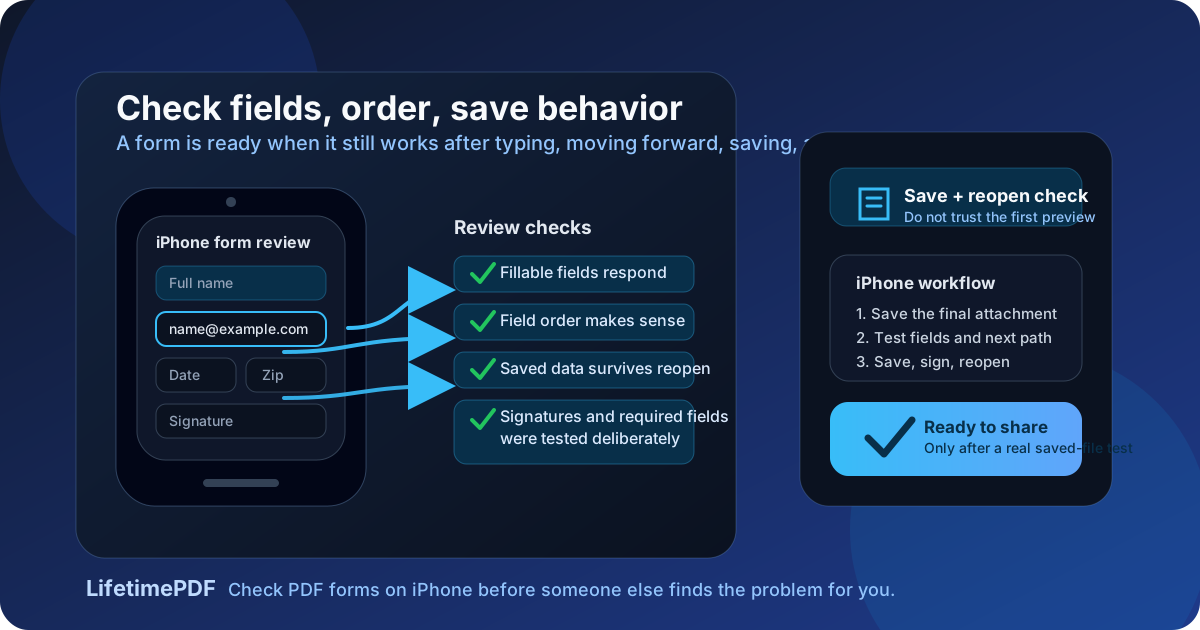
Table of contents
- Quick start: check PDF forms on iPhone in about 8 minutes
- What you are really checking when you inspect PDF forms
- Where iPhone users get misled
- Step-by-step: how to check PDF forms on iPhone
- Warning signs that the form only looks ready
- When to fix the source versus patch the PDF
- Related LifetimePDF tools and guides
- FAQ
Quick start: check PDF forms on iPhone in about 8 minutes
If your real goal is simply tell me whether this iPhone PDF form is safe to send, use this order:
- Open the exact PDF you plan to email, upload, archive, or sign from Files, Mail, Messages, Safari, or the portal export where the final version landed.
- Tap several fields right away. Make sure you are dealing with a real fillable form, not a scan or a visual mockup with blank lines.
- Move through the form in the order a person would naturally complete it. If you have a Bluetooth keyboard, use it. If not, use touch and the on-screen next flow carefully. If the form jumps into the wrong place, that is already a serious usability problem.
- Enter realistic sample data in text fields, checkboxes, dates, and signatures if the form includes them.
- Save the file, close it, reopen it from Files or Acrobat, and confirm the entered data still makes sense and has not vanished, flattened badly, or broken the layout.
- If the file is scanned or image-heavy, run OCR PDF first and then decide whether the better move is rebuilding the form instead of tolerating a weak export.
What you are really checking when you inspect PDF forms
Checking PDF forms on iPhone is not just asking whether a field highlights when you tap it. The more useful question is whether the form guides a person cleanly through a task: where to start, what to enter, what is required, what to tap next, and whether the file still works after the first real save.
That matters for accessibility, but it also matters for ordinary work. People complete forms on phones between meetings, in a parking lot, on weak signal, or from a portal download that has already bounced through several apps. If the form fails under that kind of normal pressure, it is not a small annoyance. It becomes friction, resubmission work, or a trust problem.
| What a healthy iPhone PDF form does | What a weak form does instead | Why it matters |
|---|---|---|
| Moves through fields in a sensible order | The user lands in the wrong section, another page, or a signature block too early | People lose context and start guessing what comes next |
| Makes each field obvious | Labels are vague, tiny, or too dependent on surrounding layout | A small screen makes unclear forms even harder to finish |
| Preserves data after saving | Entries disappear, signatures fail, or the file reopens strangely | Trust drops the moment work is lost |
| Works outside the original preview | Looks fine in one preview pane but breaks in Files, Acrobat, or after sharing | The real audience sees the failure, not the first viewer |
| Survives routine handoffs | Mail preview, portal downloads, or Messages copies behave differently | The “final file” stops being reliable in practice |
In plain English: the question is not merely can I type in the form? The real question is can another person complete this iPhone PDF smoothly without guessing, backtracking, or losing their work?
Where iPhone users get misled
iPhone gives you several fast ways to preview a form, but quick previews create false confidence. Files, Mail preview, Safari, in-app viewers, and even a screenshot in Messages can make a form feel more finished than it really is.
Mail preview can flatter a weak form
Mail preview is useful for a quick visual pass, but it cannot prove that field order, labels, save behavior, or signatures hold up after real use.
Touch-only review can hide order problems
A person can tap around and eventually finish a weak form, which can disguise how awkward the next-field path really is when somebody tries to complete it quickly.
The saved copy may not behave like the draft
The form you reviewed in one app may not match the attachment someone downloads from a portal, Files, or a shared iPhone workflow later.
That is why a good iPhone form check always includes at least one complete save-and-reopen test. If you never force the document through the same steps the real audience will take, you can miss the exact failures that matter most.
Step-by-step: how to check PDF forms on iPhone
1. Open the exact final iPhone copy first
Start with the PDF that will actually leave your phone. Do not test an earlier draft in one app if the real file came through Mail, Safari, Messages, Files, iCloud Drive, or a portal export. Tiny version differences are where weak form behavior often hides.
2. Confirm the form is not only pretending to be fillable
Tap into several fields and try obvious controls. If you are staring at blank lines on a scan, a flattened design export, or a photographed paper form, you may not have a real fillable PDF at all. If the file is image-based, run OCR PDF first. OCR helps you inspect the file, but it does not automatically turn a bad scan into a good form.
3. Test the field path instead of trusting the layout
Move through the form in the same order a real person would use. If you have a Bluetooth keyboard, use Tab and Shift plus Tab for a stronger check. If you are touch-only, use the next button above the keyboard when available and tap forward deliberately through the expected path. A healthy iPhone form follows the natural completion order. A weak one jumps sideways, skips required sections, or lands in fields that do not match the surrounding labels. Pair this with a quick look at PDF tab order on iPhone if the form feels disorganized.
4. Enter real sample data, not cosmetic filler
Type short and long answers. Test numbers, dates, checkboxes, radio groups, initials, and signatures if the workflow expects them. If the form is meant to be completed online, use PDF Form Filler as a second reality check. If approvals or signoff matter, run a quick handoff test in Sign PDF too. If your goal is actually completion rather than QA, the related guide How to Fill Out a PDF Form on iPhone covers the everyday user path.
5. Save, reopen, and review the next step
Many iPhone form failures do not appear until the file is saved, attached, reopened from Files, or passed through another app. Save the file, reopen it in Files or Acrobat, and confirm the data, selections, and signatures remain intact. If the form is meant to be printed, uploaded, or forwarded, spot-check that path as well.
6. Repair the source and export again if the form logic is weak
If the PDF came from Word, Pages, Acrobat, a design tool, or a dedicated form builder, the cleanest fix is usually upstream. If the source is gone, recover what you can with PDF to Word, repair the form logic, then export a cleaner replacement with Word to PDF.
Reliable sequence: confirm fillability, test field order, check labels, try real input, then save and reopen before sending the form anywhere important.
Warning signs that the form only looks ready
Form problems repeat themselves. Once you know the usual failure patterns, you can spot them much faster during an iPhone review.
| Warning sign | What goes wrong | Better move |
|---|---|---|
| Visual-only fields | The PDF looks like a form but the boxes are not real fillable controls. | Rebuild true fields instead of relying on appearance alone. |
| Broken next-field path | The user jumps across sections or pages instead of staying in the natural completion order. | Fix field order in the source or form builder. |
| Weak labels or tiny cues | People do not know what belongs in a field or whether it is required. | Clarify labels, instructions, and examples before export. |
| Save-and-reopen failure | Entered data disappears, signatures break, or the file reopens strangely. | Test the full workflow and repair the source before distribution. |
| Preview-only confidence | The form seems fine in Mail or Safari but fails after saving or sharing. | Trust the saved-file test, not only the first preview pane. |
One simple smell test: if a first-time user would need outside explanation to finish the form confidently on a phone, the structure probably needs more work.
Where people get fooled
The spacing looks tidy, the boxes line up, and the PDF feels official, so everyone assumes it works. That visual neatness creates false confidence. A real iPhone form review asks whether the file still behaves properly during typing, moving to the next field, saving, signing, reopening, and sharing—not just whether the page design looks calm.
When to fix the source versus patch the PDF
Source-first repair usually wins when the form problem is broad rather than local. If multiple fields are unclear, field order drifts across pages, signatures misbehave, or the file was never truly fillable to begin with, the final PDF is usually the wrong place to fight every symptom one by one.
Repair the source when:
- multiple pages in the form behave differently,
- field order is broken across large sections,
- the PDF came from Word, Pages, Acrobat, a design tool, or a form builder you still control,
- the form will be revised or reused again later,
- form problems appear alongside reading-order, tab-order, or accessibility issues.
If the file is part of a broader accessibility review, pair this form check with accessibility, reading order, and tab order. Forms work best inside a document structure that is already predictable and coherent.
Related LifetimePDF tools and guides
Useful tools
Need a cleaner form workflow without juggling scattered tools? LifetimePDF combines form filling, signing, OCR, source recovery, and conversion utilities in one pay-once toolkit.
FAQ
How do I check PDF forms on iPhone quickly?
Open the final iPhone copy, confirm the form is truly fillable, follow the expected field order, test real inputs, then save and reopen the file to make sure the workflow still holds up.
Can an iPhone PDF form look polished and still be broken?
Yes. Many forms look professional in Files, Mail preview, or Acrobat while still having weak field order, unclear labels, or save behavior that fails once someone actually uses the file.
Should I test field order and labels, not just the text boxes?
Absolutely. A fillable field by itself is not enough if the user cannot tell what belongs there or if the form keeps jumping away from the next logical step.
What if the PDF form is just a scan?
Run OCR first, then decide whether the form needs to be rebuilt as a real fillable PDF. A scan can preserve appearance without preserving usable form behavior.
Should I fix form problems in the PDF or in the original source?
If you still control the source, fix it there first. A clean export from the original form builder or document usually produces a better long-term result than repeated PDF-only patching.
Published by LifetimePDF — Pay once. Use forever.