How to Check if a PDF Is XFA on Windows: Acrobat, Edge, and Form Compatibility Clues
To check if a PDF is XFA on Windows, save the exact file locally, open it in Adobe Acrobat or Reader, then compare the same PDF in Microsoft Edge or another non-Adobe viewer and watch for unsupported-form warnings, missing fields, or broken layout.
If the form behaves normally in Acrobat but loses fields, scripts, save behavior, or structure in Edge, Outlook preview, browser upload, or e-sign workflows, it is very likely an XFA form rather than a standard fillable PDF.
That difference matters because Windows users often discover XFA at exactly the wrong moment: a government form refuses to open in a browser tab, a client cannot complete a field from Edge, or a portal rejects the file after it looked fine on one machine. A fast compare-between-viewers check usually tells you whether the safe move is to keep using the Adobe workflow, flatten the finished document, or rebuild the form into something more portable.
Fastest path: save one clean Windows copy, test it in Acrobat first, then open the same file in Edge and treat Acrobat-only behavior as a major XFA clue.
Need the short version? Jump to quick start: tell if a Windows PDF is XFA in about 5 minutes.
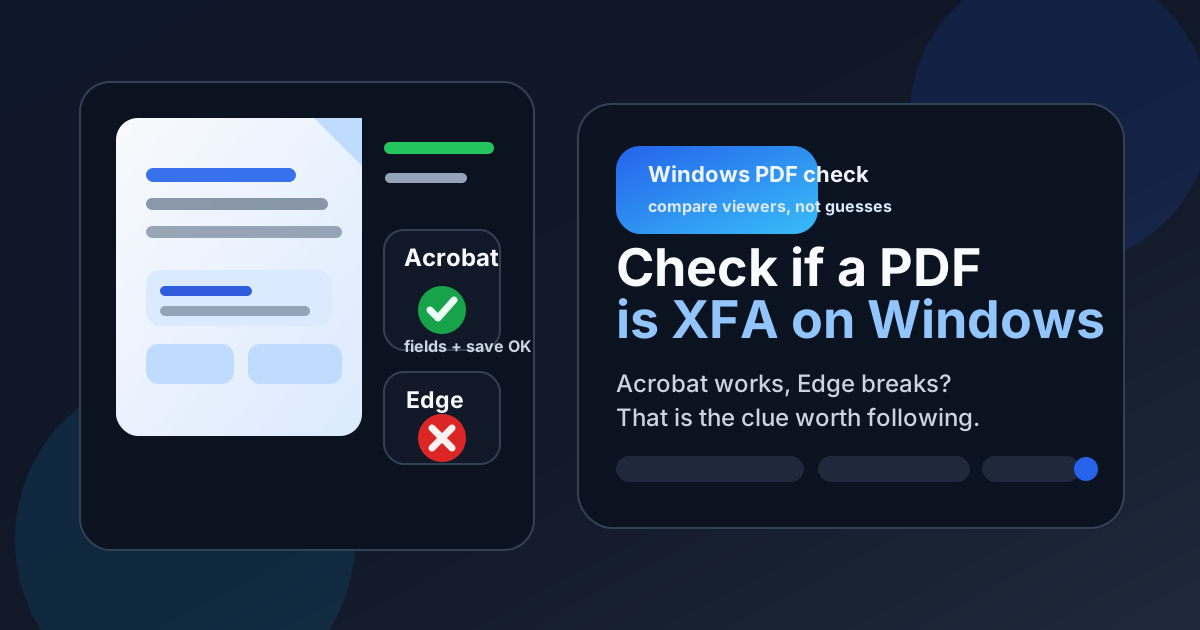
Table of contents
- Quick start: tell if a Windows PDF is XFA in about 5 minutes
- What XFA usually looks like on Windows
- The strongest Windows-side signs a PDF may be XFA
- Step-by-step: compare Acrobat, Edge, and real workflow touchpoints
- XFA vs AcroForm vs flat PDF
- What to do if the file really is XFA
- Mistakes that waste time during a Windows check
- Related LifetimePDF tools and guides
- FAQ
Quick start: tell if a Windows PDF is XFA in about 5 minutes
If you want the fastest reliable answer, do this:
- Save the PDF out of Outlook, Teams, SharePoint, or a browser tab and open the actual file from your Windows desktop or Downloads folder.
- Open it in Acrobat Reader first and test a few fields, buttons, or dropdowns.
- Open the exact same file in Microsoft Edge.
- Watch for missing fields, dead buttons, layout shifts, unsupported-form warnings, or a save/reopen failure.
- If Acrobat works but Edge or another non-Adobe step breaks, treat the file as a likely XFA form and plan the next workflow carefully.
What XFA usually looks like on Windows
XFA stands for XML Forms Architecture. In practical Windows terms, that usually means you are dealing with a form that behaves more like a mini application than a plain document. Fields may appear or disappear, sections may expand, calculations may run, and the form may depend heavily on Adobe's own viewer to behave correctly.
That is why XFA problems often show up in normal Windows work instead of in a technical audit. Someone opens the form from Edge, Outlook preview, Teams, a portal upload screen, or a signing platform and suddenly the layout is wrong, the fields are gone, or the file refuses to work outside Acrobat. The form is not necessarily broken everywhere. It is just less portable than a standard AcroForm PDF.
| Windows situation | What it often means | What to do next |
|---|---|---|
| Acrobat works, Edge does not | A strong sign the form depends on Adobe-specific behavior | Keep testing the same file in real downstream workflows before you trust it |
| Fields vanish in preview | The form may be dynamic or unsupported outside Acrobat | Open the saved local copy in Reader and compare side by side |
| Layout grows or rearranges itself | Dynamic XFA behavior becomes more likely | Complete it only in the intended viewer or rebuild the form |
| Upload or signing flow rejects the form | The platform may not support XFA structure | Flatten a completed copy or rebuild the form as standard fields |
The strongest Windows-side signs a PDF may be XFA
No single symptom proves everything, but this pattern is usually enough to make a smart call quickly.
1) Acrobat or Reader works, Edge does not
This is the biggest everyday clue. If the form behaves normally in Adobe's viewer but drops fields or logic in Edge, you are probably dealing with more than a standard AcroForm.
2) Outlook or Teams preview is useless
Preview panes are often where users first notice XFA problems. The page may render, but the form itself does not survive the preview workflow.
3) The form is clearly dynamic
If sections appear, collapse, expand, or recalculate as you type, that is consistent with XFA-style behavior and deserves a deeper compatibility check.
4) A portal or signing workflow rejects it
A file that looks fine on your Windows desktop can still fail once it hits an upload validator, e-sign step, or browser-based completion flow.
Step-by-step: compare Acrobat, Edge, and real workflow touchpoints
The safest Windows check is not theoretical. It follows the actual path your PDF will take. You are trying to learn whether the file is a portable form or an Acrobat-dependent one.
1. Save the real file locally before you test
Do not judge the PDF from an attachment preview alone. Save it from Outlook, Teams, SharePoint, or your browser to a normal Windows folder first. That removes one common source of confusion: sometimes the preview layer is the problem, not the form itself.
2. Open it in Acrobat Reader and test a few real actions
Try the form where it is most likely to work. Fill a few fields, click a button if one exists, change a dropdown, and save the file. If everything behaves normally here, you have a clean baseline for the next comparison.
3. Open the same saved copy in Microsoft Edge
Edge is useful because it represents the kind of viewer many recipients actually use when they double-click a PDF or open one from the web. If the fields disappear, the layout breaks, or the viewer warns that the form is unsupported, that difference is much more meaningful than a technical label buried in metadata.
4. Reopen the file after saving
Some forms fail only after a save cycle. Enter test data, save the PDF, close it, and reopen it in both Acrobat and Edge if possible. If values vanish, buttons stop working, or the file only preserves data in one environment, you have learned something important about the form's portability.
5. Test the real destination if the form is headed somewhere
If the PDF is meant for upload, signature, or portal submission, test that step too. A file can look acceptable on a Windows desktop but still fail in a browser-based workflow that does not support XFA properly. The safest time to discover that is before the deadline.
A reliable Windows sequence
- Save the file locally.
- Test in Acrobat or Reader.
- Compare in Edge.
- Save and reopen once.
- Test the upload or signing step if it matters.
What counts as a real XFA clue
- Unsupported-form warnings
- Missing or dead fields outside Acrobat
- Layout reflow or expanding sections
- Portal or signing failure after viewer success
- Different save behavior between viewers
Need a quick form-safe cleanup? If the goal is to deliver the completed result rather than preserve live field behavior, flattening the finished copy is usually safer than hoping every recipient supports XFA.
XFA vs AcroForm vs flat PDF
These can look similar at first glance, which is why people often misdiagnose the problem. The difference is not the visual appearance. The difference is what kind of form structure lives underneath and how broadly that structure travels.
| Type | How it behaves | Windows compatibility pattern |
|---|---|---|
| Standard AcroForm PDF | Normal text fields, checkboxes, dropdowns, and signatures inside a fixed page layout | Usually the safest for Acrobat, Edge, browser upload flows, and broader sharing |
| XFA PDF | May include dynamic sections, scripted behavior, changing layout, or Adobe-focused logic | Often works best in Acrobat and less reliably outside Adobe-centered workflows |
| Flat PDF | Looks like a form but has no live fields underneath | Easy to open almost anywhere, but not truly interactive |
This is why a good Windows check asks two separate questions:
- Is the PDF actually interactive?
- If it is interactive, is it portable or Adobe-dependent?
If you skip the second question, you can wrongly assume a file is healthy just because one viewer lets you type in it.
What to do if the file really is XFA
The right response depends on whether you are just trying to complete the form once or you control the form workflow itself.
If you only need to submit the form
If you own the workflow
For many teams, the most practical fix is not make Edge support everything. It is stop handing Edge a form structure it was never meant to carry well. If the document must travel widely, portability beats cleverness.
Mistakes that waste time during a Windows check
- Trusting the attachment preview: preview panes are convenient, but they are not a full form audit.
- Testing only one field: some XFA problems show up only after save, submit, or re-open steps.
- Assuming every interactive PDF is AcroForm: a form that accepts typing is not automatically a portable one.
- Sending the live XFA file to everyone: if the recipient only needs the completed result, a flattened copy is often safer.
- Blaming Windows itself: the bigger issue is usually viewer support, not the operating system alone.
Related LifetimePDF tools and guides
If the XFA check shows a portability problem, these are usually the most useful next steps:
FAQ
How do I check if a PDF is XFA on Windows?
Save the file locally, open it in Acrobat or Reader, then compare the same PDF in Microsoft Edge or another non-Adobe viewer. If the form behaves correctly only in Acrobat and breaks elsewhere, that is one of the strongest practical signs that it is XFA.
Can Edge show an obvious XFA label?
Usually not. Edge is better as a behavior test than a metadata labeler. If the form loses fields, save behavior, or layout there while Acrobat still works, the viewer comparison tells you more than a hidden technical tag would.
Does Acrobat-only behavior always mean XFA?
No, but it is a serious clue. Permissions, corruption, or bad JavaScript can also cause trouble, which is why you should compare the exact saved Windows copy across viewers and test one full fill-save-reopen cycle.
What is the safest way to share a completed XFA form?
If the recipient only needs the finished result, flattening the completed copy is usually safer than assuming they have the same Adobe-friendly setup you used to complete it.
Should I rebuild an XFA form if my team uses Windows browsers and portals a lot?
Usually yes. If the workflow depends on Edge, upload portals, e-sign steps, or broad sharing, a standard AcroForm PDF is usually much easier to support than an Adobe-dependent XFA form.
Bottom line: on Windows, the fastest trustworthy XFA check is a side-by-side behavior check between Acrobat and Edge, followed by one real save/reopen or upload test.