Translate PDF to Hindi: OCR Scans First, Check Script Readability Early, and Rebuild a Clean Final PDF
To translate a PDF to Hindi, upload a text-based PDF to LifetimePDF's Translate PDF tool, choose Hindi, then review script readability, names, numbers, and mixed English terms before you export or rebuild the final file.
If the PDF is scanned, run OCR first; that step usually matters more than anything else for clean Hindi output.
Most people searching for this are not trying to produce perfect literary prose. They need a Hindi version they can understand, review, send to a customer, hand to a colleague, or reuse in a cleaner document without spending the next hour fixing avoidable messes. The practical gains usually come from three choices: start with real text instead of page images, check whether important words should stay in English, and rebuild the final PDF only when layout quality actually matters.
Fastest practical path: translate clean text PDFs directly, OCR scanned files first, then do a short script, terminology, and form-label review before you send the final file.
In a hurry? Jump to the quick answer and workflow.
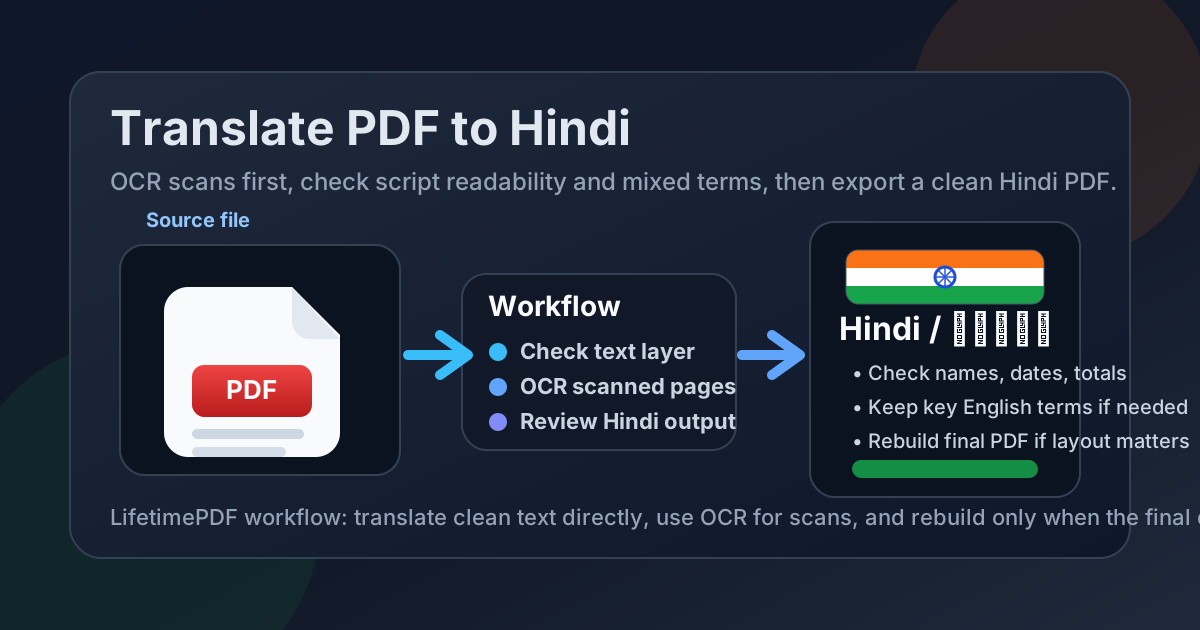
Table of contents
- Quick answer: the cleanest way to translate PDF to Hindi
- When direct PDF translation works well
- Script readability, mixed English terms, and form labels
- Scanned PDFs: why OCR comes first
- Step-by-step: translate a PDF to Hindi with LifetimePDF
- How to rebuild a clean final Hindi PDF
- Accuracy checks for forms, invoices, and customer docs
- Privacy and document handling before sharing
- Related LifetimePDF tools and pages
- FAQ (People Also Ask)
Quick answer: the cleanest way to translate PDF to Hindi
If your real goal is simply translate this PDF into Hindi without creating extra cleanup work, use this order:
- Open Translate PDF.
- Choose Hindi as the target language.
- Upload the PDF if the text is already selectable.
- If the file behaves like images, run OCR PDF first.
- Review names, form labels, dates, numbers, and whether key English terms should stay unchanged.
- If layout matters, rebuild the translated content into a fresh PDF instead of forcing the old layout to survive automatically.
When direct PDF translation works well
Direct translation works best when the PDF already contains real text and the page structure is not chaotic. In those cases, the tool can focus on language instead of guessing what each page says.
Direct translation usually works well for
- Contracts, policies, reports, and internal procedures that are mostly paragraph-based and easy to search.
- Manuals, product sheets, and customer instructions where accurate meaning matters more than perfect desktop publishing.
- Invoices, notices, shipping paperwork, and admin docs that mostly need clear wording rather than a design-perfect clone.
- Reference PDFs when your first goal is understanding the content quickly in Hindi.
Direct translation becomes less reliable when
- The PDF is scanned and each page is really just an image.
- The file is layout-heavy with columns, brochure blocks, labels over graphics, or dense tables.
- The document mixes stamps, handwriting, signatures, and photos that need context, not just word replacement.
- The language is high-stakes such as legal, medical, procurement, banking, or technical material that deserves a human review.
That does not make the translation useless. It just means the workflow should shift from one-click export to translate, review, then rebuild the final file cleanly.
Script readability, mixed English terms, and form labels
Hindi translation is not only about meaning. It is also about whether the result remains easy to read and act on. Many real-world PDFs aimed at Hindi readers still contain English brand names, product labels, legal references, account terms, or interface text. If every one of those gets translated blindly, the output can become less useful, not more.
What to review first
- Devanagari readability: confirm headings, bullet lists, and body text render cleanly and do not break in awkward places.
- Names and fixed labels: person names, company names, model numbers, URLs, email addresses, and account IDs usually should stay unchanged.
- Mixed English/Hindi terminology: software, finance, HR, logistics, and support documents often work better when some core product terms remain in English.
- Form labels and action words: terms like submit, sign, attach, due date, invoice number, and tax ID need to be instantly understandable to the intended reader.
- Numbers and date formats: recheck dates, totals, percentages, invoice values, phone numbers, and any figures people are expected to rely on.
For internal reading, general Hindi is often enough. For customer-facing or operational documents, a short review of mixed-language terms can make the difference between a document that merely looks translated and one that is actually usable.
Scanned PDFs: why OCR comes first
A scanned PDF can look readable to a person and unreadable to a translation engine. If you cannot highlight the words, search the file, or copy a sentence, the translator probably does not have real text to work with. That is why OCR matters.
OCR adds a searchable text layer so the translation workflow can work from actual words instead of page images. It also gives you an early warning if the source scan is too noisy, crooked, low-contrast, or badly photographed to trust without cleanup.
OCR is especially important for
- Signed forms, government paperwork, and scanned applications
- Old manuals, certificates, receipts, or archived documents
- Camera-made PDFs from phones or office scanners
- Files with faint print, stamps, handwritten notes, or uneven backgrounds
If OCR output still looks messy, fix the source pages before trusting the Hindi translation. Better source text almost always means better translated output.
Step-by-step: translate a PDF to Hindi with LifetimePDF
This workflow is fast enough for everyday use and careful enough for documents you actually care about.
- Start with the best source PDF you have. Use the original export if possible. Native PDFs beat screenshots, printouts, and rescans.
- Check whether the file is searchable. If text selection works, translate directly. If it does not, OCR first.
- Open Translate PDF. Choose Hindi and upload the file.
- Read the output for meaning, not just grammar. Confirm that the translation still reflects the original intent, warnings, amounts, deadlines, and instructions.
- Decide whether the translated text itself is enough. For comprehension, raw translated text may be fine. For customer-facing or shareable delivery, rebuild the final Hindi PDF neatly.
How to rebuild a clean final Hindi PDF
If the translated text is good but the document looks rough, rebuild the final version instead of forcing the source layout to behave. That gives you more control over readability, spacing, and final polish.
- Text to PDF is great when you want a clean Hindi document from reviewed translated text.
- Word to PDF works well when you want more editing control before export.
- HTML to PDF helps when the final Hindi version needs structured sections, tables, or custom styling.
For many teams, that rebuild step is the difference between machine-translated draft and something you can actually send with confidence. It also gives you room to shorten headings, fix spacing, and keep important information visually obvious.
Need a cleaner deliverable? translate first, then move the reviewed Hindi text into a fresh export instead of struggling to preserve every layout quirk from the source file.
Accuracy checks for forms, invoices, and customer docs
Translation problems rarely show up as obvious nonsense. More often, the result looks plausible while small details drift just enough to create risk. A short review pass catches most of the important issues.
Forms, applications, and onboarding packets
- Check required fields, signatures, date labels, attachment instructions, and identity details.
- Make sure the person filling the form can immediately understand what action each label expects.
Invoices, estimates, and account documents
- Recheck company names, tax references, due dates, currency amounts, balances, and payment instructions.
- Do not let translated wording blur the meaning of subtotal, paid, due, discount, or late fee.
Customer support, product, and service PDFs
- Look closely at warranty terms, setup steps, safety warnings, and support contact details.
- Keep product names, feature labels, and button text consistent with the actual interface the reader will see.
Privacy and document handling before sharing
Translation is not just a language task. It is also a document-handling task. Contracts, employee files, financial PDFs, and customer records often contain data you should not move around casually.
Before you share the translated Hindi file, ask whether it needs the full original content, whether personal data should be removed, and whether the final file should be protected. Sometimes the safest workflow is translating only the necessary pages or the necessary text, then creating a trimmed final PDF instead of forwarding the entire source along.
- Use OCR and translation only on files you are allowed to process.
- Remove unnecessary pages before sharing the final version.
- Protect the final file with PDF Protect when the audience or distribution channel requires it.
- Keep a clear original copy if you may need to compare wording later.
Related LifetimePDF tools and pages
Translating a PDF to Hindi usually works best when you combine the translation step with one or two cleanup tools:
- Translate PDF for the actual language conversion.
- OCR PDF when the source is scanned or image-only.
- Text to PDF for rebuilding a clean Hindi deliverable.
- Word to PDF when you need a review-and-export workflow.
- PDF Protect for safer sharing.
- Translate PDF for broader translation workflows beyond Hindi.
- Translate Scanned PDF if the source is image-only.
- Translate PDF to English for another exact language workflow guide.
- Translate PDF to Hindi Online for the online-first companion article.
Want the low-friction version? use Translate PDF for clean text files, OCR scanned PDFs first, then rebuild the final Hindi document only when formatting or external sharing actually matters.
FAQ (People Also Ask)
How do I translate a PDF to Hindi?
Upload the PDF to a translation tool, choose Hindi as the target language, and review the result before you export it. If the PDF is scanned or image-only, OCR it first so the translation is based on readable text instead of pictures.
Can I translate a scanned PDF to Hindi?
Yes, but the best workflow is usually OCR first, then translation. That gives the translation engine real text to work with and usually produces much cleaner Hindi output.
Will the translated Hindi PDF keep the original layout?
Sometimes, but not perfectly. Text-heavy PDFs often stay readable, while forms, brochures, multi-column pages, and table-heavy files usually need a rebuild step if you want a polished final Hindi PDF.
Should English product names stay in English inside a Hindi PDF?
Often yes. Brand names, software labels, button names, model numbers, and account terms frequently work best when left in English or only partly translated. Review those lines manually instead of assuming every word should switch languages.
What should I check before sending a Hindi business or customer PDF?
Recheck names, dates, amounts, form labels, addresses, invoice details, policy wording, and any mixed English/Hindi terms the reader is expected to act on. Those details matter more than perfect visual formatting.