Merge PDF and Excel Files: Combine Spreadsheets, Reports, and Supporting Pages Into One Clean PDF
To merge PDF and Excel files, the safest workflow is to convert the Excel workbook to PDF first, then use Merge PDF to combine that spreadsheet PDF with the rest of your documents in the right order.
That keeps columns, page breaks, and orientation steadier and gives you one final PDF that is easier to share, print, upload, or archive.
Most people searching this phrase are trying to finish a real packet, not perform a clever format trick. They have a budget sheet, pricing table, reconciliation tab, monthly report, or appendix that belongs with a main PDF. The problem is that Excel is still live and editable while PDF is meant to feel finished. Once you treat the spreadsheet as source material and the merged PDF as the delivery format, the workflow gets much calmer.
Fastest dependable path: export the spreadsheet to PDF, merge the PDFs in the right order, then compress or protect the finished packet only if the handoff actually needs it.
Need the short version? Jump to Quick start: merge Excel and PDF files in about 5 minutes.
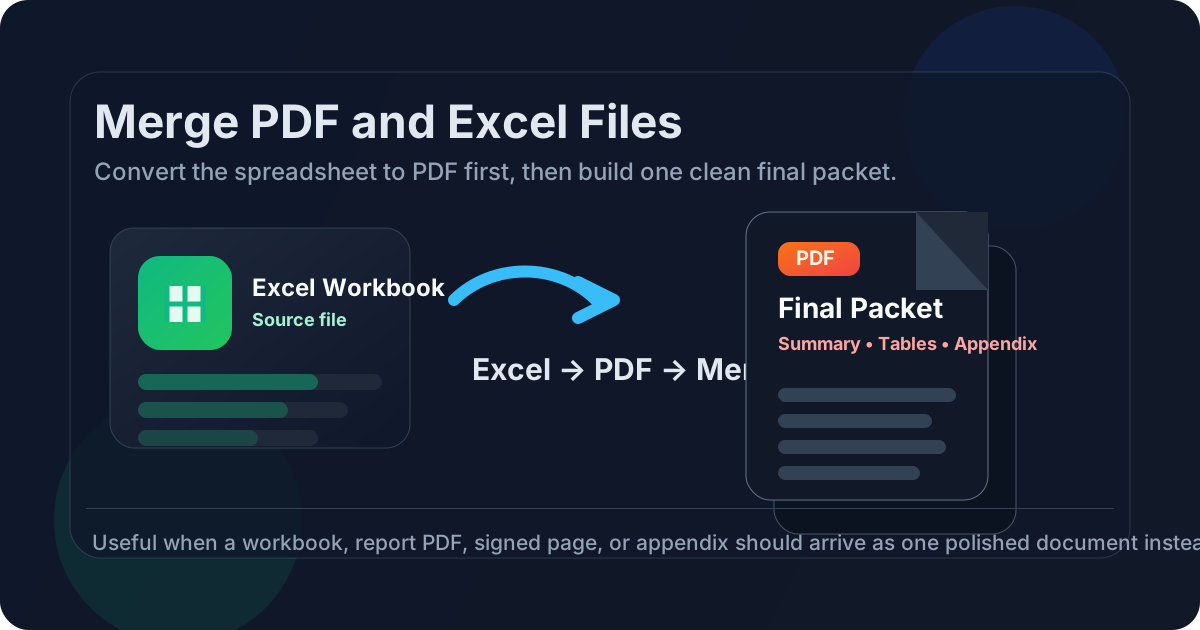
Table of contents
- Quick start: merge Excel and PDF files in about 5 minutes
- Why Excel to PDF first is the cleanest workflow
- Step-by-step: merge the files without wrecking readability
- How to keep spreadsheet pages readable
- How to handle multiple sheets and appendices
- Common real-world use cases
- Troubleshooting wide tables, giant files, and wrong order
- Related LifetimePDF tools and companion guides
- FAQ (People Also Ask)
Quick start: merge Excel and PDF files in about 5 minutes
If the workbook is already finalized and you just need one finished file, this is the workflow most people actually want:
- Open Excel to PDF.
- Convert the final XLS or XLSX file into PDF.
- Open Merge PDF.
- Upload the new spreadsheet PDF together with the report, signed pages, appendix, invoice, or supporting PDF files.
- Drag the files into the exact order you want, merge them, and download the final packet.
- If the result is too large for email or a portal upload, use Compress PDF.
Why Excel to PDF first is the cleanest workflow
There are two ways people imagine this task. One sounds convenient: upload an Excel file and a PDF together and hope the service handles everything perfectly in one pass. The other is calmer: stabilize the spreadsheet first, then merge only PDFs. The second path is usually the better one because it lets you fix layout problems before the file becomes part of a larger packet.
| Workflow | Best when | Main tradeoff |
|---|---|---|
| Convert Excel to PDF, then merge | Budgets, reconciliations, pricing sheets, reports, audit packs, finance appendices | One extra step, but much better layout control |
| Try to combine mixed files immediately | Quick internal packets where perfect formatting does not matter much | Less predictable scaling, order, and readability |
In practice, merge PDF and Excel files usually means convert the editable workbook into a stable PDF, then package everything together. That is how you keep the final result readable for the recipient instead of just technically combined.
Step-by-step: merge the files without wrecking readability
The workflow is simple, but doing each step in the right order prevents the usual spreadsheet problems from leaking into the finished packet.
1) Finalize the workbook before conversion
Settle formulas, choose the exact tabs you want, remove hidden clutter that should not ship, and check whether the intended export should be portrait or landscape. If the workbook still feels half-finished, the merged PDF will preserve that half-finished feeling in a less editable form.
2) Fix page setup before you export
Most Excel problems are page setup problems. Set the print area, confirm page breaks, use landscape for wide sheets when needed, and review scaling so important columns do not disappear off the page. It is much easier to correct that now than after the spreadsheet is already buried inside a larger merged file.
3) Convert Excel to PDF once
Use Excel to PDF with the exact workbook you plan to send. This step freezes the layout so the merge becomes packaging, not guesswork.
4) Gather the supporting PDFs
That may include a cover memo, signed approval pages, a report summary, invoices, a contract, an appendix, or existing PDF exhibits. Putting everything in one folder first makes the merge feel less chaotic and reduces the chance that you attach the wrong version later.
5) Merge in final reading order
Open Merge PDF, upload the spreadsheet PDF and the supporting PDFs, then drag them into the final sequence. The right order matters more than people expect because the recipient will experience the packet top to bottom, not as a pile of source files.
6) Review the packet once before sharing
- Check the first page: does the packet open with the right summary or main document?
- Check spreadsheet readability: are key columns visible without absurd zooming?
- Check transition points: do appendices or supporting pages begin where you intended?
- Check page orientation: did any landscape sheets or attachments rotate oddly?
- Check file size: is it still reasonable for email or a portal upload?
Calmest sequence: finish in Excel, convert once, merge once, review once, then only compress or protect if the real handoff needs that extra step.
How to keep spreadsheet pages readable
The technical merge is easy. The real quality of the result comes from whether the spreadsheet pages are still understandable when they land inside the PDF packet.
| If the spreadsheet problem is... | The better fix is usually... |
|---|---|
| Columns are cut off | Set the print area, switch to landscape, and use Fit All Columns on One Page or a careful scaling setting before export |
| Text looks tiny | Split giant tabs into logical sections or export fewer columns at once instead of forcing one impossible wide sheet onto a single page |
| The wrong tabs were included | Choose the needed sheets explicitly before conversion instead of exporting the whole workbook by habit |
| Financial tables span too many pages awkwardly | Repeat headers where possible, control page breaks, and review the spreadsheet PDF before merging it with the rest of the packet |
One common mistake is forcing everything onto one page simply because Excel offers the option. That is not always the most readable result. A two-page table that people can actually understand is often better than a one-page table that nobody can read without zooming to 300%.
How to handle multiple sheets and appendices
Many workbooks are not a single clean table. They contain summary tabs, raw data, notes, backup calculations, and sometimes hidden sheets nobody intended to share. A better merge workflow starts by deciding what belongs in the final packet and what should stay internal.
Start with the reader-facing story
Ask which sheet or PDF gives the recipient the main answer first. Usually that is a summary, report cover, signed agreement, proposal, or executive overview. Detailed tables and backups should support that story, not overwhelm page one.
Then add evidence in layers
- Main document first: summary report, cover memo, proposal, or agreement
- Spreadsheet section next: pricing tables, budget tabs, reconciliations, or schedules
- Appendices after that: backups, statements, exhibits, supporting calculations, or approvals
If the workbook has several tabs with different audiences, exporting only the relevant ones often creates a much stronger final PDF than blindly shipping the entire workbook.
Common real-world use cases
This keyword shows up because mixed-format document packets are normal work, not edge cases.
Finance and operations
Budgets, forecasts, reconciliations, expense summaries, and board packs often need spreadsheet pages merged with narrative PDFs or signed approvals.
Sales and proposals
A proposal PDF may need pricing tables, implementation schedules, or option matrices that began life in Excel.
Audit and compliance
Audit packets often combine a written report with spreadsheet evidence, reconciliations, or exception lists that must sit in a clear order.
Admin and back office
Invoice packets, account summaries, and internal approval bundles regularly mix tables, cover pages, and scanned supporting PDFs.
In all of these cases, the point is not just to combine files. The point is to send one document that feels intentional and easy to review.
Troubleshooting wide tables, giant files, and wrong order
The spreadsheet export looks cramped
Go back to the Excel step. Check orientation, margins, print area, page breaks, and scaling. If the sheet is still unreadable, split it into a cleaner summary plus appendix instead of insisting that one huge page solve everything.
The final merged PDF is too large
Merge first, then use Compress PDF on the finished packet. That way you only optimize the actual file you plan to send rather than compressing a bunch of intermediate versions.
The file order feels wrong after the merge
Rebuild the order based on how a recipient reads, not how the source files were created. If the spreadsheet is evidence for the report, it should usually follow the report. If it is the main deliverable, it may deserve to lead with a short cover page ahead of it.
The final packet contains sensitive financial data
After merging, consider using Protect PDF before sharing it. Protection does not replace access control or good judgment, but it can help when the handoff genuinely requires extra caution.
Related LifetimePDF tools and companion guides
Most people who merge spreadsheet PDFs into a packet need one or two follow-up steps. These are the most useful next moves:
- Excel to PDF for turning the workbook into a stable export first
- Merge PDF for assembling the final packet
- Compress PDF if the merged file is too heavy for email or a portal
- Protect PDF when the finished packet contains sensitive data
- Merge PDF and Word Files if part of the packet starts as DOCX instead of XLSX
- Merge PDF and Excel Files Online for the broader online workflow discussion
Need to finish the packet now? Convert the workbook first, merge the PDFs second, and only optimize the final file after the structure feels right.
FAQ (People Also Ask)
How do I merge PDF and Excel files?
The cleanest method is to convert the Excel workbook to PDF first, then merge that spreadsheet PDF with your other PDFs. That keeps the layout more stable than trying to combine a live workbook and a PDF at the last second.
Can I combine an XLSX file and a PDF into one final PDF?
Yes. Convert the XLSX workbook to PDF, review the exported pages for readability, then merge that new PDF with your other PDF files into one final packet.
How do I stop Excel columns from getting cut off in the merged PDF?
Fix the spreadsheet export before the merge. Set the print area, switch to landscape when needed, and use scaling such as Fit All Columns on One Page. Most cut-off-column problems happen in the Excel-to-PDF step, not in the merge step.
Should I merge first or compress first?
Usually merge first. The merge step solves document order and structure, while compression solves file size. Once the final packet exists, compress only if the finished file is still too large.
Will merging Excel and PDF files preserve spreadsheet formatting?
Usually yes, if the spreadsheet is converted cleanly to PDF before you merge it. The merge step normally preserves the exported PDF pages as they already look, so the important formatting decisions happen during export.