Convert PDF to JPG Online: Fast Browser Workflow for Clean Page Images
To convert PDF to JPG online, open LifetimePDF's PDF to Image tool in your browser, upload the PDF, choose JPG, and download the exported page images.
If you only need one page or a short page range, extract those pages first so the conversion is faster, cleaner, and easier to share.
That is the fast answer, but the difference between a smooth result and an annoying one usually comes down to a few small choices: whether you convert the full file or only the useful pages, whether JPG is really the right output for the content, and whether the source PDF needs quick cleanup before export. Most people searching this do not want theory. They want a browser workflow that works on the machine they already have open and produces page images they can actually use in chat, email, slide decks, ticket systems, websites, and internal docs.
Fastest practical path: open the browser tool, export only the pages you need, and use JPG when smaller shareable images matter more than ultra-sharp edge detail.
In a hurry? Jump to the quick answer and workflow.
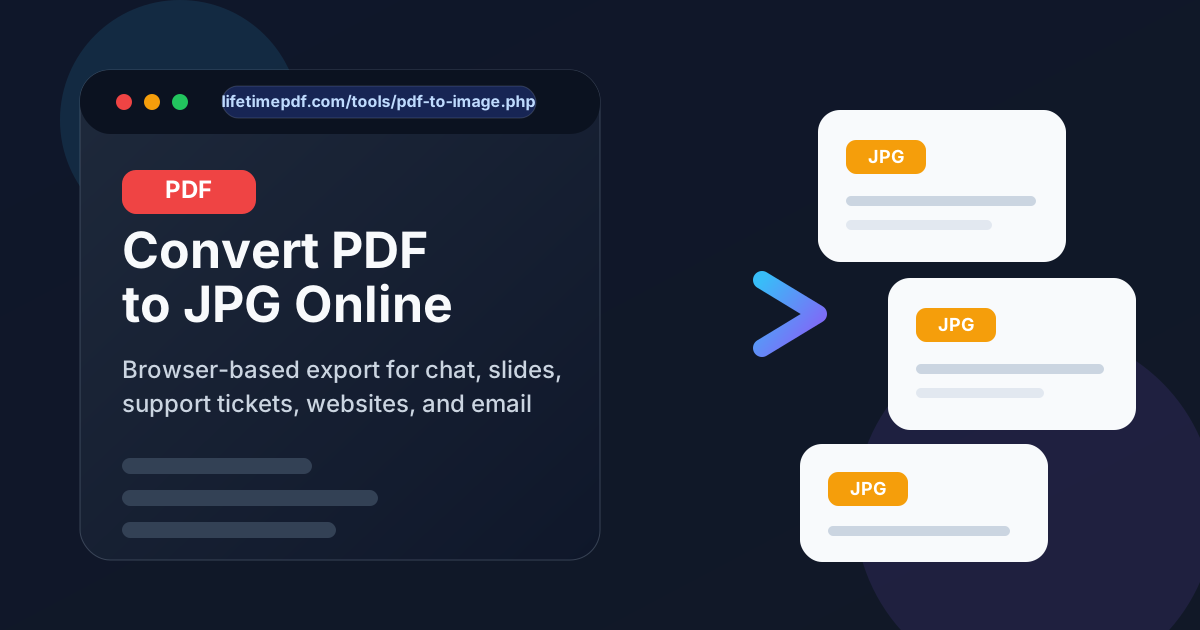
Table of contents
- Quick answer: the cleanest way to convert PDF to JPG online
- Why people want the browser workflow
- Step-by-step: convert PDF to JPG in your browser
- Convert only one page or a page range
- JPG vs PNG for online PDF exports
- How to keep page images clear and readable
- When online works better than desktop
- Privacy and sharing checks before you export
- Helpful tools and related guides
- FAQ
Quick answer: the cleanest way to convert PDF to JPG online
If the PDF is already clean, open PDF to Image, upload the file, choose JPG, and export the result. Each page becomes an image you can drop into email, chat, slides, website uploads, knowledge-base articles, or ticket attachments without asking the next person to open a full PDF viewer.
If the source PDF is long, do not convert the whole thing by default. Extract only the useful pages first. If the page has giant scan borders or the orientation is wrong, fix that before export. Those two habits save more time than most people expect because they reduce clutter, keep file sizes down, and make the final JPGs easier to review.
Why people want the browser workflow
People rarely add the word online by accident. They add it because they want the task finished in the browser, with no install, no admin permission, no software updates, and no extra setup for something that should take a couple of minutes. That is especially common on work laptops, borrowed machines, shared computers, or devices like Chromebooks where browser tools are simply the most natural path.
What “online” usually means in practice
- No install: open the tool, upload the PDF, convert it, and download the images.
- Fast one-off jobs: ideal when you just need one page for a ticket, message, or slide deck.
- Cross-device convenience: the same workflow works on Windows, Mac, Chromebook, and many tablets.
- Less friction: you solve the file problem immediately instead of turning it into a software-management task.
In other words, the search intent here is not just “turn my PDF into images.” It is “turn my PDF into images in the place I am already working.” That is why browser-based PDF tools are so useful when your real job is support, operations, sales, teaching, recruiting, publishing, or project work rather than document management itself.
| Situation | Why online helps |
|---|---|
| Work laptop with locked-down software | You can use the browser immediately without install rights. |
| Need one page image fast | The browser workflow gets you from upload to download quickly. |
| Moving between devices | The same tool works across desktop and web-friendly devices. |
| Sharing, tickets, slides, CMS uploads | JPG output is easy to drop into downstream tools and channels. |
Step-by-step: convert PDF to JPG in your browser
The simplest workflow uses LifetimePDF PDF to Image. The key is to treat the conversion like a practical handoff step, not a generic “convert everything and sort it out later” job.
1) Start with the smallest useful file
If you need one contract page, one chart, one signed page, or one appendix, isolate it first. Smaller PDFs upload faster, convert faster, and produce fewer image files to clean up afterward.
2) Upload the PDF in the browser
Open the tool and add the file. For many day-to-day jobs, that is already the whole setup. No download, no extension, no extra desktop app, just the conversion step you actually need.
3) Choose JPG output
Pick JPG when smaller, easy-to-share images are the goal. This is usually the right choice for chat attachments, email, slide decks, support tickets, and web uploads where portability matters more than perfect edge sharpness.
4) Convert and download
Run the conversion and download the page images. Review one or two pages before sending them anywhere important so you can catch soft text, wrong orientation, or an unnecessary page export early.
5) Use cleanup tools only when they actually help
- Extract Pages when the document is longer than the real job.
- Crop PDF when huge margins make the content look smaller than it should.
- Rotate PDF when the page is sideways or upside down.
- OCR PDF when the broader workflow also needs searchable text from a scan.
Need the browser workflow right now?
Convert only one page or a page range
This is the most valuable habit in the whole workflow. Many people do not really need “convert this PDF to JPG.” They need page 2 from a proposal, a single invoice page, the signature page from a contract, or one chart from a longer report. Exporting only the useful pages keeps the whole job smaller and cleaner.
- Open Extract Pages.
- Create a smaller PDF containing only the exact page or range you need.
- Convert that smaller PDF with PDF to Image.
The benefits are immediate: faster upload, faster conversion, fewer JPG files to sort through, and much less risk of sharing pages that were never meant to leave the original document. If your work involves forms, receipts, client docs, support tickets, marketing proofs, or project attachments, this single step usually saves the most time.
JPG vs PNG for online PDF exports
A lot of “convert PDF to JPG online” searches are really “convert PDF to image online” searches. That matters because JPG is popular, but not always ideal. Picking the right format up front saves rework and gives you output that fits the actual job.
| Format | Best for | Main advantage | Main tradeoff |
|---|---|---|---|
| JPG | Email, chat, ticket systems, slide decks, lightweight web sharing | Smaller files and broad compatibility | Can soften tiny text or crisp line art |
| PNG | Forms, diagrams, charts, screenshots, detail-heavy text pages | Sharper edges and cleaner fine detail | Larger file sizes |
Choose JPG when the page needs to travel easily and size matters. Choose PNG when the page is dense, technical, or full of small text that would look noticeably better with a sharper export. For everyday previews and quick sharing, JPG is usually the practical default.
If you are unsure, do not overthink it. Start with JPG for sharing tasks and switch to PNG only when the result feels softer than the document can tolerate. That is a much better rule than treating one format like a universal answer.
How to keep page images clear and readable
When PDF-to-JPG exports disappoint people, JPG itself is usually not the full problem. The more common causes are weak source scans, oversized margins, sideways pages, or converting content that was really better suited to PNG.
Best practices for better output
- Start with the cleanest source PDF: a digital original usually converts better than a rough copier scan.
- Crop unnecessary borders: use Crop PDF if white margins or scanner shadows make the content look small.
- Rotate before export: fix orientation first so the JPG is immediately usable.
- Export only the pages that matter: smaller, cleaner jobs are easier to review and easier to organize.
- Switch to PNG when needed: diagrams, forms, and text-heavy pages sometimes deserve sharper output than JPG gives.
Common reasons output looks blurry
- The original PDF is already a low-quality scan.
- The useful content occupies only a small part of the page because the margins are huge.
- JPG compression is being asked to preserve very fine lines or tiny text.
- The page orientation was wrong before the export even started.
When online works better than desktop
Browser-based conversion is not automatically better for every situation, but it is often the easiest fit for ordinary work. If you are trying to solve a document task inside a broader workflow, convenience matters more than theoretical feature depth.
Online is usually the better choice when
- you are on a work laptop and do not want to install anything just to export one page.
- you are on a Chromebook where browser tools are the natural path anyway.
- you are moving quickly between devices and want the same process everywhere.
- you only need a clean handoff into email, chat, a CMS, or a support system.
Desktop might make more sense when
- you are handling huge batches constantly and the workflow is closer to production than ordinary office use.
- you need specialized automation that goes beyond page export.
- you already have a mature offline document stack and do not need cross-device convenience.
For most people searching this term, though, the browser wins because it matches the moment. The goal is not to build a document pipeline. The goal is to get a page image out of a PDF quickly and get back to the actual work.
Privacy and sharing checks before you export
PDFs often contain more sensitive information than people realize: names, addresses, signatures, account details, comments, pricing, or pages that should never have been included in the first place. Converting a PDF page to JPG does not remove that risk. In some cases it makes the content easier to spread because image files are simple to forward and embed.
Privacy checklist
- Upload only the pages you need: smaller scope is safer and faster.
- Redact first when needed: use Redact PDF before exporting sensitive pages.
- Do not rely on cropping for confidentiality: cropping improves framing, not privacy.
- Review the exported image once: confirm that nothing unexpected is visible before sharing it.
A smart workflow for sensitive files is simple: isolate the relevant pages, redact private details if needed, export to JPG, and then review the output before it leaves your hands. That is usually enough to keep an ordinary conversion task from turning into an unnecessary exposure.
Helpful tools and related guides
PDF-to-JPG conversion is often only one step in a broader document job. These tools pair especially well with it:
- PDF to Image for the main export step
- Extract Pages when you only need part of a long PDF
- Crop PDF for removing oversized margins before export
- Rotate PDF for fixing orientation first
- OCR PDF when scanned files should also stay searchable
- Redact PDF before sharing sensitive content
Related reading
- Convert PDF to JPG
- Convert PDF to JPG Online Free
- Convert PDF to JPG Without Monthly Fees
- Convert PDF to PNG
- Browse all LifetimePDF articles
Ready to export clean page images? Keep the workflow tight: select the useful pages, fix the PDF only if needed, convert in the browser, and share lighter JPGs where they are easiest to use.
FAQ
How do I convert PDF to JPG online?
Open a browser-based PDF-to-image converter, upload the PDF, choose JPG output, and download the page images. If you only need part of the file, extract those pages first so the job is faster and cleaner.
Can I convert one PDF page to JPG online?
Yes. The easiest method is to isolate the exact page or page range first, then convert that smaller PDF to JPG in the browser. That gives you fewer files and less cleanup afterward.
Should I use JPG or PNG when exporting PDF pages online?
Use JPG when you want smaller files and easier sharing. Use PNG when the page contains fine text, diagrams, screenshots, or graphic detail that needs to stay especially crisp.
Why does my PDF to JPG output look blurry?
Usually because the source PDF was already weak, the page had oversized margins, or the content really needed PNG instead of JPG. Cropping, rotating, and starting from the cleanest source file usually helps immediately.
Is it safe to convert PDF to JPG online?
It can be safe if you upload only what you need and remove sensitive information first. For confidential files, extract the exact pages, redact private details, and review the final image before sharing it.
Published by LifetimePDF — Pay once. Use forever.