Compress PDF for Trimble Connect: Share Smaller Drawing Sets, Issue PDFs, and Coordination Documents Faster
Yes - you can compress a PDF for Trimble Connect before sharing drawing sets, issue PDFs, coordination packets, transmittals, submittals, and project handoff files, and Medium compression is usually the safest place to start because it reduces file size without making sheet numbers, revision notes, callouts, signatures, or issue references hard to read.
If the file is a bulky project package where only a few sheets or sections matter, trim the useful pages first because smaller Trimble Connect PDFs are easier for design teams, field crews, consultants, owners, and subcontractors to open, review, and forward.
Trimble Connect PDFs often travel farther than the original sender expects. A drawing excerpt turns into a coordination attachment. A review pack gets reused in a meeting. A transmittal becomes part of a handoff chain. A closeout document gets reopened months later on a phone or tablet in the field. When the PDF is heavier than the next person actually needs, every one of those handoffs slows down. The goal is not to crush the file as much as possible. The goal is to keep the useful detail, remove unnecessary weight, and make the document easier to trust on the next screen.
Fastest path: Use LifetimePDF's Compress PDF tool, start with Medium compression, and create a smaller Trimble Connect-ready PDF in seconds.
In a hurry? Jump to Quick start: compress a PDF for Trimble Connect in under a minute.
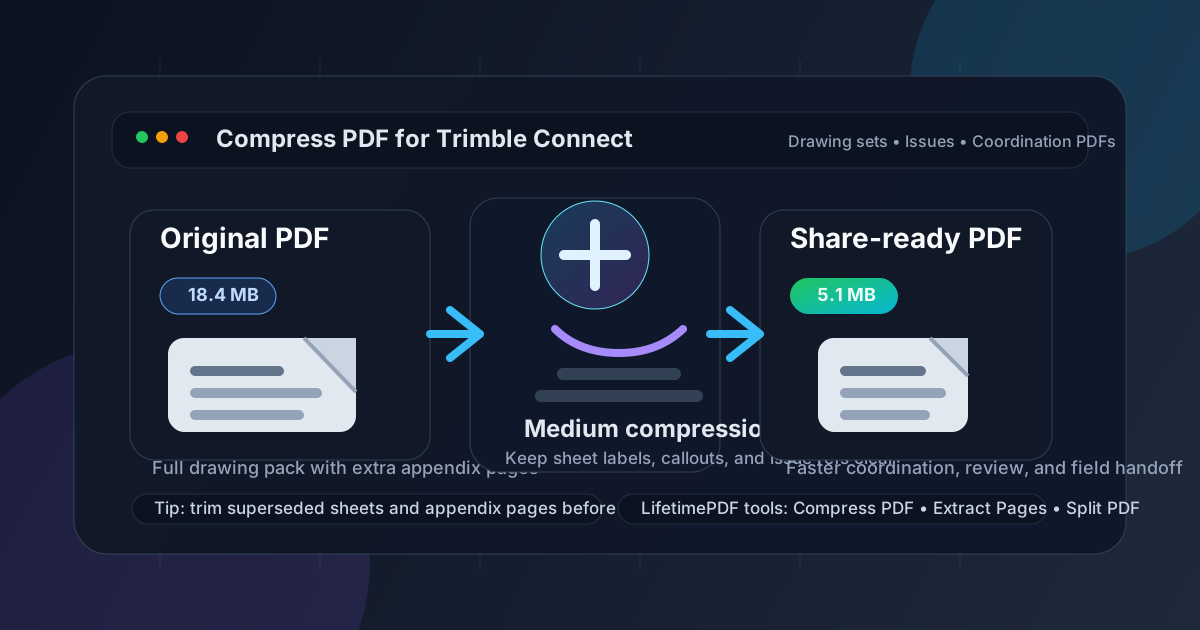
Table of contents
- Quick start: compress a PDF for Trimble Connect in under a minute
- Why compress PDFs before using them in Trimble Connect workflows?
- What size should a Trimble Connect-friendly PDF be?
- Which compression level should you choose?
- Step-by-step: shrink a PDF with LifetimePDF
- Common Trimble Connect PDFs that benefit from compression
- What if the PDF is still too large?
- How to keep drawing details and issue references readable
- Workflow habits that keep Trimble Connect document traffic cleaner
- Related LifetimePDF tools and internal links
- FAQ (People Also Ask)
Quick start: compress a PDF for Trimble Connect in under a minute
If your goal is simply make this Trimble Connect PDF smaller so it is easier to share, reopen, and review, keep it straightforward:
- Open Compress PDF.
- Upload the drawing set, issue export, submittal pack, transmittal, coordination PDF, or field-ready project document.
- Start with Medium compression.
- Download the smaller version and zoom in on sheet numbers, callouts, signatures, revision notes, issue references, and any tiny table text.
- If it is still too large, use Extract Pages, Delete Pages, or Split PDF instead of repeatedly squeezing the whole pack.
That usually works because the biggest gains come from two moves together: reasonable compression and tighter scope. Most recipients do not need every superseded sheet, every duplicate cover page, or every archived appendix just to answer one project question.
Why compress PDFs before using them in Trimble Connect workflows?
Trimble Connect PDFs matter when someone needs a quick answer from a real project context. A coordinator may need to forward a lighter drawing excerpt. A consultant may need a smaller issue packet for review. A site lead may need a compact file on a tablet. An owner representative may need a clean transmittal that opens quickly without hunting for bandwidth. Smaller PDFs reduce friction in every one of those moments.
- Faster uploads and downloads: smaller files move through shared workflows with less waiting.
- Easier mobile review: leaner PDFs are more practical on phones and tablets in the field.
- Cleaner coordination handoffs: people spend less time wrestling with oversized attachments.
- Better version discipline: tighter, cleaner PDFs are easier to review before someone accidentally forwards the wrong package.
- Less inbox and storage waste: if the same package is sent around repeatedly, cutting the size once helps every later handoff.
Compression is especially useful when the document is mostly a transport format rather than the permanent archive. If the goal is quick access, faster sharing, or lighter review, smaller is usually better as long as the details that drive action stay readable.
What size should a Trimble Connect-friendly PDF be?
There is no perfect number for every project, but these targets are practical:
- Under 2 MB: excellent for short issue PDFs, one-off drawing excerpts, and quick mobile review.
- 2 MB to 5 MB: a strong everyday target for many drawing sets, submittals, transmittals, and coordination packets.
- 5 MB to 10 MB: still workable for larger packs, especially if they include multiple sheets, scans, or signatures.
- Above 10 MB: often a sign that the file is either image-heavy, scan-heavy, or carrying more pages than the next reviewer really needs.
The right answer depends on the document type. A one-page transmittal should not weigh as much as a multi-sheet review set. A closeout pack can be larger than a field instruction PDF. What matters is whether the file opens quickly and still shows the smallest important detail clearly.
Which compression level should you choose?
Most people get better results by starting conservatively and only getting more aggressive if the file is still too large.
Low compression
Use this when the PDF contains very fine sheet details, dense schedules, small signatures, or highly detailed markups. File-size savings will be more modest, but it is the safest option when readability is non-negotiable.
Medium compression
This is the best default for most Trimble Connect workflows. It usually shrinks the file enough to make sharing easier while keeping drawing references, issue notes, tables, and approval markings readable.
High compression
Use this only when speed matters more than fine detail, or when the PDF is just a quick-reference copy rather than the master project record. Always verify small text, revision clouds, legends, and signatures afterward because those details fail first.
Step-by-step: shrink a PDF with LifetimePDF
Here is the simplest workflow when you need a smaller Trimble Connect-ready PDF without wasting time:
- Open the tool. Go to Compress PDF.
- Upload the file. Add the drawing set, issue export, transmittal, submittal packet, or coordination PDF you need to share.
- Choose Medium compression first. That is the best default for most Trimble Connect documents because it usually preserves the details people still need to review, approve, comment on, or verify.
- Download the result. Compare the new file size with the original.
- Preview the smallest important detail. Zoom in on sheet numbers, callouts, notes, approval signatures, issue references, and any dense schedules.
- Trim the pack if needed. If the file is still too large, extract the useful pages, remove repeated covers or blank scans, or split one oversized binder into smaller parts.
Fast tool stack for Trimble Connect: compress first, then clean the document structure only if the file is still heavier than it should be.
Common Trimble Connect PDFs that benefit from compression
Some Trimble Connect-related PDFs are much more likely than others to become bloated. These are the usual suspects:
- Drawing sets and sheet excerpts: multi-page sets get heavy fast, especially when they include large-format pages or repeated versions.
- Issue PDFs and review packets: comments, screenshots, and markup pages add up quickly.
- Submittal packages: supporting inserts, scans, and signatures can make routine approvals bulkier than they need to be.
- Transmittals and coordination bundles: when one file combines correspondence, plans, and reference sheets, size balloons quickly.
- Field-ready markup sets: compact files are easier to reopen on tablets and phones on site.
- Closeout or handoff PDFs: long record packs become easier to reuse when they are trimmed and compressed before distribution.
- Scan-heavy supporting records: scanned sketches, signed forms, and legacy PDFs often benefit from cleanup before compression.
If one of those document types keeps causing friction, the best fix is usually to compress it once, then clean up the page scope before it travels through the rest of the workflow.
What if the PDF is still too large?
When compression alone is not enough, the problem is often structure rather than raw image weight. In other words, the PDF may simply contain far more pages than the next reviewer needs.
- Use Extract Pages if the reviewer only needs one issue packet, one transmittal section, or a handful of sheets.
- Use Delete Pages to remove repeated covers, blank scans, superseded sheets, or appendix pages that are not relevant to the current task.
- Use Split PDF if one file has become a catch-all project binder that would work better as smaller parts.
- Use Crop PDF if scans include oversized margins or wasted border space.
- Use OCR PDF if the document is scan-heavy and you also want searchable text later.
How to keep drawing details and issue references readable
The biggest mistake is checking only the final file size. What matters is whether the next person can still read the details that drive action.
- Zoom in on the smallest sheet numbers, callouts, revision notes, issue IDs, and approval markings.
- Check that legends, schedules, signature blocks, and detail bubbles are still easy to recognize.
- Review scan-heavy pages separately because they often degrade sooner than digital sheet exports.
- Look at tables, closeout records, and reference lists because compact text can blur before headings do.
- Preview the file on a tablet or phone if that is how the next reviewer will actually open it in the field.
If the compressed copy fails any of those checks, step back. Use a lighter compression level or reduce the page count instead of forcing the whole file smaller at any cost.
Workflow habits that keep Trimble Connect document traffic cleaner
The easiest PDF to share is the one that never became messy in the first place. A few habits keep Trimble Connect files lighter over time:
- Share tighter subsets: send the exact sheets or sections people need instead of defaulting to the entire package.
- Remove scanner waste early: blank pages, crooked borders, and repeated scans add size without adding value.
- Separate active and archival packets: keep the full record complete while day-to-day working copies stay lighter.
- Strip superseded sheets from working files: keep only the version relevant to the current decision.
- Reuse cleaned versions: if one file keeps circulating, shrink and tidy it once before the next round of sharing.
Those habits usually do more for day-to-day coordination than aggressive compression by itself.
Related LifetimePDF tools and internal links
If you are cleaning up Trimble Connect documents regularly, these LifetimePDF tools are the most useful companions:
- Compress PDF for the first pass on oversized files.
- Extract Pages when only a few sheets or issue pages matter.
- Delete Pages to remove repeated covers, blanks, and appendix clutter.
- Split PDF if one packet has become too large to stay useful.
- Merge PDF when you need a clean final package after trimming the pieces.
Related guides on the site: Compress PDF for Revizto, Compress PDF for Bluebeam, Compress PDF for Procore, Compress PDF for Autodesk Build, and Compress PDF for Oracle Aconex.
Bottom line: for most Trimble Connect files, start with Medium compression, then trim the pack if the document is still heavier than the task requires.
FAQ (People Also Ask)
How do I compress a PDF for Trimble Connect?
Upload the file to a PDF compressor, start with Medium compression, download the smaller result, and preview it before sharing it in Trimble Connect workflows or sending it to the next reviewer. If the file is still larger than you want, extract only the pages people actually need instead of repeatedly over-compressing the full packet.
What PDF size should I target for Trimble Connect?
Under 5MB is a practical target for many drawing excerpts, issue PDFs, coordination packets, and handoff documents, while under 2MB feels especially lightweight for quick previews and mobile review. Larger multi-sheet sets may need more room, but they are usually easier to manage once trimmed or split.
Will compressing a PDF make sheet numbers or issue references blurry?
Usually not if you begin with Medium compression and review the result before replacing the original. The biggest risk is with tiny sheet labels, dense callouts, small revision notes, signatures, and issue references, so always zoom in on the smallest important detail first.
Should I compress the whole drawing set or only selected pages?
If the reviewer only needs one issue packet, one transmittal, or a few sheets, share only those pages. A smaller, tighter PDF is usually faster to open and easier to act on than one oversized project binder.
What if my Trimble Connect PDF is still too large after compression?
Extract only the relevant pages, delete repeated cover sheets or blank scans, crop wasted margins, or split one large document into smaller parts. Structural cleanup usually protects readability better than pushing compression harder again and again.
Which Trimble Connect PDFs benefit most from compression?
Drawing sets, issue exports, coordination packets, transmittals, submittal packages, field-ready markup sets, and closeout or handoff PDFs are common candidates because they get reopened and forwarded across several teams during a project.