Compress PDF for Screaming Frog: Shrink Crawl Exports, Audit PDFs, and Client Reports Without Losing Detail
To compress a PDF for Screaming Frog, export the report, upload it to Compress PDF, start with Medium compression, and keep the smaller file only if URL rows, issue labels, chart legends, and screenshots still look clear.
For most Screaming Frog workflows, under 2MB works well for focused summaries, while broader technical audits and appendix-heavy handoff decks usually land best around 2MB to 5MB if the smallest useful text still reads comfortably.
Screaming Frog PDFs get heavy for very normal reasons. A crawl summary turns into charts, issue tables, screenshots, redirect examples, and appendix pages. A technical audit picks up annotations, before-and-after comparisons, and evidence for developers or clients. Compression helps most when it removes that extra weight without flattening the details that make the audit useful.
Fastest path: use LifetimePDF's Compress PDF tool, begin with Medium compression, then do one quick readability check before you email, upload, or archive the smaller Screaming Frog PDF.
Short on time? Jump to Quick start: compress a Screaming Frog PDF in under 2 minutes.
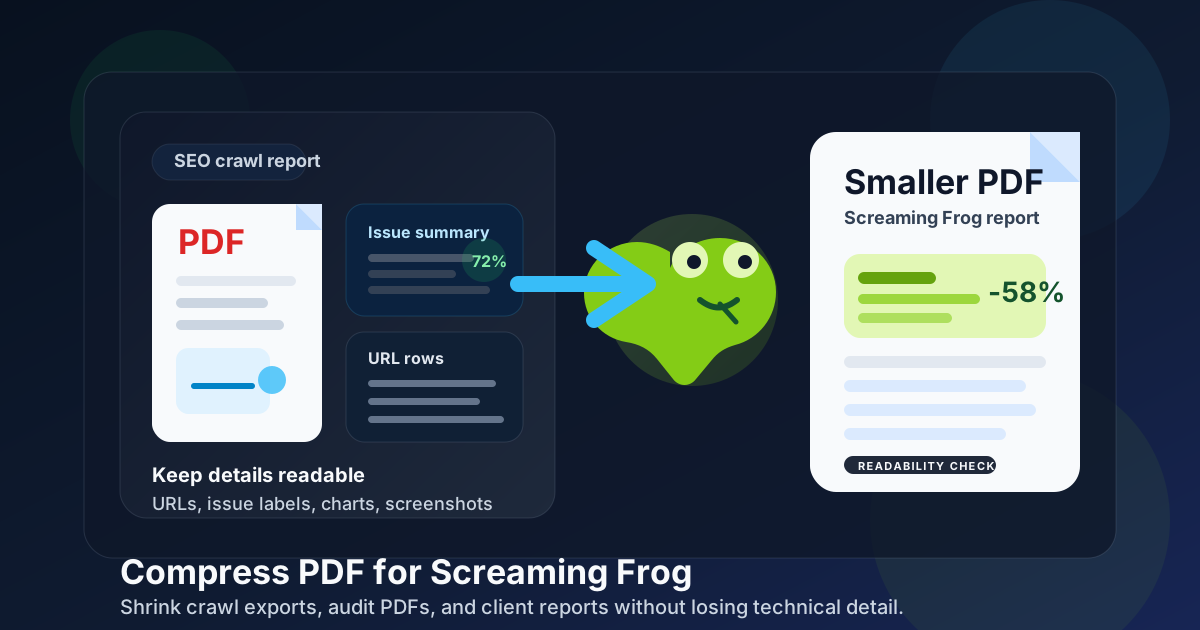
Table of contents
- Quick start: compress a Screaming Frog PDF in under 2 minutes
- Why smaller PDFs help in Screaming Frog workflows
- What file size should you aim for?
- Which compression level should you choose?
- Step-by-step: shrink a Screaming Frog PDF with LifetimePDF
- Best approach for common Screaming Frog report types
- When to split pages instead of compressing harder
- How to keep URL rows, screenshots, and notes readable
- Workflow habits that reduce PDF bloat
- Related LifetimePDF tools and useful reading
- FAQ (People Also Ask)
Quick start: compress a Screaming Frog PDF in under 2 minutes
If your real goal is simply make this Screaming Frog PDF smaller so it is easier to send, this workflow is usually enough:
- Open Compress PDF.
- Upload the report you actually plan to share, such as a crawl overview, issue summary, redirect review, screenshot-backed technical audit, image audit handoff, or client-ready SEO deck.
- Choose Medium compression first.
- Download the smaller copy and compare the size reduction.
- Check the weakest details once: narrow URL rows, issue labels, redirect targets, chart legends, dates, screenshot callouts, and short notes.
- If the file is still bulky, use Split PDF or Delete Pages before pushing stronger compression across the full report.
Why smaller PDFs help in Screaming Frog workflows
Screaming Frog reports are useful because they turn a live crawl into something fixed. The crawl itself is where you investigate, but the PDF is what gets attached to a technical audit, added to a ticket, sent to a client, or reopened in a meeting. That is when file size starts to matter.
Heavy PDFs add friction everywhere. They upload more slowly, feel awkward in email, and open poorly when someone only needs the summary or proof for one issue. In practice, the extra weight usually comes from screenshot-heavy appendix pages, repeated browser captures, long lists of examples, or one all-purpose document trying to serve several audiences at once. Good compression is not about chasing the tiniest number possible. It is about removing weight while protecting the details people still need to act on.
Why compression usually helps
- Faster handoffs: lighter PDFs are easier to email, upload to tickets, and attach to project updates.
- Smoother reviews: smaller files open faster when a client or developer only wants the headline issues.
- Cleaner archives: monthly crawl packs are easier to store when they are not bloated.
- Better meeting flow: review calls go more smoothly when everyone can open the same audit quickly.
- Less resend friction: compressing once is easier than rebuilding and resending an oversized file later.
What file size should you aim for?
There is no perfect number for every Screaming Frog export, but practical ranges help you avoid compressing harder than necessary:
| Document type | Comfortable target | What to protect |
|---|---|---|
| Crawl overview or issue summary | Under 2MB | Issue counts, chart labels, short recommendations |
| Redirect review or canonical examples | 1MB to 3MB | URL rows, target paths, status codes, notes |
| Screenshot-backed technical audit | 2MB to 5MB | Annotations, browser text, highlighted issues |
| Client deck with appendix pages | 2MB to 5MB | Summary pages, key evidence, action items |
| Large evidence pack or handoff archive | Split instead of forcing one target | Readability first, especially small screenshots and long URLs |
If the PDF is far above those ranges, the problem is not always the compression level. It is often that the document is doing too many jobs at once. A summary for a client, an appendix for developers, and visual proof for stakeholders often work better as separate files than as one oversized bundle.
Which compression level should you choose?
Compression works best when you choose the level based on what the reader still needs to inspect:
Low compression
Use Low when the report contains lots of tiny text, thin columns, or proof screenshots that someone may zoom into. This is a safe choice for redirect lists, canonical examples, and screenshots with callouts.
Medium compression
This is the strongest default for most Screaming Frog PDFs. It usually cuts enough size to make sharing easier while preserving issue summaries, charts, URL rows, date labels, and short technical notes.
High compression
Use High only when the file still needs a major size drop and the content is visually forgiving. High compression is more acceptable for summary-heavy decks than for appendix pages full of tiny URLs or screenshot evidence.
Step-by-step: shrink a Screaming Frog PDF with LifetimePDF
- Finish the PDF first. Export or save the report only after you know which pages actually need to go out.
- Open Compress PDF.
- Upload the file. Use the real handoff version, not a rough working copy with pages nobody needs.
- Choose Medium compression. Start there unless you already know the PDF is exceptionally delicate.
- Download the smaller copy. Compare the new size against the original so you know whether the first pass was enough.
- Review the weak spots. Check the narrowest URL rows, the smallest chart labels, screenshot callouts, and any before-and-after evidence.
- Trim structure if needed. Use Extract Pages, Delete Pages, or Split PDF when the file is still bigger than it should be.
The goal is not to make the file microscopic. The goal is to create the lightest version that still lets the next person trust what they are looking at.
Best approach for common Screaming Frog report types
Crawl overview or issue summary
These usually compress well because the most important content is headline counts, short labels, and a few charts. Medium compression is usually enough. If the PDF is still bigger than expected, repeated cover pages or logo-heavy templates may be adding more weight than the crawl summary itself.
Redirect review or canonical examples
Be more careful here. Thin columns, long URLs, status codes, and short note fields can become annoying fast if the text softens too much. Medium is still a strong first pass, but Low can be safer when the appendix is mostly table-driven.
Screenshot-backed technical audit
This is where file size grows quickly. Browser captures, highlights, arrows, and annotated examples add a lot of visual weight. Compression helps, but removing repeated screenshots or splitting the appendix often helps more.
Image, alt text, or metadata handoff
These reports often mix tables with visual examples. Medium usually works well if you still review the smallest text areas once afterward. If the screenshots show tiny UI elements or filenames, keep the compression lighter.
Client deck plus technical appendix
This is the classic oversized PDF. Usually the best move is to keep the summary deck lean and move the raw evidence into a second file. Readers who want the headline story and readers who want every example are rarely the same audience.
When to split pages instead of compressing harder
Compression is only one fix. Sometimes the smarter move is to send less PDF.
- Split the executive summary if stakeholders only need priorities and outcomes.
- Extract proof pages when a developer only needs the examples tied to one issue group.
- Delete repeated screenshots that say the same thing several times.
- Separate appendices so the main file opens quickly and the evidence pack stays optional.
How to keep URL rows, screenshots, and notes readable
Before you keep the compressed copy, review the parts most likely to break first:
- Long URL rows: make sure paths, parameters, and status codes still separate cleanly.
- Issue labels: confirm headings and counts are still readable at normal zoom.
- Chart legends and dates: small labels fade quickly if compression is too aggressive.
- Screenshot callouts: arrows, circles, and tiny browser text should still make sense on first glance.
- Action notes: if the recommendation line is hard to read, the report becomes less useful immediately.
You do not need to review every page in detail. Just check the weakest examples. If the smallest, busiest, or most annotation-heavy pages still look good, the rest usually will too.
Workflow habits that reduce PDF bloat
The best compression result often starts before you touch the compressor.
- Export only the pages the audience actually needs.
- Remove duplicate covers and repeated appendix sections.
- Keep screenshots focused instead of full-browser when the issue lives in one small area.
- Use separate files for the summary and evidence pack when the audiences differ.
- Archive the full version if you need it, but share the lighter version on purpose.
This is usually how technical SEO reporting gets easier over time. Not by squeezing harder, but by getting clearer about what each PDF is supposed to do.
Related LifetimePDF tools and useful reading
If compression alone is not the full answer, these tools and articles usually help:
- Compress PDF for Screaming Frog Without Monthly Fees
- Compress PDF for SEO Client Reports
- Compress PDF for Semrush
Want the quickest workflow? Compress first, then split or extract only if the audit still feels heavier than it should.
FAQ (People Also Ask)
How do I compress a PDF for Screaming Frog?
Export the report as a PDF, upload it to a compressor, start with Medium compression, and preview the smaller result before you share it. For most Screaming Frog reports, Medium is the safest first step because it reduces size while keeping URL rows, issue counts, chart labels, and screenshots readable.
What file size should I aim for with Screaming Frog reports?
Under 2MB is a strong target for short crawl summaries, redirect reviews, and focused issue updates. Larger technical audit packs and screenshot-heavy handoff decks usually work best around 2MB to 5MB as long as the smallest useful text still looks clear.
Will compression make Screaming Frog URL lists blurry?
It can if you compress too aggressively. That is why Medium compression is the safest default for most Screaming Frog PDFs. Always check the narrowest URL rows, chart legends, and screenshot notes before keeping the smaller copy.
Should I split a large Screaming Frog PDF instead of compressing it harder?
Often, yes. If one PDF mixes the executive summary, screenshot appendix, and raw technical evidence for different readers, splitting it usually works better than forcing stronger compression across every page.
What should I do if the Screaming Frog PDF is still too large after compression?
Remove repeated screenshots, crop wasted browser margins, extract only the pages the reader needs, or split the appendix before trying stronger compression. In many Screaming Frog workflows, the biggest size problem comes from packaging too much into one PDF.