Compress PDF for Keyword Cupid Without Monthly Fees: Shrink Keyword Clusters, Topic Maps, and Client PDFs Without Another Subscription
If you need to compress a PDF for Keyword Cupid without monthly fees, export only the report you actually need, run it through a pay-once PDF tool, start with Medium compression, and keep the smaller copy only if the labels and notes still read clearly.
For most Keyword Cupid exports, that is enough to shrink keyword clusters, topic maps, and client PDFs without turning a simple finishing task into another recurring software bill.
The PDF problem usually appears after the real SEO work is already done. You have grouped the keywords, cleaned the list, decided what belongs together, and now you just need a shareable file that opens fast and does not feel clumsy in email, Slack, Google Drive, or a client portal. That is why the best workflow here is not complicated. The goal is a smaller PDF that still keeps the useful context intact when someone zooms in on a cluster name, a supporting screenshot, or a short recommendation.
Fastest path: export the Keyword Cupid report, use LifetimePDF's Compress PDF tool, begin with Medium compression, and split or extract pages only if the file is still heavier than you want.
In a hurry? Jump to Quick start: compress a Keyword Cupid PDF in under 2 minutes.
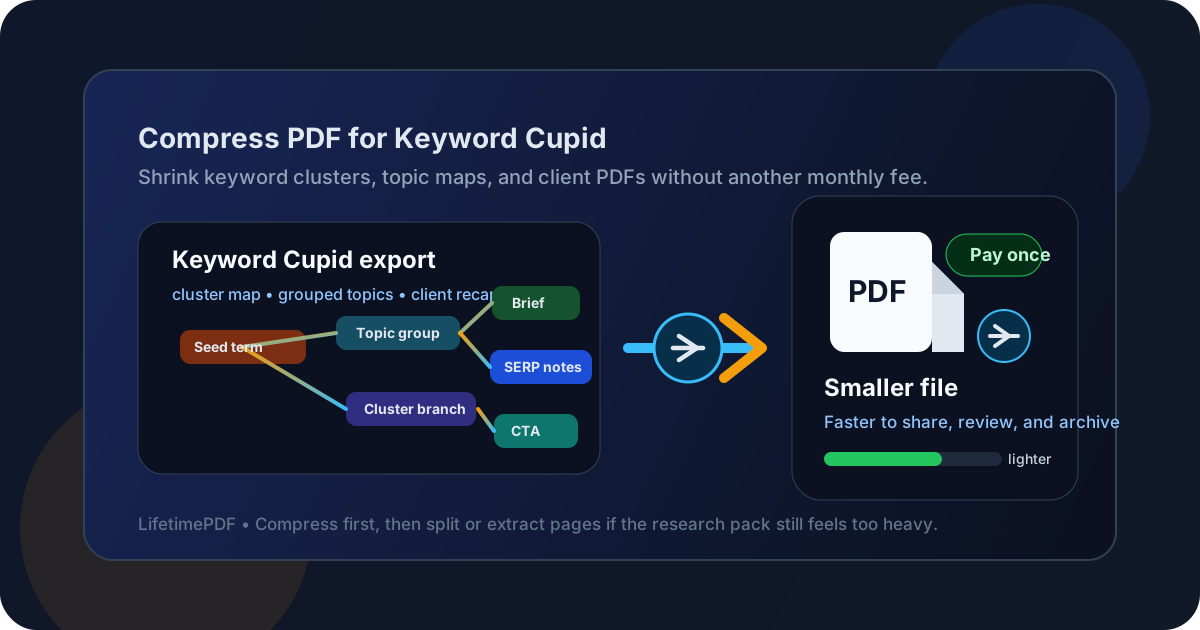
Table of contents
- Quick start: compress a Keyword Cupid PDF in under 2 minutes
- Why "without monthly fees" matters for Keyword Cupid exports
- Why smaller PDFs help in Keyword Cupid workflows
- What file size should you aim for?
- Which compression level should you choose?
- Step-by-step: use LifetimePDF to shrink the file
- Best approach for common Keyword Cupid PDF types
- What to do if the PDF is still too large
- How to keep labels, maps, and notes readable
- Workflow habits that reduce PDF bloat
- Related LifetimePDF tools and useful reading
- FAQ (People Also Ask)
Quick start: compress a Keyword Cupid PDF in under 2 minutes
If your real goal is simply make this Keyword Cupid PDF smaller so it is easier to send, review, and save, this workflow is usually enough:
- Export only the Keyword Cupid file you actually want to share.
- Open Compress PDF.
- Upload the Keyword Cupid PDF.
- Choose Medium compression first.
- Download the smaller file and compare the new size.
- Preview the parts that matter most: cluster labels, topic groups, screenshots, notes, and final recommendations.
- If the report is still bulky, use Extract Pages, Split PDF, or Delete Pages before pushing compression harder.
Why "without monthly fees" matters for Keyword Cupid exports
The search intent behind this keyword is practical. People are not looking for a whole new SEO platform. They are trying to finish the last boring step after the analysis is already done.
Keyword clustering work tends to sit near the top of a content workflow. You use it to decide what belongs together, where a page should focus, what supporting sections might make sense, and how to explain the strategy to somebody else. But the PDF problem shows up at the bottom of that workflow, right before handoff. Maybe you are sending a writer a simplified brief, attaching grouped keywords to a proposal, or giving a client an easier-to-review recap. At that moment, file size suddenly matters a lot more than the clustering feature list.
Paying another monthly fee just to shrink a finished export is hard to justify. A pay-once PDF workflow fits better because the actual job is small, repeatable, and predictable: make the file lighter, keep the useful details readable, and move on.
Why smaller PDFs help in Keyword Cupid workflows
Smaller PDFs create less friction. They upload faster, open faster on slower laptops, preview more cleanly inside browsers, and feel less annoying when someone needs to forward them again. That matters because Keyword Cupid outputs often get passed between people with different priorities.
- Writers want the grouped keywords and the main direction without digging through a bloated appendix.
- Editors want a cleaner handoff they can review quickly while planning assignments.
- Clients want the strategy and evidence without waiting for a huge file to load.
- Internal teams want a version that is easy to archive, attach, and reopen later.
The right compression pass makes those handoffs smoother. It does not need to produce the tiniest file on earth. It only needs to make the PDF easier to live with while preserving the labels and visual cues that explain the clustering logic.
| Common Keyword Cupid PDF | What people usually care about | What to protect during compression |
|---|---|---|
| Keyword cluster export | Group names, keyword relationships, and page focus | Small labels, spacing, and readable text |
| Topic map or planning recap | Hierarchy, grouping logic, and next-step clarity | Branch labels, headings, and callouts |
| Writer handoff PDF | Clean direction and minimal friction | Main summary pages and notes |
| Client-ready strategy pack | Clarity, speed, and confidence | Screenshots, summary slides, and proof pages |
What file size should you aim for?
There is no perfect universal size target, but there are practical ranges that usually work well.
- Under 2MB: a strong target for short keyword clusters, concise topic maps, and focused writer handoffs.
- 2MB to 5MB: a realistic range for screenshot-heavy research recaps and client-ready strategy PDFs.
- Above 5MB: often a sign that the file includes appendix pages, repeated screenshots, or extra material that the next reader may not actually need.
The better question is not how tiny can this become? It is what is the smallest version that still feels trustworthy when someone reads the fine print? If the map labels, supporting notes, or summary screenshots look muddy, you probably saved the wrong bytes.
Which compression level should you choose?
Start in the middle. Most Keyword Cupid PDFs benefit from a balanced first pass rather than an aggressive one.
Use light compression when
- the document is mostly text,
- the file is already fairly small, or
- you only need a modest reduction before emailing it.
Use medium compression when
- the PDF mixes text with screenshots or diagrams,
- cluster labels need to remain readable at normal zoom, or
- you want the safest default for client-facing delivery.
Use stronger compression only when
- the file is still too heavy after cleanup,
- the PDF is mostly a convenience copy rather than a reference document, or
- you have already removed extra appendix pages and still need more size reduction.
Strong compression is not automatically wrong. It just becomes riskier once the PDF relies on tiny labels, color-coded groupings, or screenshots that someone may need to inspect later.
Step-by-step: use LifetimePDF to shrink the file
- Export the right PDF first. If the real audience only needs the summary, do not start with the full research pack.
- Open Compress PDF.
- Upload the Keyword Cupid export. Drag and drop works if that is faster for you.
- Choose Medium compression. That is usually the best first pass for cluster-heavy PDFs.
- Download the compressed copy.
- Run one quick quality check. Read the smallest labels, review any screenshot callouts, and scan the summary pages.
- Only then decide whether you actually need more compression.
If the first result is still larger than you want, try cleanup before aggression. In many cases, removing extra pages creates a better outcome than repeatedly squeezing the whole file.
Best approach for common Keyword Cupid PDF types
1. Keyword cluster exports
These usually depend on readable group names and clear spacing. Medium compression is often enough. Check the smallest cluster labels before you keep the new file.
2. Topic maps and planning recaps
These benefit from clarity more than raw size reduction. If the visual grouping is part of the value, avoid jumping straight to heavy compression.
3. Writer handoff PDFs
Writers often need the summary pages, not every supporting export. Use Extract Pages to create a tighter handoff rather than sending the entire research archive.
4. Client-ready strategy packs
Client PDFs are where presentation matters most. Smaller is good, but confidence matters more. If a key screenshot, note, or label looks fuzzy, the file may feel less professional even if it is easier to send.
What to do if the PDF is still too large
When the PDF stays bulky after a sensible compression pass, the answer is usually structure, not force.
- Split the appendix into a second file with Split PDF.
- Extract only the key pages for the next reader with Extract Pages.
- Delete repeated evidence pages with Delete Pages.
- Crop extra margins if the export wastes a lot of white space.
- Keep a full archive copy and share a lighter working copy instead.
This is usually the better trade-off. A focused 1.8MB summary plus a separate appendix is often more usable than one 8MB file that tries to serve every reader at once.
How to keep labels, maps, and notes readable
The most useful review is a quick human check. Before you send the compressed file, look at the exact things that carry meaning in a clustering PDF:
- the smallest cluster or group names,
- topic map branches and hierarchy labels,
- screenshots or supporting visuals,
- summary tables, and
- short notes or action points near the end.
If those survive, the PDF is probably ready. If those fail, the file may technically be smaller but practically be worse.
Workflow habits that reduce PDF bloat
- Export intentionally. Do not print everything when only a summary needs to travel.
- Keep evidence separate. Save supporting screenshots or raw exports in a second file.
- Remove duplicates early. Repeated pages quietly inflate PDFs.
- Standardize handoffs. A short client recap and a separate appendix usually scale better than one all-in-one document.
- Name files clearly. A small, readable PDF is even more useful when the filename tells people what it contains.
Those habits matter because the easiest PDF to compress well is the one that was packaged sensibly before compression started.
Related LifetimePDF tools and useful reading
If your Keyword Cupid PDF needs more than basic compression, these tools usually help next:
- Compress PDF for the first size reduction pass
- Extract Pages for slimmer client or writer handoffs
- Split PDF for long appendices and archives
- Delete Pages for duplicate or low-value sections
Similar workflows: Compress PDF for Keyword Insights Without Monthly Fees and Compress PDF for TopicMojo Without Monthly Fees.
FAQ (People Also Ask)
How do I compress a PDF for Keyword Cupid without monthly fees?
Use a pay-once PDF tool like LifetimePDF, upload the Keyword Cupid export, start with Medium compression, and preview the smaller result before sharing it. If the file is still too bulky, split or extract the pages people actually need instead of over-compressing the whole document.
What file size should I aim for with Keyword Cupid PDFs?
Under 2MB is a practical target for short keyword clusters, concise topic maps, and writer handoffs. Larger strategy packs and screenshot-heavy client recaps usually work better around 2MB to 5MB as long as the smallest labels still look clear.
Will compression make Keyword Cupid labels or maps blurry?
It can if you compress too aggressively. Medium compression is usually the safest first pass. Always check the smallest labels, branch names, screenshots, and notes before you keep the compressed copy.
Why look for a Keyword Cupid workflow without monthly fees?
Because PDF cleanup is finish-line work. If you already pay for research or clustering tools, another recurring fee just to make exported PDFs smaller is usually hard to justify. A pay-once workflow fits the task better.
What if my Keyword Cupid PDF is still too large after compression?
Extract the summary pages, split the appendix, remove duplicate screenshots, crop wasted margins, or delete backup pages before forcing heavier compression. In many cases, a smaller focused PDF works better than one oversized all-in-one pack.
Ready to shrink the file? Start with a balanced compression pass, then clean up pages only if the export is still heavier than it needs to be.