Compress PDF for JetOctopus: Keep Crawl Reports, Log Analysis Exports, and Technical SEO Evidence Small Without Losing the Details
To compress a PDF for JetOctopus, export the file, upload it to LifetimePDF's Compress PDF tool, start with Medium compression, and keep the smaller copy only if chart labels, URL examples, segment names, and screenshot callouts still look clear.
For most JetOctopus PDFs, under 2MB works well for short crawl recaps, while broader reports, log-analysis exports, and stakeholder packs usually land best around 2MB to 5MB.
In real JetOctopus work, the PDF is rarely the analysis itself. It is the portable version of the analysis: the file that gets attached to a ticket, added to a client update, forwarded to engineering, or archived as proof after the conversation moves on. Smaller is helpful only if the evidence survives. The best result is not the tiniest file. It is the one that moves easily and still holds up when somebody zooms in on the details.
Fastest path: run the JetOctopus PDF through LifetimePDF's Compress PDF tool on Medium, then do one quick readability check before you send, upload, or archive the smaller copy.
In a hurry? Jump to Quick start: compress a JetOctopus PDF in about 2 minutes.
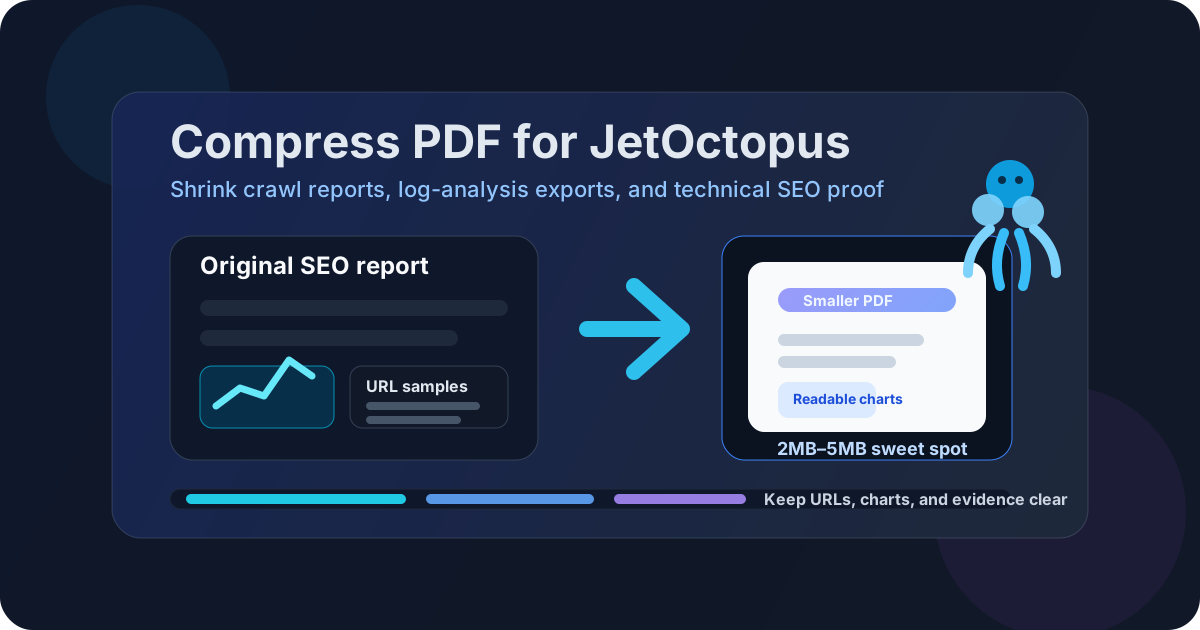
Table of contents
- Quick start: compress a JetOctopus PDF in about 2 minutes
- Why smaller PDFs help in JetOctopus workflows
- What file size should you aim for?
- Which compression level should you choose?
- Step-by-step: shrink a JetOctopus PDF with LifetimePDF
- Best approach for common JetOctopus PDF types
- What if the PDF is still too large?
- How to check quality before you share it
- Workflow habits that reduce PDF bloat
- Related LifetimePDF tools and useful reading
- FAQ (People Also Ask)
Quick start: compress a JetOctopus PDF in about 2 minutes
If your real goal is simply make this JetOctopus PDF smaller so it is easier to send, upload, or archive, this workflow is usually enough:
- Open Compress PDF.
- Upload the JetOctopus PDF you actually plan to share, such as a crawl recap, log-analysis export, issue summary, segment snapshot, rendering review, or client-ready technical SEO handoff.
- Choose Medium compression first.
- Download the smaller result and compare the new size with the original.
- Preview the weakest details once: chart labels, URL paths, segment names, screenshot callouts, issue counts, and recommendation text.
- If the file still feels bulky, extract the pages the next reader actually needs or split the appendix before you push compression harder.
Why smaller PDFs help in JetOctopus workflows
JetOctopus exports often leave the platform because somebody needs a fixed version of the story. That could be a crawl summary for engineering, a log-analysis snapshot for a traffic investigation, a segmented issue pack for a specialist, or a cleaner client-facing recap for a broader audience. Once the work becomes a PDF, file size matters in a very practical way.
Heavy PDFs are slower to open, more annoying to forward, and easier for busy people to postpone. The extra weight usually comes from wide tables, screenshot-heavy appendices, repeated proof pages, and one report trying to answer every question for every audience at once. Compression helps, but the real win comes from making the file lighter without making the evidence shakier.
What usually needs to stay sharp
- URL examples: long paths, pagination samples, and page-group examples need to stay legible.
- Issue labels and counts: if these blur, the report feels less trustworthy.
- Chart labels and trend lines: crawl-depth graphs, status-code summaries, and log spikes are easy to damage with harsh compression.
- Screenshot proof: rendered-page callouts, JavaScript issues, and evidence captures should still point to the exact problem.
- Recommendation blocks: the action item is often as important as the proof itself.
What file size should you aim for?
There is no single magic number for every JetOctopus export, but practical ranges help you avoid compressing harder than necessary:
| PDF type | Practical target | Why it works |
|---|---|---|
| Short crawl recap or issue summary | Under 2MB | Easy to email, attach to tickets, and open during quick reviews. |
| Log-analysis export or segment report | 2MB to 4MB | Usually enough room for charts, labels, notes, and a few proof screenshots. |
| Client-ready technical SEO handoff | 2MB to 5MB | Large enough to keep annotations and supporting visuals readable without feeling bloated. |
If you can get below those numbers without damaging clarity, great. If not, do not force it. A report that stays readable at 3.8MB is more useful than one crushed to 1.1MB where the chart legends and URL samples turn soft.
Which compression level should you choose?
For most JetOctopus PDFs, Medium is the right starting point. It usually cuts enough size to matter without destroying the visual evidence people still need.
- Low compression: use it when the PDF already looks lean and you only need a small reduction while protecting dense tables or tiny labels.
- Medium compression: best for most crawl summaries, issue packs, log-analysis exports, and client review decks.
- High compression: use it carefully for quick-reference copies only after checking every important detail.
Step-by-step: shrink a JetOctopus PDF with LifetimePDF
- Start with the final PDF. Compress the version you truly plan to share, not an earlier draft that still includes extra pages.
- Open Compress PDF.
- Upload the file. This might be a crawl overview, an issue package, a log-analysis recap, a render-audit PDF, or a client-ready summary.
- Choose Medium compression. It is the best first pass for most JetOctopus workflows.
- Download the smaller result. Compare the new size with the original so you know whether the gain was worth it.
- Preview the details that matter. Check chart labels, segment names, URL paths, screenshot callouts, issue counts, and recommendation blocks.
- Trim structure before using stronger compression. If the file is still too large, split the appendix, extract proof pages, or delete repetition before trying High compression.
Best approach for common JetOctopus PDF types
1. Crawl overview recaps
These usually go to stakeholders who need the shape of the issue, not every backup page. Keep the summary, a few proof visuals, and the action items. If the PDF contains long appendix tables that nobody will open right away, split them into a separate file.
2. Log-analysis exports and segment summaries
These often depend on small chart labels, date ranges, bot-segment names, and URL pattern examples. Medium compression is usually safe, but check the smallest labels after download. If a single appendix is making the file heavy, extract the main summary and keep the raw evidence separate.
3. Screenshot-heavy evidence appendices
Render issues, crawl traps, canonical conflicts, pagination problems, and mobile-vs-desktop screenshots can add a lot of weight fast. Before compressing harder, remove duplicates, crop wasted browser chrome, and keep only the screenshots that prove the point.
4. Client or stakeholder packs
These files usually need to balance clarity with portability. The best version is rarely the complete internal working deck. It is a tighter handoff that keeps conclusions, proof, and next steps together while leaving backup material in a separate appendix when necessary.
What if the PDF is still too large?
If Medium compression does not get the file where you want it, try structure fixes before you crush the whole PDF harder:
- Use Extract Pages to keep only the summary, findings, and proof sections.
- Use Split PDF to separate the main narrative from the appendix.
- Use Delete Pages to remove repeated covers, stale screenshots, or backup sections that do not need to travel.
- Use Crop PDF when oversized margins or browser framing waste space.
How to check quality before you share it
Give the compressed copy one quick review. You do not need a full audit. Just check the parts most likely to break.
Check these details
- Chart legends and trend labels
- URL paths and page-group examples
- Issue counts and severity labels
- Screenshot callouts and highlighted proof
- Recommendation text and next-step notes
If the weakest element still reads clearly at normal zoom, the PDF is probably safe to send. If not, go back one step, keep the file a little larger, or split the backup material instead of forcing stronger compression.
Workflow habits that reduce PDF bloat
- Export only the pages you really need. A cleaner export makes every compression pass work better.
- Separate the appendix from the summary. Different readers usually need different levels of detail.
- Crop oversized screenshots before sharing. Empty browser chrome and giant margins add weight without adding value.
- Avoid duplicated proof. If two screenshots make the same point, keep the clearer one.
- Archive the master separately. Keep the full original, but share the lighter copy built for the next reader.
- Compress near the end. Repeated export-and-recompress cycles waste time and often produce inconsistent files.
Related LifetimePDF tools and useful reading
If you work with JetOctopus PDFs regularly, these tools usually help most:
- Compress PDF for the first size-reduction pass.
- Extract Pages when only the summary or proof pages need to travel.
- Split PDF for separating the executive recap from the appendix.
- Delete Pages to remove repeated screenshots or stale sections.
- Crop PDF to trim empty screenshot borders and wasted space.
- Lifetime access if PDF cleanup shows up in your reporting workflow constantly.
Suggested internal reading
- Compress PDF for JetOctopus
- Compress PDF for JetOctopus Without Monthly Fees
- Compress PDF for Oncrawl
- Compress PDF for Lumar
- Compress PDF for Botify
- Compress PDF for ContentKing
- Compress PDF Online
- Browse all LifetimePDF articles
FAQ (People Also Ask)
How do I compress a PDF for JetOctopus?
Export the JetOctopus PDF, upload it to a PDF compressor, start with Medium compression, and review the smaller result before you send it. For most JetOctopus PDFs, Medium is the safest first pass because it lowers file size while keeping charts, URL examples, segment names, issue labels, and log-analysis visuals readable.
What file size should I aim for with JetOctopus PDFs?
Under 2MB works well for short crawl recaps, issue summaries, and focused stakeholder updates. Broader crawl reports, log-analysis exports, and client-ready technical SEO packs usually sit best around 2MB to 5MB as long as the smallest useful details still look clear.
Will compression make JetOctopus charts or URLs blurry?
It can if you compress too aggressively. That is why Medium compression is usually the best starting point. Always check chart labels, URL examples, segment names, screenshot notes, and log visuals before you keep the smaller file.
Should I split a large JetOctopus appendix instead of compressing harder?
Often, yes. If one PDF includes the executive summary, crawl findings, log-analysis evidence, screenshot appendices, and backup pages for different audiences, splitting it usually works better than forcing stronger compression across the entire file.
What should I do if the JetOctopus PDF is still too large after compression?
Extract only the pages the next reader needs, split the appendix, delete repeated screenshots, crop wasted margins, and only then try a stronger compression level. In many JetOctopus workflows, the bigger problem is over-packing one PDF, not the PDF tool itself.
Ready to shrink the file? Compress first, then split or trim only if the pack still feels heavier than the next reader needs.
Published by LifetimePDF — Pay once. Use forever.