Compress PDF for Emburse Certify Without Monthly Fees: Shrink Receipts, Expense Reports, and Reimbursement PDFs Without Another Subscription
If you need to compress a PDF for Emburse Certify without monthly fees, upload the file to LifetimePDF's Compress PDF tool, start with Medium compression, and keep the smaller copy only if merchant names, dates, totals, taxes, categories, and policy notes still look clear.
For most Emburse Certify workflows, that is enough to shrink receipts, expense report attachments, reimbursement backups, statement excerpts, and approval PDFs without paying for another recurring subscription just to finish routine document cleanup.
Emburse Certify paperwork gets bloated for very unglamorous reasons. A receipt packet starts as phone captures. A reimbursement backup picks up duplicates. A statement page arrives as a large export. Someone adds an approval screenshot just in case. Suddenly the PDF feels heavier than the information inside it. The useful goal is not the tiniest file on earth. The useful goal is a smaller file that still feels trustworthy when finance, an approver, or an auditor opens it later.
Fastest path: run the Emburse Certify file through LifetimePDF's Compress PDF tool at Medium, then use OCR, page cleanup, or split tools only if the file still carries more weight than the workflow needs.
In a hurry? Jump to Quick start: compress an Emburse Certify PDF in about 2 minutes.
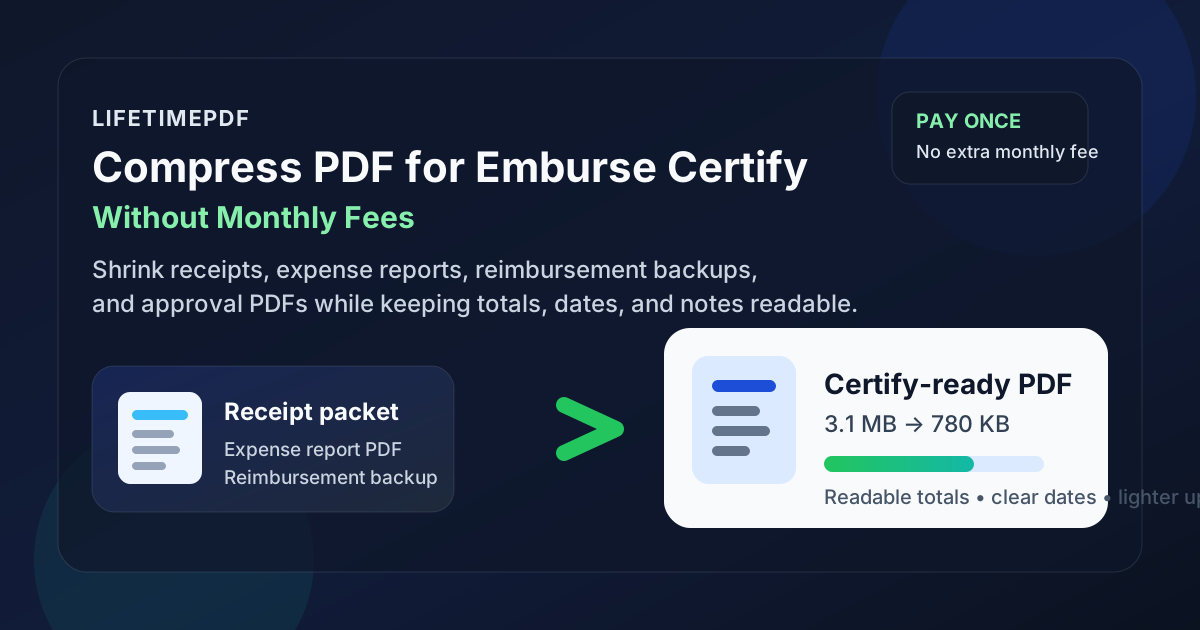
Table of contents
- Quick start: compress an Emburse Certify PDF in about 2 minutes
- Why "without monthly fees" matters here
- Why smaller PDFs help in Emburse Certify workflows
- What file size should an Emburse Certify PDF be?
- Which compression level should you choose?
- Step-by-step: use LifetimePDF to shrink the file
- Best approach for common Emburse Certify PDFs
- What to do if the PDF is still too large
- How to keep expense details readable
- Workflow habits that reduce PDF bloat
- Related LifetimePDF tools and useful reading
- FAQ (People Also Ask)
Quick start: compress an Emburse Certify PDF in about 2 minutes
If your real goal is simply make this PDF smaller so it is easier to use in Emburse Certify, this workflow is usually enough:
- Save the final receipt packet, expense report attachment, reimbursement backup, statement excerpt, card-support PDF, travel invoice, or approval memo you actually plan to keep.
- Open Compress PDF.
- Upload the file and choose Medium compression first.
- Download the smaller result and compare the new size.
- Preview the weak spots: merchant names, dates, totals, tax lines, expense categories, approver notes, and any faint receipt text.
- If the file is still bulky, run OCR PDF, remove duplicate pages, or split one oversized packet before trying stronger compression.
Why "without monthly fees" matters here
Emburse Certify-related PDF cleanup almost never happens once and disappears. It comes back with every reimbursement cycle, card reconciliation, month-end close, manager approval packet, and audit support request. That is why the subscription angle matters. When a repetitive admin task keeps returning, paying another monthly fee just to compress, OCR, split, and tidy routine PDFs gets old fast.
A pay-once workflow fits this kind of work better. You want a tool you can open whenever a receipt bundle is oversized or a reimbursement backup needs cleaning. You do not want another recurring bill attached to every ordinary PDF fix.
- Recurring work: expense-document cleanup does not stop after one reimbursement run.
- Multiple tasks: compression often leads to OCR, extraction, splitting, or packet cleanup.
- Better cost fit: a pay-once tool makes more sense for routine document admin than another subscription.
- Less friction: the easier the workflow is, the more likely people are to clean the PDF before upload instead of hoping it is fine.
Why smaller PDFs help in Emburse Certify workflows
Emburse Certify files often start small and become awkward quietly. A meal receipt gets saved from a phone. An exported expense page gets attached. A reimbursement note joins the packet. A statement excerpt and approval screenshot sneak in later. By the time everything becomes one PDF, the file can feel far heavier than the proof inside it.
Smaller PDFs are easier to upload, faster to open, and less annoying to review later. That matters when the real job is checking dates, totals, taxes, categories, cardholder details, and approval context rather than waiting on a bloated attachment. Compression is not about smashing the file until it looks rough. It is about removing avoidable weight while keeping the record clear enough to trust.
Why compression helps
- Faster uploads: helpful when receipts and support files need to move through expense review without unnecessary delay.
- Smoother review: lighter PDFs are easier for employees, approvers, finance teams, and auditors to open on desktop or mobile.
- Cleaner storage: smaller files are easier to archive, resend, and reuse later.
- Less scan bloat: phone captures, printed receipts, and rescanned pages often carry extra weight that adds no real value.
- Better follow-up options: leaner PDFs are easier to OCR, split, or extract pages from if the workflow changes.
If the PDF is mostly receipts, reimbursement support, policy notes, and standard approval pages, it usually should not feel huge. When it does, the extra weight often comes from image-heavy scans, blank backsides, duplicate pages, or screenshots that never needed to stay in the final packet.
What file size should an Emburse Certify PDF be?
There is no single perfect number for every Emburse Certify workflow, so practical ranges are more helpful than chasing a magic limit. You want a file that uploads comfortably, opens quickly, and still looks dependable when somebody checks the supporting details.
| Document type | Practical target | Why it works |
|---|---|---|
| Text-heavy expense report attachment, reimbursement form, or approval PDF | < 1MB to 2MB | Usually enough for files that should stay easy to upload and review |
| Mixed expense packet with receipts, notes, and statement pages | 1MB-3MB | Leaves room for several pages without making the file awkward |
| Scan-heavy receipt bundle, paper backup, or image-based support packet | 2MB-5MB | Gives image-heavy pages enough room to stay readable while still trimming avoidable weight |
These are working targets, not laws. If a slightly larger file preserves faint receipt text, tax lines, or policy annotations that matter, that is a good trade. Readability is more important than chasing the smallest possible number.
Which compression level should you choose?
Start with the lightest setting that solves the real problem. In most Emburse Certify workflows, that means testing Medium first and only going stronger if the PDF is still carrying obvious extra weight.
- Light compression: best when the file is already clean and only needs a modest reduction.
- Medium compression: usually the best starting point for receipts, reimbursement backups, expense report attachments, and statement excerpts.
- Strong compression: useful only when the file is still too large after cleanup, and only after you confirm the smallest text stays readable.
Step-by-step: use LifetimePDF to shrink the file
- Choose the final packet first. Remove unrelated appendices, duplicate pages, blank backsides, and screenshots that do not need to travel with the stored proof.
- Open Compress PDF. Upload the version you actually plan to keep, not every draft generated along the way.
- Start with Medium compression. This usually trims enough weight without making routine expense evidence harder to read.
- Download and review once. Check merchant names, dates, totals, tax lines, categories, statement references, and approval comments.
- Use cleanup tools only if needed. If the result is still bulky, run OCR PDF, Extract Pages, or Split PDF before trying stronger compression again.
In other words: reduce weight in stages. A cleaner packet plus moderate compression usually gives a better result than trying to solve everything with one aggressive squeeze.
Best approach for common Emburse Certify PDFs
Receipt bundles and card-support files
These usually get heavy because they come from phone captures, not because they need to be large. Start with Medium compression, then review the faintest merchant text, dates, totals, and taxes. If the bundle still feels bulky, clean the scan and OCR it before trying a stronger setting.
Expense report attachments
These are often text-heavy and compress well. You can usually aim for a smaller file without hurting readability, as long as categories, comments, reimbursement amounts, and approval context still look clean.
Reimbursement backups and mileage support
Reimbursement packets tend to collect extra pages over time. Before compressing harder, remove anything that does not help prove the claim. A smaller relevant packet is usually better than a huge file full of low-value extras.
Travel invoices, statement excerpts, and approval memos
These often include dense tables or small printed references. Medium compression is safer here because dates, taxes, line totals, or policy notes can become annoying fast if the original file was already weak.
Policy exceptions and audit-support PDFs
These should stay crisp. If the document is mostly text, do not over-compress it just to save a few extra kilobytes. The better goal is a modestly smaller file that still looks professional when someone opens it during review later.
What to do if the PDF is still too large
If compression alone does not solve the problem, the issue is usually the packet structure or the source quality rather than the compressor itself.
- Run OCR on image-only scans so the PDF becomes easier to search and often easier to manage.
- Delete duplicate or irrelevant pages such as blank backsides, repeated captures, or outdated drafts.
- Extract only the pages that matter when a longer statement or export was included but the workflow only needs a few pages.
- Split oversized packets if one reimbursement backup has quietly become a catch-all file for multiple topics.
- Replace weak source scans when the real problem is poor quality rather than file size.
How to keep expense details readable
Before you keep the smaller file, do one quick readability check. Open the compressed copy and zoom in on the weakest parts instead of only glancing at the first page.
- Merchant names
- Transaction dates
- Totals and taxes
- Expense categories or statement references
- Reimbursement notes or approval comments
- The faintest text on the noisiest scan in the packet
If those details still look trustworthy, the file is probably ready. If any of them look muddy, fix the packet or the source first. A slightly larger readable PDF is better than a smaller file that creates review friction later.
Workflow habits that reduce PDF bloat
The easiest PDF to compress is the one that never became messy in the first place. A few small habits prevent routine document weight from piling up.
- Save only the final receipt, statement page, or approval file you actually need.
- Avoid exporting giant packets when one relevant section would do.
- Replace weak phone scans instead of stacking more screenshots on top.
- Use OCR on scanned receipts and statement pages before they disappear into storage.
- Compress before the attachment becomes a repeated problem.
Small habits matter because document friction compounds. One oversized attachment is an annoyance. A workflow full of oversized attachments becomes a time tax.
Related LifetimePDF tools and useful reading
Useful tools
Best fit
This workflow is a strong fit if you regularly clean receipts, reimbursement backups, statement excerpts, or approval PDFs and want a pay-once way to keep recurring expense-document prep under control.
Want the simple version? Use LifetimePDF to compress the file first, check readability once, then keep the smaller copy only if the proof details still look trustworthy.
FAQ (People Also Ask)
How do I compress a PDF for Emburse Certify without monthly fees?
Use a pay-once PDF tool like LifetimePDF, upload the Emburse Certify-ready file, start with Medium compression, and review the smaller result before you keep it. If the file is still bulky, trim duplicate pages, clean scan waste, or split the packet instead of over-compressing the whole document at once.
What file size should I aim for before using a PDF in Emburse Certify?
Under 2MB is a practical target for text-heavy expense reports, card-support PDFs, reimbursement forms, and ordinary approval files. Scan-heavy receipt bundles and mixed expense packets often work better around 2MB to 5MB as long as totals, dates, taxes, and support notes still look clear.
Will compression make receipts or approval details blurry in Emburse Certify?
It can if you compress too aggressively. Medium compression is usually the safest first pass. Always review merchant names, dates, totals, tax lines, categories, and the faintest scanned text before keeping the smaller file.
Should I run OCR on scanned receipts before storing them?
Usually yes if the file came from a scanner or phone camera and the text is not selectable. OCR makes receipts, reimbursement backups, statement pages, and approval packets easier to search, review, and reuse later during finance and audit follow-up.
Why look for an Emburse Certify PDF workflow without monthly fees?
Because expense-document cleanup repeats across receipts, reimbursements, approvals, and month-end support files. A pay-once PDF workflow is often a better fit than adding another subscription just to compress, split, OCR, and tidy recurring documents.