Compress PDF for Contentful: Upload Smaller Asset PDFs, Lead Magnets, and Download Files Faster
To compress a PDF for Contentful, upload the final file to LifetimePDF's Compress PDF tool, start with Medium compression, and keep the smaller copy only if body text, screenshots, and branded pages still look clean.
For most Contentful assets, under 3MB is a comfortable target for lead magnets and short downloads, while longer product guides, case studies, and screenshot-heavy resources usually work best around 3MB to 8MB after light cleanup.
Contentful teams usually are not fighting the PDF alone. They are fighting a whole publishing path: the asset library, the entry that references the file, the front-end download, the gated page, the help center, and the reader opening it on a phone. The goal is not the smallest possible PDF. The goal is a lighter asset that still feels trustworthy wherever your stack serves it.
Fastest path: run the Contentful PDF through LifetimePDF's Compress PDF tool on Medium, then test the smaller file through the exact page, entry, or download flow your audience will actually use.
In a hurry? Jump to Quick start: compress a Contentful PDF in about 2 minutes.
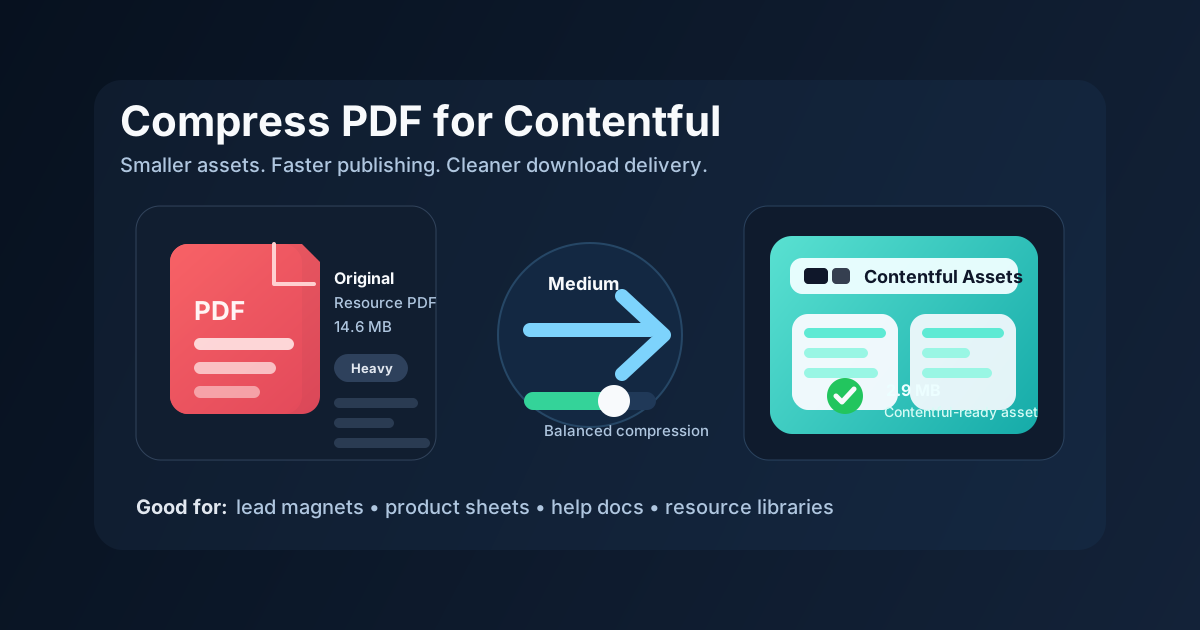
Table of contents
- Quick start: compress a Contentful PDF in about 2 minutes
- Why Contentful PDFs get heavy so quickly
- Where upload and delivery friction show up
- What file size should you aim for?
- Which compression level should you choose?
- Step-by-step: shrink a Contentful PDF with LifetimePDF
- Best strategy for common Contentful PDF types
- What if the file still feels too heavy?
- How to keep text, screenshots, and covers readable
- Workflow habits that keep Contentful assets lighter
- Related LifetimePDF tools and useful internal reading
- FAQ (People Also Ask)
Quick start: compress a Contentful PDF in about 2 minutes
If your real goal is simply make this PDF small enough to move cleanly through Contentful without making it look cheap, this workflow is usually enough:
- Open Compress PDF.
- Upload the exact lead magnet, product sheet, resource download, case study, help document, or onboarding PDF you plan to publish.
- Choose Medium compression first.
- Download the smaller file and compare the new size with the original.
- Attach that smaller copy to the Contentful workflow you actually use.
- Open the live delivery path once and check the weakest points: cover text, body text, screenshots, tables, diagrams, and CTA pages.
- If the file is still too heavy, split the appendix, delete extra pages, or crop wasted margins before trying stronger compression.
Why Contentful PDFs get heavy so quickly
Contentful PDFs often become heavier than they need to be because they are designed for reuse. The same file might appear in a resource library, a gated landing page, a product page, a customer email, a help article, and an internal archive. That sounds efficient, but it often leads to one oversized PDF trying to serve several jobs at once.
Asset weight also grows quietly. A polished download picks up full-bleed covers, product screenshots, brand pages, appendix sections, localization notes, print extras, and redundant pages carried over from older versions. Compression helps, but the best result usually comes from a cleaner share copy plus balanced compression instead of maximum shrinking alone.
What usually adds the most weight
- Full-page images and screenshots: UI captures, feature comparisons, and branded covers often weigh more than the actual text.
- Long appendix sections: reference material, legal pages, regional notes, and archive-only pages bulk up the asset without helping every reader.
- One PDF for every audience: prospects, customers, support teams, and internal reviewers rarely need the exact same file.
- Design-first exports: PDFs exported from presentation, design, or marketing tools can stay visually strong while still carrying unnecessary weight.
- Version sprawl: small updates often leave duplicate pages, old screenshots, or stale sections inside the latest file.
Where upload and delivery friction show up
A PDF can look perfectly fine on your laptop and still feel awkward once it moves through Contentful. The file has to survive the publishing workflow, the front-end download, and the actual reader experience. That means the better question is not just did the asset upload? It is also does the final download still feel fast and dependable?
| Where the friction shows up | What it usually feels like | Most useful fix |
|---|---|---|
| Oversized asset upload | The PDF technically works but feels heavier than the rest of the publishing workflow | Use Medium compression first, then trim waste if the result is still bloated |
| Front-end download feels sluggish | Visitors wait longer than expected to open a simple resource | Reduce screenshot weight, split oversized packs, and keep the web copy leaner than the archive copy |
| One file serves too many jobs | A lead magnet, sales sheet, and reference appendix all get bundled together | Break the PDF into a main resource plus secondary support files |
| Wasted margins and decorative pages | The file is larger than expected without adding useful information | Crop the PDF and remove print-only or filler pages |
| Over-aggressive compression | The file becomes smaller, but screenshots, diagrams, or small text feel less trustworthy | Go back to a lighter level and keep the smallest version that still looks dependable |
Passing the upload is only step one. The better result is a PDF that moves smoothly through the CMS and still feels premium when someone actually clicks download.
What file size should you aim for?
There is no universal Contentful number because every site, audience, and PDF format is different. Still, a practical target range helps you stop guessing.
| Contentful PDF type | Comfortable target | Why that range works |
|---|---|---|
| Lead magnet, checklist, short guide | 1MB to 3MB | Easy to deliver and usually enough for text-first downloads with a light visual layer |
| Product sheet, case study, brochure, media kit | 2MB to 5MB | Leaves room for branded covers, charts, and screenshots without making the asset feel bloated |
| Onboarding guide, manual, help pack, long resource | 3MB to 8MB | Longer PDFs need more room, but still benefit from trimming appendix pages and oversized images |
| Very large appendix or reference bundle | Split it | If one file is trying to serve several purposes, splitting usually works better than forcing stronger compression |
Which compression level should you choose?
Most Contentful PDFs should start at Medium. That level usually gives the best balance between a lighter file and a download that still feels polished across a landing page, gated resource flow, documentation entry, or product library.
- Light compression: good when the PDF is already close to your target and only needs a modest size reduction.
- Medium compression: the best default for most lead magnets, product sheets, guides, and branded downloads.
- Strong compression: better as a last resort when the file is still far too heavy after cleanup.
If the PDF contains small charts, interface screenshots, comparison tables, or fine-print details, stronger compression can make the file look cheaper than the original content deserves. That is why a small cleanup pass often beats jumping straight to the most aggressive setting.
Step-by-step: shrink a Contentful PDF with LifetimePDF
- Start with the final share copy. Use the exact PDF you want readers to download, not a master archive with internal-only pages.
- Open Compress PDF.
- Choose Medium compression first. That is usually the most reliable starting point for Contentful asset workflows.
- Download the smaller result. Compare the size with the original so you know whether the change was meaningful.
- Test the actual delivery path. Attach the file to the entry, landing page, resource center, or documentation flow you really use.
- Open the live file once. Check the cover, body text, screenshot captions, diagrams, tables, and any page that contains an important CTA or trust element.
- Clean up only if needed. If the file is still too large, use Delete Pages, Extract Pages, or Crop PDF before pushing compression harder.
Best practical sequence: compress first, test the live delivery path second, trim pages third, and only then consider stronger compression.
Best strategy for common Contentful PDF types
Lead magnets and gated downloads
These usually need the lightest footprint because the PDF is part of a conversion path. If the file is slow to open on mobile or feels heavy after form submission, the resource feels less valuable before the reader even reaches page one. Start with Medium compression and optimize for a clean, quick download rather than a print-perfect file.
Product sheets and sales collateral
These are trust documents. Keep compression balanced, then review pricing tables, product screenshots, charts, logos, and contact details before replacing the original. A smaller file is useful, but not if the core proof points look weak.
Help-center docs and onboarding guides
Text clarity matters more than decorative design here. If a manual is long, split it by task, product line, or audience instead of forcing one oversized PDF into every Contentful entry. Smaller files are easier for readers to save, search, and reopen later.
Media kits and resource libraries
These often collect brand pages, fact sheets, bios, press assets, and secondary references. If the kit is growing into a bundle, separate the main download from the appendix material. That usually creates a cleaner public asset than trying to crush the whole pack harder.
What if the file still feels too heavy?
If you compressed the PDF and it still feels awkward, the problem may be structural rather than technical. The file may simply be trying to carry too much information for one public asset.
- Split the PDF if one document combines a main guide, worksheets, legal pages, and a long appendix.
- Delete repeated pages such as duplicate covers, archive-only sections, or stale version notes.
- Crop wide margins when the layout wastes space without adding value.
- Keep a web copy and an archive copy if the heavier master still matters internally.
- Re-export the source cleanly if design software or presentation exports are carrying oversized images into every version.
How to keep text, screenshots, and covers readable
The PDF is only better if it still works. Before you replace the original file, review the details most likely to break:
- cover headlines and subheads
- small body text and footnotes
- screenshots, charts, and UI labels
- tables, pricing blocks, and comparison rows
- CTA pages, sign-up prompts, or contact details
- the busiest page in the entire file, not just the cleanest one
If the smallest useful detail still feels easy to trust at normal laptop zoom and on a phone download, the file is probably compressed enough.
Workflow habits that keep Contentful assets lighter
- Export a web copy and an archive copy when the same PDF does not need to do both jobs.
- Separate the core download from the appendix when readers only need the main resource.
- Trim oversized screenshots before they become permanent bloat in every asset update.
- Keep mobile readers in mind because a PDF that feels fine on desktop can still feel annoying on a phone connection.
- Clean metadata before publishing with PDF Metadata Editor if you want the title and file properties to look polished.
- Use PDF to HTML or HTML to PDF intentionally when part of the resource really belongs as a web page instead of a download.
Compression works best as final polish, not as a rescue plan for a PDF that was oversized long before you tried to upload it.
Related LifetimePDF tools and useful internal reading
If Contentful is part of your normal publishing workflow, these tools and articles pair well with this guide:
- Compress PDF for the first size-reduction pass.
- Split PDF for long downloads that should be broken into smaller parts.
- Extract Pages when only the core section should be published.
- Delete Pages to remove stale appendix or duplicate cover pages.
- Crop PDF to trim wasted margins from print-oriented layouts.
- PDF Metadata Editor for cleaner titles and download properties.
- PDF to HTML when part of the resource belongs on the page instead of inside the download.
- HTML to PDF if you are turning a web page into a cleaner downloadable asset.
- Compress PDF for Webflow.
- Compress PDF for WordPress.
- Compress PDF for Ghost.
- Compress PDF for Substack.
- Lifetime access if PDF cleanup is a recurring part of your publishing stack.
Bottom line: for most Contentful PDFs, start with Medium compression, test the real delivery path, and trim page weight before you use stronger compression.
FAQ (People Also Ask)
How do I compress a PDF for Contentful?
Upload the final PDF to a compressor, start with Medium compression, download the smaller copy, and test the exact Contentful delivery path before publishing it. Medium is usually the safest first pass because it lowers file size without making text, screenshots, or branded pages feel unreliable.
What file size should I aim for when uploading a PDF to Contentful?
For many lead magnets, product sheets, and short downloads, under 3MB is a comfortable target. Longer case studies, onboarding guides, manuals, or screenshot-heavy resources often land best around 3MB to 8MB as long as the smallest useful text still reads clearly.
Why does a Contentful PDF still feel slow after it uploads?
Because upload success is only part of the job. A PDF can technically upload and still feel heavy when someone opens it from a landing page, help center, gated resource flow, or mobile download. Compression helps, but removing extra pages, wide margins, and oversized screenshots often helps even more.
Will PDF compression make my Contentful lead magnet blurry?
It can if you compress too aggressively. That is why Medium compression is the best place to start. Always check the cover page, body text, screenshots, diagrams, tables, and CTA sections before replacing the original file.
Should I split a long PDF instead of compressing it harder for Contentful?
Often, yes. If one PDF bundles the main guide, appendix material, print extras, localization notes, or internal pages for different audiences, splitting it usually creates a cleaner Contentful download than pushing stronger compression across the whole file.
Published by LifetimePDF - Pay once. Use forever.