Ask Questions About a Scanned PDF Without Monthly Fees: OCR Image-Only Files and Get Better Answers Without Another Subscription
Yes, you can ask questions about a scanned PDF without monthly fees if you OCR the file first and then run your document questions on the searchable version.
That workflow works for image-only scans, photographed pages, messy archives, and mixed document packets without adding another recurring bill just to pull out dates, totals, clauses, or action items.
The real issue is not only cost. It is reliability. Scanned PDFs often look readable to a person while still behaving like a stack of page images to software. When people get weak answers from scanned files, the problem is often the missing text layer, not the question itself. The better approach is simple: make the scan searchable, narrow the document if needed, ask sharper questions, and verify the answers that actually matter.
Fastest path: OCR the scan, check the extracted text once, then upload the cleaner file to LifetimePDF's AI PDF Q&A tool and start with one broad orientation question.
In a hurry? Jump to Quick start: ask a scanned PDF better questions in a few minutes.
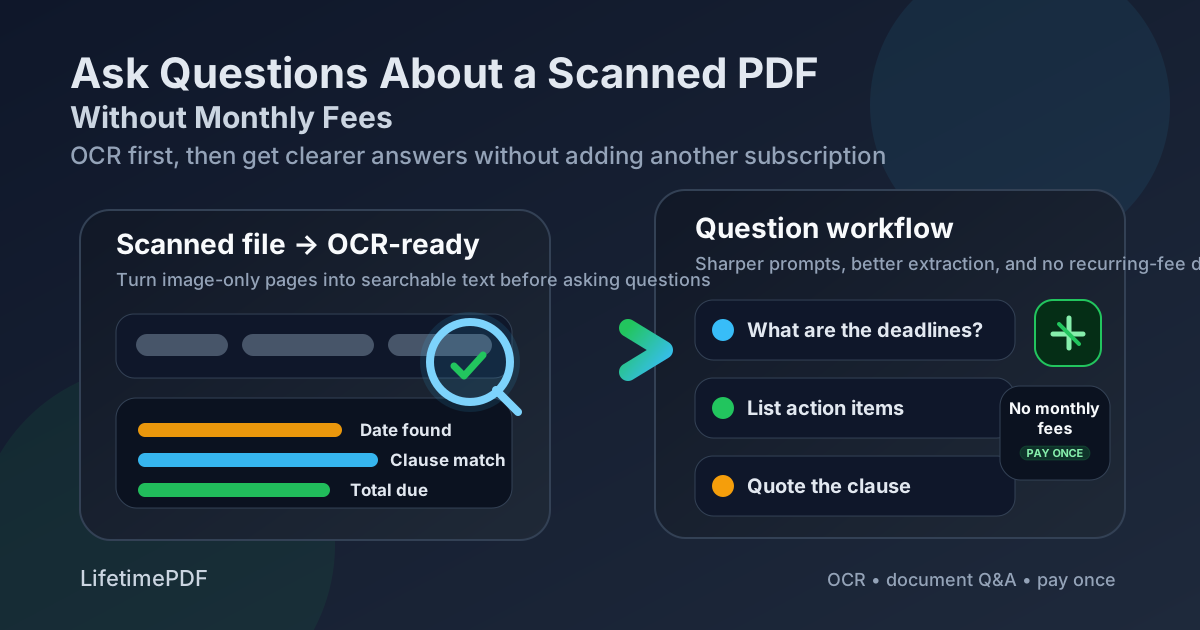
Table of contents
- Quick start: ask a scanned PDF better questions in a few minutes
- Why “without monthly fees” matters for scanned PDF workflows
- Why scanned PDFs usually need OCR before document Q&A
- Step-by-step: how to ask questions about a scanned PDF without monthly fees
- Best prompts for contracts, invoices, reports, and manuals
- How to handle mixed packets, phone photos, and messy scans
- How to verify the answers before relying on them
- Safer handling for sensitive scanned documents
- Related LifetimePDF tools for a smoother workflow
- FAQ
Quick start: ask a scanned PDF better questions in a few minutes
If the real goal is I need answers from this scan without reading every page by hand, this is the practical order:
- Open OCR PDF.
- Upload the scanned or photographed file and create a searchable version.
- Check the result quickly with PDF to Text or by selecting a few lines manually.
- If the PDF is long, isolate the relevant section with Extract Pages.
- Upload the cleaned file to AI PDF Q&A.
- Start with one broad question such as “What is this document about?” or “List the main dates, totals, names, and obligations.”
- Follow with narrower prompts and verify anything important in the source PDF before acting on it.
Why “without monthly fees” matters for scanned PDF workflows
The without monthly fees angle matters because scanned-PDF work is rarely glamorous, but it is incredibly common. People receive signed forms, copier scans, photographed receipts, contract packets, archive bundles, approvals, insurance paperwork, vendor documents, and old paper records all year long. They do not want a new subscription every time they need a better text layer and a clearer answer.
This is also one of those workflows that quietly spreads. Once a team realizes it can OCR a scan, ask for the key dates, and turn a messy packet into a usable checklist, the process stops being occasional and becomes normal. That is exactly when recurring-fee tools start to feel like rent on document competence. A pay-once workflow makes more sense because the need is practical and repeatable, not novelty software that deserves endless billing.
| What people actually need | What gets annoying fast |
|---|---|
| Extract answers from scanned files without rereading every page | Stacking one subscription for OCR and another for document Q&A |
| Repeat the workflow for contracts, forms, reports, and archives | Paying monthly for what is usually a short practical task |
| Verify risky details quickly instead of hunting blindly | Trusting a messy image-only scan and hoping the answer is right |
Best mindset: scanned-PDF question workflows should feel like utility, not like another recurring software relationship.
Why scanned PDFs usually need OCR before document Q&A
A normal exported PDF usually contains a real text layer. A scanned PDF often does not. Even when the page looks legible to your eyes, the file may still behave like a picture. That is why document Q&A can miss details, merge lines, skip dates, or answer vaguely when the source is really an image stack.
OCR, or optical character recognition, is what turns that page image into searchable text. It is not magic, and weak scans can still stay weak, but OCR usually gives the question workflow something much more useful to work with. In practice, the jump from image-only to searchable enough is often the difference between frustrating guesses and genuinely helpful extraction.
| File type | What it behaves like | Best next step |
|---|---|---|
| Text-based PDF | Searchable content with cleaner structure | Upload directly, then verify important answers |
| Image-only scan | A stack of page photos with little or no text layer | Run OCR before asking questions |
| Mixed packet | Some pages have text, others are scans, inserts, or phone photos | Extract the relevant pages and OCR the weak section first |
| Low-quality archive | Blur, skew, stamps, shadows, and uneven contrast | Expect narrower prompts and stronger verification |
Step-by-step: how to ask questions about a scanned PDF without monthly fees
1. Check whether the scan is actually searchable
Before you ask anything, search for a word you can clearly see on the page. Then try selecting and copying one line. If search fails or the copied result looks like garbage, you already know what to do: OCR first.
2. Run OCR on the file
Use OCR PDF to add a searchable text layer. That gives the question workflow a much better chance of recognizing clause wording, invoice fields, section headings, dates, and names.
3. Test the extracted text once
A one-minute sanity check goes a long way. Open PDF to Text or just copy a few lines. If headings, names, and numbers look broadly correct, the scan is usually ready for Q&A. If the text is chaotic, fix the pages before trusting the answer layer.
4. Narrow the document if the packet is long
Many real-world scans are packets rather than single documents. You may only need pages 12 to 19, not the entire 80-page file. Use Extract Pages or Split PDF so your questions stay focused.
5. Ask one orientation question before detailed follow-ups
Start broad. Ask what the document is about, what sections it contains, or which dates and totals appear. That answer doubles as a quality check. If the overview is clearly off, you can stop before trusting narrower prompts.
6. Move from broad to narrow questions
Once the orientation answer looks sane, switch to specific extraction questions:
- Contracts: Which clause covers termination, renewal, payment timing, or notice?
- Invoices: What are the invoice number, due date, subtotal, tax, and final amount?
- Reports: What are the main findings, risks, deadlines, and recommended next steps?
- Manuals: Which pages explain setup, reset, maintenance, or troubleshooting steps?
7. Verify what matters in the source PDF
Dates, money, legal wording, names, identifiers, and high-stakes instructions should always be confirmed in the original PDF. The goal is not blind trust. The goal is faster review with less manual hunting.
Short version: OCR → text check → extract pages if needed → ask broad first → ask narrow follow-ups → verify risky details.
Best prompts for contracts, invoices, reports, and manuals
Better prompts are usually more concrete, not more complicated. When the source is a scan, specific output requests help even more because they force the workflow to target the details you actually care about.
| Use case | Prompt that usually works well | Why it helps |
|---|---|---|
| Contract review | List the renewal date, notice period, payment terms, and any clause that limits liability. | Targets the details most likely to matter in a scanned contract |
| Invoice extraction | Extract the vendor name, invoice number, due date, subtotal, tax, and total due. | Pulls structured fields instead of a vague summary |
| Report review | Summarize the findings and list any deadlines, risks, or next steps mentioned in the document. | Gives you orientation plus action items |
| Manual or SOP | Which pages explain setup, reset, maintenance, or troubleshooting for this device or process? | Helps you find instructions faster inside a long scan |
How to handle mixed packets, phone photos, and messy scans
Many scanned PDFs are not uniformly bad. They are uneven. One page may be crisp. The next is sideways. Then comes a photographed receipt, a signed form, a faint appendix, or a copier page with a dark border. In those cases, answer quality depends on how much noise you leave in the workflow.
What usually helps most
- Rotate sideways pages before OCR so the text layer has a better chance of reading correctly.
- Crop wasted borders and shadows when a phone photo added a lot of dead space.
- Extract only the pages that matter instead of asking questions across the whole packet every time.
- Use PDF to Text as a quick inspection step to see whether names, totals, and headings survived OCR sensibly.
- Ask narrower questions when the scan quality is inconsistent.
This matters even more for archival records and older paper files. A messy archive can still be useful, but section-by-section work usually beats expecting one upload to understand the whole stack perfectly.
For noisy scan packets: clean the pages you care about and ask questions on the smaller subset instead of the entire bundle.
How to verify the answers before relying on them
Verification is what keeps scanned-PDF Q&A useful instead of risky. The point is not to doubt every answer. The point is to double-check the answers that would actually matter if they were wrong.
Verify these first
- Dates and deadlines
- Totals, taxes, balances, and payment terms
- Quoted legal or policy wording
- Names, addresses, and account identifiers
- Anything pulled from faint, skewed, or low-quality sections of the scan
One easy habit is to ask the question, then manually locate the answer in the PDF. That still saves time because you are verifying a guided answer rather than searching blind. Good document Q&A speeds up review. It should not replace judgment on the parts that can actually cause trouble.
Safer handling for sensitive scanned documents
Scanned PDFs often contain the exact records people worry about most: IDs, signed forms, invoices, contracts, medical paperwork, HR files, client records, and archived case material. Before sending a whole document through any workflow, ask whether the entire file actually needs to move through unchanged.
- Remove irrelevant pages when only one section matters.
- Redact personal or confidential details before wider sharing.
- Keep the verification step close to the source document for high-stakes files.
- Protect the final PDF if it still contains sensitive information.
If you need to blank out private information before sending or storing the file, use Redact PDF first. If you need a smaller working subset, use Extract Pages before uploading the document for questions.
Related LifetimePDF tools for a smoother workflow
Asking questions about a scanned PDF without monthly fees works best as part of a small workflow instead of one isolated click. These tools pair naturally with it:
| Tool | Best use |
|---|---|
| OCR PDF | Turn scanned pages into searchable text before asking questions |
| AI PDF Q&A | Ask broad and narrow questions once the scan is readable |
| PDF to Text | Spot-check whether OCR produced usable text |
| Extract Pages | Focus the question workflow on the relevant section only |
| Redact PDF | Hide confidential information before broader review or sharing |
Suggested internal reading
- Ask Questions About a Scanned PDF
- Ask Questions About a Scanned PDF Online Free
- Ask Questions About a PDF Without Monthly Fees
- Extract Text from Scanned PDF Without Monthly Fees
- Chat with PDF Without Monthly Fees
- Browse all LifetimePDF articles
Ready to turn a scan into answers without adding another recurring bill?
Best workflow for most scans: OCR → text check → ask broader first → extract the exact details → verify the risky parts.
FAQ
Can I ask questions about a scanned PDF without monthly fees?
Yes. The cleanest approach is to OCR the file first, confirm that the text layer looks usable, and then ask your questions on the searchable version. That gives you better answers without turning routine document work into another monthly subscription.
Do I need OCR before asking questions about a scanned PDF?
Usually yes. If the file is image-only, photographed, or poorly extracted, OCR is what gives the document-question workflow readable text to work with. Without OCR, scanned-PDF answers are more likely to miss important details.
What is the best first question to ask a scanned PDF?
Start broad. Ask what the document is about, what sections it contains, or which dates, totals, and names appear. If that answer looks sensible, then move into narrower follow-ups for clauses, deadlines, obligations, and quoted wording.
What if the scanned PDF is still messy after OCR?
Work section by section. Rotate sideways pages, crop wasted borders, extract the relevant pages, and test the extracted text before you ask detailed questions. A smaller cleaner subset usually performs better than one large noisy packet.
Which LifetimePDF tools work best together for scanned PDF questions?
The most practical stack is OCR PDF for text recovery, PDF to Text for extraction checks, Extract Pages for narrowing long packets, Redact PDF for privacy, and AI PDF Q&A for the actual question workflow.
Published by LifetimePDF - Pay once. Use forever.