How to Split PDF on Android: Separate Pages from Files, Gmail & Drive Without Losing Track
To split a PDF on Android, open a browser-based Split PDF tool in Chrome, choose the file from Files, Gmail, Google Drive, or Downloads, select the page ranges you want as separate outputs, and save the smaller PDFs back to your phone.
If you only need one section rather than several parts, Extract Pages is usually the cleaner Android workflow.
That is the short answer. The useful part is knowing how to avoid the messy mobile version of this job: duplicate downloads, attachment previews that are fine for reading but bad for editing, cloud copies that are not the same as the local file, and several smaller PDFs that become harder to manage than the original document. A good split workflow on Android keeps the output practical, not just technically divided.
Fastest path: save the source PDF somewhere obvious in Files, open LifetimePDF's Split PDF tool in Chrome, create only the few sections you actually need, then rename the outputs before you send them anywhere.
In a hurry? Jump to Quick start: split PDF on Android in a few minutes.
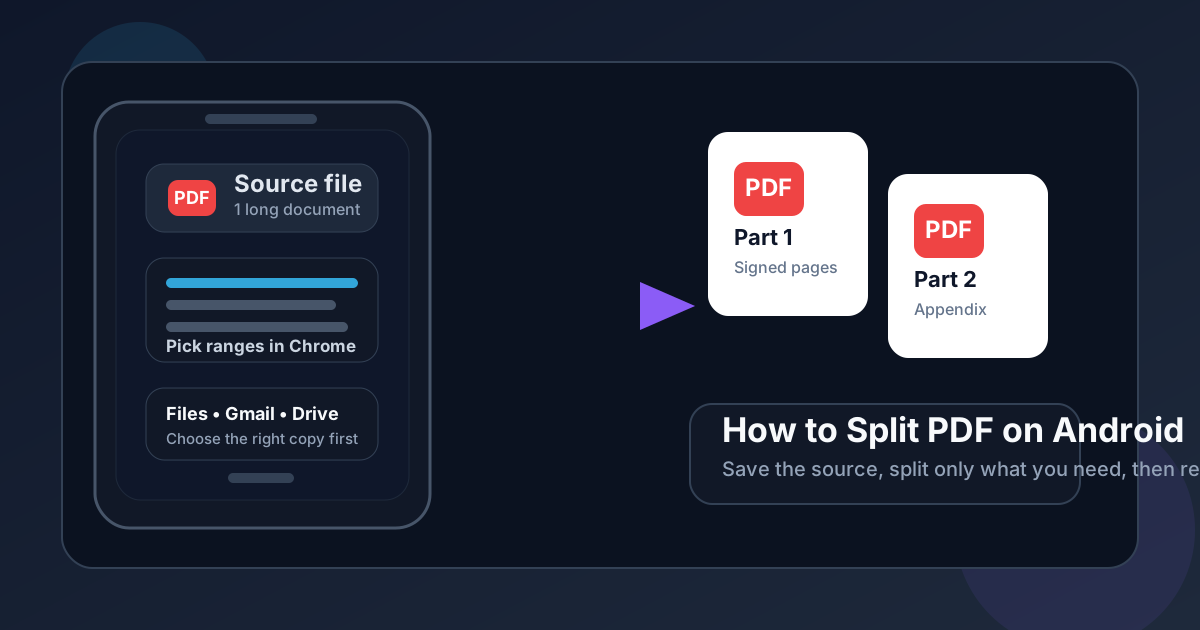
Table of contents
- Quick start: split PDF on Android in a few minutes
- The easiest Android workflow for splitting PDFs
- Step-by-step: create smaller PDF parts without confusion
- Split PDF vs extract pages vs delete pages on Android
- Working with PDFs from Gmail, Drive, Files, and Downloads
- Best Android use cases for split PDFs
- Common Android mistakes and how to avoid them
- Related LifetimePDF tools for smoother mobile workflows
- FAQ (People Also Ask)
Quick start: split PDF on Android in a few minutes
If the file is already on your phone and you know roughly how it should be divided, this is the fastest practical workflow:
- Open Split PDF in Chrome.
- Choose the source file from Files, Downloads, a saved Gmail attachment, or Google Drive.
- Decide whether the PDF should become a few meaningful sections, several single-page files, or whether you really only need one extracted range.
- Create the smaller PDFs and save them with names that make the result obvious.
- Open each output once before you upload, message, print, or archive it.
That last step matters more than people think. On Android, the biggest mistake is often sharing the wrong file because the original full PDF and the new smaller PDFs end up together in Downloads with similar names.
The easiest Android workflow for splitting PDFs
The best Android workflow is usually not about the browser button itself. It is about getting the file handling right around it. Start by saving the source PDF locally instead of working from a mail preview or cloud tab. Then decide what the finished set should look like before you split anything.
In practice, most people on Android are splitting PDFs for one of four reasons: they want to keep only one part of a long packet, send a lighter section to someone else, break a report into reviewable chunks, or keep private pages out of a file that has to leave the phone. All four are easier when you think in terms of the final output first.
| Method | Best for | Where it struggles |
|---|---|---|
| Split PDF | Turning one PDF into several smaller files | Overkill if you only need one selected section |
| Extract Pages | Keeping one range or one set of pages in a new PDF | Not ideal if you need multiple separate outputs |
| Delete Pages | Making one cleaned-up copy of the original | Less convenient when several outputs are needed |
| Organize PDF | Reordering, previewing, and cleaning page flow first | Does not by itself create several separate files |
If your goal is several outputs, use split. If your goal is one smaller output, use extract. If your goal is one revised version of the original, use delete pages. That one decision saves a lot of wasted tapping.
Step-by-step: create smaller PDF parts without confusion
Here is a repeatable Android routine that works well for school packets, claim forms, contracts, receipts, onboarding documents, scanned pages, apartment applications, and long reports:
- Save the source PDF first. If the file came from Gmail, Drive, WhatsApp, a browser download, or a scanner app, save it to a folder you can find easily again in Files.
- Open the split workflow in Chrome. Launch Split PDF.
- Choose meaningful sections. Think in terms of sections another person would understand, such as signed pages, exhibits, ID pages, billing pages, or appendices.
- Create only the outputs you need. Resist the urge to split every page individually unless there is a real reason.
- Rename the results immediately. Use names like lease-signature-pages.pdf, expense-receipts.pdf, or school-forms-only.pdf instead of vague names like document-1.pdf.
- Open each new file once. Check the beginning and end of each output before you send it anywhere.
Useful rule: name the outputs based on what they are for, not the page numbers you happened to choose. A person opening the file later will understand insurance-claim-pages.pdf much faster than pages-8-14.pdf.
If you are not sure which pages belong together, use Organize PDF first. Reordering or previewing pages before you split usually leads to cleaner output than trying to repair a confusing set of smaller files afterward.
Split PDF vs extract pages vs delete pages on Android
These three tasks sound similar, but they solve different problems.
Split PDF is for when one document should become several files. Maybe you have a 40-page packet and want one file for the signed section, one for supporting documents, and one for appendices. That is a split workflow.
Extract Pages is better when you only want one result. If you need pages 5 through 8 from a longer report and nothing else, use Extract Pages. It gives you one clean smaller PDF instead of several parts you never asked for.
Delete Pages is right when the finished file should still mostly look like the original, just without some pages. That is common when a packet includes duplicate scans, internal notes, or extra cover sheets that should not stay in the final copy.
- Need several outputs? Use Split PDF.
- Need one smaller output? Use Extract Pages.
- Need one edited version of the original? Use Delete Pages.
On Android, that distinction is worth remembering because it stops you from creating too many files and then cleaning up a mess you did not need in the first place.
Working with PDFs from Gmail, Drive, Files, and Downloads
The split step itself is easy. Source chaos is the real Android problem. One file is sitting in Downloads. Another came from Gmail. A third is in Drive. Files may show both a local copy and a cloud shortcut. If you split the wrong source, the outputs will be wrong no matter how clean the tool is.
The safest habit is to save the source PDF to a clear folder first, then split from that local copy. That gives you one reliable starting point and makes the output files easier to name and compare.
- Gmail: save the attachment first instead of working from preview mode if you are not sure where the file lives.
- Google Drive: confirm whether you are working from the latest version and save a local copy if needed.
- Files: create a simple folder for the job if the PDF is mixed in with screenshots and random downloads.
- Downloads: rename the source if the folder is full of duplicates like report (1).pdf and report-final.pdf.
A little naming discipline goes a long way here. Clear names make it much less likely that you send the full confidential file when you meant to send only a smaller section.
Best Android use cases for split PDFs
Splitting PDFs on Android is especially useful when one file is technically complete but practically too broad.
- School paperwork: separate permission pages, receipt pages, and teacher forms.
- Contracts and forms: send only the signature pages or the section another person actually needs.
- Receipts and expense packets: break one long scan into smaller claim-friendly sections.
- Medical or insurance documents: separate ID pages, claim pages, and supporting records into clearer chunks.
- Apartment or loan applications: keep private pages out of the file that is going to a different recipient.
- Large reports: split the summary, appendix, and backup material into more manageable files before sending from your phone.
In all of those cases, the benefit is not just file size. It is clarity. Smaller PDFs are easier to review, easier to upload, and easier to share with the right people without oversharing the rest.
Common Android mistakes and how to avoid them
Most Android split problems are predictable.
- Splitting the wrong copy: save the source locally and use that version, not an older attachment preview or cloud shortcut.
- Making too many tiny files: split by meaningful section, not by habit.
- Using vague filenames: rename outputs immediately so the next step is obvious.
- Skipping the final check: open each smaller PDF once before you send it.
- Compressing too early: split first, then compress only the outputs that still need it.
If one of the new files still feels clumsy, that usually means the first split plan was not quite right. Go back and make fewer, cleaner sections instead of trying to patch the outputs with a lot of extra steps.
Related LifetimePDF tools for smoother mobile workflows
Splitting is often only one step in a larger Android workflow. These tools pair well with it:
- Extract Pages if you only need one selected section.
- Delete Pages if you want one cleaned-up version instead of several outputs.
- Organize PDF if the page order is messy before you split.
- Compress PDF if one of the new files is still too large for upload limits.
- Protect PDF if the resulting file still contains sensitive material.
Good mobile sequence: organize first if needed, split or extract second, then compress or protect only the final outputs that are actually leaving your phone.
FAQ (People Also Ask)
How do I split a PDF on Android without installing another app?
Open a browser-based Split PDF tool in Chrome, choose the file from Files, Gmail, Drive, or Downloads, set the page ranges or sections you want, create the smaller PDFs, and save them with clear names. That is usually the quickest no-install route on Android.
What is the difference between split PDF and extract pages on Android?
Use Split PDF when one file needs to become several output files. Use Extract Pages when you only want one selected section as one new PDF. The actions are related, but the end result is different.
Will splitting a PDF reduce quality on Android?
Usually no. Splitting normally preserves text clarity, layout, and page quality because the pages are being reorganized into smaller PDFs rather than rebuilt from screenshots.
Can I split a PDF that came from Gmail or Google Drive on Android?
Yes. Save the source locally first if needed, split that version in Chrome, then rename the new files clearly so you do not confuse them with the original attachment or cloud copy.
Should I split first or compress first on Android?
Usually split first. Splitting decides document scope, while compression decides file size. Once you have the right smaller PDFs, compress only the outputs that are still too large to share comfortably.