How to Check if a PDF Is Searchable on Android: Quick Files, Drive, and Gmail Tests Before You Run OCR
To check if a PDF is searchable on Android, open the file from Files, Google Drive, Gmail, Chrome, or Downloads, search for a visible word, then long-press and copy one short line into Keep or Docs.
If search fails, the page behaves like one big image, or the pasted text comes out broken, the PDF probably needs OCR before you keep working.
That is the short answer. The useful part is knowing how to test the exact Android copy you plan to keep or share, how to tell the difference between a native PDF and a scanned one, and how to avoid trusting a file just because it looks sharp on a phone screen. A PDF that opens cleanly on Android is not automatically a PDF your device can really search, copy, index, or extract well.
Fastest path: save one local copy, test search, copy one line into Keep or Docs, then use PDF to Text or OCR only if the quick checks are weak.
In a hurry? Jump to Quick start: tell if an Android PDF is searchable in under 2 minutes.
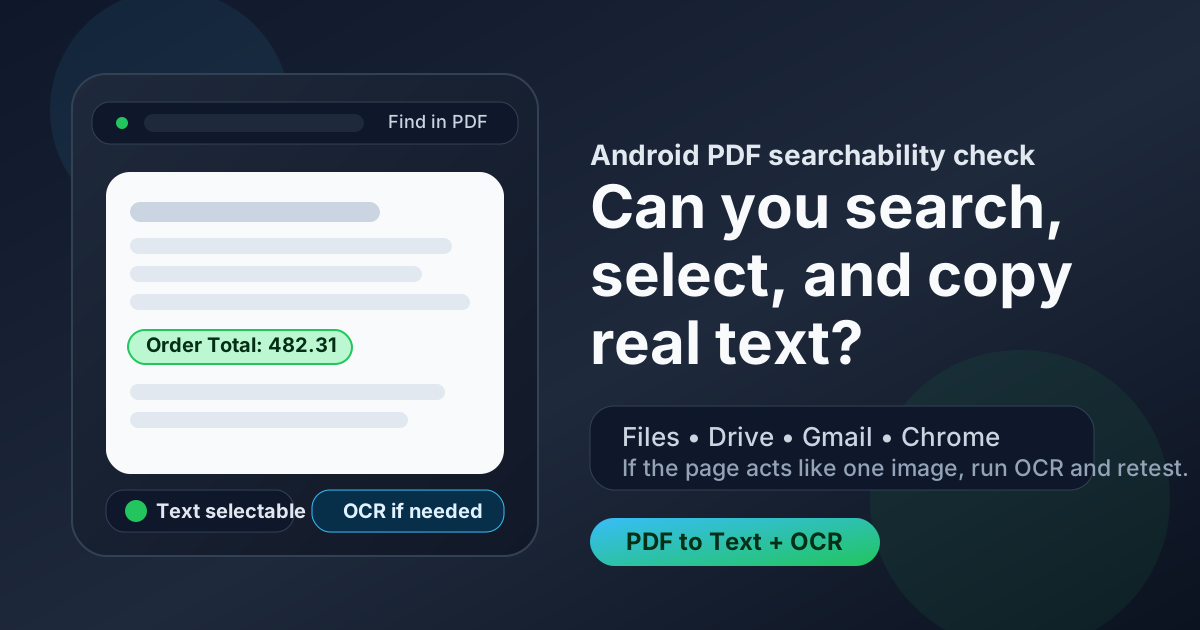
Table of contents
- Quick start: tell if an Android PDF is searchable in under 2 minutes
- The easiest Android workflow for checking searchable PDFs
- What “searchable” actually means on Android
- Step-by-step: check a PDF from Files, Gmail, Drive, Chrome, WhatsApp, or Downloads
- Fast warning signs that the PDF is not fully searchable
- When to run OCR and when to export a cleaner source file
- Android habits that lead to cleaner searchable PDFs
- Related LifetimePDF tools and guides
- FAQ (People Also Ask)
Quick start: tell if an Android PDF is searchable in under 2 minutes
If you already have the file on your phone and just need a fast answer, use this order:
- Save the exact file from Gmail, Chrome, WhatsApp, or Google Drive into one obvious folder in Files.
- Open the PDF and use the viewer's Find or Search option to look for a word you can clearly see on the page.
- Long-press one short sentence, copy it, and paste it into Google Keep or Google Docs.
- If you want a stronger check, run the file through PDF to Text and see whether the extracted content stays readable.
- If those tests fail or only work on some pages, run OCR PDF and repeat the same checks.
The easiest Android workflow for checking searchable PDFs
On Android, the biggest mistake is testing the wrong copy. People preview one version in Gmail, open another from Drive, then share a third copy out of Files and assume the PDF is probably fine because one version behaved correctly. That creates false confidence fast.
A cleaner workflow is simple: work from one saved file in Files, run the quickest search and selection checks first, and only move into OCR or deeper extraction testing when the easy tests raise doubts. That keeps the process fast for healthy PDFs and practical for messy ones.
| Android situation | Best move | Why it helps |
|---|---|---|
| The PDF came from Gmail, WhatsApp, Chrome, or Drive | Save one local copy first | You avoid testing one version and sharing another |
| The PDF came from Google Docs, Word, Sheets, or another source app | Run the quick search and copy tests first | Native PDFs often already contain a good text layer |
| The PDF came from a scanner, copier, or phone camera | Expect OCR to be the likely next step | Scans often look readable but still behave like images |
| The file is a mixed packet with inserts, signatures, or photographed pages | Test more than one page | Search may work on some pages while failing on others |
In plain English: checking searchability on Android is mostly about resisting shortcuts. If the PDF is headed into review, quoting, school, legal, finance, accessibility, or AI extraction work, one minute of testing saves far more time later.
What “searchable” actually means on Android
A searchable PDF contains a usable text layer behind the page image or layout. That text layer is what makes search, highlighting, copying, extraction, indexing, and follow-up workflows work properly. Without it, your Android device is mostly looking at a picture of text.
Most PDFs fall into one of three buckets:
- Native PDF: exported from Google Docs, Word, Sheets, Slides, or another app with real text already built in.
- Scanned PDF: a picture of paper pages, usually with no usable text layer yet.
- Hybrid PDF: part native, part scanned, or OCR applied unevenly so some pages work and others do not.
The tricky part is that all three can look fine on a phone screen. That is why behavior tests beat guesswork.
Step-by-step: check a PDF from Files, Gmail, Drive, Chrome, WhatsApp, or Downloads
Here is the practical Android workflow that covers most real-world situations.
1) Start with the exact file you plan to keep or share
If the PDF is still sitting inside a Gmail preview, a Chrome tab, or a share sheet overlay, save it first if that makes the workflow clearer. One obvious copy in Files reduces version mistakes and makes retesting much easier.
2) Run the Android search test
Search for a word you can clearly see on the page. Pick something distinctive like a heading, total, invoice number, date, or product name instead of a tiny common word. If search returns nothing on obvious text, the file may be image-only or partly broken.
3) Long-press one line and paste it into Keep or Docs
This is one of the best Android reality checks. If the text selects cleanly and pastes into Keep or Docs in readable order, the PDF probably has a usable text layer. If the whole page behaves like one image or the pasted result becomes blanks, symbols, or scrambled spacing, the file still needs work.
4) Use PDF to Text when you want a stronger answer
Send the file through PDF to Text when the basic tests are mixed. This shows whether the extracted content stays readable enough for real use instead of merely passing one lucky search query. It is especially helpful for reports, tables, multi-column layouts, and packets that may contain both native and scanned pages.
5) OCR and retest if the file is a scan or only partly searchable
If the PDF came from a printer scanner, copier, photographed page, or old archive, run OCR PDF next. After OCR, repeat the same tests. Do not assume the first pass solved everything. Retesting is what tells you whether the new text layer is actually useful.
Recommended Android sequence: save the file, test search, test copy-paste, run PDF to Text if needed, then OCR and retest when the text layer is weak.
Fast warning signs that the PDF is not fully searchable
You do not need a long forensic session to spot a weak Android PDF. A few signals show up quickly:
- Search fails on a word that is clearly visible on the page.
- Text selection grabs the whole page or behaves like dragging across a photo.
- Keep or Docs paste comes out broken with missing characters, strange spacing, or random symbols.
- Only some pages work, which usually means the PDF is a mix of native and scanned content.
- Rotated pages, dark borders, or skewed scans make OCR and extraction noticeably worse.
- Tables and forms fall apart even when ordinary body text seems searchable.
None of those warning signs automatically means the PDF is useless. They do mean you should slow down before trusting the file for search, extraction, summarizing, review, or automation.
When to run OCR and when to export a cleaner source file
OCR and source repair solve different problems. OCR is the right first move when the PDF is basically an image of text, such as a copier scan, photographed page, or legacy archive file. It adds a text layer so your Android device can start searching and copying the content.
A cleaner export from the source file is often better when the PDF came from Google Docs, Word, Sheets, or another editable document and still behaves badly. If the file was created through a rough print-to-PDF workflow, or if the original export flattened text in an awkward way, rebuilding from the source can outperform repeated after-the-fact fixes.
Run OCR when
- the text cannot be selected at all,
- search fails on obvious content,
- the file came from a scanner, copier, or camera,
- some pages are clearly just images, or
- you need the document for extraction, summarizing, translation, or records review.
Re-export from the source when
- the PDF came from Google Docs, Word, or Sheets and should already have real text,
- copy-paste order is consistently messy even though the source still exists,
- fonts, tables, or slides were flattened through a print workflow, or
- you control the original document and can produce a cleaner PDF in a few minutes.
Android habits that lead to cleaner searchable PDFs
The easiest way to get searchable PDFs on Android is to reduce avoidable damage before the file becomes a PDF.
- Export from the source app when possible. A direct export from Google Docs, Word, Sheets, or another document app usually preserves text better than screenshotting or printing through an awkward workflow.
- Fix orientation before OCR. If the page is sideways, use Rotate PDF first so recognition has cleaner input.
- Trim heavy scan borders. Dark edges, shadows, and extra blank margins can hurt recognition. Crop PDF helps clean those up.
- Retest after OCR instead of trusting it blindly. Search one key term, select one sentence, and paste one line into Keep or Docs again.
- If one viewer feels limited, retest in Drive or Chrome. Android PDF apps do not all expose search and text-selection controls the same way, so it is smart to retry the same file in a second common viewer before you blame the document.
- Check the pages that matter most. Names, dates, totals, clause numbers, item codes, and reference numbers are where weak text layers cause the most real-world damage.
Android cleanup stack: rotate if needed, crop ugly borders, run OCR, then test search and copy-paste again.
Related LifetimePDF tools and guides
Checking whether a PDF is searchable is usually the first step in a bigger Android workflow. These tools and guides fit naturally around it:
- PDF to Text - test whether the text layer is good enough for extraction and reuse
- OCR PDF - add a searchable text layer to scanned or image-only PDFs
- Rotate PDF - fix sideways pages before OCR
- Crop PDF - remove dark borders and wasted scan edges
- How to Check If a PDF Is Searchable - generic cross-platform workflow
- How to OCR a PDF on Android - a fuller Android OCR workflow
- How to Check if a PDF Is Tagged on Android - the next step when search works but structure still matters
- Why Is My PDF Not Searchable? - common causes behind image-only PDFs
- How to Rotate a PDF on Android - clean up sideways pages before OCR
- How to Crop a PDF on Android - trim ugly scan borders before you retest
FAQ (People Also Ask)
How do I check if a PDF is searchable on Android?
Open the file on your Android device, search for a visible word, long-press one short line, and paste it into Keep or Docs. If those tests fail, the PDF usually needs OCR before it becomes properly searchable.
Can a PDF open normally on Android and still not be searchable?
Yes. A PDF can look perfectly readable on Android while still behaving like a picture to software. Searchability depends on the text layer underneath, not just on how clean the page looks.
Why does search work on some Android PDF pages but not others?
Mixed PDFs often combine native text pages with scanned inserts, signatures, photos, or flattened sections. Search works on the text pages but fails on the image-only pages until OCR is applied.
What is the fastest way to test a scanned PDF on Android?
Try searching for a visible word first, then select one sentence and paste it into Keep or Docs. If the text cannot be searched, selected, or copied cleanly, run OCR and repeat the same tests on the processed file.
Should I OCR the PDF or export a new one from Google Docs, Word, or another app?
If the file is a scan, OCR is usually the right first step. If the file came from Google Docs, Word, or another editable source and still behaves badly, a cleaner export from the source is often better than repeated patching.
Ready to test the file for real?
Good default workflow: save one copy → test search → test copy-paste → OCR only if needed → retest before you move on