How to Check if a PDF Has Fillable Fields on iPad: Spot Real Tablet Forms Before You Start Typing
To check if a PDF has fillable fields on iPad, save it in Files, open it in a stable viewer, tap inside obvious boxes, and watch for the keyboard, insertion point, checkbox response, or another real form control.
If tapping only pans the page, zooms the document, or leaves the boxes behaving like printed artwork, the PDF is probably scanned, flattened, or only visually formatted rather than truly interactive.
That is the short answer. The useful part is knowing how to test the exact copy you received in Mail, Safari, Drive, or a portal, why Apple Pencil markup can fool people into thinking a dead form is alive, and how to switch quickly from guessing to the right workflow. On iPad, the bigger screen makes forms feel easier than on a phone, but it also makes polished static PDFs look even more convincing than they really are.
Fastest practical path: save one copy to Files, tap a likely field, test one short value, then move to a second field or checkbox before you trust the form.
In a hurry? Jump to quick start: tell if a PDF is fillable on iPad in under 3 minutes.
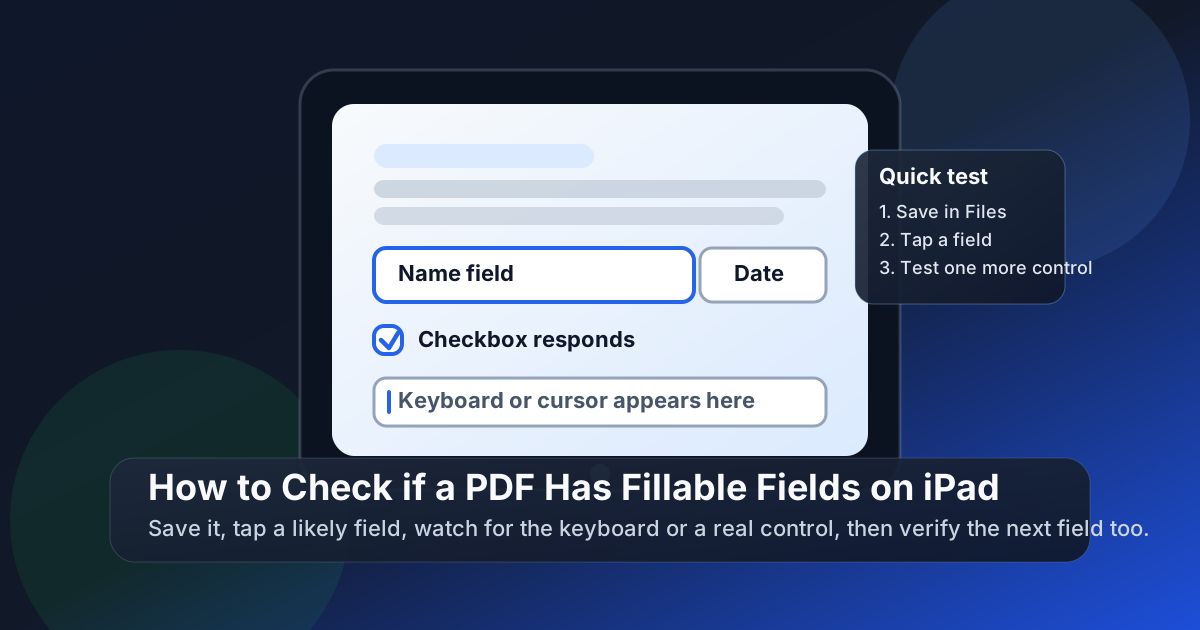
Table of contents
- Quick start: tell if a PDF is fillable on iPad in under 3 minutes
- What counts as a real fillable field on iPad
- Step-by-step: check a PDF for fillable fields on iPad
- Files vs Mail preview vs Safari on iPad
- iPad signals that tell you what kind of PDF you have
- Apple Pencil, keyboard, and trackpad clues
- What to do if the file is scanned, flattened, or locked
- Related LifetimePDF tools for smoother iPad form work
- FAQ
Quick start: tell if a PDF is fillable on iPad in under 3 minutes
If you want the shortest route to a dependable answer, use this sequence:
- Save the PDF from Mail, Safari, Drive, or a portal into one clear location in Files.
- Open the file and tap a place that should obviously be a field, such as a name box, date line, checkbox, initials area, or signature field.
- See whether the keyboard appears, a cursor lands inside the box, or a checkbox or dropdown actually responds.
- Test one more control by tapping the next field or using Tab if you have an attached keyboard.
- If nothing responds, switch to PDF Form Filler or OCR PDF instead of fighting the same dead file.
What counts as a real fillable field on iPad
On iPad, people often mistake any blank line or clean-looking box for a working form field. That assumption causes most of the frustration. A real fillable PDF usually reveals itself in a few concrete ways:
- The keyboard appears when you tap inside a text field.
- A cursor or insertion point lands inside the box instead of the page simply zooming or panning.
- Checkboxes react to taps instead of behaving like printed symbols.
- Dropdowns, date pickers, or selectors respond if the form includes them.
- Your text stays inside the field rather than floating like loose markup.
- The file can be saved and reopened with the test value still sitting in the right place.
A PDF can still be usable even if it is not truly fillable. It just needs a different workflow. The goal here is not to label the file good or bad. The goal is to identify what kind of form you actually have before you commit to finishing it on your iPad.
Interactive PDF form
Text boxes, checkboxes, dropdowns, and signature areas respond to taps like real controls.
Flattened PDF form
The layout still looks like a form, but the controls are dead. You may still need to place text manually.
Scanned PDF form
The page behaves like an image. OCR can help with text recognition, but it does not automatically create working form fields.
Step-by-step: check a PDF for fillable fields on iPad
Here is the workflow that works best when you want a reliable answer instead of guessing from the preview.
Step 1: Save the exact file you plan to use
On iPad, PDFs often open from a Mail preview, a Safari tab, a portal viewer, a Messages attachment, or an older copy in Files. That is how people test one version, edit another, and submit a third. Save the form into a clearly named folder in Files first so the document you are checking is the same document you plan to complete.
Step 2: Zoom enough to avoid misreading the tap result
The larger iPad screen helps, but small date boxes, initials zones, and checkboxes can still be deceptive. Zoom in until the field edges are obvious, then tap inside the center of the box rather than the border line. This reduces false negatives where the form seems dead simply because the tap landed on decoration instead of the field itself.
Step 3: Tap the spots that should clearly be interactive
Start with the easiest targets: full name, date, address, yes/no checkbox, and signature box. If the PDF is truly fillable, at least one of those areas should respond quickly. If every tap only scrolls, zooms, or highlights the page without opening a live control, that is an early warning sign.
Step 4: Test one value and one move to the next control
Use a harmless sample like Test, 123, or a single checkbox tap. Then move to the next field by tapping it directly or using Tab on an attached keyboard if you have one. A genuine form usually makes the second interaction easier, not harder. If the first input seems to work but the next field does not, the document may be partially broken rather than fully interactive.
Step 5: Save, close, and reopen if the form matters
If the document is important, do one extra pass: save the PDF, close it, then reopen it from Files. This confirms whether the value remains attached properly. Some viewers let you type on-screen but fail when the file is reopened, exported, or handed off to someone else.
Best next move after the test: if the form works, fill it normally. If it does not, move straight to the correct repair path instead of retrying the same dead file.
Files vs Mail preview vs Safari on iPad
Different iPad viewing paths create different assumptions. None of them guarantees that the form underneath is truly interactive.
| iPad view | Best for | Where it can mislead you |
|---|---|---|
| Files | Testing the exact saved copy you plan to keep or send | A clean preview can still come from a static or flattened PDF |
| Mail preview | Quick first look at the form | It is easy to trust the preview and forget you have not tested the saved copy yet |
| Safari or portal viewer | Checking whether the downloaded file behaves similarly in-browser | Some portals show a polished wrapper that hides the fact the underlying PDF has dead fields |
| Split View workflow | Comparing the PDF with notes or instructions beside it | Convenient multitasking can make annotation feel like true form entry when it is really just markup on top |
In practice, Files is the safest place to verify fillable fields because it reduces version mix-ups. Use Mail or Safari previews for convenience, but do not trust them as your only proof.
iPad signals that tell you what kind of PDF you have
This table is the fastest way to interpret what your iPad is showing you.
| What you see on iPad | What it usually means | Best next step |
|---|---|---|
| The keyboard appears inside a box | The PDF probably contains a real text field | Type one short test value and check a second field |
| A checkbox, picker, or dropdown responds cleanly | At least part of the form is interactive | Test another control before you trust the whole form |
| Tapping only pans or zooms the page | The file is likely static, flattened, or poorly authored | Use a form filler instead of repeated tap attempts |
| Apple Pencil can write, but no live field appears | You are probably annotating on top of the page rather than filling a structured field | Treat the file as non-fillable and switch workflows |
| Your input disappears after reopen | The viewer workflow is unreliable or the field handling is weak | Switch to a dedicated PDF form tool before completing the real document |
| The whole page feels like one big image | The PDF is probably scanned | Run OCR, then retest the form behavior |
Apple Pencil, keyboard, and trackpad clues
iPad has one extra source of confusion that laptops and phones do not: excellent markup tools. Because Apple Pencil can write beautifully on almost any PDF, people often assume the file itself must be fillable. That is not how it works.
Apple Pencil is useful, but it is not proof of a live form
If you can handwrite on the page, draw a checkmark, or scribble initials, you may only be using annotation. Annotation can be perfectly fine when you just need to finish a document, but it does not mean the PDF contains real text fields, checkboxes, tab order, or structured form logic.
An attached keyboard gives you a cleaner truth test
If you use Magic Keyboard or another external keyboard, press Tab after selecting a likely field. When focus moves from one input to the next, that is one of the strongest signals that the iPad is dealing with a real form rather than a picture of one.
Trackpad or pointer behavior can help too
With a trackpad or mouse connected, hover and click behavior may reveal whether a region acts like an input control or ordinary page artwork. It is not a perfect test on its own, but paired with keyboard and tap behavior it helps separate real form structure from visual design.
Do not confuse a neat markup workflow with a real form workflow
If the iPad lets you write on the page but never gives you a keyboard inside a field, never moves to the next box, and never stores the value as field data, you are annotating a document, not filling a true form.
What to do if the file is scanned, flattened, or locked
Once you know the form is not behaving like a real interactive PDF, the next move depends on the reason.
If the PDF is scanned
A scanned form is usually just a picture inside a PDF container. Run OCR PDF if you need searchable text, then retest the file. If you only need to complete and send it back, use PDF Form Filler to place your answers neatly over the page.
If the PDF is flattened
A flattened form keeps the appearance of a form after the live fields are gone. In that case, the quickest route is often manual placement with a form filler. If you own the document and want a proper reusable form, rebuild the controls with PDF Field Editor instead of forcing everyone to annotate the page forever.
If the PDF is locked or badly exported
Sometimes the fields exist, but the tablet workflow is blocked by restrictions or weak export choices. Save, reopen, and test again from Files first. If the form still behaves badly, ask for a cleaner original or rebuild the fields if the form belongs to you. Repeatedly tapping the same broken preview almost never fixes the underlying problem.
Related LifetimePDF tools for smoother iPad form work
These are the most useful follow-up pages when your iPad form check leads to action.
If you want a broader explanation of what makes a form genuinely interactive before you narrow down by device, the generic guide How to Check if a PDF Has Fillable Fields is the best companion read.
FAQ
How do I check if a PDF has fillable fields on iPad?
Save the PDF to Files, tap inside likely fields, and watch for the keyboard, cursor, checkbox response, or picker behavior. If your input stays inside the box and another field also responds, the PDF probably has real fillable fields.
Why can't I type into a PDF form on iPad even though it looks like a form?
Because many PDFs are only visual layouts. They may be scanned pages, flattened forms, or static exports with printed lines and boxes that never behave like real interactive controls.
Is Apple Pencil proof that a PDF is fillable on iPad?
No. Apple Pencil can annotate almost any PDF, including dead forms. Writing neatly on the page is not the same thing as entering data into a true structured field.
What is the fastest iPad test for a fillable PDF?
Save one copy in Files, tap a likely field, type one short value, and then test a second field or checkbox. That quick sequence tells you far more than staring at the preview and guessing.
What should I do if the PDF is scanned or flattened?
Use OCR if the page behaves like an image, then use a PDF form filler to place answers manually. If you control the document, repair or rebuild the form with a field editor so future users get real interactive fields.
Bottom line: on iPad, do not judge a form by the preview or by whether Apple Pencil can write on it. Trust what happens when you tap, type, move to the next control, save, and reopen.
Published by LifetimePDF — Pay once. Use forever.