How to Add Bookmarks to PDF on iPhone: Files, Pages, and a Workflow That Actually Holds Up on Mobile
To add bookmarks to PDF on iPhone, the cleanest route is to start from a document with real headings, export it back to PDF, and then check the outline in Files or another iPhone PDF app that exposes bookmarks.
If the finished PDF is all you have, convert it to Word first, rebuild the section structure, and export a cleaner file instead of trying to perform delicate outline surgery inside a flat mobile preview.
That is the short answer. The useful iPhone answer is understanding what kind of file is actually on your phone. A Pages draft, a Word attachment, a scanned packet from a copier, and a PDF someone texted you five minutes before a meeting do not want the same fix. Good bookmarks matter even more on iPhone because scrolling through a long PDF on a small screen gets irritating fast.
Fastest reliable path: if the source file still exists, repair the headings there and export again. If the PDF is all you have, recover an editable copy first, fix the structure, then test the outline on your phone before you share it.
In a hurry? Jump to quick start: add bookmarks to a PDF on iPhone in about 8 minutes.
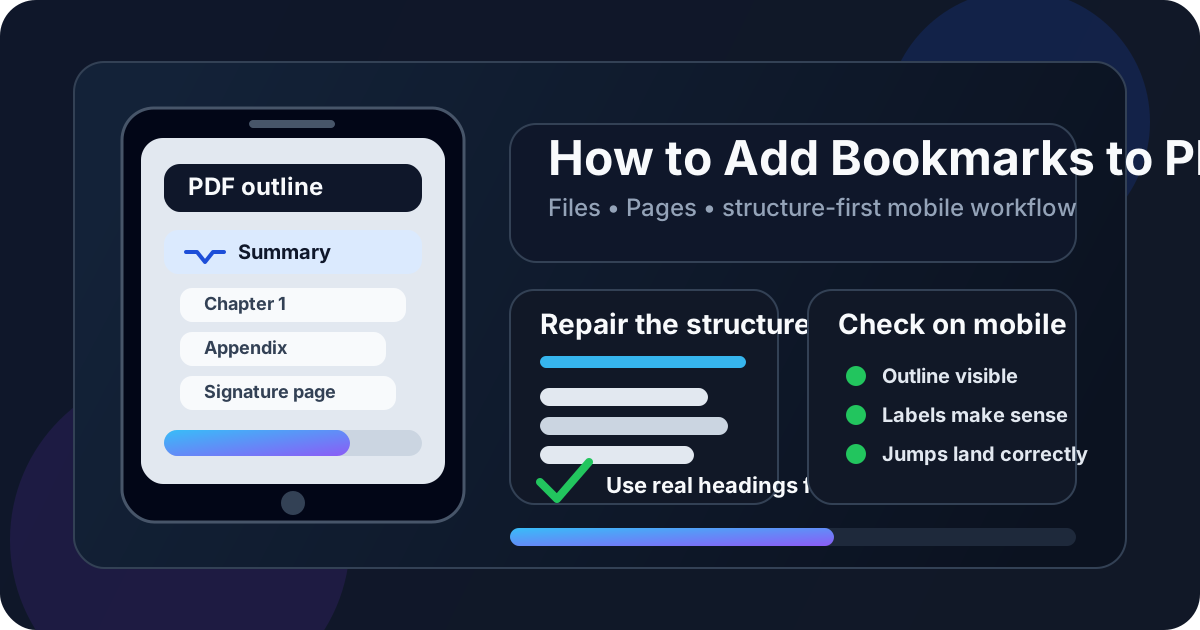
Table of contents
- Quick start: add bookmarks to a PDF on iPhone in about 8 minutes
- What actually works on iPhone
- Choose the best iPhone route for the file you have
- Step-by-step: when the original Pages, Word, or editable source still exists
- Step-by-step: when the PDF is all you have on iPhone
- Scanned PDFs on iPhone: OCR first or waste time later
- What makes bookmarks actually useful on a phone
- Common iPhone mistakes that create bad PDF bookmarks
- Final QA before you share the file
- Related LifetimePDF tools and guides
- FAQ (People Also Ask)
Quick start: add bookmarks to a PDF on iPhone in about 8 minutes
If your real goal is simply make this PDF easier to navigate on my iPhone without turning the task into a whole desktop project, use this order:
- Save the exact file into Files so you are working on the same PDF you plan to send, upload, or archive.
- If the document still exists in Pages, Word, Google Docs export, or HTML, fix the headings there instead of poking around a finished PDF.
- If the PDF is all you have, run it through PDF to Word so you can rebuild the structure cleanly.
- If the file is scanned and text selection does not work, run OCR PDF before you do anything else.
- Export the repaired document back to PDF with Word to PDF or HTML to PDF.
- Open the final file on your iPhone and test the important outline entries, especially the summary, appendix, pricing section, or signature page.
What actually works on iPhone
iPhone is excellent for reviewing PDFs, catching outline problems, and making small edits to an already-structured document. It is much less elegant when you try to invent a whole bookmark hierarchy inside a finished PDF that never had one. That is why the reliable workflow is structure first, PDF second.
In practice, that means one of two things:
- If the source document still exists, use real headings there and export again.
- If the source is gone, recover an editable version first, then rebuild the structure before creating the final PDF.
This matters on mobile because good bookmarks are not just a nice sidebar feature. On iPhone they act like a survival tool for long files. When the PDF is 40, 80, or 180 pages long, a clean outline saves a lot more time than endless thumb-scrolling.
Best mental model: use iPhone to inspect, confirm, and share a clean outline. Use a structured source or recovered editable copy to create that outline in the first place.
Choose the best iPhone route for the file you have
The right answer depends on the file in front of you, not on the app you wish had a perfect one-tap bookmark button. Being honest about the starting point saves the most time.
| Starting point | Best iPhone workflow | Why it works |
|---|---|---|
| Pages, Word, or editable document | Clean the headings there, then export back to PDF | Real document structure gives you the cleanest bookmark outline and the least cleanup later |
| Finished PDF only | Convert with PDF to Word, rebuild sections, then export again | It is easier to repair navigation in an editable file than inside a frozen mobile PDF |
| Scanned PDF | Run OCR first, then repair structure if needed | Image-only files look like documents but behave like pictures until OCR happens |
| HTML or web content | Use proper H1, H2, and H3 structure, then convert to PDF | Clean semantic structure turns into clearer navigation than ad hoc formatting |
My practical take: if the source still exists, stay there as long as possible. The more structure you repair before the export, the less time you waste fighting a final PDF on a phone-sized screen.
Step-by-step: when the original Pages, Word, or editable source still exists
This is the easiest version of the job and the one iPhone users should prefer whenever possible.
- Open the document in Pages, Word, or the editable app where it still behaves like a real document.
- Apply real heading levels to the major sections instead of using larger bold text that only looks like structure.
- Rename weak section names so the future bookmark labels make sense on their own.
- Trim noisy subsections. Not every paragraph deserves a bookmark entry.
- Export the cleaned file with Word to PDF and review the outline on your iPhone.
This route is cleaner because the bookmark list reflects a real hierarchy instead of guesswork. Reports, onboarding packets, course guides, proposals, contracts, board books, and long reference PDFs all benefit from this.
One small iPhone-specific note: if you are editing directly on your phone, keep the structure simple. Strong top-level sections and a sensible second level are far more valuable than a fussy five-layer outline nobody wants to navigate on mobile.
Best-case workflow: repair the hierarchy once in the source file, export once, then do a quick tap-through instead of endlessly patching the final PDF.
Step-by-step: when the PDF is all you have on iPhone
This is the common real-life scenario: the original file is gone, the PDF is already moving around in texts, email threads, or cloud folders, and somebody still expects cleaner navigation before the day is over. In that case, do not romanticize doing everything inside the final PDF. Recover an editable source first.
- Save the PDF from Mail, Messages, Safari, or another app into Files.
- Convert the file with PDF to Word.
- Repair the heading hierarchy so the document has clear top-level sections and useful subsections.
- Rename vague headings that would make weak bookmark labels, such as Notes, Section 2, or Other.
- If the packet is too large or chaotic, break it into manageable parts with Split PDF before rebuilding the final version.
- Export the improved file with Word to PDF and test the outline again on iPhone.
It may feel indirect, but it is usually faster than wrestling with a fixed-layout PDF and hoping a good outline appears by sheer stubbornness. A repaired source gives you better bookmarks, cleaner labels, and a more dependable file for the next person too.
Scanned PDFs on iPhone: OCR first or waste time later
If your file came from a scanner, copier, phone camera, or old paper archive, the visible text may not be real text at all. It may simply be page images. That matters because useful bookmark workflows depend on readable structure.
Signs the file needs OCR
- You cannot highlight words normally.
- Search does not find text that is clearly visible.
- The PDF behaves like a stack of pictures instead of a document.
- The source came from scans, faxes, or photographed pages.
The right order for scanned PDFs
- Run OCR PDF.
- Check whether the recognized text is accurate enough to work with.
- Convert to Word if you need to rebuild or repair the structure.
- Export back to PDF after the hierarchy is clean.
- Open the finished file on iPhone and test the important jumps.
If your broader goal is also making the file easier to search later, this work pays off twice. OCR improves both navigation and findability.
What makes bookmarks actually useful on a phone
Plenty of PDFs technically have bookmarks and still feel annoying on iPhone. Good bookmarks are not just present. They are clear, selective, and trustworthy.
Use labels a rushed reader can scan quickly
Executive Summary, Scope of Work, Appendix B, and Signature Page are useful. Info, Section, and Misc are not.
Keep the hierarchy shallow enough for a small screen
Two or three levels is enough for most documents. If the outline turns into an endless collapsible forest, people stop trusting it and go back to scrolling.
Only bookmark what saves real time
Good outlines help someone jump to the places they are most likely to revisit. They do not mirror every tiny heading in the file.
Make the PDF internally consistent
If the visible page says Appendix D but the bookmark still says Appendix C, the file feels stale immediately. On mobile, that kind of mismatch is extra annoying because the screen gives the reader less context to recover gracefully.
Common iPhone mistakes that create bad PDF bookmarks
| Mistake | Why it backfires | Better move |
|---|---|---|
| Trying to do everything inside the final PDF | Finished mobile PDFs are great for review, not for inventing a deep structure from scratch | Repair the source or recover one first |
| Using fake headings | Bigger bold text is not real structure, so the final outline becomes messy | Apply true heading levels in the editable file |
| Skipping the tap-through test | A bookmark list can look fine and still jump to the wrong place | Test summary, chapter, appendix, and signature-related entries before sharing |
| Over-bookmarking the document | Dense outlines become visual noise on a phone | Keep only entries that save real navigation time |
| Ignoring page-order drift after merges | Bookmarks can land one or two pages off after insertions or reordering | Fix page order first, then trust the outline |
My honest opinion: the biggest iPhone bookmark mistake is assuming the phone is the problem when the real problem is a sloppy document structure. Once the structure is clean, mobile review becomes dramatically easier.
Final QA before you share the file
Before the PDF leaves your iPhone, run this short review:
- Do the top-level bookmarks match the actual major sections of the document?
- Do the labels make sense without extra explanation?
- Do the important entries jump to the correct page?
- Does the outline still make sense after recent merges, edits, or page deletions?
- Does the file need page numbers, compression, or protection before delivery?
If the answer is yes to the first four questions, the navigation layer is probably doing its job. Finish the rest only after that: compress the file if it is heavy, protect it if it is sensitive, and add page numbers if reviewers will keep citing sections back and forth.
Calm final sequence: fix structure → export PDF → open the outline on iPhone → test key jumps → then handle delivery extras like page numbers or security.
FAQ (People Also Ask)
How do I add bookmarks to a PDF on iPhone?
Start from an editable source such as Pages or Word if possible, use real heading levels, export back to PDF, then open the outline on your iPhone and test the important jumps. If the PDF is all you have, convert it to Word first so you can rebuild the structure properly.
Can I add PDF bookmarks on iPhone without Adobe Acrobat?
Yes. A practical iPhone route is to repair the document structure in Pages, Word, or another editable source, export it back to PDF, and verify the outline on mobile. The key is clean structure, not one specific app.
What if my PDF is scanned?
Run OCR first. If the file is image-only, the text is much harder to organize, so bookmark work becomes slower and less reliable until the document is searchable.
Do bookmarks matter more on iPhone than on desktop?
In a way, yes. Long PDFs are more annoying to scroll on a phone, so a clean outline saves more effort on mobile than most people expect.
How do I know the bookmarks actually work on iPhone?
Open the PDF in Files or another iPhone PDF app that shows bookmarks, then tap the key entries such as the summary, appendix, exhibits, or signature page and confirm they land exactly where they should.
Published by LifetimePDF — Pay once. Use forever.