Translate PDF to Somali: OCR Scans First, Review Names, Numbers, and Mixed Somali-English Wording, and Export a Clean Final PDF
To translate a PDF to Somali, upload a text-based PDF to LifetimePDF's Translate PDF tool, choose Somali, then review names, dates, numbers, and mixed Somali-English wording before you export or rebuild the final file.
If the PDF is scanned, run OCR first; that usually improves the Somali result more than any translation setting.
Most people searching for this are not trying to create perfect one-click localization. They need to understand a school notice, clinic handout, NGO field report, logistics sheet, customer instruction page, contract summary, government letter, onboarding packet, or family paperwork quickly enough to use it. In practice, the fastest wins come from starting with real searchable text, checking the short lines where names and numbers matter most, and rebuilding the final PDF only when layout quality genuinely matters.
Fastest practical path: translate readable PDFs directly, OCR scanned files first, then do a short review for names, dates, numbers, and mixed Somali-English wording before sending the final file.
In a hurry? Jump to the quick answer and workflow.
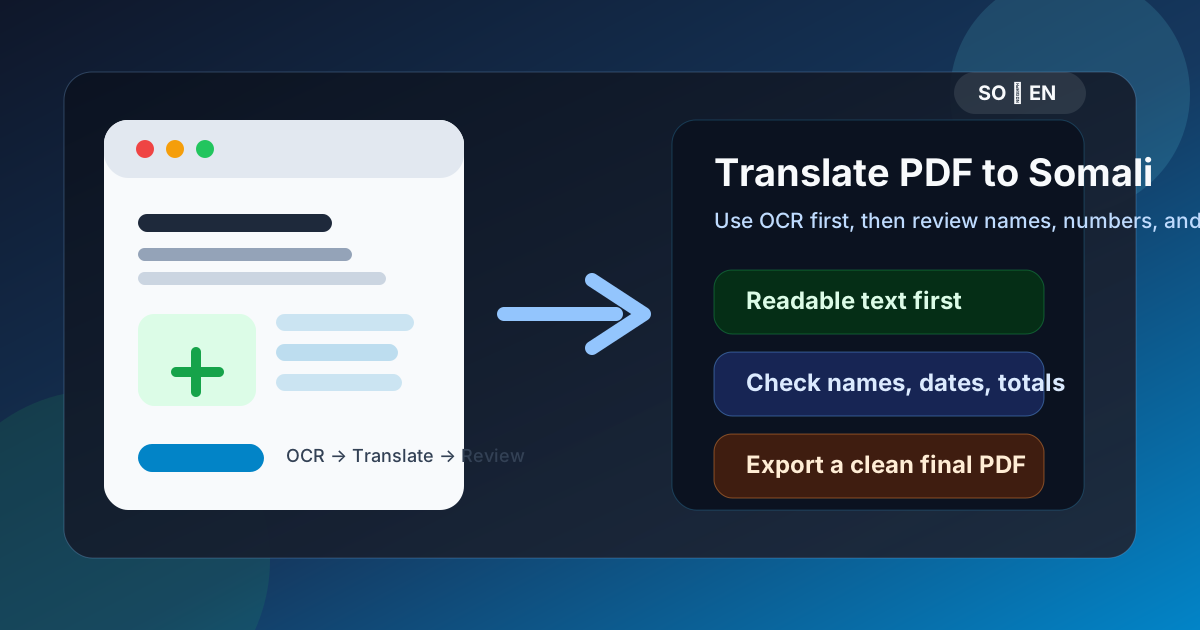
Table of contents
- Quick answer: the cleanest way to translate PDF to Somali
- When direct PDF translation works well
- Why Somali still needs a short review pass
- Scanned PDFs: why OCR should come first
- Step-by-step workflow with LifetimePDF
- How to create a clean final Somali PDF
- Before you share: privacy and final checks
- Helpful tools and related Somali pages
- FAQ
Quick answer: the cleanest way to translate PDF to Somali
If your PDF already contains selectable text, the cleanest workflow is simple: upload it to Translate PDF, choose Somali, translate the file, then review the parts where mistakes actually matter before you share the result. Those usually are names, dates, amounts, headings, field labels, addresses, official references, organization names, service names, and the short lines where Somali mixes with English acronyms or borrowed terms.
If the source is scanned, photographed, faxed, or exported from an older copier, do OCR first. That one step usually matters more than anything else because the translator works far better with real text than with page images.
When direct PDF translation works well
Direct translation works best when the file is mostly text and the layout is not trying to do too much. In real use, that includes letters, notices, school packets, clinic handouts, support guides, intake forms, public information sheets, onboarding packs, invoices, policy summaries, NGO reports, and internal documentation.
Good candidates for direct translation
- Text-heavy pages: paragraphs, headings, bullet lists, and ordinary tables usually translate faster and more cleanly than design-heavy layouts.
- Comprehension-first jobs: when the goal is to understand the document quickly, even a rough first pass into Somali can save a lot of time.
- Internal review workflows: education, healthcare, logistics, support, nonprofit, and administrative teams often need a readable Somali version first and a polished version later.
- Bilingual follow-up: if the translated text will be pasted into email, chat, notes, or another document, perfect PDF formatting matters much less.
Where people usually get frustrated
- Scanned PDFs: poor OCR can break words, table structure, and line order before translation even starts.
- Heavy layouts: brochures, certificates, forms, and multi-column pages rarely keep their original formatting perfectly.
- Mixed terminology: many real documents mix Somali with English product names, agency acronyms, or Arabic-origin terms that should be reviewed instead of translated blindly.
- Short labels and numbers: small wording mistakes in headings, dates, invoice totals, or action lines make the final document feel less trustworthy than it should.
- High-stakes content: legal, healthcare, financial, immigration, and compliance material should not be trusted on translation alone without a human check.
Why Somali still needs a short review pass
Somali PDF translation is not tricky only because of vocabulary. The real issues usually come from extraction quality, proper nouns, mixed terminology, official wording, and whether the final text still sounds natural for the audience reading it. A two-minute review catches most of the mistakes that make a translated document feel awkward or less trustworthy than it should.
What to review first
- Headings and short labels: these are the first places readers notice if something looks copied, vague, or mechanically translated.
- Names and places: people, schools, clinics, streets, agencies, suppliers, and departments should stay recognizable and consistent across the document.
- Dates, times, totals, and IDs: these are the details readers lose trust in first if anything looks off.
- Mixed Somali-English wording: software labels, imported technical terms, and organization acronyms sometimes read better when a few source terms stay recognizable instead of being translated mechanically.
- Action lines: instructions like sign here, call this number, bring these documents, or pay by this date must be clear and practical.
This matters a lot for contracts, school forms, healthcare instructions, public notices, immigration packets, tenant communication, community programs, product manuals, and vendor documentation. The right outcome is not every line translated as literally as possible. It is a Somali version people can read, trust, and act on.
Scanned PDFs: why OCR should come first
If a PDF came from a scanner, phone camera, fax, legacy copier, or screenshot workflow, it may look readable to you while still being unreadable to the translation engine. In that case, translation errors are often OCR errors wearing a different coat.
Run OCR PDF first when:
- you cannot highlight normal text in the PDF,
- search does not find words that are clearly visible,
- the file looks like page photos instead of text,
- stamps, signatures, or handwritten notes break the reading order, or
- the source contains forms and labels that already look inconsistent.
OCR is not just a technical extra. It gives the translator a searchable text layer so the Somali output has a better chance of preserving names, numbers, list structure, and line order. Even a short OCR pass can dramatically reduce cleanup later.
If the file is a scan, do this first. It is the easiest way to improve the final Somali result.
Step-by-step workflow with LifetimePDF
- Check the PDF type. If you can select or search the text, translate directly. If not, OCR first.
- Open Translate PDF. Go to LifetimePDF Translate PDF.
- Choose Somali. Set Somali as the target language before or after upload, depending on your workflow.
- Upload the file. Start with the original PDF or the OCR-ready version.
- Review the first screen of output. Check headings, dates, totals, names, and whether mixed Somali-English wording still makes sense for the real reader.
- Spot-check the important pages. Contracts, forms, notices, medical instructions, invoices, and approvals deserve more attention than filler pages.
- Clean up mixed terms deliberately. Keep URLs, official references, and recognizable labels readable instead of over-editing them into something the final reader will not recognize.
- Export or rebuild. Copy the text, download the result, or rebuild a cleaner final PDF if you need something polished.
The reason this workflow works is that it prioritizes the actual bottlenecks. Most PDF translation failures are not about the target language itself. They come from bad source extraction, poor scan quality, mixed terminology, and skipping the short human review that would have caught the obvious problems.
How to create a clean final Somali PDF
If you only need the translated content for internal understanding, copying the Somali text may be enough. But if the document is going to a patient, customer, family, official contact, supplier, student, partner, or public-facing team, it is usually worth producing a cleaner final PDF.
When a rebuild makes sense
- The translated lines wrap badly and the page no longer feels easy to read.
- The original file had complex layout that did not survive extraction well.
- You need a cleaner handoff document for external sharing.
- You want a simpler Somali-first version instead of a messy copy of the original layout.
In those cases, use Text to PDF for a fast clean export. If you need more control, rebuild the content in Word first and then export a new PDF. The goal is not to imitate every original design choice. The goal is to create a Somali document people can actually use confidently.
Before you share: privacy and final checks
Before a translated PDF leaves your hands, do one last check. This is especially important when the document contains personal data, medical details, commercial terms, internal instructions, or anything that could create confusion if a date, number, or name is wrong.
- Recheck names and organizations so proper nouns still match the source.
- Recheck dates, totals, account numbers, and addresses because these are the highest-risk fields for practical mistakes.
- Confirm action lines are understandable so the reader knows what to sign, submit, pay, bring, or send next.
- Confirm mixed terminology still feels intentional instead of half-translated or inconsistent across pages.
- Protect the final PDF with PDF Protect if the contents are private or high-stakes.
This final pass is short, but it is what turns a machine-assisted translation into something usable in the real world.
Helpful tools and related Somali pages
If you are building a repeatable workflow rather than solving one document once, these are the most relevant next stops:
- Translate PDF for the main translation step
- OCR PDF for scanned files
- Text to PDF for a quick clean Somali export
- PDF Protect before sharing sensitive files
- Translate PDF to Somali Online for the broader browser-based workflow
- Translate PDF to Somali Without Monthly Fees for the pay-once angle
- Translate PDF to Swahili for an adjacent East African workflow
- Translate PDF to Arabic for an adjacent mixed-terminology workflow
- Translate PDF to Amharic for a nearby document-language workflow
Ready to do it now? Start with the translator, OCR first if needed, then rebuild or protect the final file only if the document actually needs it.
FAQ
How do I translate a PDF to Somali?
Upload a text-based PDF to a translation tool, choose Somali, review names, dates, headings, field labels, and any mixed Somali-English wording, then export or rebuild the final file. If the source is scanned, OCR it first so the translation runs on readable text.
Can I translate a scanned PDF to Somali?
Yes. OCR should come first. Once the scan becomes searchable text, Somali translation is cleaner and easier to review.
Why should I review names and numbers after translating a PDF to Somali?
Because names, dates, totals, and action lines are the details readers notice first. A quick review catches the mistakes that would make the final document feel less trustworthy.
Will the translated Somali PDF keep the original formatting?
Sometimes partly, but not perfectly. Text-heavy PDFs often stay readable, while forms, brochures, tables, and multi-column layouts usually need a rebuild step for a cleaner final Somali PDF.
What should I check before sharing a Somali PDF externally?
Check names, dates, totals, addresses, headings, action steps, and mixed Somali-English wording or official terminology. Then protect the file if the contents are private or high-stakes.