Google Forms to PDF: Save Forms, Responses, and Submission Records Without Making a Mess
Yes — the cleanest way to turn Google Forms to PDF is to open the exact view you need and use your browser's print to PDF option so you save the blank form, the response summary, or one submission on purpose.
If the first export still feels messy, move to the linked response sheet and let LifetimePDF help you create a cleaner PDF, then protect, compress, or merge the finished file only if the handoff actually needs it.
That is the real trick: do not ask one PDF export to do four different jobs. People searching for this usually want one of these outcomes: a printable copy of the form, a quick summary of answers, a record of one person's submission, or a cleaner report built from response data. Once you choose the right source view first, Google Forms to PDF becomes straightforward instead of strangely frustrating.
Fastest practical path: export the right Google Forms view first, then use LifetimePDF only for the one finishing step the file still needs.
In a hurry? Jump to Quick start: save the right Google Forms view as PDF in a few minutes.
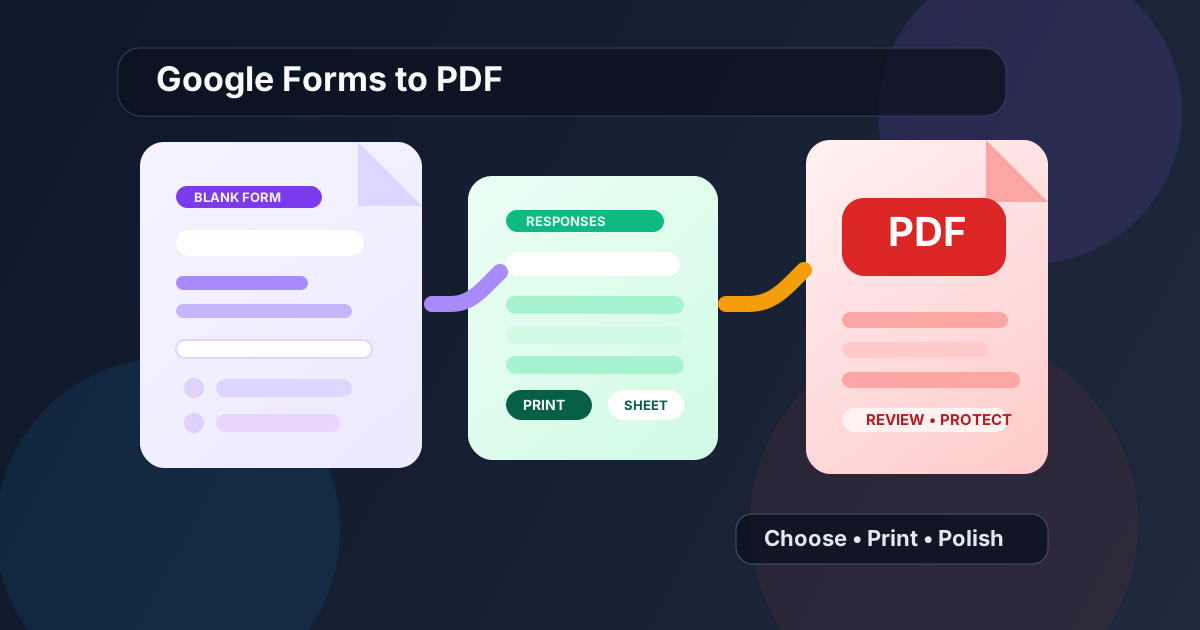
Table of contents
- Quick start: save the right Google Forms view as PDF in a few minutes
- What should you export: form, summary, submission, or sheet?
- Step-by-step: Google Forms to PDF
- When Google Sheets is the smarter route
- How to handle private or sensitive form data safely
- Common Google Forms to PDF problems and fixes
- What to do after the PDF is created
- Related LifetimePDF tools and guides
- FAQ (People Also Ask)
Quick start: save the right Google Forms view as PDF in a few minutes
If you want the short version, use this order:
- Decide whether you need the blank form, the response summary, an individual submission, or the response sheet.
- Open that exact view in Google Forms or Google Sheets.
- Use your browser print command and choose Save as PDF.
- Check scale, page breaks, and whether the output is actually readable for another person.
- If the result looks crowded, use the response sheet and create a cleaner report with Excel to PDF.
- If the file contains private information, protect it before sharing.
What should you export: form, summary, submission, or sheet?
The phrase Google Forms to PDF sounds simple, but the right workflow changes depending on the document you actually need to hand off. A blank questionnaire, a chart-heavy response summary, one person's completed submission, and a cleaned spreadsheet report are four different outputs.
| PDF target | Best when | Why it works |
|---|---|---|
| Blank form | You need a printable copy, approval attachment, offline reference, or archived template | Useful when the questions themselves matter more than the live form link |
| Response summary | You want a quick snapshot of answers, charts, counts, or trends | Fastest option when the dashboard already tells the story clearly |
| Individual submission | You need one person's answers as a shareable record | Much cleaner than printing the whole summary when the job is really one response |
| Response sheet | You need sorting, filtering, cleaner tables, or a more formal report | Usually the best route when the PDF has to be easy to review outside Google Forms |
This is why some Google Forms PDFs feel polished and others feel awkward. The export step itself is rarely the real problem. The real problem is usually that the wrong source view got turned into PDF.
Need a cleaner table-style report from form responses?
Step-by-step: Google Forms to PDF
If you want the low-friction workflow, this is the cleanest sequence.
1) Start by naming the outcome
Before you touch print, decide what the PDF is supposed to represent. Is it a paper-friendly copy of the form? A summary for a meeting? A record of one completed submission? A spreadsheet report for admin review? That small decision prevents most wasted exports.
2) Open the exact view that matches the job
For a blank form, open the live form itself. For charts and totals, use the Responses view. For one person's answers, open the individual response view. For cleaner row-and-column reporting, open the linked Google Sheet. The more intentional this step is, the cleaner the PDF usually becomes.
3) Print to PDF from your browser
Use your browser print command and select Save as PDF. Before you download it, review margins, page orientation, page breaks, headers, and scale. Calm print previews create calm PDFs.
4) Review the finished file like the recipient would
Do not just confirm that a PDF exists. Open it once and ask whether it is easy for another person to understand. Long answers should not be chopped in strange places, charts should be readable, question labels should make sense, and the last page should feel intentional.
5) Add only the finishing step the file still needs
Many exports are already done. If the file is too large, compress it. If it contains personal information, protect it. If it belongs inside a packet, merge it with the related files. Good workflows stay short unless the document gives you a reason to add another step.
When Google Sheets is the smarter route
Google Forms is excellent for collecting answers. It is not always the best place to present those answers as a polished PDF. When readability matters more than preserving the exact dashboard view, the linked response sheet usually gives you more control.
Use the sheet when you need structure
If the answers need sorting, filtering, grouping, or column cleanup, the spreadsheet route is often easier to work with. That matters for hiring pipelines, classroom submissions, intake forms, survey exports, support triage, event registrations, and any workflow where someone needs to review data quickly.
Use the sheet when the forms view feels crowded
The forms summary may be useful on screen but awkward in PDF. Charts can shrink, long answers can feel cramped, and busy dashboards can print in a way that is technically correct but not pleasant to read. A cleaned table is often better.
Use LifetimePDF when the sheet becomes the real handoff
If the response data works better as a spreadsheet-style report, download the sheet in the format that fits your workflow and use Excel to PDF to create the final document. That gives you a more deliberate report than forcing the original forms dashboard to behave like a report builder.
Need the spreadsheet route? Clean the response sheet first, then turn that version into the PDF you actually want to share.
How to handle private or sensitive form data safely
Many Google Forms PDFs are not casual documents. They can include names, email addresses, phone numbers, addresses, student information, internal comments, client answers, hiring details, or financial context. That means the export step is not the last question. The next question is whether the file is safe to circulate.
- Review the PDF once before sending it so you know exactly what personal or internal information made it into the file.
- Choose the smallest useful export because one submission record is often safer than a full dashboard or full response log.
- Protect the finished file with PDF Protect when the content should not circulate freely.
- Compress only after the content is final so you are not generating multiple slightly different copies of the same sensitive report.
Common Google Forms to PDF problems and fixes
The PDF looks cluttered
That usually means the source view was wrong for the job. Try printing one submission instead of the summary, or use the response sheet if the dashboard is too busy.
Long answers break across pages awkwardly
Check print preview first. If the output still feels messy, the spreadsheet route or a different view is often more reliable than repeatedly printing the same cramped layout.
The file is too large for upload or email
Export first, then use Compress PDF. That is faster than rebuilding the report from scratch hoping the next export will magically shrink.
You need one combined packet
If the form PDF belongs with instructions, consent pages, policy attachments, signed approvals, or related reports, use Merge PDF after export. A single packet is usually easier to review than five separate attachments.
The summary is fine, but the final report still feels unfinished
That is a sign the export succeeded but the handoff still needs formatting help. Clean the response sheet or add one finishing tool instead of blaming the original export for everything.
What to do after the PDF is created
Conversion is usually only the midpoint. The better question is what the file needs next.
- Need a cleaner table report? Use Excel to PDF.
- Need a smaller upload? Use Compress PDF.
- Need to lock the file down? Use PDF Protect.
- Need to combine it with other files? Use Merge PDF.
- Need to break a large export into smaller review pieces? Use Split PDF.
For most workflows, the clean sequence is this: pick the right Google Forms view → export it once → review it once → use only the one extra PDF step the file truly needs. That is how you get a useful PDF without turning a simple handoff into an administrative side quest.
Most useful real-world sequence: export with intention, then polish only if necessary.
Related LifetimePDF tools and guides
Google Forms to PDF works best when the export does not stop at “saved.” These tools and guides pair naturally with the workflow:
- Excel to PDF — useful when response data is easier to review as a cleaned spreadsheet report.
- PDF Protect — protect PDFs that contain private answers or internal review notes.
- Compress PDF — shrink large exports for portal uploads or email limits.
- Merge PDF — combine the form PDF with policies, appendices, or supporting documents.
- Split PDF — break big exports into smaller review files.
Related blog guides
- Google Forms to PDF Online
- Google Sheets to PDF Online
- Google Docs to PDF Online
- Compress PDF for Google Forms File Uploads Fast
- Password Protect PDF for Email Online
FAQ (People Also Ask)
How do I save Google Forms as PDF?
Open the exact form view you need and use your browser's print-to-PDF option. If the forms layout is too busy, open the linked response sheet and export or convert that version instead.
Can I save one Google Forms response as PDF?
Yes. Open the individual response view and print that single submission to PDF so the file reads like a record for one person instead of a whole dashboard.
What is the cleanest way to save Google Forms responses as PDF?
Use the response summary only when it already looks clear. If the answers need sorting, filtering, or cleaner formatting, the linked response sheet usually makes a better PDF than the forms dashboard.
How do I share a Google Forms PDF safely when it contains personal information?
Review the export carefully, make sure you are sharing the smallest useful version, and protect the finished file with PDF Protect before sending it.
Why does a Google Forms PDF sometimes look awkward or hard to read?
Most often, the wrong view was exported. Summary dashboards, long free-text answers, and crowded charts can print poorly, while one submission view or a cleaned response sheet usually produces a more readable result.
Ready to make your Google Forms export easier to share?
Best practical flow: choose the right view → save to PDF → review once → convert, compress, protect, or merge only if the file still needs it.
Published by LifetimePDF — Pay once. Use forever.