Compress PDF for Synup Without Monthly Fees: Shrink Listing Reports, Review Summaries, and Client PDFs Without Another Subscription
If you need to compress a PDF for Synup without monthly fees, use a pay-once PDF tool, start with Medium compression, and review listing tables, screenshots, and summary notes once before you send the smaller file.
For most Synup workflows, that is enough to shrink listing reports, review summaries, and client PDFs without turning routine file cleanup into one more recurring software bill.
Synup already does the valuable part by helping teams manage listings, spot review trends, and package local SEO work for clients or stakeholders. The frustrating part often happens right at the end. You have a useful PDF, but it is heavier than it needs to be for email, a shared drive, a client portal, or a quick internal handoff. The goal is not to crush the file until it looks cheap. The goal is to make it lighter while keeping the tables, screenshots, location details, and action notes clear enough that the next reader can still trust what they are seeing.
Fastest path: export the Synup file you actually need, run it through LifetimePDF's Compress PDF tool at Medium, then split or extract pages only if the report still feels heavier than the next reader needs.
In a hurry? Jump to Quick start: compress a Synup PDF in under 2 minutes.
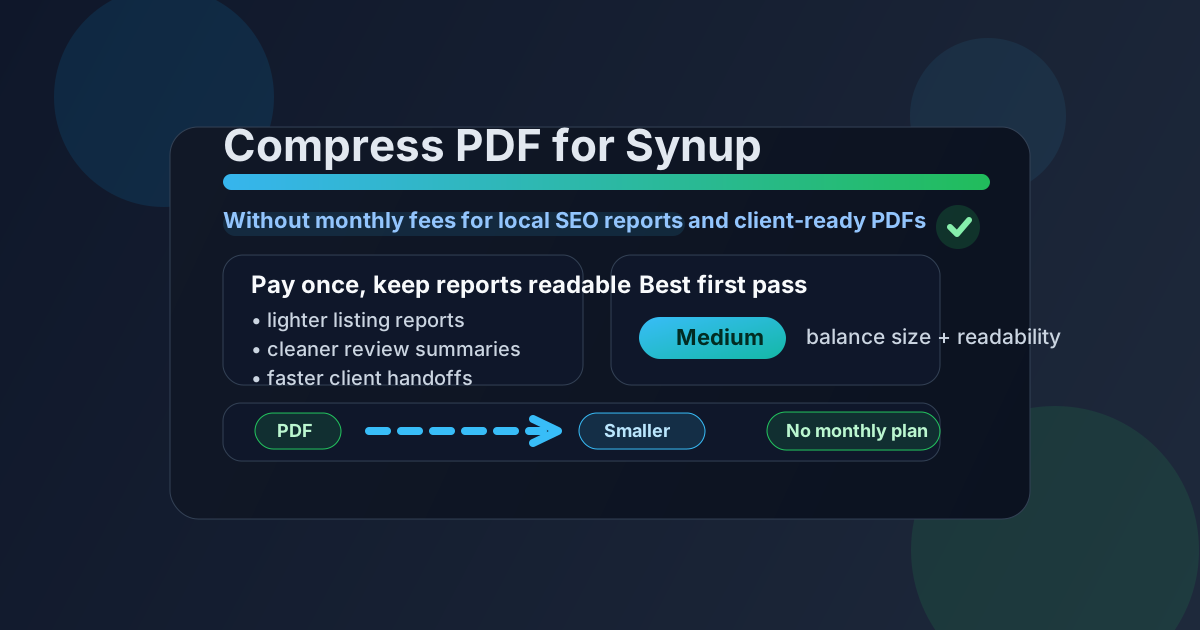
Table of contents
- Quick start: compress a Synup PDF in under 2 minutes
- Why "without monthly fees" matters here
- Why smaller PDFs help in Synup workflows
- What size should a Synup PDF be?
- Which compression level should you choose?
- Step-by-step: use LifetimePDF to shrink the file
- Common Synup PDFs that benefit from compression
- What to do if the PDF is still too large
- How to keep listing tables and review evidence readable
- Workflow habits that reduce PDF bloat
- Related LifetimePDF tools and internal links
- FAQ (People Also Ask)
Quick start: compress a Synup PDF in under 2 minutes
If your real goal is simply make this Synup PDF smaller so it is easier to send, use this workflow:
- Open Compress PDF.
- Upload the Synup export you want to share.
- Choose Medium compression first.
- Download the smaller file and compare the new size.
- Preview the sections that matter most: listing rows, business names, location details, review highlights, screenshots, and summary recommendations.
- If the PDF is still bulky, use Extract Pages, Split PDF, or Delete Pages instead of repeatedly crushing the whole document.
Why "without monthly fees" matters here
This keyword exists for a very normal reason. People already pay for the platform that produced the report. They may also pay for analytics, rank tracking, call tracking, reporting dashboards, review tools, and storage. Adding another monthly plan just to make one exported PDF smaller feels like the least exciting kind of software sprawl.
Synup PDFs are finish-line work. The listing updates are already made. The review trend has already been analyzed. The local SEO recap is already assembled. The only job left is making the file easier to send, upload, or archive without damaging the parts people actually need. That is exactly the kind of task where a pay-once workflow makes more sense than another recurring charge.
There is also a trust issue with many PDF sites that market themselves as free. You upload the file, wait for processing, then find the download fenced behind a login or trial wall. When you are trying to get a local SEO recap to a client before a call, that friction is worse than the oversized PDF you started with. A straightforward workflow that lets you compress the file, download it, and move on is the better fit.
Why smaller PDFs help in Synup workflows
Synup reports often leave the platform when someone needs a fixed snapshot of local search work. Maybe it is a client who wants a listing cleanup update. Maybe it is an account manager reviewing a review-summary PDF before a meeting. Maybe it is a franchise owner who needs a location-level report without another login. In all of those cases, file size becomes a delivery problem.
Large PDFs are slower to upload, more annoying to forward, and easier for busy readers to postpone. The extra weight often comes from screenshot appendices, multi-location exports, wide tables, or one oversized PDF trying to answer every question at once. Compression helps, but the deeper win is making the file small enough to move easily while keeping the details people still rely on, such as business names, listing rows, review excerpts, screenshots, and next-step notes.
When a report feels lighter and cleaner, people are more likely to actually use it. That matters whether you are sending a one-location update to a small business owner or a multi-location recap through an agency workflow.
What size should a Synup PDF be?
A good Synup PDF target depends on who will read it and what the document contains. There is no perfect number, but these ranges work well in real local SEO workflows:
- Under 2MB: best for single-location updates, short review summaries, or a compact listing report.
- 2MB to 4MB: a comfortable range for client-ready recaps with a few screenshots and notes.
- 4MB to 5MB: still reasonable for multi-location packs if the content is genuinely useful and still easy to read.
- Above 5MB: usually a sign that the file has extra appendix pages, duplicate screenshots, repeated location sections, or too much material for one reader.
The right question is not only How small can I make this? It is How small can I make this while keeping the exact pieces the next person still needs? For Synup exports, those pieces are usually location names, listing status rows, review text, screenshots, and the action summary.
Practical rule: if the smallest useful table row or screenshot becomes harder to trust, the file is over-compressed even if the number looks impressively small.
Which compression level should you choose?
For most Synup PDFs, the safest order is simple:
- Start with Medium. It usually gives the best trade-off between smaller files and readable detail.
- Check the smallest elements. Look at listing rows, location names, review snippets, screenshots, and action notes at normal zoom.
- Only go stronger if the file is still too heavy. Stronger compression can help, but it also raises the risk that screenshots and fine table text become muddy.
Medium is a better default because Synup reports often contain mixed content. Some pages are mostly text and tables. Others include screenshots, maps, or visual proof for a client. Over-compressing the whole file can hurt the pages that matter most.
Step-by-step: use LifetimePDF to shrink the file
- Export or print the Synup report you actually plan to share.
- Open Compress PDF.
- Upload the file.
- Choose Medium compression.
- Download the smaller result.
- Check the pages that carry real decision value, especially listing tables, review summaries, screenshots, and recommendations.
- If the file is still too large, use Extract Pages to keep only the summary section, or Split PDF to separate one location from the rest.
- If the export includes repeated screenshots or appendix material, remove them with Delete Pages and compress again only if needed.
That sequence usually beats the common mistake of compressing harder and harder while keeping every page. In many client workflows, sharing less PDF is the smarter move.
Common Synup PDFs that benefit from compression
The keyword is specific, but the real need shows up in several kinds of files:
Listing reports
These often combine status tables, business details, and notes across one or more locations. The file does not need to be huge to become annoying. A lighter copy makes it easier to send to clients and location managers.
Review summaries
Review exports can become heavy when they include screenshots, long notes, and multiple locations. Compression helps, but these PDFs still need review text and context to stay readable.
Location snapshots
One-location recaps should usually stay lean. If one becomes large, it often contains unnecessary screenshots, white space, or duplicate proof pages that can be trimmed before another compression pass.
Multi-location client packs
These are the easiest files to split. Instead of sending one giant PDF to every stakeholder, create smaller files by region, brand, or location group. Readers get the pages that matter to them, and the file size improves without sacrificing clarity.
What to do if the PDF is still too large
If Medium compression is not enough, do not jump straight to the harshest setting. Work through the cleaner options first:
- Extract only the key pages. Many readers need the summary, not the full appendix.
- Split multi-location exports. One file per region or client owner is often easier than one master PDF.
- Delete repeated screenshots. Repetition is one of the easiest sources of unnecessary weight.
- Crop wasted margins. Empty space can add up across a long report.
- Re-export with only the needed date range. Sometimes the problem starts before the PDF even reaches the compressor.
In other words, treat compression as one tool in a cleanup workflow, not the entire workflow.
How to keep listing tables and review evidence readable
The quality check for Synup PDFs is straightforward. Open the compressed file and inspect the details that carry trust:
- business names and location labels
- listing status rows and table headings
- review text excerpts and star-rating context
- screenshots that prove the issue or improvement
- summary notes and recommended actions
If those elements still look clear at normal zoom, the compressed file is probably good enough for real use. If any of them look soft, cramped, or unreliable, go back and reduce the number of pages instead of forcing more compression.
Workflow habits that reduce PDF bloat
The easiest size savings often come before the file is compressed. These habits help keep Synup exports cleaner from the start:
- export only the locations the next reader actually needs
- avoid mixing summary pages and raw appendix pages in the same client handoff
- separate account-manager review copies from full internal archive copies
- crop unnecessary margins before sharing screenshot-heavy reports
- delete duplicate proof pages before compressing
- keep one master file for the archive and a lighter file for distribution
This matters because the best PDF workflows are not just smaller. They are easier for the next person to use.
Related LifetimePDF tools and internal links
Compress PDF is the main tool for this job, but a few related tools make the workflow better:
- Compress PDF for the first pass
- Extract Pages when a client only needs the summary
- Split PDF for multi-location packs
- Delete Pages to remove appendix clutter
- Crop PDF to trim extra margins around screenshots
Want the simplest route? Compress first, then split or extract only if the report is still bigger than the next reader needs.
FAQ (People Also Ask)
How do I compress a PDF for Synup without monthly fees?
Use a pay-once PDF workflow like LifetimePDF, upload the Synup export, start with Medium compression, and check the smaller copy before you send it. If the file is still too large, extract the summary pages or split multi-location sections instead of over-compressing everything.
Why look for a Synup PDF workflow without monthly fees?
Because the expensive part of the workflow already happened inside your local SEO stack. Shrinking the finished PDF is usually a small cleanup task, so a pay-once tool fits better than another recurring subscription.
What file size should I aim for with Synup reports?
Under 2MB is strong for single-location updates and short review summaries. Client-ready packs with screenshots often land more comfortably around 2MB to 5MB, provided the smallest useful details still look clear.
Will compression make Synup screenshots or tables blurry?
It can if you compress too aggressively. Medium compression is usually the safest first pass because it reduces size while preserving listing rows, review evidence, and screenshot detail well enough for normal reading.
What if my Synup PDF is still too large after compression?
Split the pack by location, extract only the pages the reader needs, remove duplicate screenshots, and crop empty margins. In many cases, a cleaner smaller subset works better than crushing the entire original file harder.