Compress PDF for Siteimprove: Share Smaller Accessibility Reports, SEO Audit Exports, and Client PDFs Faster
If you need to compress a PDF for Siteimprove, export the report, upload it to LifetimePDF's Compress PDF tool, start with Medium compression, and review the smaller copy once before sending it.
For most Siteimprove workflows, that is enough to shrink accessibility reports, SEO audit exports, and client PDFs while keeping issue tables, page URLs, screenshots, charts, and action notes readable.
Siteimprove already did the hard part. It found the issues, organized the findings, and turned a pile of page-level problems into something a marketer, accessibility lead, or client can actually act on. The PDF job is the handoff. Usually the real need is not a new reporting system. It is a lighter file that opens faster, uploads more smoothly, and still looks trustworthy when someone scans a screenshot, checks a URL, or reads the recommendation that matters.
Fastest path: run the Siteimprove export through LifetimePDF's Compress PDF tool at Medium, then split or extract pages only if the file still carries more weight than the next reader needs.
In a hurry? Jump to Quick start: compress a Siteimprove PDF in under 2 minutes.
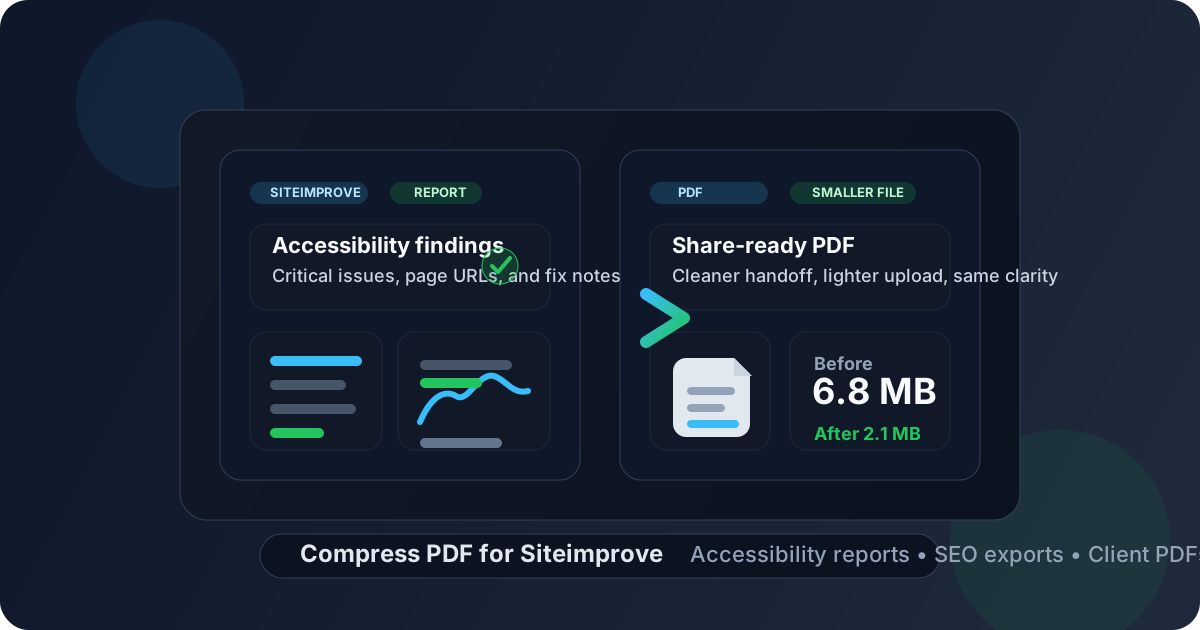
Table of contents
- Quick start: compress a Siteimprove PDF in under 2 minutes
- Why smaller PDFs help in Siteimprove workflows
- What file size should a Siteimprove PDF be?
- Which compression level should you choose?
- Step-by-step: use LifetimePDF to shrink the file
- Best approach for common Siteimprove PDFs
- What to do if the PDF is still too large
- How to keep tables, screenshots, and URLs readable
- Workflow habits that reduce PDF bloat
- Related LifetimePDF tools and useful reading
- FAQ (People Also Ask)
Quick start: compress a Siteimprove PDF in under 2 minutes
If your real goal is simply make this Siteimprove PDF smaller so it is easier to send, this workflow is usually enough:
- Export the Siteimprove file you actually plan to share, whether that is an accessibility report, SEO audit export, issue snapshot, governance review, or client-ready handoff.
- Open Compress PDF.
- Upload the file and choose Medium compression first.
- Download the smaller result and compare the new size.
- Preview the details that matter most: issue counts, page URLs, screenshot labels, chart text, notes, and remediation guidance.
- If the file is still bulky, use Extract Pages, Delete Pages, or Split PDF before forcing stronger compression across the whole report.
Why smaller PDFs help in Siteimprove workflows
Siteimprove reports rarely stay inside the platform. They get forwarded to content teams, attached to tickets, uploaded to portals, shared with clients, and saved in archive folders where somebody later needs a fixed snapshot instead of a live view. Heavy PDFs slow every one of those handoffs down.
Smaller files remove friction without changing the reporting story. A lighter export is easier to upload, easier to forward, and easier to reopen later when someone only needs the headline issues or one supporting screenshot. The key is reducing file size without damaging the parts that make the report useful in the first place.
- Faster stakeholder delivery: lighter files move more smoothly through email, chat, portals, and project tools.
- Easier internal review: a teammate can open the report quickly before a meeting instead of waiting on a bulky packet.
- Cleaner archives: recurring accessibility and SEO exports stop piling up as oversized attachments.
- Less handoff friction: content owners, developers, and clients can focus on the fix instead of the download.
The biggest file-size problems usually come from repeated screenshots, appendix pages nobody will read, long evidence sections, or one giant PDF trying to serve executives, implementers, and auditors all at once. Compression helps, but it works best when you pair it with a little cleanup.
What file size should a Siteimprove PDF be?
There is no single perfect number, but practical targets help. For short issue snapshots, focused stakeholder recaps, and single-purpose updates, under 2MB is a strong goal. For broader accessibility audits, SEO exports, and screenshot-heavy client PDFs, 2MB to 5MB is usually more realistic as long as page URLs, evidence screenshots, and recommendations still read clearly.
| Siteimprove PDF type | Practical target | What to protect |
|---|---|---|
| Issue snapshots and short stakeholder updates | < 2MB | Issue counts, key URLs, short notes, and next steps |
| Accessibility reports and SEO audit exports | 2MB to 4MB | Tables, screenshots, chart labels, and findings |
| Appendix-heavy client packs and evidence PDFs | 3MB to 5MB | Proof screenshots, page detail, and context someone may need later |
You do not win by chasing the tiniest file possible. You win when the next reader can open the PDF quickly and still trust what they are seeing. If page URLs, screenshot text, issue labels, or action notes become annoying to read, the file is too compressed even if the size number looks impressive.
Which compression level should you choose?
For Siteimprove exports, Medium compression is usually the right first move. It often cuts enough file weight while keeping issue tables, page URLs, screenshots, chart labels, and recommendations readable.
- Low compression: useful when the PDF is already close to your size target and includes lots of narrow tables or long URLs.
- Medium compression: best default for most accessibility reports, issue summaries, and client-ready Siteimprove handoffs.
- High compression: only worth trying when file size matters more than polish, and only after you confirm the smallest useful details still work.
In practice, people often get better results by starting at Medium and then trimming extra pages if the report is still too large. That usually beats hitting the whole packet with a harsher setting right away.
Step-by-step: use LifetimePDF to shrink the file
- Export the right PDF first. Do not start with the largest possible packet if the audience only needs the summary or one issue category.
- Open the compressor. Go to LifetimePDF Compress PDF.
- Upload the Siteimprove file. This might be an accessibility report, SEO audit pack, content quality export, issue snapshot, or stakeholder-ready review.
- Choose Medium compression. That is the safest first pass for most web governance and reporting documents.
- Download and review. Compare the old and new size, then check legibility on the smaller file.
- Trim or clean only if needed. If the file is still too large, split the appendix, extract the summary, or remove repeated screenshots before trying a harsher compression setting.
The review step matters. Open the compressed file once before sharing it. Look at the smallest issue row, the longest page URL, the chart legend, the screenshot labels, and any short note that explains what should happen next. If those still feel readable at normal size, you are probably done.
Best approach for common Siteimprove PDFs
Accessibility reports
These often combine high-level scores, tables, and proof screenshots. Medium compression usually works well. What matters most is protecting the issue labels, affected pages, and fix guidance that someone will actually use.
SEO audit exports
These usually depend on page lists, issue counts, and section-level summaries. They often compress cleanly, but long URLs and table columns are the risky spots. Keep the details legible even if the file stays slightly larger.
Client recaps and stakeholder handoffs
These should feel light and intentional. A compact file is easier to forward and easier to open in the few minutes a client, executive, or busy teammate is willing to give it. That does not mean stripping out value. It means sending the right pages in the cleanest possible package.
Evidence packs and archives
Archive versions should be lighter, but still readable enough to answer questions later. Preserve the pages that show the problem, the scope, and the recommended fix, then cut repeated or low-value support material.
What to do if the PDF is still too large
If Medium compression does not get you where you need to be, do not jump straight to aggressive compression. Usually a better answer is removing file weight that is not helping the reader.
- Extract only the summary or decision-making pages.
- Split long report packs into a main report and a backup appendix.
- Delete duplicate screenshots, stale revisions, and repeated covers.
- Crop wasted white space or oversized margins.
- Clean metadata before sending the report outside your team.
You can handle those cleanup steps with Extract Pages, Delete Pages, Split PDF, Crop PDF, and PDF Metadata Editor.
Good tradeoff: one clean main PDF plus a separate appendix is often more useful than one giant Siteimprove file trying to serve every reader at once.
How to keep tables, screenshots, and URLs readable
A good compressed Siteimprove PDF still feels dependable. Before you share it, check the parts most likely to suffer:
- issue counts, labels, and status summaries
- page URLs, titles, and narrow table columns
- screenshot evidence and callouts
- chart labels, dates, and summary visuals
- short notes that explain what changed
- client-facing conclusion pages that people may quote later
If any of those become hard to read at a normal zoom level, back off. A slightly larger file is usually the better business choice than a smaller one that makes the report harder to trust.
Workflow habits that reduce PDF bloat
The easiest way to get smaller PDFs is to avoid unnecessary weight before export. A few habits make a real difference.
- Export only the sections and date range the next reader actually needs.
- Keep the share version separate from the full archive copy.
- Send role-specific PDFs instead of one oversized packet for everybody.
- Remove repeated screenshots before exporting the final share version.
- Standardize on a compress-once, review-once workflow before external sharing.
A clean lightweight workflow is often: Extract or Split -> Compress -> Review -> Share. That is simple, repeatable, and much less frustrating than trying to rescue an oversized PDF at the last second.
Related LifetimePDF tools and useful reading
If you want a cleaner Siteimprove workflow, these tools and related guides pair well with this task:
- Compress PDF for the main file-size reduction step.
- Split PDF when the main summary and appendix should be separate files.
- Extract Pages when only a few sections need to be shared.
- Delete Pages for removing repeated support pages or stale revisions.
- Crop PDF to trim oversized margins and wasted space.
- Compare PDFs when you need to verify what changed between report drafts.
- Compress PDF for Siteimprove Without Monthly Fees for the subscription-focused companion guide.
- Check PDF Accessibility Online for accessibility review workflows around final PDFs.
- Compress PDF for Screaming Frog for a close technical SEO companion.
- Compress PDF for Google Search Console for another search-report handoff workflow.
- Compress PDF for Ahrefs for another SEO reporting use case.
Want the simplest setup? Use LifetimePDF for the compression step, then keep Split PDF, Extract Pages, and Delete Pages nearby for report packs that mix a decision-ready summary with a bulky appendix.
FAQ (People Also Ask)
How do I compress a PDF for Siteimprove?
Upload the Siteimprove export to LifetimePDF, start with Medium compression, and review the smaller result before sharing it. If the PDF is still too bulky, split or extract only the pages the next reader actually needs instead of over-compressing the whole export.
What file size should I aim for with Siteimprove PDFs?
Under 2MB is a strong target for short issue summaries and focused updates. Broader accessibility audits, SEO exports, and screenshot-heavy recaps usually work better around 2MB to 5MB as long as the smallest useful text still reads clearly.
Will compression make Siteimprove screenshots or tables blurry?
It can if you compress too aggressively. Medium compression is usually the safest first pass because it reduces file size while preserving table detail, page URLs, screenshot evidence, chart labels, and action notes.
Should I split a large Siteimprove report instead of compressing it harder?
Often, yes. If one PDF mixes a leadership summary, appendix pages, evidence screenshots, and sections meant for different readers, splitting it usually works better than forcing stronger compression across the whole file.
Which Siteimprove files benefit most from compression?
Accessibility reports, SEO audit exports, issue snapshots, client handoffs, and archive copies are the most common candidates because they often get shared through email, portals, project tools, and recurring review workflows.
Published by LifetimePDF - Pay once. Use forever.