Compress PDF for Signable: Keep Contracts, Approvals, and Signer Packets Light Without Losing the Details
To compress a PDF for Signable, upload the final signer-ready file to LifetimePDF's Compress PDF tool, start with Medium compression, and keep the smaller copy only if signature boxes, initials, dates, labels, and fine print still read cleanly.
For most Signable workflows, under 2MB is a strong target for text-heavy contracts and approvals, while onboarding packets, mixed-content forms, and scan-heavier support pages usually work best around 2MB to 5MB depending on what still needs to stay readable.
Signable usually appears at the moment the document has to move. A client is opening it from email, a manager is approving something between meetings, or a new hire is trying to finish paperwork on a phone instead of a laptop. The smart fix is usually balanced compression plus light cleanup, not smashing the entire packet until it looks thin and untrustworthy.
Fastest path: use LifetimePDF's Compress PDF tool at Medium, then trim duplicate pages, scan borders, or bulky appendices only if the Signable packet is still heavier than it needs to be.
Need the short version? Jump to Quick start: compress a Signable PDF in about 2 minutes.
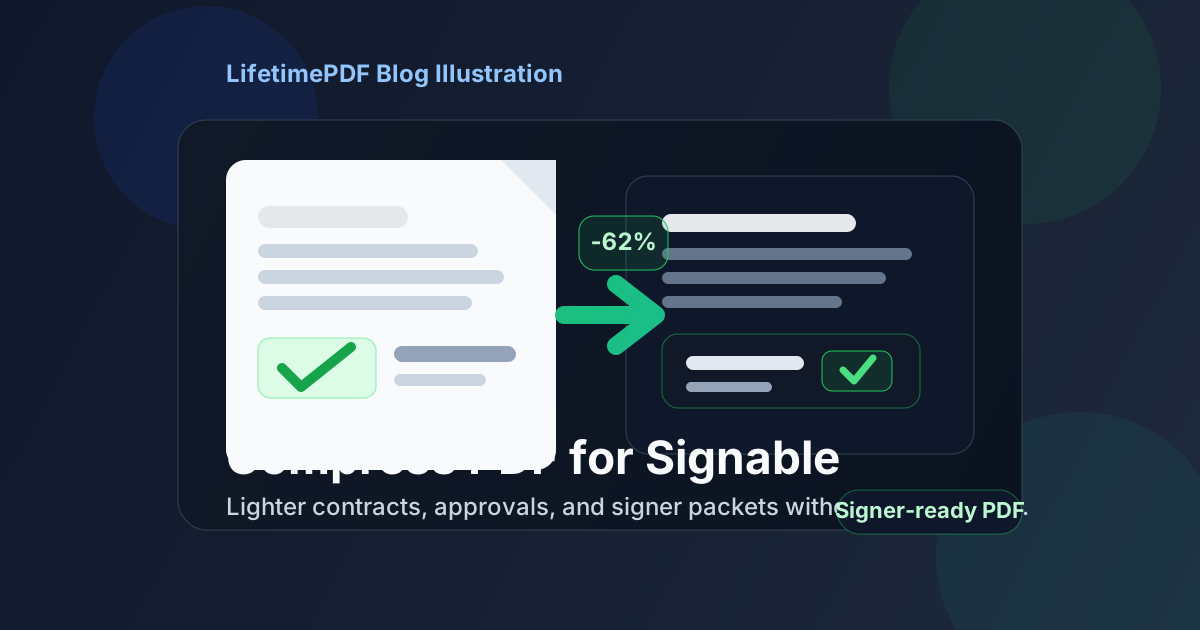
Table of contents
- Quick start: compress a Signable PDF in about 2 minutes
- Why smaller PDFs help in Signable workflows
- What size should a Signable PDF be?
- Which compression level should you choose?
- Step-by-step: shrink a PDF with LifetimePDF
- Best approach for common Signable document types
- What to do if the PDF is still too large
- How to keep signer-facing details readable
- Workflow habits that prevent PDF bloat
- Related LifetimePDF tools and useful reading
- FAQ (People Also Ask)
Quick start: compress a Signable PDF in about 2 minutes
If your real goal is simply make this Signable PDF smaller so it uploads cleanly and still feels safe to review or sign, this workflow is usually enough:
- Start with the contract, service agreement, quote approval, consent form, onboarding packet, vendor document, or signer-ready PDF you actually plan to send.
- Open Compress PDF.
- Choose Medium compression first.
- Download the smaller result and compare the new size.
- Check the fragile details once: names, dates, signature boxes, initials areas, checkbox labels, totals, and the smallest paragraph on the weakest page.
- If the file still feels bulky, use Delete Pages, Extract Pages, Split PDF, or Crop PDF before trying stronger compression.
Why smaller PDFs help in Signable workflows
Signable usually shows up right at the point where a draft stops being internal working material and becomes a live document someone else has to act on. That could mean a customer signing a service agreement, a team lead approving a quote, a vendor reviewing a purchase document, or a new hire filling out onboarding paperwork. When the PDF is heavier than it should be, the friction shows up at exactly the wrong moment.
Smaller PDFs upload faster, preview more smoothly, and feel less annoying when the signer opens them inside a browser or from a phone. That matters even more when the packet picked up weight from repeated exports, scanned signatures, photographed IDs, embedded screenshots, duplicated pages, or reference material that never needed to stay in the signer-facing copy.
- Faster uploads: useful when a contract needs to go out now, not after another cleanup loop.
- Smoother review and signing: lighter PDFs behave better in browser-based and mobile signing flows.
- Better mobile handling: many recipients first open the packet on a phone or tablet.
- Less scan waste: signed pages, IDs, photographed paperwork, and old scans often carry margins, shadows, and image bulk that add no value.
- Cleaner follow-up work: smaller PDFs are easier to split, archive, resend, attach to tickets, and store later.
What size should a Signable PDF be?
There is no single perfect number for every Signable workflow, so practical ranges are more useful than chasing the smallest possible file. You want a PDF that feels easy to open and professional to sign.
| Document type | Practical target | Why it works |
|---|---|---|
| Text-heavy contract, approval sheet, or standard form | < 1MB to 2MB | Usually enough for smooth review and signing without hurting readability |
| Quote approval, consent form, or mixed-content signer bundle | 1MB to 3MB | Leaves room for logos, tables, labels, and moderate visuals without feeling bloated |
| Scan-heavy support file or image-based attachment | 2MB to 5MB | Often safer when IDs, initials, low-contrast text, and photographed pages still need to stay clear |
If your file already sits in a sensible range and opens quickly, stop there. Compression is supposed to make the workflow smoother, not win a size contest.
Which compression level should you choose?
Most Signable users do best by treating compression like a quality dial rather than a one-way shrink button.
- Low compression: useful when the source is already clean and only needs a modest size drop.
- Medium compression: the best starting point for most Signable documents because it usually lowers size without damaging signature boxes, initials areas, checkbox labels, dates, totals, or fine print.
- High compression: best reserved for bulky scans or oversized support files after you confirm the final copy still feels trustworthy.
If the PDF includes faint scans, thin signature lines, checkbox labels, or small legal text, go gentler first. Over-compressing those details creates more risk than value.
Step-by-step: shrink a PDF with LifetimePDF
- Export or save the final Signable-ready PDF.
- Open LifetimePDF's Compress PDF tool.
- Upload the file and choose Medium compression.
- Download the smaller version.
- Preview the exact details that matter most: names, dates, signature boxes, initials areas, checkbox labels, totals, and the smallest body text.
- If the file still feels too heavy, clean the structure before you compress harder.
Best approach for common Signable document types
Contracts and service agreements
Start with Medium compression and verify clause text, signature boxes, dates, and initials areas. These files are usually text-heavy, so if they feel unusually large, the real problem is often scan weight, repeated exports, or embedded screenshots that never needed to be there.
Quote approvals and consent forms
Watch labels, short instructions, dates, names, totals, and signature prompts. These UI-like details can degrade faster than ordinary body text if the source export was already weak.
Onboarding packets and vendor paperwork
Mixed-content files often include logos, policy pages, signatures, tables, and support documents. That does not automatically make them hard to compress, but it does mean you should review the weakest page instead of assuming the entire packet is fine because the cover still looks sharp.
Scanned attachments and signed copies
If the PDF came from a scanner or phone camera, crop dead borders, delete blank backs, or split unrelated support material before pushing compression harder. In many Signable workflows, better packet structure helps more than brute force.
What to do if the PDF is still too large
When Medium compression is not enough, the next best move is usually structural cleanup, not brute force.
- Delete duplicate or stale pages.
- Crop scan borders and dead margins.
- Extract only the reviewer-facing or signer-facing pages.
- Split a heavy appendix or support packet into a separate file.
- Rebuild a messy export if it contains huge screenshots or repeated scans.
In other words, sending less PDF often works better than compressing the same bloated packet harder.
How to keep signer-facing details readable
Do one deliberate review after compression. You do not need a full audit. You just need to inspect the fragile parts that would create hesitation if they looked rough.
- Signature boxes and initials areas
- Checkbox labels and short instructions
- Names, dates, totals, clause references, and sign-off fields
- Any scanned ID, attachment, or low-contrast page
- The smallest paragraph on the weakest page in the packet
If those still look clean at ordinary reading zoom, the PDF is probably ready.
Workflow habits that prevent PDF bloat
- Keep a clean master packet instead of repeatedly exporting new variants.
- Do not merge backup material into the main signer copy unless it is truly needed.
- Prefer digital source files over print-scan-rescan loops.
- Separate bulky appendices from the actual working PDF when possible.
- Compress once near the end instead of stacking multiple rounds of compression.
These habits matter because the easiest PDF to compress well is the one that was not bloated in the first place.
Related LifetimePDF tools and useful reading
- Compress PDF for the actual size reduction step
- PDF Form Filler for typed fields before review or signing
- Extract Pages when only part of the packet needs to travel
- Split PDF for heavy appendices and support material
- Crop PDF to remove scan borders and wasted margins
- Compress PDF for Signable: Upload Smaller Contracts and Forms Faster
- Compress PDF for Signable Without Monthly Fees
- Compress PDF for SignNow, Compress PDF for Signeasy, and Compress PDF for DocHub for closely related signing workflows
FAQ (People Also Ask)
How do I compress a PDF for Signable?
Upload the Signable-ready PDF to a compressor, start with Medium compression, and keep the smaller copy only after checking signature boxes, initials, dates, labels, and small legal text. For most Signable workflows, Medium is the safest first step.
What file size should I aim for before using a PDF in Signable?
Under 2MB is a strong target for text-heavy contracts, approvals, and standard forms. Mixed packets often work well around 1MB to 3MB, while scan-heavy attachments may land closer to 2MB to 5MB if that keeps the important details readable.
Will compression hurt signature boxes, initials, labels, or fine print?
It can if you compress too aggressively. That is why Medium compression is usually the best starting point. Always review the fragile parts before keeping the smaller file.
Should I compress before or after merging documents for Signable?
If you already know the final signer packet, merge first and compress the finished file once. If the bundle is oversized because it includes stale drafts, duplicate pages, or support material nobody needs, trim those first.
What if my PDF is still too large after compression?
Delete duplicate pages, crop scan borders, extract only the needed section, split one oversized packet, or rebuild a messy export more cleanly. In many workflows, better packet structure helps more than stronger compression.
Ready to shrink the file? Start with the final Signable packet, use Medium compression, and keep the smaller copy only after a quick readability check.