Compress PDF for Screaming Frog Online Without Monthly Fees: Reduce Crawl Reports in Your Browser Without Subscription Bloat
To compress a PDF for Screaming Frog online without monthly fees, export the report as PDF, upload it to Compress PDF in your browser, start with Medium compression, and keep the smaller copy only if URL rows, charts, screenshots, and recommendations still look clear.
For most Screaming Frog PDFs, under 2MB works well for focused summaries, while full audits, migration reviews, and screenshot-heavy appendices usually land best around 2MB to 5MB without needing another recurring software bill.
This search usually happens late in the workflow. The crawl is done, the issues are already found, and the report is ready. What is left is the least glamorous step: make the PDF smaller, keep the evidence readable, and send it without adding friction or another subscription. That is exactly where an online, no-monthly-fee workflow earns its keep.
Fastest path: export the Screaming Frog PDF, open LifetimePDF's Compress PDF tool in your browser, begin with Medium compression, then check one long URL table and one screenshot-heavy page before you share the smaller copy.
Need the short version? Jump to Quick start: compress a Screaming Frog PDF online in under 2 minutes.
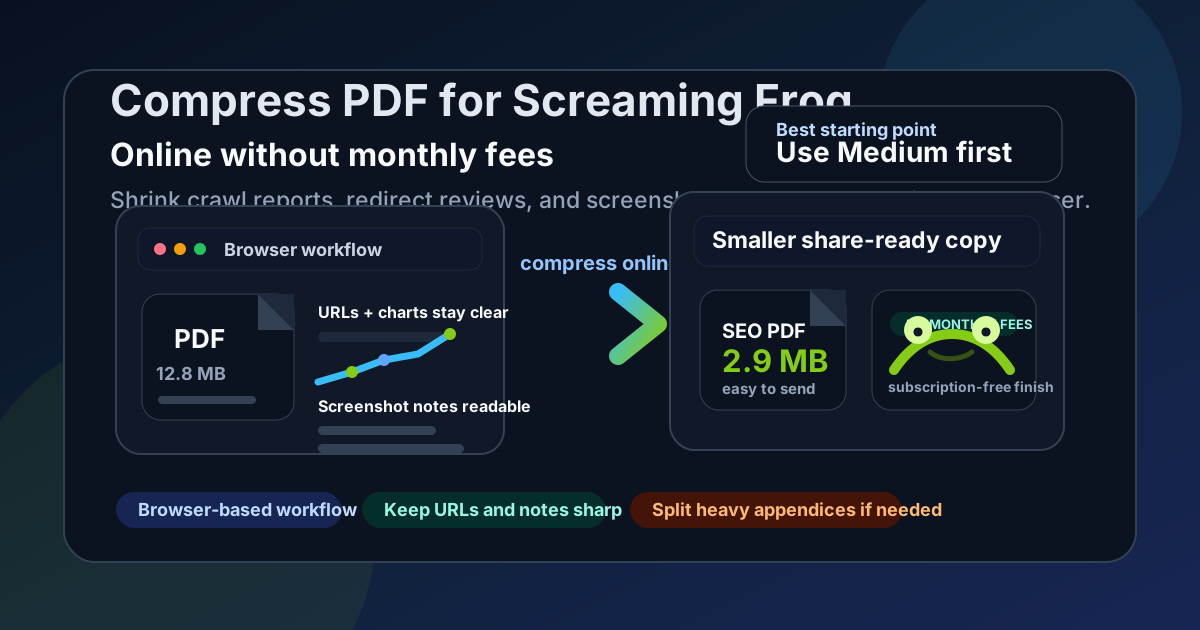
Table of contents
- Quick start: compress a Screaming Frog PDF online in under 2 minutes
- Why this exact search intent makes sense
- Why use an online workflow for Screaming Frog PDFs?
- What file size should you aim for?
- Which compression level should you choose?
- Step-by-step: compress a Screaming Frog PDF in your browser
- Best approach for common Screaming Frog export types
- When to split the PDF instead of compressing harder
- How to keep URLs, screenshots, and notes readable
- Related LifetimePDF tools and useful next steps
- FAQ (People Also Ask)
Quick start: compress a Screaming Frog PDF online in under 2 minutes
If your real goal is simply make this Screaming Frog PDF smaller in the browser so I can send it, this is the clean workflow:
- Export or save the finished Screaming Frog report as PDF.
- Open Compress PDF.
- Upload the file you actually plan to share, whether it is a crawl overview, redirect review, response code audit, migration QA report, screenshot-backed technical audit, or client-facing SEO deck.
- Choose Medium compression first.
- Download the smaller copy and compare the new file size with the original.
- Check one long URL page and one screenshot-heavy page at normal zoom.
- If the PDF still feels too bulky, use Split PDF, Extract Pages, or Delete Pages before forcing stronger compression across the whole file.
Why this exact search intent makes sense
The phrase online without monthly fees sounds specific because the need is specific. You do not usually buy a tool just to shrink one exported report. More often, you already pay for crawling software, analytics, storage, reporting tools, and whatever stack your SEO work requires. Then a PDF gets too heavy for email, a client portal, or a task ticket, and suddenly the last tiny step in the workflow becomes annoying.
That is why this keyword is clean rather than forced. It combines two practical constraints people really care about:
- Online: the finishing step should happen quickly in the browser, with no extra install or device-specific setup.
- Without monthly fees: the fix should not create another recurring cost for work that feels routine.
For consultants, agencies, in-house teams, and freelance SEOs, that combination is sensible. The report already exists. You just want it smaller, easier to send, and still trustworthy when someone opens it later.
Why use an online workflow for Screaming Frog PDFs?
Screaming Frog work is often done across several environments. You might crawl on a desktop, review findings in a browser, share updates in chat, and upload evidence to a ticketing system or client portal. A browser-based PDF step fits neatly into that reality because it stays fast and low-friction.
| Need | Why it matters | Best response |
|---|---|---|
| Quick sharing | Bulky PDFs are awkward in email, chat, and task systems. | Compress the file first so it uploads and opens faster. |
| No extra install | Managed machines and rushed handoffs make extra software annoying. | Use a browser workflow that works as a finishing step. |
| No recurring bill | PDF cleanup is real work, but it is rarely worth another subscription. | Use a pay-once or non-subscription tool for routine cleanup. |
| Readable technical proof | Long URLs, status codes, screenshot notes, and chart labels break first. | Start with medium compression and check the weakest details once. |
Online does not automatically mean better. It only helps when it removes friction without damaging readability. That is why the best online workflow is conservative at first: compress once, review once, then decide whether the file is truly ready.
What file size should you aim for?
There is no perfect universal number because Screaming Frog PDFs vary a lot. A redirect review with a few tables behaves differently from a screenshot-heavy technical audit or migration QA pack. Still, these ranges are practical starting points:
| Type of PDF | Good target size | What to protect |
|---|---|---|
| Short crawl summaries and issue updates | Under 2MB | URL rows, issue counts, chart labels |
| Redirect reviews and migration QA exports | 1MB to 3MB | Redirect targets, status codes, date notes |
| Technical audits with screenshots | 2MB to 5MB | Screenshot callouts, annotations, recommendations |
| Client-ready packs with appendices | 2MB to 5MB or split into parts | Summary pages first, appendix pages second |
The better rule is this: stop when the PDF feels small enough and still reads clearly at normal zoom. A slightly larger audit people can trust is usually more useful than a tiny file that makes technical evidence feel fuzzy or incomplete.
Which compression level should you choose?
If your Screaming Frog report contains long URLs, status code examples, screenshots, and annotations, the wrong compression level can do real damage. Most of the time, the safest order looks like this:
- Medium compression: best starting point for most SEO PDFs.
- Lower compression: useful when the report contains lots of tiny screenshot text or dense tables.
- Higher compression: only worth trying after you know the file is still too large and the audience does not need every detail at the smallest zoom levels.
In Screaming Frog workflows, the fragile areas are predictable: long path segments, redirect chains, chart legends, issue labels, screenshot callouts, and short recommendations tucked into dense pages. Those are the sections to inspect before you call the job done.
Step-by-step: compress a Screaming Frog PDF in your browser
- Export the final version first. Compress the PDF you genuinely plan to send, not an unfinished draft that will change again in ten minutes.
- Open Compress PDF. Keep the workflow in the browser so you can move quickly.
- Choose Medium compression. Treat it as the default, not the compromise.
- Download the smaller copy. Compare the original and compressed sizes so you know whether the change was actually worthwhile.
- Review the weakest pages. Check long URL tables, screenshot pages, chart-heavy summaries, and any page with small annotations or examples.
- Decide whether to stop or refine. If the file already shares easily and still reads cleanly, stop there. If not, split bulky sections or extract only what the reader needs.
This is the part people overcomplicate. You do not need an elaborate process. You need one clean pass, one quick QA check, and a smaller file that still behaves like a useful audit document.
Best approach for common Screaming Frog export types
Crawl overview or issue summary
These are usually the easiest files to shrink. They often respond well to Medium compression because the important content is mostly headings, charts, and moderate-density tables. Aim for a small file that opens fast in email or chat.
Redirect review or migration QA PDF
These are more sensitive. A broken redirect chain or a status-code mistake can hide inside small text. Compress conservatively and check the rows containing the exact examples you expect a developer or SEO lead to use.
Screenshot-backed technical audit
This is where file size grows quickly. Browser captures, annotations, and evidence pages make the PDF bulky fast. Compression helps, but this is also the format where splitting the appendix often works better than pushing the entire file through harder compression.
Client-facing SEO deck
Here the goal is smooth delivery. The report should open easily, feel polished, and avoid awkward upload limits. Usually the best move is compressing the executive version and keeping the full appendix as a separate supporting file.
When to split the PDF instead of compressing harder
A large Screaming Frog PDF is not always a compression problem. Sometimes it is a packaging problem. One file may be trying to serve too many readers at once: executives, developers, clients, and your own archive. In those cases, splitting is cleaner than squeezing every page harder.
- Split the executive summary from the technical appendix.
- Extract only the migration QA pages needed for a developer handoff.
- Delete repeated screenshots or duplicated proof pages.
- Keep a lightweight client copy and a fuller internal reference copy.
LifetimePDF tools such as Split PDF, Extract Pages, and Delete Pages are especially useful when a report contains one strong summary section and one bulky evidence section.
How to keep URLs, screenshots, and notes readable
The QA check after compression does not need to take long. It just needs to be targeted. In most Screaming Frog PDFs, these are the first elements that tell you whether compression went too far:
- Long URLs and path segments that wrap across tight columns
- Status codes and redirect targets that matter for debugging
- Chart legends and tiny labels in summary pages
- Screenshot callouts and annotations that explain why an issue matters
- Short recommendation text tucked into a dense layout
- Dates and comparison notes in migration or before-and-after reviews
If those details still look comfortable at normal zoom, the PDF is usually safe to send. If they already look fragile, do not keep pushing the file smaller just to hit a prettier number.
Related LifetimePDF tools and useful next steps
A good Screaming Frog handoff is often more than one tool. These are the most useful follow-up actions when compression alone does not solve the problem:
Compress first
Use Compress PDF when the document is already well-structured and just needs to become easier to share.
Split bulky packs
Use Split PDF when one export is trying to serve different audiences at once.
Keep only essential pages
Use Extract Pages to build a cleaner developer handoff or shorter client recap.
Remove dead weight
Use Delete Pages when repeated screenshots, empty sections, or backup evidence are inflating the file.
Recommended workflow: compress the finished Screaming Frog PDF online, review two high-risk pages, then split or extract pages only if the file still feels too heavy.
FAQ (People Also Ask)
How do I compress a PDF for Screaming Frog online without monthly fees?
Export the Screaming Frog report as PDF, upload it to a browser-based compressor like LifetimePDF, start with Medium compression, and review the smaller copy before sharing it. That gives you an online workflow without adding another recurring bill just for PDF cleanup.
What file size should a Screaming Frog PDF be?
Short summaries often work well under 2MB. Larger audit packs, migration reviews, and screenshot-heavy appendices usually land better around 2MB to 5MB if the smallest useful details still look clear.
Will compression make Screaming Frog URLs and screenshots blurry?
It can if you push the file too hard. Start with Medium compression and review long URL tables, chart labels, screenshot annotations, and short notes before keeping the compressed version.
Why not just use a monthly PDF tool?
Because this is usually a finishing step, not the main job. If you regularly need to shrink exported audits, a no-subscription workflow often makes more sense than adding another recurring expense to your SEO stack.
What if the Screaming Frog report is still too large after compression?
Split the appendix, extract only the pages your reader needs, or remove repeated screenshots before trying stronger compression. In many cases, better packaging beats harsher compression.