Compress PDF for Pentaho Without Monthly Fees: Shrink Dashboard Exports, Scheduled Reports, and Analysis PDFs Without Another Subscription
If you need to compress a PDF for Pentaho without monthly fees, export or print the file, upload it to LifetimePDF's Compress PDF tool, start with Medium compression, and keep the smaller copy only if prompts, table rows, chart labels, and totals still read clearly.
For most Pentaho workflows, that is enough to shrink dashboard exports, scheduled reports, and analysis PDFs without adding another recurring subscription just to finish the sharing step.
Pentaho already does the expensive part. It helps teams build dashboards, schedule recurring reports, package operational detail, and turn analytics into something people can review away from the live environment. The file-size problem usually shows up at the very end. Someone needs a smaller report for email, a cleaner dashboard export for leadership, or a lighter analysis PDF that opens quickly on a laptop during a meeting. That is exactly where a pay-once PDF workflow makes more sense than stacking one more monthly tool on top of a BI budget that is already doing enough.
Fastest path: run the Pentaho export through LifetimePDF's Compress PDF tool at Medium, then crop browser margins, split audience-specific sections, or extract summary pages only if the file still includes more weight than the next reader actually needs.
In a hurry? Jump to Quick start: compress a Pentaho PDF in under 2 minutes.
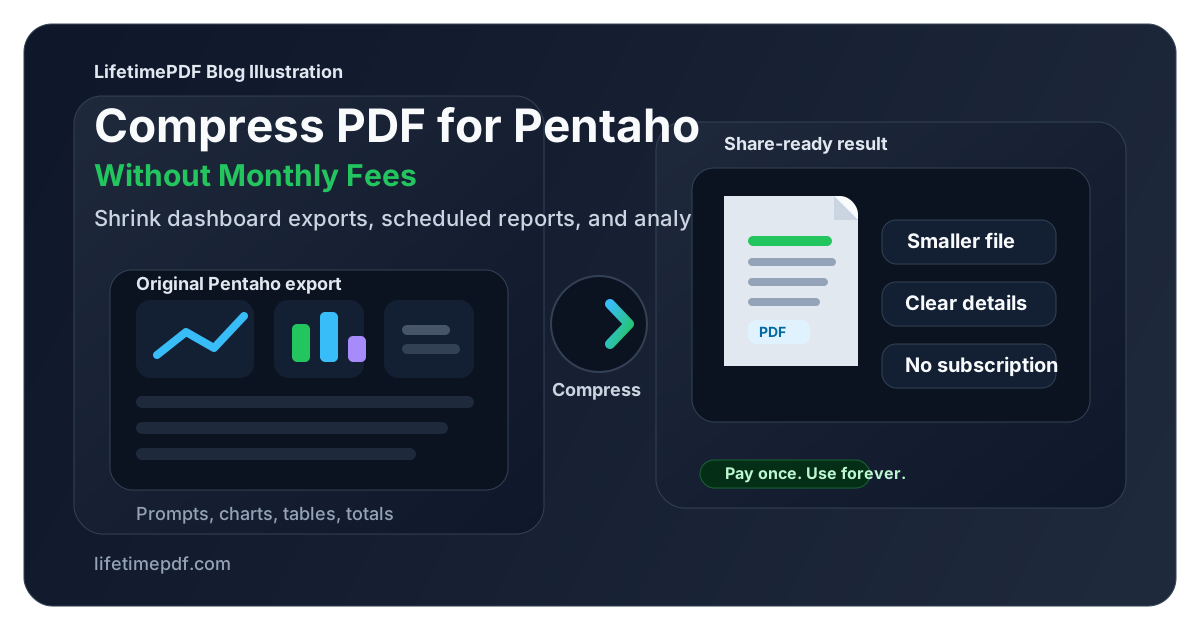
Table of contents
- Quick start: compress a Pentaho PDF in under 2 minutes
- Why "without monthly fees" matters here
- Why smaller PDFs help in Pentaho workflows
- What file size should a Pentaho PDF be?
- Which compression level should you choose?
- Step-by-step: use LifetimePDF to shrink the file
- Best approach for common Pentaho PDFs
- What to do if the PDF is still too large
- How to keep prompts, tables, and totals readable
- Workflow habits that reduce PDF bloat
- Related LifetimePDF tools and useful reading
- FAQ (People Also Ask)
Quick start: compress a Pentaho PDF in under 2 minutes
If your real goal is simply make this Pentaho PDF smaller so it is easier to send, this workflow is usually enough:
- Export or print the Pentaho file you actually plan to share, whether that is a dashboard export, scheduled report, Analyzer output, executive summary, browser print-to-PDF copy, or review packet.
- Open Compress PDF.
- Upload the file and choose Medium compression first.
- Download the smaller result and compare the new size.
- Preview the details that matter most: prompts, filter or parameter values, dates, chart labels, legend text, table rows, totals, and short commentary.
- If the file is still bulky, use Crop PDF, Extract Pages, or Split PDF before forcing stronger compression across the whole report.
Why "without monthly fees" matters here
This is finish-line work. The dashboard is already built. The scheduled report already exists. The analysis already answered something useful. Once the remaining job becomes make this PDF lighter so it is easier to attach, upload, or archive, another recurring fee starts to feel like overhead instead of value.
That matters even more in BI environments because the stack is rarely cheap. You already have data pipelines, warehousing, access controls, report maintenance, and support overhead. A pay-once PDF workflow matches the actual task better because the task is narrow, repeated, and practical. You are not buying a new analytics layer. You are just making the final document easier to move.
Most Pentaho PDF moments are ordinary but important. A finance lead needs a lighter scheduled packet. An ops manager wants an exception report that opens quickly on mobile. A leadership team needs a dashboard export that does not bounce in email. Those are real needs, but they usually do not justify another subscription whose entire purpose is shrinking the last file in the workflow.
Simple logic: if Pentaho already did the reporting work, a pay-once PDF workflow usually fits the sharing step better than another monthly bill.
Why smaller PDFs help in Pentaho workflows
Pentaho exports rarely stay inside the analytics environment forever. They get emailed to stakeholders, attached to project updates, dropped into shared drives, added to audit trails, and saved for later comparison. Heavy PDFs slow all of that down.
The issue is not only attachment limits. Large PDFs feel clumsy everywhere. They open slower. They are more annoying to resend. They make recurring archives heavier. And when one file contains several dashboard pages, long detail tables, screenshot-heavy appendix sections, or different audience views bundled together, the extra size usually adds friction without adding insight.
- Faster handoffs: lighter files move more smoothly through email, chat, ticket systems, and shared folders.
- Better meeting prep: readers can open the report quickly instead of waiting on a bloated packet.
- Cleaner archives: recurring scheduled exports stop piling up as oversized attachments.
- Less friction for mixed audiences: leadership, analysts, and operations teams can each get a cleaner version when the packet is trimmed to what they actually need.
The trick is not chasing the smallest number. The trick is reducing the waste while keeping the document trustworthy. If prompts, chart labels, totals, and summary notes still feel easy to scan, the compression choice is doing its job.
What file size should a Pentaho PDF be?
There is no single perfect number, but practical targets help. For short dashboard snapshots, summary reports, and concise scheduled PDFs, under 2MB is a strong goal. For broader operational packs, parameter-heavy analysis PDFs, and appendix-heavy review copies, 2MB to 5MB is usually more realistic as long as the important details still read clearly.
| Pentaho PDF type | Practical target | What to protect |
|---|---|---|
| Short dashboard snapshots and KPI summaries | < 2MB | Headline metrics, filter context, dates, and chart labels |
| Scheduled reports and review packs | 2MB to 4MB | Prompts, page headers, compact tables, totals, and short notes |
| Analyzer output and appendix-heavy exports | 3MB to 5MB | Readable rows, subtotal logic, legends, and support screenshots |
| Browser print copies with extra white space | As small as possible after cleanup | Text clarity, page flow, and only the pages somebody still needs |
If you are only sending a summary page or two, aim lower. If the PDF has to preserve dense tables, several parameter values, or multiple supporting pages, do not chase a tiny file at the expense of readability. A slightly larger report that still feels dependable is usually the better handoff.
Which compression level should you choose?
For most Pentaho exports, Medium is the right first move. It usually gives the cleanest balance between size reduction and readable reporting detail.
| Compression level | Best for | Watch out for |
|---|---|---|
| Low | Dense tables, narrow columns, and files where every small detail matters | You may not save enough size to matter |
| Medium | Most dashboard exports, scheduled reports, review packets, and browser print copies | Still review prompts, legends, totals, and dates once |
| High | Oversized files that still need more reduction after cleanup | Small row text, footer notes, and thin chart detail can start to look soft |
Step-by-step: use LifetimePDF to shrink the file
- Export only what you really need. If the next reader only needs a summary section or one dashboard page, do not start with the biggest possible packet.
- Open Compress PDF.
- Upload the Pentaho PDF. That could be a dashboard export, scheduled report, Analyzer output, browser print copy, or executive packet.
- Choose Medium compression. It is usually the safest first pass.
- Download the smaller result.
- Review the details that still matter. Check prompts, report dates, page headers, totals, column names, legends, and small labels.
- Only do extra cleanup if the file is still too large. Use page-level tools before forcing stronger compression across every page.
This order matters. If you compress aggressively before removing unnecessary pages or browser waste, you often end up with a file that is both softer and still heavier than it needs to be.
Best approach for common Pentaho PDFs
| Common PDF | Best first move | Why |
|---|---|---|
| Dashboard export for leadership | Medium compression | Usually shrinks cleanly while preserving the headline story |
| Scheduled operational report | Medium compression, then extract the pages that matter | Many readers only need the summary pages, not the full appendix |
| Analyzer output or table-heavy export | Compress lightly and trim duplicate or unnecessary pages | Dense rows often suffer more from aggressive compression than charts do |
| Browser print-to-PDF copy | Crop margins first, then compress | Browser white space often adds weight faster than the report content itself |
| One packet for several audiences | Split by audience before compressing harder | Separate summary, detail, and appendix copies usually read better and compress better |
Most oversized Pentaho PDFs are not oversized because the reporting tool failed. They are oversized because the packet tries to do too much at once. Compression helps most when the document is already close to the shape the audience really needs.
What to do if the PDF is still too large
When Medium compression is not enough, the answer is usually smarter cleanup, not brute-force compression.
- Crop browser margins: print-generated PDFs often carry big white borders that add weight without adding meaning.
- Split by audience: send leadership the summary and analysts the detail instead of packing everything into one file.
- Extract the useful section: if only a handful of pages matter, keep those pages instead of the full packet.
- Delete repeated appendix pages: duplicate screenshots, blank separators, and stale support pages add bulk quickly.
- Then try stronger compression only if necessary: once the unnecessary weight is gone, stronger compression has a better chance of working cleanly.
Useful combo: Compress PDF for the first pass, then use page-level tools only if the report is still bigger than the next handoff really needs.
How to keep prompts, tables, and totals readable
Before you send the smaller file, do one quick quality pass. You do not need a long review. You just need to make sure the report still feels trustworthy.
- Open the smallest chart-heavy page and check label clarity.
- Scan prompt values, date ranges, and report headers.
- Review table headers, narrow numeric columns, subtotals, and totals.
- Check the summary page somebody is most likely to quote in a meeting.
- Open the file once on a smaller screen if recipients often review it on laptops or phones.
If one key page looks soft, step back. A slightly larger PDF that is easy to trust is better than a tiny file that makes people question the numbers.
Workflow habits that reduce PDF bloat
The cleanest compression results usually come from better export habits upstream.
- Export only the views you need: smaller starting files are easier to optimize well.
- Avoid one monster packet for every audience: summary and detail rarely need to travel together.
- Remove throwaway pages early: blank covers, duplicate exports, and unnecessary appendix pages add dead weight.
- Keep one share-ready version: once you approve the smaller file, save that copy instead of recompressing it repeatedly.
- Use comparison when precision matters: if the packet is leadership-facing or client-facing, compare the original and compressed copy once before sending.
Related LifetimePDF tools and useful reading
If you work with recurring Pentaho exports, these tools usually cover the rest of the cleanup workflow:
- Compress PDF for the first pass on dashboard exports, scheduled reports, and analysis PDFs.
- Crop PDF to trim oversized browser margins and wasted space.
- Split PDF when different readers need different sections.
- Extract Pages when only the summary or appendix should travel.
- Delete Pages for repeated support pages, blank separators, or outdated backup detail.
- Compare PDFs when you want one final confidence check before sending a stakeholder-facing file.
- Compress PDF for Pentaho for the broader workflow guide.
- Compress PDF for IBM Cognos Analytics Without Monthly Fees for a close enterprise BI companion.
- Compress PDF for MicroStrategy Without Monthly Fees for another dashboard-heavy reporting workflow.
- Compress PDF for GoodData Without Monthly Fees for another scheduled-report use case.
- Compress PDF for Tableau Without Monthly Fees for another analytics-stack comparison.
If this is a recurring reporting job: a pay-once tool stack makes more sense than another monthly bill just to shrink final exports.
FAQ (People Also Ask)
How do I compress a PDF for Pentaho without monthly fees?
Use a pay-once PDF tool like LifetimePDF, upload the Pentaho export, start with Medium compression, and review the smaller result before sharing it. If the file is still too large, crop margins, split sections, or extract the pages the next reader actually needs instead of over-compressing the full report.
What file size should I aim for with Pentaho PDFs?
Under 2MB is a strong target for short dashboard snapshots and concise summary reports. Broader scheduled packets, appendix-heavy exports, and table-heavy analysis PDFs usually work better around 2MB to 5MB as long as the smallest useful text still looks clear.
Will compression make Pentaho tables or charts blurry?
It can if you compress too aggressively. That is why Medium compression is usually the safest first pass. Review prompts, row labels, totals, dates, legends, and commentary before keeping the smaller copy.
Should I split a long Pentaho report instead of compressing harder?
Often, yes. If the PDF mixes summary pages, backup tables, repeated appendix content, and several audience-specific sections, splitting usually works better than forcing stronger compression across the whole document.
Why look for a Pentaho PDF workflow without monthly fees?
Because shrinking the final PDF is finish-line work. If you already pay for BI infrastructure and reporting software, another recurring bill just to reduce export size is hard to justify. A pay-once workflow fits the job better.
Published by LifetimePDF - Pay once. Use forever.