Compress PDF for Paycor: Keep Resumes and Supporting PDFs Small Without Losing ATS-Friendly Clarity
To compress a PDF for Paycor, upload your final resume or supporting document to LifetimePDF's Compress PDF tool, start with Medium compression, and keep the smaller copy only if names, dates, headings, links, and contact details still look clear.
For most Paycor uploads, aim for under 2MB for resumes and cover letters, and roughly 2MB to 5MB for transcripts, certificates, portfolios, or other scan-heavy supporting PDFs.
Paycor application flows usually feel straightforward until one bloated PDF becomes the thing holding everything up. Maybe your resume export carries oversized graphics, maybe a transcript scan has huge white borders, or maybe you bundled too many supporting pages into one file. The practical goal is not the tiniest file possible. It is a smaller document that still looks trustworthy when a recruiter or hiring manager opens it.
Fastest path: run the Paycor file through LifetimePDF's Compress PDF tool on Medium, then do one quick readability check before uploading the lighter copy.
Need the short version? Jump to Quick start: compress a PDF for Paycor in under 2 minutes.
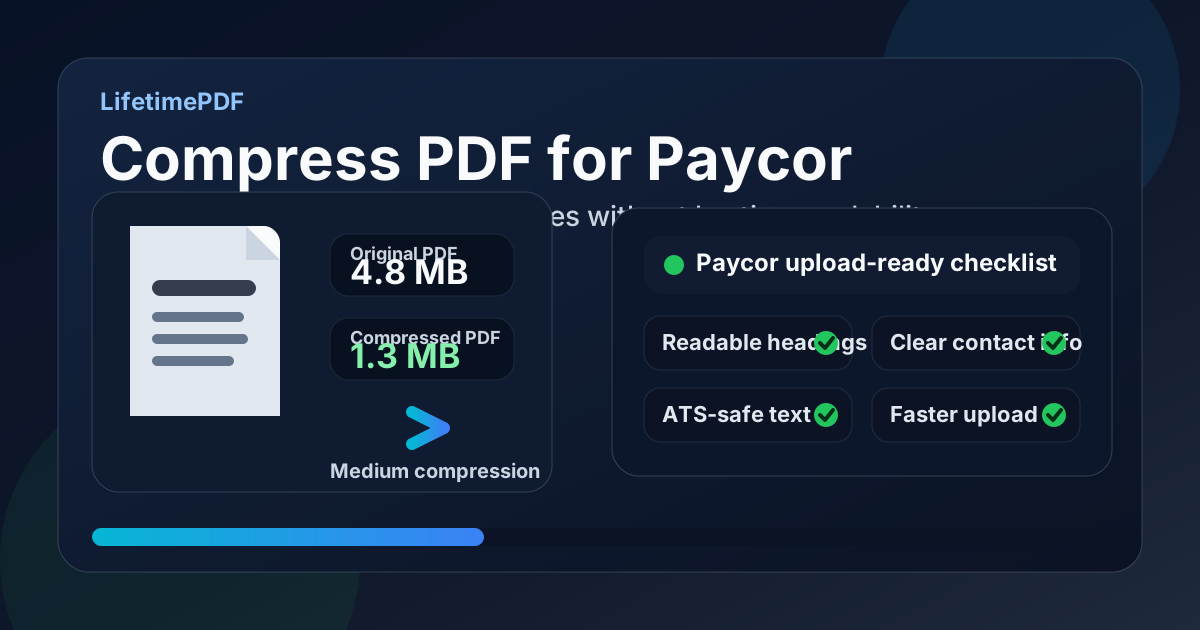
Table of contents
- Quick start: compress a PDF for Paycor in under 2 minutes
- Why smaller PDFs help in Paycor workflows
- What file size should you aim for?
- Which compression level should you choose?
- Step-by-step: shrink a Paycor PDF with LifetimePDF
- Best strategy for common Paycor file types
- What if the PDF is still too large?
- How to keep Paycor files readable and ATS-friendly
- Privacy and document-cleanup habits before you upload
- Related LifetimePDF tools and useful internal links
- FAQ (People Also Ask)
Quick start: compress a PDF for Paycor in under 2 minutes
If your real goal is simply make this PDF smaller so the Paycor upload goes through cleanly, this workflow is usually enough:
- Open Compress PDF.
- Upload the final resume, cover letter, transcript, certificate, portfolio, or supporting PDF you plan to submit.
- Choose Medium compression first.
- Download the smaller result and compare the new size with the original.
- Open it once and check the details that matter most: your name, contact info, headings, dates, bullet points, links, and any fine text inside samples or certificates.
- If the file is still heavier than you want, use Extract Pages, Delete Pages, or Crop PDF before trying a stronger compression setting.
Why smaller PDFs help in Paycor workflows
Paycor is the kind of application environment where document friction feels small until you hit it repeatedly. One heavy resume is annoying. A heavy resume plus a cover letter, transcript, certification PDF, and work sample becomes a pattern. Smaller PDFs upload faster, retry faster, and make less of a mess when you are applying to several roles in one sitting.
There is also a presentation side to this. A clean, right-sized PDF feels more deliberate than a file that opens slowly, includes extra blank pages, or looks like it was exported straight from a scanner without review. Recruiters may not say, "this PDF is too big," but they absolutely notice when a file feels messy or awkward compared with the rest of the application.
Compression is not a magic fix for weak content, of course. It is just one quiet bit of application hygiene. But it is one of the easiest improvements you can make when you want the technical part of the process to disappear into the background.
What file size should you aim for?
Paycor experiences vary by employer, role, and document type, so there is no single number that matters in every case. Still, practical targets help:
- Resume or cover letter: ideally under 2MB.
- Transcript or certificate: usually fine around 2MB to 5MB if the text stays crisp.
- Portfolio or work sample PDF: as small as possible while preserving charts, screenshots, or design detail that actually matters.
- Combined support packet: only combine documents if the application flow clearly benefits from it.
Think of the target as small enough to upload easily, large enough to remain credible. A file that is technically tiny but visibly degraded does not help you.
Which compression level should you choose?
Most people should start in the middle instead of reaching for the strongest setting right away. Here is the simple rule of thumb:
- Low compression: useful when the PDF is already modest and you only need a small trim.
- Medium compression: the best default for most Paycor resumes, cover letters, and normal supporting files.
- High compression: worth testing only when the file is still bulky after cleanup or when the source is image-heavy.
Medium usually wins because it handles the common problem well: PDFs that are larger than they need to be, but not so enormous that they justify aggressive quality loss. If you ever move to High compression, preview the result carefully instead of assuming it is still fine.
Step-by-step: shrink a Paycor PDF with LifetimePDF
- Start with the final version. Do not compress a draft if you still plan to edit content later.
- Open Compress PDF.
- Upload your file. This can be a resume, cover letter, transcript, certification, combined packet, or portfolio PDF.
- Choose Medium compression. That is the safest first pass for most Paycor uploads.
- Download the smaller copy.
- Review the essentials once. Check names, headings, dates, bullet points, links, and any small text or graphics.
- Only escalate if needed. If the result is still too large, trim pages, crop borders, or split the document before trying stronger compression.
Useful rule: compress once, review once, upload once. Endless re-compressing usually causes more damage than it solves.
Best strategy for common Paycor file types
Resume PDFs
These are usually the easiest files to shrink because good resumes are mostly text. If your resume is already text-based, Medium compression should reduce size without changing the reading experience much.
Cover letters
Cover letters tend to compress cleanly too. If one is unexpectedly large, the problem is often an oversized logo, decorative background, or exported image rather than the text itself.
Transcripts and certificates
These are often the real problem files because they may come from scans or image-based exports. Crop unused borders, delete irrelevant pages, and keep the text sharp enough that course names, dates, and credential details still read clearly.
Portfolios and work samples
A portfolio needs a little more judgment. If images or charts are the point of the document, do not crush them so hard that they stop communicating anything useful. Sometimes the right fix is shortening the PDF, not squeezing every page further.
What if the PDF is still too large?
If Medium compression does not get you where you need to go, the answer is usually cleanup, not panic.
- Remove blank or duplicate pages with Delete Pages.
- Keep only the required sections with Extract Pages.
- Trim scan borders and wasted margins with Crop PDF.
- Split bulky packets into smaller logical pieces if the Paycor form allows separate uploads.
- Re-export the original document cleanly if the file became huge because of bad source settings.
In other words, make the document simpler before asking compression to do all the work. Cleaner source files almost always outperform aggressively compressed messy ones.
How to keep Paycor files readable and ATS-friendly
The biggest ATS risk is usually not compression itself. It is the source document. A resume built from screenshots, text boxes, odd layout tricks, or image-only pages was already fragile before you touched compression.
To keep a Paycor file safe and readable:
- Use real selectable text whenever possible.
- Keep headings simple and obvious.
- Use readable contrast and ordinary font sizes.
- Review dates, job titles, email address, phone number, and links after compression.
- If a scan matters, consider OCR PDF so the text layer is more useful.
If the compressed file still feels normal to read, it is usually normal enough to upload.
Privacy and document-cleanup habits before you upload
Smaller files are good, but cleaner files are better. Before uploading to Paycor, take a minute to remove things that do not belong in the final version.
- Delete unused pages or drafts.
- Remove hidden metadata with Remove PDF Metadata if the file came from a messy workflow.
- Use PDF Metadata Editor if you want cleaner title and author fields.
- Double-check that the upload version matches the role you are applying for now, not the last one.
That last point matters more than people admit. The wrong file version is a bigger application problem than a slightly large file.
Related LifetimePDF tools and useful internal links
If you are cleaning up a Paycor application packet, these are the most useful next steps:
- Compress PDF for the main size reduction step.
- Word to PDF for cleaner resume exports.
- Merge PDF if one upload field requires a single combined packet.
- Extract Pages and Delete Pages for trimming support files.
- Crop PDF and OCR PDF for scan-heavy documents.
You may also want the two existing Paycor companion guides already on LifetimePDF: Upload Resume and Job Application Files Faster and Without Monthly Fees.
FAQ (People Also Ask)
How do I compress a PDF for Paycor?
Upload the file to a PDF compressor, start with Medium compression, and keep the smaller copy only if names, headings, dates, links, and contact details still look clear. That is usually the safest way to cut file size without making the application feel sloppy.
What PDF size should I aim for on Paycor?
Under 2MB is a strong target for resumes and cover letters. For transcripts, certifications, and other scan-heavy documents, 2MB to 5MB is a reasonable range if that keeps key details readable and uploads reliable.
Will compression hurt ATS readability in Paycor?
Usually not if you start with Medium compression and the original PDF already uses real selectable text. ATS problems are more often caused by image-based resumes, screenshots, or decorative templates than by sensible compression.
Should I upload one combined PDF or separate files in Paycor?
Use the structure the application flow gives you. If Paycor offers separate fields, separate files are often cleaner. If it asks for one supporting document, combine only the pages that actually belong together.
Which LifetimePDF tools are most useful for Paycor applications?
Compress PDF is the main starting point, followed by Word to PDF, Merge PDF, Extract Pages, Delete Pages, Crop PDF, OCR PDF, Remove PDF Metadata, and PDF Metadata Editor when you need a smaller, tidier, more upload-ready file.
Ready to fix the file and move on? Start with one clean compression pass, then upload the lighter Paycor-ready copy.