Compress PDF for Outranking: Keep Content Briefs, Optimization Reports, and Client PDFs Small Without Losing the Strategy
To compress a PDF for Outranking, export the final brief or report, upload it to LifetimePDF's Compress PDF tool, start with Medium compression, and keep the smaller copy only if headings, screenshots, recommendation boxes, and notes still look clear.
For most Outranking PDFs, under 2MB works well for focused writer handoffs, while screenshot-backed optimization reviews and client-ready strategy packs usually feel best around 2MB to 4MB after light cleanup.
Outranking exports usually show up right at the point where the work needs to leave the platform and become useful for somebody else. A writer needs the brief. An editor needs the recommendation summary. A client needs a shareable version that opens quickly and still feels trustworthy. That is why size matters here. The job is not to make the PDF tiny at any cost. The job is to make it lighter without wrecking the screenshots, outline structure, and action notes that explain what should happen next.
Fastest path: run the Outranking PDF through LifetimePDF's Compress PDF tool on Medium, then do one quick readability check before you email, upload, archive, or hand off the smaller copy.
In a hurry? Jump to Quick start: compress an Outranking PDF in about 2 minutes.
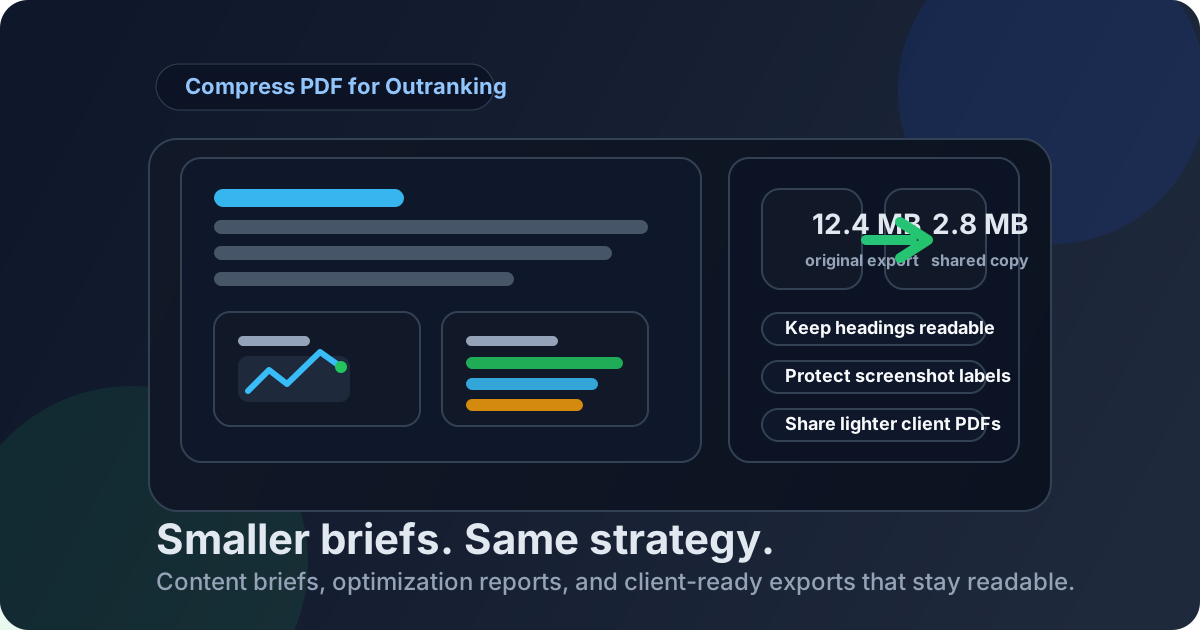
Table of contents
- Quick start: compress an Outranking PDF in about 2 minutes
- Why Outranking PDFs get heavy so quickly
- What file size should you aim for?
- Which compression level should you choose?
- Step-by-step: shrink an Outranking PDF with LifetimePDF
- Best strategy for common Outranking PDF types
- When to split instead of compressing harder
- How to protect screenshots, notes, and recommendation blocks
- Workflow habits that keep Outranking PDFs smaller
- Related LifetimePDF tools and useful internal reading
- FAQ (People Also Ask)
Quick start: compress an Outranking PDF in about 2 minutes
If your real goal is simply make this Outranking PDF smaller so it is easier to send, review, and save, this workflow is usually enough:
- Open Compress PDF.
- Upload the exact Outranking export you plan to share, such as a content brief, optimization report, writer handoff, screenshot-backed summary, or client-ready recommendation PDF.
- Choose Medium compression first.
- Download the smaller result and compare the new size with the original.
- Open it once and check outline headings, screenshot labels, recommendation notes, and the smallest useful tables.
- If the file is still bulkier than it should be, extract the summary pages, split the appendix, or delete repeated screenshots before trying stronger compression.
Why Outranking PDFs get heavy so quickly
Outranking PDFs often become heavier than necessary because one file starts doing too many jobs at once. It becomes a writer brief, an editor review, a client proof pack, an internal reference, and a screenshot archive all inside the same document. Once SERP captures, annotation-heavy pages, recommendation panels, and appendix material stack up, the file grows faster than the next reader's actual needs.
The issue is usually not compression alone. It is packaging. Wide screenshots, repeated evidence pages, and one master export for several audiences usually create more weight than value. Compression helps, but the best result usually comes from a clean document plus balanced compression instead of maximum shrinkage alone.
What usually adds the most weight
- Screenshot-heavy proof pages: image-based pages grow much faster than text-heavy briefs and recommendation summaries.
- One file for several audiences: writers, editors, managers, and clients rarely need the exact same depth.
- Repeated captures and examples: duplicate or near-duplicate screenshots quietly inflate the document.
- Main brief plus full appendix in one export: the archive copy and the share copy are rarely the same file in practice.
- Oversized screenshots and empty margins: screen-based exports often carry visual waste that the next reader does not need.
What file size should you aim for?
There is no perfect number for every Outranking PDF because a two-page writer brief behaves differently from a screenshot-backed strategy pack. Still, a few practical ranges make it easier to know when to stop compressing.
| Outranking PDF type | Good target | Why it helps |
|---|---|---|
| Focused content briefs, quick writer handoffs, and short optimization summaries | Under 2MB | Easy to send, preview, and reopen without slowing the handoff down |
| Most optimization reviews and client-facing recap PDFs | 2MB to 4MB | Usually the best balance between readability and convenience |
| Screenshot-heavy evidence packs and appendices | 4MB to 6MB | Still workable, but often a sign that splitting or trimming will create a better final file |
| Over 6MB | Compress again or simplify the package | Usually means the PDF is carrying more evidence, versions, or screenshots than the next reader needs |
These are comfort targets, not hard rules. If the PDF opens quickly, shares easily, and still keeps the smallest useful details readable, you are probably already in a good place.
Which compression level should you choose?
For most Outranking work, the safest answer is Medium. It usually removes enough weight to matter without immediately softening the headings, annotations, and screenshots people still need to read.
Low compression
- Best when dense tables and screenshot clarity matter more than maximum size reduction.
- Useful for evidence-heavy packs with tiny labels or narrow columns.
- Not usually the best first pass when the document is obviously bulkier than it should be.
Medium compression
- Best starting point for most Outranking PDFs.
- Usually reduces size meaningfully while keeping content sections, screenshots, and notes readable.
- Good for writer handoffs, strategist reviews, manager approvals, and client-ready recaps.
High compression
- Useful when the file is still awkward after cleanup.
- More likely to soften screenshot text, small labels, and short notes.
- Best used after you have already removed unnecessary pages.
Step-by-step: shrink an Outranking PDF with LifetimePDF
Here is a reliable workflow for most Outranking briefs, optimization recaps, and client handoffs:
- Open Compress PDF.
- Upload the final Outranking PDF you actually plan to store, attach, or send.
- Choose Medium compression.
- Download the smaller result and compare the new file size.
- Review the most fragile details once: outline sections, screenshot callouts, summary tables, and recommendation blocks.
- If the file is still too large, use Extract Pages, Split PDF, Delete Pages, or Crop PDF before trying a stronger pass.
That order matters. Compression removes file-weight waste. Page tools remove scope waste. When you use both in the right order, you usually end up with a lighter Outranking PDF that still feels deliberate and readable.
Good workflow: compress first, then decide whether you also need page cleanup, metadata cleanup, or a before-and-after comparison.
Best strategy for common Outranking PDF types
Content briefs
These should stay easy to scan. If the PDF mainly helps someone decide what to write or optimize next, readability matters more than aggressive shrinking. Medium compression is usually enough.
Optimization reviews
These are often the riskiest to over-compress because the value lives in screenshot detail and recommendation context. If the evidence supports a decision, be conservative. A slightly larger file is usually fine if it keeps the capture trustworthy.
Writer brief appendices
Writers usually need the distilled version, not every screenshot and backup page. If the PDF mixes the main direction with supporting proof, extracting the useful pages often works better than compressing the entire document harder.
Client or manager strategy packs
These benefit from feeling light and easy to forward. That does not mean stripping out the useful parts. It means sending the right pages in the cleanest package so the reader can focus on the recommendation instead of the file weight.
When to split instead of compressing harder
If one pass of compression is not enough, the next answer is often structural rather than technical. Splitting the document usually works better when different readers need different depths of detail.
- Extract only the pages that support the next decision: ideal for quick reviews and writer handoffs.
- Split the appendix: keep the main summary light and move the screenshot archive into a second PDF.
- Delete repeated pages: duplicate captures and stale exports add weight fast.
- Crop oversized screenshots: browser chrome and empty edges add size without adding meaning.
- Build for the audience: strategists, writers, and clients often need different files, not one huge master packet.
When compression alone is not enough: clean the structure before you jump to High compression.
How to protect screenshots, notes, and recommendation blocks
The file is only better if it still works. Before you replace the original export, check the details most likely to break:
- the smallest screenshot labels and interface text
- the shortest recommendation notes people may quote later
- outline headings and section dividers that guide the brief
- summary panels, tables, or scoring blocks
- the busiest screenshot page in the whole file
- the most compressed-looking page, not just the cleanest one
A quick review at ordinary laptop zoom is usually enough. If the smallest important detail still feels easy to trust, the PDF is probably compressed enough.
Workflow habits that keep Outranking PDFs smaller
- Separate the summary from the appendix when different readers need different depths.
- Export only what the audience needs instead of bundling every backup page into the same file.
- Trim duplicate screenshots before the PDF becomes the version everyone forwards.
- Use one archive copy and one shareable copy when the heavier master still matters internally.
- Clean metadata before outside delivery with PDF Metadata Editor if the final file properties should look polished.
- Compare revisions when several versions are circulating with Compare PDFs.
Compression works best as final polish, not as a rescue plan for a document that tried to carry every possible detail into the same export.
Related LifetimePDF tools and useful internal reading
If Outranking is part of your normal content or SEO workflow, these tools and articles pair well with this guide:
- Compress PDF for the first size-reduction pass.
- Extract Pages when only part of the pack needs to be shared.
- Split PDF for long packs with summaries and appendices.
- Delete Pages to remove repeated proof or stale support pages.
- Crop PDF to trim screenshot waste.
- Compare PDFs if you want a cleaner before-and-after review.
- PDF Metadata Editor if you want the final file properties to look clean.
- Compress PDF for Outranking: Share Smaller Content Briefs, Optimization Reports, and Client PDFs Faster.
- Compress PDF for Outranking Without Monthly Fees.
- Compress PDF for Frase.
- Compress PDF for Clearscope.
- Compress PDF for Surfer SEO.
- Lifetime access if PDF cleanup is a recurring part of your content stack.
Bottom line: for most Outranking PDFs, start with Medium compression, review the smallest useful details once, and trim page weight before you use stronger compression.
FAQ (People Also Ask)
How do I compress a PDF for Outranking?
Export the Outranking view as a PDF, upload it to a PDF compressor, start with Medium compression, and keep the smaller copy only if headings, screenshots, recommendation boxes, and notes still read clearly. Medium is usually the safest first pass.
What file size should I aim for with Outranking PDFs?
Under 2MB works well for focused content briefs and writer handoffs. Broader optimization packs, screenshot-backed strategy recaps, and client-facing summaries usually land best around 2MB to 4MB as long as the smallest useful details still look clear.
Will compression make Outranking screenshots or recommendation blocks blurry?
It can if you compress too aggressively. That is why Medium compression is usually the best starting point. Always review screenshot labels, small tables, and recommendation notes before you keep the compressed copy.
Should I split a large Outranking PDF instead of compressing it harder?
Often, yes. If one file combines the main brief, screenshot evidence, editor notes, and appendix pages for different readers, splitting it usually creates a more useful result than forcing stronger compression across the whole PDF.
Which LifetimePDF tools pair best with Outranking exports?
Compress PDF is the main starting point. Extract Pages, Split PDF, Delete Pages, Crop PDF, Compare PDFs, and PDF Metadata Editor all help create cleaner, smaller, share-ready Outranking PDFs.
Published by LifetimePDF - Pay once. Use forever.